LIGURIA. –
I. GEOGRAPHY
Among the Italian regions, it is the least extensive (5,411 sq. km), but one of the most densely populated and economically important. It corresponds to the southern slope of the Ligurian Alps and Apennines, with small sections of the northern slope, and thus constitutes the natural outlet to the Mediterranean not only for the richest part of the Po Valley, but also for a considerable sector of Central Europe.The mountains rise steeply above a rocky coast or one enclosed by narrow strips of beach. Cultivable land is scarce, but is put to remarkably profitable use (fruit, early-season produce, flowers, vegetables); commerce (ports, railways) and industries (shipbuilding, metallurgy, engineering, textiles) animate the activity of a population almost entirely concentrated (only 10% of the population is dispersed, in L.) on the narrow coastal strip. Together with neighboring Lombardia, L. is the only Italian region in which the highest percentage of the active population is engaged in industry (38%). The very mild climate and the beauty of the landscape make this region a succession of renowned winter and summer climatic resorts. The larger inhabited centers generally correspond to Roman settlements: two of them exceed 100,000 inhabitants and constitute, respectively, the most active commercial port (Genova) and the first military port in Italy (La Spezia).
 | Provinces and provincial capitals (population in 1949 in thousands of inhabitants) | Number of municipalities | Area in sq. km | Population | ||
|---|---|---|---|---|---|---|
| 1936 Census | Estimate 1 Jan. 1949 | |||||
| absolute thousands of inhabitants | density per sq. km | |||||
| Genova (673) | 67 | 1823 | 867,608 | 887 | 476.4 | |
| Imperia (30) | 61 | 1155 | 158,470 | 159 | 134.1 | |
| La Spezia (124) | 32 | 885 | 221,634 | 238 | 230.4 | |
| Savona (72) | 69 | 1548 | 219,108 | 234 | 141.8 | |
| L. | 229 | 5411 | 1,466,820 | 1518 | 288 |
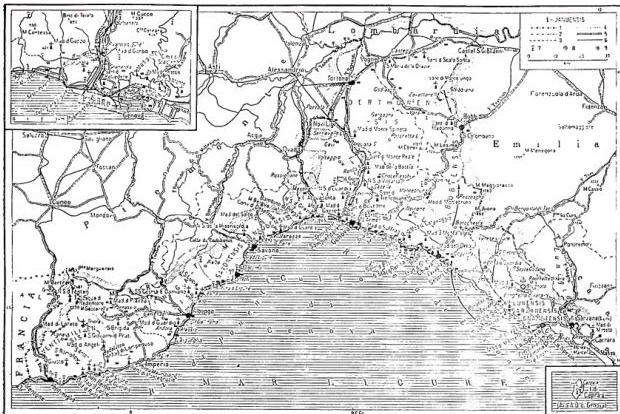
LIGURIA — 1) State borders; 2) regional boundaries; 3) provincial boundaries; 4) boundaries of ecclesiastical jurisdictions; 5) roads; 6) railways; 7) oratories; 8) parish churches; 9) abbeys.
II. HISTORY
The region takes its name from the ancient population of the Ligurians, of Mediterranean stock, who many centuries before the third century B.C. (when the Romans began their advance toward the north) occupied a large part of northern Italy and southern France, extending also into the Iberian Peninsula; in Roman antiquity the name of L. also extended to the Po Valley south of the Po and eastward to the upper Taro Valley and the middle Trebbia Valley; within these boundaries L. constituted the IX Regio Augusta; in the time of Diocletian L. also included all of present-day Piedmont and much of Lombardy; it then gradually contracted until it came to comprise, as now, almost only the entire Tyrrhenian slope of the Alps and the Apennines, from the basin of the Roia to that of the Magra.Now divided into the three provinces of Imperia, Genoa, and La Spezia, it comprises the bishoprics of Ventimiglia (established in the sixth century), Albenga (already existing in the fifth century), Noli (established in 1239, later abolished), Vado (from 680, and subsequently Savona from 999), Genoa (traditionally traced back to s. Barnabas and a metropolitan see from the twelfth century), Chiavari, and Brugnato (on the Spezia–Bracco road), established in 1133, later modified in the nineteenth century into the bishopric of Luni-Sarzana and now the bishopric of La Spezia; until 1768 the bishoprics of Corsica also depended on the metropolitan of Genoa, and until 1860 the bishopric of Nice.
The period when Christianity entered L., understood in its present extent, is uncertain; the oft-repeated account of the coming of s. Barnabas, of ss. Nazarius and Celsus, and then of s. Calimerus, bishop of Milan, and of ss. Marcellinus, Vincent, and Donninus, is legendary; it seems that no persecution raged there, since the Ligurian saints s. Secundus and s. Calogerus likewise suffered martyrdom outside the region; mention is also made of s. Lawrence, who, on coming from Spain to Rome, is said to have stopped at Genoa around 260, at the site where the Genoese Cathedral, consecrated in the twelfth century, was later erected. It is certain, however, that Christianity was already flourishing there between the third and fourth centuries.
The history of L., understood within its modern boundaries, is the local history of the individual cities and valleys; the Ligurians, the ancient inhabitants of the country, themselves divided into tribes, largely independent of one another, for example the Ingauni (centered on Albenga), the Intemelii (centered on Ventimiglia), the Sabates (perhaps centered on Savona), the Tigulii (centered on Sestri Levante), the Ligures Montani, and others, not counting the Ligurian tribes of the Po Valley. Romanization took place through the foundation of the Roman colony of Genua (before 218 B.C.) and then through wars, some of them extremely arduous, in the second century B.C.; around 150 the entire Riviera could be said to be in Roman possession, connected by sea with the principal ports of the Tyrrhenian coast, but by land joined to the rest of the Roman world by means of the Via Postumia (148 B.C.), through Libarna, Deriona, Iria (= Voghera), and Piacenza, and later, shortly before 100 B.C., by means of the Via Aemilia Scauri, which descended through Aquae Statiellae (= Acqui) to Vada Sabatia (= Vado). The coastal road, already laid out in individual sections by the coastal peoples, achieved its full development in the first century B.C. and subsequently under Augustus, first between Luni and Genoa, where it was called, by extension, the Via Aurelia, and then between Genua and Nicaea (= Nice), under the name Julia Augusta.
Information about maritime L. in the early Middle Ages is obscure; it was sacked by the Heruli and Goths and finally by the Lombards, who probably made it a duchy; the history of the first Ligurian bishoprics is likewise obscure, although certainly the heretical movements of the early centuries, and especially Arianism, gained no foothold there; indeed, in those times Genoa became a refuge for Catholics.
In the tenth century L. was divided into three Marches: Arduinica (west), Aleramica (center), and Obertenga (east), subsequently fragmented by feudalism in the eleventh and twelfth centuries; yet the rights of the marquises and counts later encountered their greatest obstacle in the opposition of the bishops, until the new communal organizations arose, especially that of Genoa, which sought to obtain primacy over the other inhabited centers of the Riviera. In this work of expansion the commune of Genoa was in agreement with its bishop, who did not hesitate, once the commune had established itself over its neighbors, to remove churches belonging to other jurisdictions and place them under its own. This occurred, for example, in the twelfth century with the churches of Porto Venere, occupied by the Genoese, taken from the bishop of Luni, and transferred to the bishop of Genoa; significant struggles were also fought, especially on the western Riviera, around Ventimiglia and S. Remo, in which the authority of the bishops became entangled in feudal and communal conflicts; nor were relations with the papacy always peaceful, as shown by the interdicts against Genoa in the thirteenth and fifteenth centuries and those against Savona in the fourteenth century; in 1453 Paolo da Campo Fregoso was simultaneously cardinal archbishop and doge of the Republic of Genoa. The struggles between Genoa and the other small maritime republics of the west (above all Savona) were then influenced by the protection offered by the emperors to one city or another, until, in 1528, after Savona had been subjugated, the Genoese state could be said to extend over both Rivieras. In the eighteenth century the Savoy dynasty began to assert its dominion. And after the Napoleonic wars and the Restoration, in 1815 L. became part of the Kingdom of Sardinia.
The company of Ligurian saints is not very large: known in the fourth or fifth century are s. Ampelius, a hermit, and subsequently s. Venerius, as well as a series of saints in the fifteenth and sixteenth centuries and, later still, s. Leonard of Porto Maurizio; mention should also be made of s. Syrus, bishop of Genoa, in the sixth century, and Blessed James of Varagine (= Varazze), bishop and writer of the thirteenth century.
There are about sixty sanctuaries, many of them gathered in the mountains overlooking the sea or in the inland valleys: one of the oldest is undoubtedly the sanctuary of Madonna di Savoia, near Monterosso al mare, traditionally dated to the eighth century; others date from the twelfth century, such as that of N. Signora del Monte near Genoa and the sanctuary of Coronata at Cornigliano Ligure; others from the fourteenth century, such as S. Bartolomeo degli Armeni in Genoa and the sanctuary of Acqua Santa near Voltri; or from the fifteenth century, such as the Sanctuary of N. Signora d’Oregina in Genoa; the sixteenth century saw the establishment of the sanctuary of S. Maria di Montallegro near Rapallo, with an adjoining hospice for pilgrims; and later still, the sanctuary of N. Signora della Vittoria, near the Giovi Pass; those of Madonna di Lampedusa near Castellaro di Taggia, and of Madonna del Soccorso at Pietra Ligure; Madonna della Guardia above Arma di Taggia; the sanctuary of S. Lucia near Borghetto S. Spirito; and the sanctuary of Madonna della Guardia between Varazze and Cogoleto.
III. REGION
CONCILIARE LIGURE. — Whereas all the historical regions of Italy were included in the circular of 24 August 1889 concerning episcopal conferences and in the motu proprio Qua Cura of 8 December 1938 concerning tribunals, the concistorial decree of 15 February 1919 expressly excludes L., together with other regions, because in this region the ecclesiastical province of Genoa practically groups together all the dioceses whose sees are located in the region.Consequently, the Ligurian region, ecclesiastically, unites around the metropolitan see of Genoa the suffragan dioceses of Albenga, Bobbio, Chiavari, Luni or La Spezia with Sarzana and Brugnato, Savona and Noli, and Tortona. The Ligurian regional tribunal is likewise established in Genoa, with matrimonial jurisdiction in trials of first instance; it is also competent to hear appeals from the Lombard regional tribunal. In turn, the Ligurian regional tribunal has the Piedmontese regional tribunal (Turin) as its court of appeal. In the specific case, regional plenary councils are simply provincial councils for the reasons stated above, and therefore follow the norms of can. 283 ff.
Agostino Pugliese
IV. ART
The oldest testimonies to Ligurian civilization are prehistoric. The deposits of the “Arené Candide” and the “Balzi Rossi” constitute substantial documentation of the Paleolithic and Neolithic periods and are the most important of their kind in Italy. The protohistoric period, by contrast, includes the archaic necropolis discovered in the excavations of Via XX Settembre in Genova, as well as other remains at Savignone and Ameglia and the Celtic deposits of the Val di Magra. Roman civilization has left, in addition to the imposing remains of Luni (on the border with Tuscany), remains at Ventimiglia, Albenga, Genova, and other localities.1. Architecture
As early as the Middle Ages, the Ligurians displayed particular expertise in the art of building. Remains of imposing architectural works still exist in the lands formerly under their dominion and in Genova; here they can be seen in the remains of the walls erected to defend against Barbarossa’s incursions in 1155 and in the restored Porta Soprana. The beautiful tower of the Embriaci also dates from the 12th century and has now been brought into greater prominence by the demolition of the surrounding houses, caused by the bombardments of the last war. Tower houses were built during the 12th and 13th centuries in Genova, Savona, and Albenga. With the advent of the Gothic style, the forms became more refined: in civil architecture, a few examples from this period remain, such as the Palazzo Spinola and the Palazzo dei Doria in Piazza S. Matteo in Genova.
With the Renaissance (which arrived rather late), art naturally underwent new developments. Its principal masters were above all Montorsoli and Pierin del Vaga, called upon to build and decorate the Palazzo di Andrea Doria (Palazzo Principe); from this moment Genoese architecture embarked upon a new splendour, first through the work of Alessi and then of Bartolomeo Bianco, Rocco Lurago, and others. In the sixteenth century the Via Nuova
(now Garibaldi) was built, rightly considered one of the most beautiful and harmonious streets in the world. The narrow and steep configuration of the Genoese terrain led architects to give their buildings a scenographic character, so that they appear embellished with hanging gardens, perspective stairways, and so forth. Worthy of mention are the Villa delle Peschiere, the Cambiaso villa in Albaro and the Scassi villa at Sampierdarena, all by Alessi; the Palazzo imperiale by G. B. Castello; the Palazzo Doria Tursi by Rocco Lurago; and the University building by Bartolomeo Bianco. Alessi was also responsible for the finest Genoese church of the Renaissance, S. Maria di Carignano, grand and solemn in its central-plan form, which seems to echo the designs left by Bramante for S. Pietro. The chapel of N. S. di Loreto, near Finale, likewise has a central plan; so too does the small church of S. Maria della Rotonda in the plain of Albenga, which nevertheless seems to recall buildings from a much earlier period. The architectural taste initiated by Alessi persisted throughout the seventeenth and eighteenth centuries, despite the evolution of styles, and not only in Genoa but through much of L. (the Palazzo reale by G. A. Falcone and P. F. Cantone); while in the religious architecture of the Baroque period, the finest example in Genoa remains the basilica of the S. ma Annunziata (much damaged by the war and currently undergoing restoration). From the Neoclassical period, one should mention the façade of this church and the Carlo Felice theatre, whose interior, however, was destroyed during the Second World War. The city underwent extensive building development in the second half of the nineteenth century (Via XX Settembre) and now boasts the tallest “skyscrapers” in Europe.
2. Sculpture
Few documents of Romanesque sculpture have survived; among them, mention should be made of a wooden crucifix (akin to the “Volto Santo” of Lucca) in the small sanctuary church of S. Croce, on the precipitous slopes above the Bocche del Magra. At S. Margherita, outside the Capuchin church, there is a Madonna and Child that is not untouched by contemporary Provençal sculpture. Remains ofRomanesque sculpture also exist in Genoa. During the Gothic period, Giovanni Pisano in Genoa (the tomb of Margherita di Brabante) and Giovanni di Balduccio in Sarzana left outstanding evidence of their activity. In the fifteenth century, Lombard sculptors came to the region, among whom the Gagini were pre-eminent, introducing the Renaissance taste in decorative forms of striking plastic emphasis, characteristic of northern styles. Their activity was directed chiefly toward the decoration of portals, some of which are deservedly famous (that of Piazza S. Matteo in Genoa, by Giovanni Gagini; another in Via Davide Chiossone, by Pace Gagini; and so forth). The activity of the Gagini continued into the sixteenth century. At the same time Gaspare della Scala and Nicolò da Corte were working there. Between 1539 and 1547, G. A. Montorsoli (Palazzo Principe), Giacomo and Bartolomeo della Porta, and others were in Genoa.
In the seventeenth century, Baroque styles were brought to Genoa by the Frenchman Pietro Puget; but Bernardo and Francesco Schiaffino also emerged, highly receptive to Bernini’s art (Bernardo’s masterpiece is the Ratto di Proserpina,
in the Palazzo reale of Genoa). Domenico and Filippo Parodi ultimately gave impetus to a fruitful school that continued into the eighteenth century and found in Maragliano artists who distinguished themselves particularly in wooden sculpture. The documents of nineteenth-century sculpture are found for the most part among the tombs of the Stagliese cemetery.
3. Painting
A sixth-century mosaic is found in the baptistery of Albenga. The cathedral of Sarzana preserves the precious Crocifisso di Guglielmo (1138), the oldest Romanesque painting in L. There are few documents of fourteenth-century painting (the frescoes at Sampierdarena, in S. Maria della Cella, and the detached frescoes by Manfredino da Pistoia in Genoa reveal the influence of Tuscan art). In the fourteenth century, Sienese painting exerted its influence and left works in L. The best-known local painter at that time was Nicolò da Voltri, who was not unfamiliar with the art of the Modenese painter Barnaba, active in the region until the early fifteenth century. During the latter century, Tuscan, Lombard, Piedmontese, and also transalpine influences succeeded one another. The most notable local painters were Giovanni Barbagelata (the altarpiece of the parish church of Varazze), Agostino Casanova, and finally, the greatest of them all, Ludovico Brea, head of the Ligurian-Niçois school. Also active in the region were the Piedmontese Luca Baudo, Giovanni Masone, and finally, among others, Vincenzo Foppa, whose influence on the local masters, still attached to the Gothic style, and on Brea himself, was highly fruitful. Giovanni Canavesio should also be mentioned; he worked in western L., but was of Piedmontese origin. Finally, the enigmatic painter Carlo del Mantegna (Carlo Braccesco) was active; a famous altarpiece by him remains in the sanctuary of Monte Grazie (Imperia).While Teramo Piaggio and Antonio Semino, in the full Cinquecento, still favoured fifteenth-century forms, Pierin del Vaga brought a breath of new life to Genoa by decorating the Palazzo Principe with frescoes. The true history of Genoese painting begins in the sixteenth century, chiefly through the work of Luca Cambiaso, the great fresco painter, Semino, and Tavarone. But its greatest glory came in the seventeenth century, when the Genoese school established itself as one of the most important in Italy. Under the influence of multiple currents (Tuscan, Lombard, Venetian, and Flemish), the exuberant art of Strozzi emerged, to which Venetian painting itself was indebted. Domenico Fiasella, Valerio Castello, Orazio and Giovanni Andrea De Ferrari, Bartolomeo Guidobono, and others then made this school illustrious, while Rubens and Van Dyck, during their stays in Genoa, left the city distinguished testimonies of their art. At the end of the seventeenth century, G. B. Gaulli, BACCIA (v.), and Domenico Piola brought new glory to Genoese painting; Piola was an exuberant and facile painter of frescoes. His disciple Gregorio De Ferrari, insufficiently known, opened the way to eighteenth-century painting with his luminous frescoes, displaying astonishing inventive freedom and a taste that seems to foreshadow the “French” style. But the greatest Genoese artist of the eighteenth century was undoubtedly the “expressionist” Alessandro Magnasco, creator of “touch” painting and, as such, a forerunner of Guardi. From the nineteenth century, Niccolò Barabino, a native of Sampierdarena, should be mentioned.
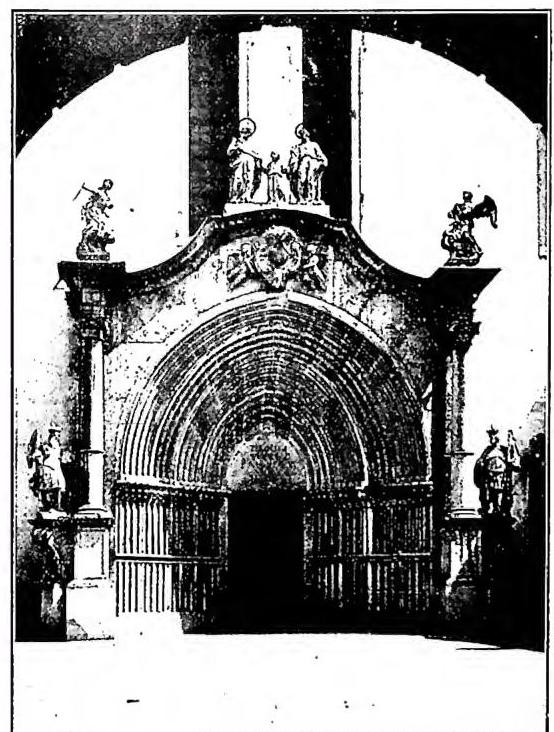
(photograph: Bildarchiv d. Ö. Nationalbibliothek)
LILIENFELD – Portal of the abbey church (13th century).