Machine translation of the 1948–1954 Italian original. The original text is authoritative.
MAGNASCO, ALESSANDRO, known as il LISSANDRINO. — Painter, born in Genoa in 1667, died there on 12 March 1749, one of the most original figures of the Baroque period.
As a young man he went to Milan and, soon abandoning the practice of portraiture, devoted himself to painting small figures, which became his best-known manner, in which M. belongs to the so-called “genre painting,” which flourished particularly in that period. In 1703 he returned to Genoa; then he went to Florence and for some time was court painter there. He travelled extensively through Tuscany, Emilia, and Lombardy; having returned to Milan in 1711, he remained there until 1735, when he settled in Genoa, where he died at the age of eighty-two, after creating, in his final years, some of his greatest masterpieces.
M.’s art sprang from multiple sources. In his homeland, during his youth, he was certainly impressed by the genre paintings of Luca and Cornelio van Wael, the fantasies and pictorial boldness of il Grechetto, and the vivid tonalities of Valerio Castello. In Milan, during his formative period, he was influenced by the “pathos” of Crespi and Morazzone. From Ricci he learned the successful manner of Venetian painting. Yet he assimilated all these influences into an artistic vision of extraordinary expressive and personal force, which nevertheless has some of its “antecedents” in the works of Callot, Cerquozzi, and Salvator Rosa.
His painting, from a heavy, dark, and somewhat summary manner, as in Corso ammaestrato or Vecchia con gli zingari and other paintings of his in the Uffizi Gallery, moves toward a freer and more chromatic-
(Anderson photograph)
MAGNASCO, ALESSANDRO, DETTO IL LISSANDRINO — Martyrdom of St. Erasmus. Milan, Viganò collection.
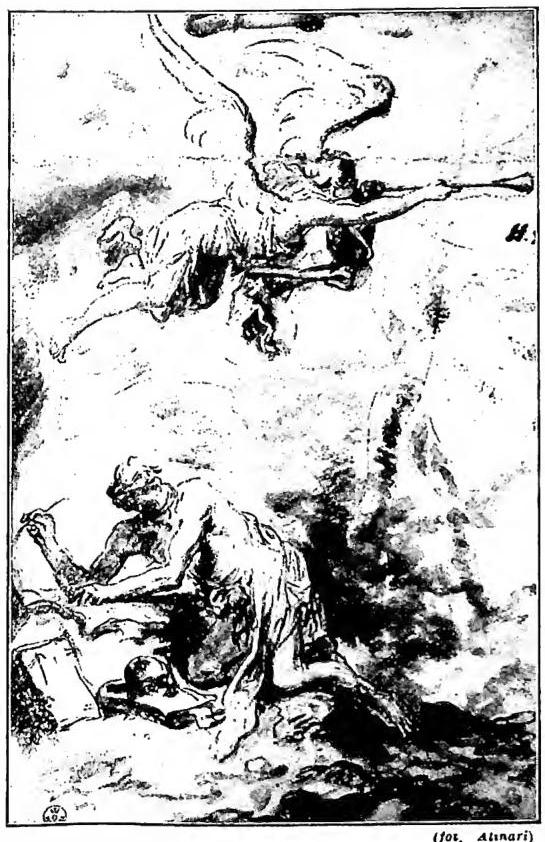
(phot. Alinari) MAGNASCO, ALESSANDRO, DETTO IL LISSANDRINO - St. Jerome and an angel playing the trumpet. Drawing - Florence, Uffizi.lively in spirit, as in the two canvases with Gypsy Visions in the Lecchi collection at Calvisano near Brescia, or in the Scenes of the Inquisition in the Museums of Budapest and Vienna. A deepening of his painful human sensibility is apparent in the Mad Cart in the Bianchi collection at S. Remo, in the Penitent Friars and the Sermon to the Quakers in the Brass collection in Venice. Subsequently, however, his palette brightened somewhat, the pigment acquired greater richness, and his touch became more vivid and sprightly; he then created the four masterpieces, probably executed for Count Colloredo, Austrian governor of Lombardy, now in the convent of Seitenstetten in Austria: The Catechism, The Synagogue, The Monks in the Library, The Monks in the Refectory. His final creations belong to a later period, in which exquisite ash-gray tones emerge, such as The Synagogue in the Cleveland Museum (U.S.A.), the Gypsies’ Banquet at the Louvre, the Entertainment in a Garden at Albaro in the Palazzo Bianco of Genoa, and the Supper at Emmaus in the convent of S. Francesco d’Albaro in Genoa. The subjects favored by M., apart from portraits of the young and a few sacred subjects, were inspired by the life of his own time, in its sometimes humblest and most wretched aspects: gypsy scenes, clandestine gatherings of witches, tempted friars, stormy seas, carts of lunatics, attacks on stagecoaches, sacrilegious thieves—in short, a living world, remote from all academicism and rhetoric. He also painted in fresco, namely the “little figures” in landscapes painted by another artist, preserved in the Villa di Brigano at Gera d’Adda. Often, especially during his early period, M. painted in collaboration with landscape painters such as Clemente Spera, Carlo Antonio Tavella, il Perugini, and Marco Ricci.
M.’s figure returned to the attention of art criticism only a few decades ago, when his visions were recognized as an unusual anticipation of contemporary “expressionist” painting.
BIBL.: C. G. Ratti, Le Vite de' pittori, scultori ed architetti genovesi ecc., Genoa 1769; A. Ferri, A. M., in Biblioteca d'arte illustrata, Rome 1922; G. Fiocco, La pittura veneziana del '600 e '700, Verona 1929; G. Delogu, Pittori minori liguri ecc., Venice 1930; O. Grosso, All'ombra della Lanterna, Genoa 1949; A. Morassi, Mostra del M., there 1949; B. Geiger, A. M., Bergamo 1949 (with all the preceding bibliography).
Antonio Morassi
Cite this article
“MAGNASCO, ALESSANDRO DETTO IL LISSANDRINO.” Enciclopedia Cattolica, vol. VII (1951), p. 1094. Azione Romana digital edition, https://azioneromana.com/article/magnasco-alessandro-detto-il-lissandrino.