
TIZIANO, VECELLIO. – Painter, born in Pieve di Cadore, probably around 1488–90, died in Venice on 27 August 1576.
Son of Gregorio and Lucia, brother of Francesco, father of Orazio. One of the greatest artists of all time. His year of birth was long held to be 1477, in which case T. would have lived for nearly a century. But it is highly probable that T. was younger than he, or others on his behalf, wished to make people believe (the question is not without importance, since it is one thing to imagine T. painting the Assumption at the age of 40, and another at 30—in the development of Venetian painting; Dolce even says that he painted it «as a young man»). At the age of nine—and this is a quite credible account—his father is said to have entrusted him in Venice to the musician Sebastiano Zaccato for the study of art. From there he is said to have moved on to the workshops of Gentile and then Giovanni Bellini. Later, however, attracted by Giorgione’s art, he placed himself under his guidance, and when Giorgione frescoed the façade of the Fondaco dei Tedeschi facing the Grand Canal in 1508, he commissioned him to paint the side facing the Mercerie (frescoes that have disappeared and have been preserved only in part through Zanetti’s engravings, 1760). Giorgione was then just over 30 and already famous; T. was at his pri-
In 1513 he offered his services to the Republic of Venice, declaring that he had refused foreign offers, and stated that he was ready to paint the Battle of Cadore for the Hall of the Great Council. At the same time he requested that he be granted the “senseria” of the Fondaco dei Tedeschi, under the same conditions previously enjoyed by Giambellino. After some hesitation, the Council of Ten granted him the requested “senseria” and a painter’s studio at S. Samuele. In return, T. undertook to paint every reigning doge at life size. Finally, in 1516, he was also commissioned to paint the Battle (the portraits and the Battle were destroyed in the fire of 1577). From 1516 he was in contact with the Court of Ferrara, for the Bacchanals intended for the apartments of Alfonso I d’Este; but it was only in 1523 that T. completed the canvas of Bacchus and Ariadne. In that same year T. began his relations with the Court of Mantua. In 1530 his wife Cecilia died, with whom he had lived unmarried until 1525; she had borne him three children: Pomponio, who became a priest; Orazio, a painter; and Lavinia. In 1530 he met Charles V in Bologna and painted his portrait; from that day began his relations with the Habsburgs, which were to carry such weight in T.’s life and fortune. In Sept. 1531 he abandoned his workshop at S. Samuele and took a house at the “Birri,” in the northern part of the city, overlooking the lagoon and his native mountains; he was to live there until his death. In 1533 Charles V appointed him court painter, Count Palatine, Knight of the Golden Spur, and granted him a hereditary noble title transmissible to his sons (in ’41 he assigned him an annual pension of 100 scudi, increased to 200 in ’48).
In the autumn of 1542 his relations with the Farnese began; and in Apr. of the following year T. painted the Portrait of Pope Paul III Farnese (who was staying in Bologna, Ferrara, and Busseto). By July he was already back in Venice. In 1545 T. went to Rome, stopping at Ferrara and Pesaro, where he was received by Duke Guidobaldo d’Urbino. He arrived on 15 October and was received with great honors both by Cardinal Bembo and by the Pontiff himself, and lodged at the Belvedere. Vasari served as his guide; he met Michelangelo and was appointed an honorary citizen. He remained there until the spring of 1546. On his return he stopped in Florence, as the guest of Cosimo de’ Medici at Poggio a Cajano. Already at the beginning of 1548 he went to Augsburg at the invitation of Charles V, and remained there until October. In 1550 he was summoned there again and stayed until the summer of ’51. During these two stays in Germany, T. painted the portraits of Charles V, Philip II, and the leading figures gathered there; from that time began the dispatch of his paintings to the Spanish Court, as well as his repeated and pressing demands for payment, which earned him a reputation for greed and avarice.
At the “Birri,” T. lived like a great lord, surrounded by friends, among whom, foremost, were Aretino and Sansovino (who had been resident in Venice since 1527). Yet it was also a life of strenuous, unremitting labor, directed toward ever higher goals. Perhaps no artist received greater honors during his lifetime; and history has confirmed them.
The beginnings of T. are not yet fully clarified. It must be regarded as certain that the prolonged youthful contemplation of Zaccato’s mosaics made a powerful impression on him, one that formed the germ of his intense coloristic sensibility and of his “patchwork” style of painting.
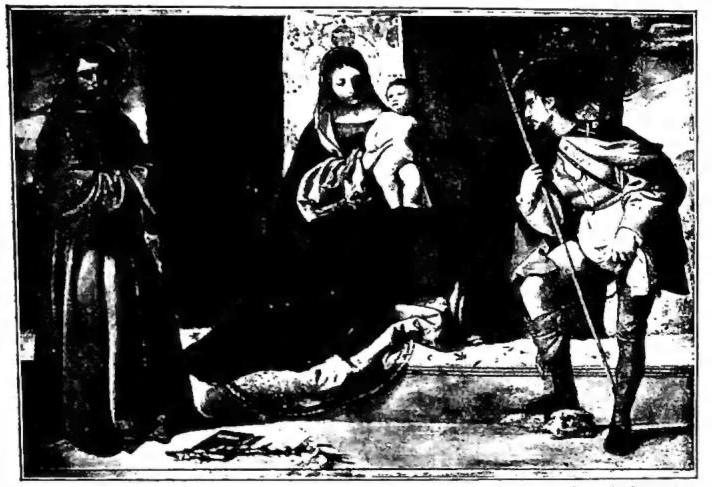
His study with Gentile and Giovanni Bellini was of no great importance, so immediately different is T.’s style. And this style—that is, this new way of painting—took its point of departure from Giorgione, his master. Dolce, in his Dialogo, which dates from 1557, reports that Giorgione is said to have remarked of T.: “even in his mother’s womb he was a painter”; a clear reference to the artist’s precocity, since, not yet twenty years old, he frescoed one side of the Fondaco beside him. Certainly T.’s earliest works were Giorgionesque, suffused with intense lyricism. Such are the Pastoral Concert in the Louvre, erroneously attributed to Giorgione; the Noli me tangere in the National Gallery of London; the Legend of Orpheus in the Carrara Gallery in Bergamo; the Madonna with Sts. Roch and Anthony in the Prado; the Adulteress in the Glasgow Museum; and finally Sacred and Profane Love in the Borghese Gallery—all works to be dated to approximately 1508–12. To these must be added another masterpiece, the celebrated Sleeping Venus in Dresden, which belongs to T. and not to Giorgione, as was long believed. Also dating from approximately 1510–15 is the canvas showing Jacopo Pesaro and Pope Alexander before St. Mark, in the Antwerp Museum.
The altarpiece in the sacristy of the Salute, with St. Mark enthroned and four saints; the Zingarello in the Vienna Museum; the Three Ages in the Bridgwater Gallery in London; the Holy Conversation in the Balbi Gallery in Genoa; and the famous Concert in the Pitti—also erroneously attributed to Giorgione—likewise belong to this youthful period, to mention the most important works. Among his portraits of these years, one should recall the Knight of Malta in the Uffizi; the so-called Ariosto in the National Gallery; the so-called Parma in Vienna; and the beautiful female figures—which are also somewhat idealized portraits—such as the Flora in the Uffizi, the Salome in the Doria Gallery in Rome, the Lucretia in Vienna, and the so-called Laura Dianti in the Louvre: all works full of dreamy sweetness, of delicate handling, yet of intense, fiery color, rich in glazes. The lyrical element predominates, although in some frescoes of the Scuola del Santo and in certain passages of the Adulteress and elsewhere one can already discern a power of dramatically expressive and highly effective representation. And if one recalls other youthful masterpieces by T., such as the Christ with the Coin in Dresden, the Annunciation in Treviso Cathedral, or finally the exquisite Baptism of Christ in the Capitoline Gallery in Rome, one will gain a revealing vision of the artist’s creative power up to approximately his thirtieth year.
With the Assumption of the Frari, T.’s mature period begins, fervent with great creations and profoundly innovative. Dolce records that when the altarpiece was unveiled to the public (1510), it was not understood, so different was it from the “dead and cold things of the Bellinis, the Vivarini,” and so forth; “but then people began to marvel at the new manner discovered in Venice by T.” The “new manner” consisted in the monumental grandeur of the concepts, the expressive vitality of the figures, and the bold movement of the composition; but above all
in the way color was used, no longer superimposed upon the drawing, but itself creating the form through a new process of rich, patch-like handling, all ablaze with resonant vibrations. Thus, from the seed of Giorgione (whom Dolce calls “that little spark which T. had discovered in Giorgione’s works”) arose the idea of modern painting.
The Assumption was followed by a series of masterpieces, each of which marked a new stage in the history of Venetian painting: the altarpiece with the Madonna appearing to ss. Francesco and Biagio, executed in 1520 for the church of S. Francesco in Ancona; the Madonna di Casa Pesaro, at the Frari, commissioned in 1519 and inaugurated in 1526; the polyptych of the Resurrection, painted for Bishop Altobello Averoldo and placed in 1522 in the church of SS. Nazaro and Celso in Brescia, a work revealing new concepts of luminism; the great panel of the Madonna di s. Niccolò, formerly in the church of the Frari, now in the Vatican. In 1528 T. emerged victorious from the competition (in which Palma and Pordenone had taken part) for the altarpiece of the Killing of s. Peter the Martyr at SS. Giovanni and Paolo, a work which, placed on the altar in 1530, aroused universal admiration; it was later destroyed by fire in 1867. Meanwhile, between about 1520 and 1523, T. painted for the Court of Ferrara three sublime masterpieces on pagan subjects: the Feast of Venus, the Bacchanal, and Bacchus and Ariadne; the first two are now in the Prado, the third in the National Gallery in London.
An incredible number of portraits of the most important figures of his time came from T.’s brush: from that of Duke Alfonso d’Este, now in the Metropolitan Museum of New York, to that of Duke Federico Gonzaga in the Prado; from those of Francesco Maria della Rovere and his wife Eleonora Gonzaga, dukes of Urbino, in the Uffizi, to those of the Marquis Davalos (Paris), and of Cardinal Ippolito Medici in Magyar costume, at Pitti; and so on, down to the more complex portraits of Charles V and Philip II, which inaugurated a new era in the field of portraiture. The artist portrays his models with extreme simplicity, without outward poses, without any attempt to create fictitious settings; his figures appear with great naturalness, in an atmosphere of austerity that lends them a lofty human ethos. His colours too, especially in the male portraits, are sober and measured in warm harmonies. And when T. intends to render, along with his subject, the setting surrounding him, he achieves this without declamatory gestures, with a nobility of expression to which few can be compared in the history of painting: the Portrait of Duke Alfonso Davalos Haranguing the Soldiers (Prado), that of Bishop Madruzzo, formerly in Trento, and those of Charles V on Horseback and Philip II in Armour (both in the Prado) will remain unsurpassable examples, not only of stupendous pictorial power, but also of profound psychology. They represent not merely physical persons, but the “idea” immanent in them.
T.’s pictorial activity never ceased. The great public paintings followed one another. After the aforementioned altarpiece of s. Peter the Martyr (1530), he supplied, this time for the Ducal Palace, the much-requested canvas of the Battle of Cadore, also destroyed by fire, of which only the engraving remains; sufficient, however, to show us how it represented a new, dramatic, and vivid model for battle painting in the future. He painted the Annunciation for the church of S. Rocco; the Presentation in the Temple and the S. Giovanni, both now in the Accademia of Venice; the three canvases with the Sacrifice of Abraham, David and Galia, and Cain and Abel, now on the ceiling of the sacristy of the Salute. He supplied the Assumption for Verona Cathedral, the Crowning with Thorns for the church of the Grazie in Milan (now in the Louvre), the Last Supper and the Resurrection for the ducal palace of Urbino, and the series of Roman Emperors for the ducal palace of Mantua. He continued to create, together with master-
T. finally came to know this classical world when he went to Rome in 1543, and his spirit received further impulses from the sight of ancient monuments and statues, as well as from his contacts with Michelangelo; but the influence of Michelangelo’s creations—previously known through prints and drawings—had already been absorbed on various occasions, for example, in the canvases mentioned above from the sacristy of the Salute. Yet he saw and interpreted that classical world in his own way; that is, by enhancing it in a new, more intensely chromatic expression. His contacts, first with Pope Paul III Farnese and then with Emperor Charles V, must have stimulated T.’s creative energies immensely. The works he created during that period are of the highest stature; nevertheless, it cannot be said which are the finest. For Paul III he painted various portraits, the most celebrated of all being the one representing him with his nephews Ottavio and Alessandro Farnese, now in the Museum of Naples (1546). Here begins the portrait “of a group of figures,” of which the Vendramin Family, now in the National Gallery in London, is a superb example. But by now his colour too had progressively become freer, bolder, softer, and more impetuous, possessing a depth and intensity never previously known. For the Emperor’s court he supplied Madrid with a series of works, today almost all in the Prado and the Escorial: Sisyphus and Prometheus; Venus and Adonis; the Glory of Charles V (1551–1554); the Entombment (1559), the Adoration of the Magi, and Christ in the Garden, the latter creations imbued with a profoundly religious pictorial atmosphere, already touching upon that complete dissolution of colour which characterizes T.’s final style.
From this final period, the Prado also preserves the St. Margaret, the Ecce Homo, Christ Carrying the Cross, the impressive Votive Picture of Philip II for the victory at Lepanto, the allegory of Spain Defending Religion, and finally the marvellous painting of Adam and Eve. At the Escorial: the great Last Supper and the monumental Crucifix. But he supplied other works for his Venice and for the princes of his time; for the Jesuit church, the Martyrdom of St. Lawrence (1548–58); for S. Maria della Salute, the Descent of the Holy Spirit; for S. Salvatore, the Transfiguration and the Annunciation; for the Library of S. Marco, the Allegory of History (1560). For the cathedral of Serravalle, near Vittorio Veneto, T. painted a large altarpiece of the Madonna with ss. Peter and Paul; for the church of Medole near Mantua, a Christ Appearing to the Madonna; for S. Domenico in Ancona, an impressive Christ on the Cross with Mary, s. John
In approximately seventy—or slightly more—years of activity, T. created such an imposing body of masterpieces that it surpasses the production of any artist who came afterward, including the already immense oeuvres of a Rubens, a Rembrandt, or a Goya. But the singular aspect of T.ʼs creative spirit is that, from his beginnings around 1505–1507 to the year of his death, 1577, there is in him not only a continual crescendo of expressive force, but also a continual enhancement, or transformation, if one prefers, of his pictorial means. Any division of T.ʼs activity into periods is arbitrary and has a purely academic and practical significance.
It has been divided into three or four periods, but it could equally well be done otherwise. In him there is a continuous progression, never a change of direction. And within the progression itself, a continual ascent. Between Sacred and Profane Love and the Assumption there is an essential break, in the sense that one passes from Giorgionesque lyrical concepts to a bold, fiery pictorial interpretation; from softly tonal application to a thick, fleshy impasto of colour. From the Assumption to the portrait of Paul III with his grandsons (ca. 1545), the pictorial material becomes more ductile, takes on warmer and deeper tones, and is enriched by immense sensitivity; it is an entirely new procedure, a mixture of a fatty, patch-like impasto with glazes and scumbling. This is his “late” pictorial period, in which, however, the great artist continues, in his process of optical and chromatic synthesis, the boldest experiments that painting has ever attempted—not out of vain aestheticism, but from the necessity of an immediate, ductile, lightning-fast expressive language. It is known that T. sketched his canvases without preparatory drawing, directly with the brush, then established their large masses in light and shadow, still like phantoms;
and S. Domenico. His masterpieces of maturity are dispersed among various museums; of these, only the most important are mentioned: the Rape of Europa, in the Gardner Museum of Boston, begun in 1559 and sent to Spain in 1562, a work of unattainable freshness; Diana and Callisto, Diana and Actaeon, both at Bridgewater House in London; the Hunt of Actaeon, belonging to the Earl of Harewood, also in London; Perseus and Andromeda, in the Wallace Collection; Tarquinio and Lucrezia in the Museum of
then he would turn the canvases toward the wall and continue them only after several days, in order to gain the freshest impression; and he would take them up again, with strokes and scumblings, until from the barely sketched phantoms the figures acquired body, life, and spirit. But these highly revolutionary pictorial methods were not understood by everyone at the time, nor were they always understood by posterity; least of all in periods when “drawing” returned to favour, namely in the Neoclassical period. It was only in the second half of the nineteenth century, when painting recovered a deeper and more human meaning, that people once again began to understand the immense pictorial power of the creations of the “old” T., which are the most genuine expression of “pure” painting, so dear to modern artists. - Vedi tavv. XVIII-XIX.