
SANSOVINO, JACOPO TATTI called il. - Architect and sculptor, born in Florence on July 2, 1486, died in Venice on Sept. 27, 1570. A pupil of Andrea Sanso-
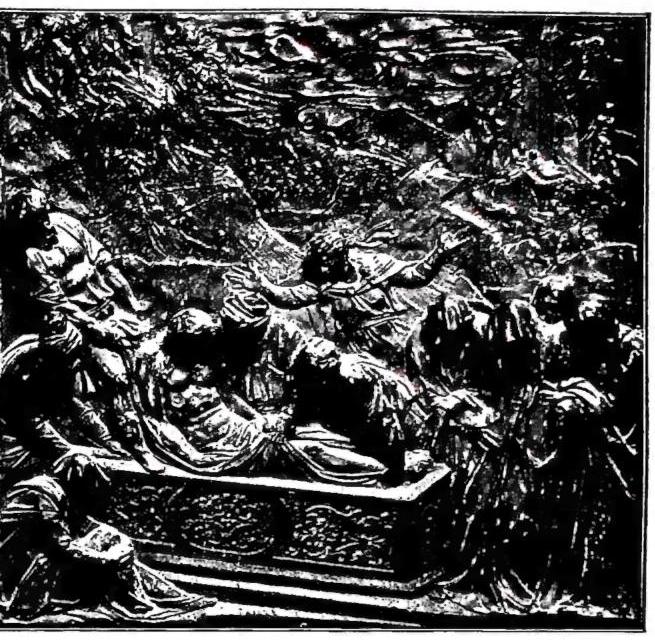
(phot. Alinari)
From his earliest works he showed that he had assimilated the Tuscan grace of his master and that he felt the influence of Raphael, subordinating any pursuit of formal energy, inspired by Michelangelo and the study of the ancients, to that of pictorial effects and linear elegances. The masterpiece of this period is the Bacchus (1514, Bargello Museum), vibrating with joyful vitality. Other works: the statues of St. James in S. Maria del Fiore and in S. Maria di Monserrato in Rome, and the Madonna del Parto in S. Agostino there, of classical majesty.
In Rome S. also executed his first architectural works: the unexecuted project for S. Giovanni dei Fiorentini, the remodeling of the interior of S. Marcello (the monument of Card. di S. Angelo and Bishop Urso there is by him), and the Palazzo Gaddi-Amici, which in the decoration of its courtyard provides a first example of those pictorial qualities that the artist would fully develop in Venice, where he fled in 1527 and became in 1529 the official architect, holding the office of Proto of St. Mark's.
He debuted there with the restoration of the domes of the Marcian church and with the completion of the Procuratie Vecchie, subsequently turning his hand to the churches of S. Giminiano and S. Francesco della Vigna and to the Scuola della Misericordia, works carried out—like so many of S.'s others—slowly and laboriously, amidst modifications and interventions by assistants, and not all of them completed. In 1534 he dated the Madonna of the Arsenal, in 1535 he completed a relief in the Basilica del Santo in Padua, left unfinished by Minelli, and the following year he began another, with the Miracle of Carilla. The year 1537 marked the beginning of an exceptional number of works: the Mint (Zecca), the Library (Libreria), the Loggetta of the bell tower, Palazzo Corner, and a group of reliefs for the presbytery of St. Mark's, completed in 1544. Dating from 1546 is the door of the sacristy of St. Mark's, from 1550 the statue of Hercules commissioned by the Duke of Ferrara and now in Brescello, from 1554 the beginning of the statues of Mars and Neptune for the Ducal Palace and the casting of the statue of T. Rangone for the facade of S. Giuliano, built by S. himself in collaboration with Vittoria. Dating from these same years are the Fabbriche Nuove di Rialto.
the facade of S. Giminiano, the design of the Golden Staircase in the Ducal Palace. When he was almost eighty years old, he completed the monument to Doge Venier in S. Salvatore.
In the Venetian artistic climate, especially in contact with painters like Titian, S. was able to fully express his temperament: the reliefs of the door of the sacristy of St. Mark's, following a Ghibertian layout, are full of dramatic fervor, executed in an impressionistic manner and vibrating with light; admirable, in the same church, are the statues of the Evangelists, executed "with knife strokes resembling Tintoresque brushstrokes" (Venturi), and the reliefs with the stories of St. Mark. The dramatic intensity that also animates the statue of the Baptist at the Frari, full of nervous momentum, becomes composed and solemn sweetness in the numerous images of the Madonna and Child, in relief and in the round (Arsenal, Loggetta, Correr Museum and Ca' d'Oro in Venice; Vittorio Veneto; Bargello; Berlin; Louvre). The academic effort instead cools the colossal Giants of the ducal staircase, whereas a mannerist grace stamps the four pagan images on the facade of the Loggetta. Particularly successful are numerous sculptures of a decorative nature, or inserted into architectural complexes: the statue of T. Rangone at S. Giuliano, the fireplace formerly at Ponte Casale, the Pocodataro tombs at S. Sebastiano, and the Venier tomb at S. Salvatore.
Even in the massive and severe building of the Mint, S. achieves pictorial effects from the variation of the rustication, which he then employs on the ground floor of Palazzo Correr, whose upper floors, with the motif of paired columns and the rich ornamentation of the window spandrels, display that quest for chiaroscuro movement and solemn magnificence that would find another admirable realization in the double loggia of the Library. This latter motif would also give rise to the grandiose mass of Villa Garzoni at Ponte Casale and Palazzo Dolfin. Architecture and sculpture vie with each other in rendering the loggia of the bell tower picturesque and sumptuous.
Less fortunate was S. in his religious buildings: the churches of S. Giminiano and S. Spirito in Isola having been demolished, the interior of S. Francesco della Vigna altered during construction, and the facade of S. Giuliano being less than fortunate, we nevertheless retain a typical example of his pictorial style in the completion of S. Fantino. Among his numerous other works are cited: the Quignone tomb in S. Croce in Rome, the reliefs with the Ascension in St. Mark's and at the Bargello, the relief with a sacra conversazione in Berlin, the two bronzes of Mars and Neptune in Detroit. - See pl. CXVIII.