
VITTORIO VENETO, DIOCESE of. — City and diocese in the province of Treviso on the southern slope of the Belluno Prealps; the city is watered by the Meschio. It has an area of 1,420 sq. km. and a population of 286,520 inhabitants, almost all Catholics, distributed among 167 parishes served by 367 diocesan priests and 87 religious priests; it has a seminary, 11 male and 112 female religious communities (Ann. Pont. 1953, p. 450).
From its establishment (second half of the 7th century) until 1939 it was called the diocese of Ceneda (Cenetensis), after the southern district, the residence of the bishops. In 1866, together with the northern district of Serravalle, the city took the name of Vittorio Emanuele II; in 1918 this became an auspicious name of victory for Italy, which concluded the world war at V. S. Congreg. Consistorial, dated 13 May 1939, it was called the diocese of V. V. (Victoriensis Venetorum).
I. HISTORY
The diocese, a suffragan of Aquileia, was first established in the second half of the 4th century at Opitergium (v. ODERZO). After the destruction of Oderzo by Grimoaldo (665), the new see was re-established at Ceneda as a Lombard foundation. A placitum of Liutprand (6 June 743), reported in a document from the 11th–12th century, which some historians declare authentic and others spurious, attributes it to this Catholic King, who left behind him a widespread traditional renown; P. Paschini instead considers it reliable that it should be attributed to the period when the schism of the « Three Chapters » (v.) was still burning in the Venetian medi-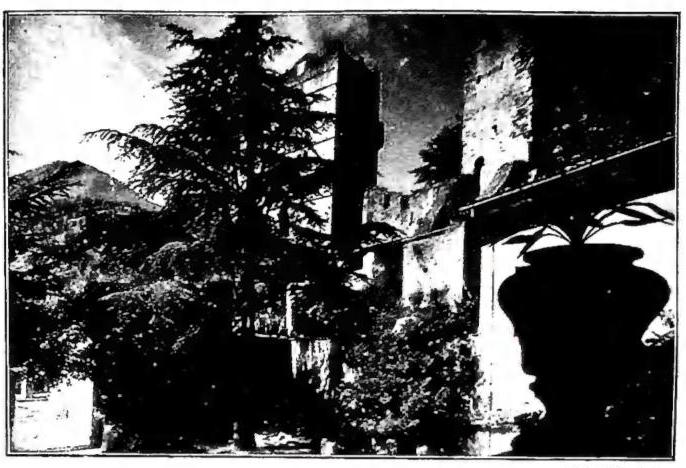
(photo Marin)
Already a Roman nucleus and an important road junction toward the Alps, in the Middle Ages Ceneda became the seat of a Lombard Duchy and then a Carolingian county, at the head of which Otto I (in 962) placed the same bishops; during the period of the Communes it joined with Treviso (1147). Powerful families dominated the territory, such as the Caminesi at Serravalle (1175–1335) and the Collalto (1110–1806; the castles of Collalto and S. Salvatore di Susegana). In 1388 Ceneda came under Venetian rule; the bishops of Ceneda, however, refused to recognize its absolute dominion over their county, and a dispute arose between them, supported by the Roman Curia, and Venice (one may recall the consultations of fra' Paolo Sarpi, 1613–15), which continued until 1768, when the county was suppressed.
The diocese of Ceneda encompassed the territory belonging to Oderzo, except for certain pievi, which remained under the dioceses of Aquileia, Treviso, and Padua and which in 1818, by Pius VII’s brief De salute dominici gregis, were permanently incorporated into Ceneda.
The diocese of V. V. now lies between the Piave and the Livenza, and between the Belluno and Carnic Pre-Alps; it borders the dioceses of Concordia, Belluno-Feltre, Padua, Treviso, and Venice.
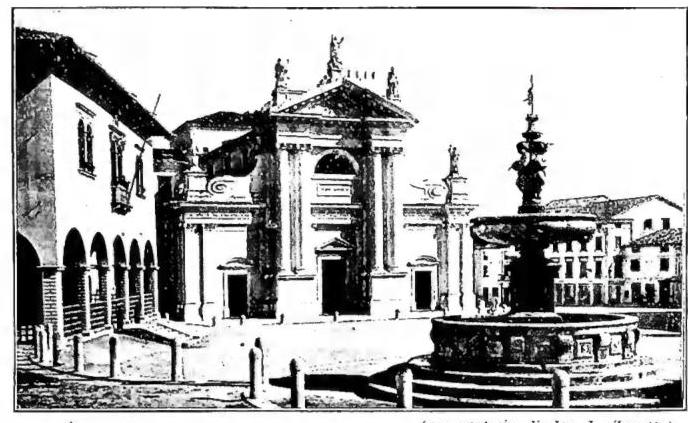
(courtesy of don L. Zovatto)
VITTORIO VENETO, DIOCESI di – Facade of the Cathedral (arch. G. Moretti, 1912). On the left: Old Municipal Palace, now the Museum of the Battle of V. V. (1918).
II. MONUMENTS
In the diocese of V. V., the ancient Benedictine abbeys of S. Maria di Follina (Cistercians and Camaldolese from 1150 to 1717, Servants of Mary since 1915), with its basilica (1305–35), a well-frequented diocesan shrine, and its Romanesque-style cloister (1268), intermingled with various Gothic variations, as well as those of S. Bona di Vidor, S. Pietro di Colle, and S. Andrea di Busco, have survived, some only with partial structures; the commendatory abbot of the abbeys of Follina and Colle was also s. Carlo Borromeo. Many other monasteries and convents, approximately thirty in all, disappeared following the Venetian and Napoleonic suppressions. There remain: one monastery of Cistercian Benedictine nuns, five convents of religious orders, and various houses of religious congregations.In the shrine of Motta di Livenza, erected at the beginning of the 16th century following an apparition of the Virgin, the basilica, cloister, and altarpiece with decorations and bas-reliefs on the high altar are magnificent Renaissance works by J. Sansovino; there are also frescoes and paintings by Pordenone, Amalteo, Palma il Giovane, the school of G. B. Tiepolo, and Nono. The shrine of S. Augusta, virgin and martyr (5th century), on the hill of the same name at Serravalle, is a destination for pilgrimages from the diocese and from the Veneto.
The city of V. V., comprising Serravalle and Ceneda and, between them, the newer section, extends and develops longitudinally between the short circle of hills, backed by the Pre-Alps, amid the picturesque variety of well-wooded parks and flower-filled fountains and the succession of Romanesque, Gothic, and Renaissance sacred and civic architecture that gives the city its distinctive appearance and character.
In the monumental Palazzo della Comunità of Serravalle, a small museum (1938) preserves relics and works of art from various periods, including frescoes by Francesco da Milano and a Madonna and Child in stucco and papier-mâché by Jacopo Sansovino; the medieval castle of S. Martino is still the bishop’s residence, and nearby the complex of diocesan institutions extends and flourishes.
The ancient Cathedral, dedicated to the Assumption and to s. Tiziano and dating from the end of the 8th century, was destroyed by the people of Treviso and immediately afterward (at the end of the 12th century) rebuilt in the Romanesque style; reconstructed in the mid-18th century, it assumed a neoclassical appearance, with a recent façade and the survival of Romanesque structural elements (crypt, massive restored bell tower, division into three naves).
III. ART
It preserves valuable works of art by Iacopo da Valenza (Virgin between s. Sebastiano and s. Antonio da Padova, 1484; Madonna enthroned with saints, 1507); by the school of Tiziano (Virgin between s. Sebastiano and s. Rocco, 1540); by Dario Varotari (Baptism of Jesus, second half of the 16th century); the ancient episcopal throne (first half of the 15th century), with the ss. Ermagora and Fortunato, evangelizers of Aquileia and the Veneto region; a missal and a breviary, whose miniatures are attributed to Giulio Clovio (1498–1578), a gift of Cardinal Marino Grimani, bishopof Ceneda; and the bronze urn containing the relics of s. Tiziano. The Coronation of the Virgin (1438), a masterpiece by Iacobello del Fiore, was ceded in the last century to the Accademia di Belle Arti of Venice.
Other paintings, predominantly altarpieces, are scattered throughout the diocese; those by Tiziano in the parish church of Serravalle; by Cima da Conegliano in the cathedral of Conegliano and in S. Fior di Sopra; by Pordenone in the parish churches of Susegana and Moriago, and by A. Bellunello, Iacopo Bassano, and Amalteo in the cathedral of Oderzo and Motta di Livenza, are of high artistic value; as are those by A. Previtali and Meschio, and by G. B. Canal at Serravalle. Also to be added are fourteenth- and fifteenth-century frescoes in the church of S. Giovanni Battista of Serravalle, in the church of S. Andrea of Bigonzo, and in that of S. Pietro di Feletto, as well as successful modern pictorial cycles, such as those by Pino Casarini in the cathedral and in the cathedral of Sacile.
Ceneda 1845; L. Marson, Guida di V. e suo distretto, Treviso 1889; id., Romanità e divisi dell'agro cenetone, Rome 1904; A. Maschietto, S. Tiziano, Oderzo 1932; id., S. Momo, there 1933; id., La chiesa cattedr. di V. V., there 1951; P. Paschini, Le origini della Chiesa di Ceneda, in Miscell. Mercati, V (Studi e testi, 126), Città del Vaticano 1946, pp. 145–50. Paolo Lino Zovatto