
TORCELLO (Turricellum). - Ancient episcopal see, an island in the Municipality of Venice, from which it is 10 km distant,
I. HISTORY
After the descent and destructions of the Lombards, Altino (v.) permanently emigrated to T., where the episcopal see was also transferred. Churches, cenobiums, and dwellings soon arose, "so as to rival the abandoned city which, because of its walled and turreted circuit, was recalled at least in the name of the new site: hence the designation T. (Turricellum), perhaps indicating the existence of some lookout and defense tower, if it is not the transformation of an older denomination: Doreum" (Brunetti). Encircling and defending it were the islands of Mazzorbo, S. Niccolò de Cavana, S. Giacomo in Palùo, ancient Burano, Murano, Costanciaca, Centranica, S. Pietro di Casa Calbo, Ammiano, and other smaller ones, so that the problem of the origins of Venice is closely connected to the history of T., where the first outlines of what would later be, in spirit and action, the great maritime Republic were formed.The consecration of the Basilica in 639 is attested by the epigraph which is the oldest document of the history and lagunar consolation of Venice; Constantine Porphyrogenitus, in the mid-10th century, calls T. "a great emporium of trade and labor." From T. came that Rustico, one of the two sailors who brought the body of St. Mark from Alexandria of Egypt in their ships to the Venetian lagoons (year 828).
The conditions of T., even in the late Middle Ages, were better than those of other islands and coastal villages, if in the 15th century some of their convents migrated there. T. declined as Venice absorbed its activity; but the decisive cause must be considered the gradual silting up of the lagoon and the consequent spread of malaria. Despoilers of marble and stone hastened the work of destruction even though laws (1441) established penalties: "beyond the whip, let the thief have one eye gouged out without remission."
The succession of bishops lasted until 1792; in 1659 the episcopal see was transferred to Murano; in 1818 it was annexed to the patriarchate of Venice.
II. ART
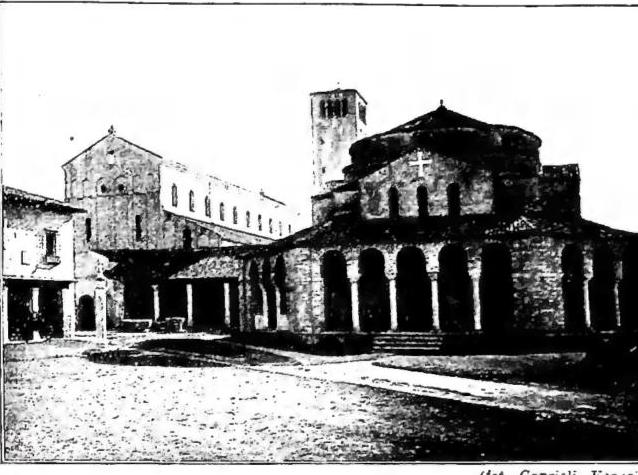
T., in its appearance as a lagoon center, retains certain configurational elements that make it similar to Venice: the Rio Maggiore, which corresponds to the Grand Canal, other narrower canals, paved fondamenta, small squares, calli, the central square with the cathedral church and government palaces. In 639, by order of Isaac, Exarch of Ravenna, the master of the soldiers erected the Basilica with a longitudinal plan, preceded by a portico (replaced in the 9th century by a narthex), with three naves divided by columns with a single central apse, flanked by a prothesis and diaconicon; a structure and type reminiscent of similar constructions in Ravenna, Parenzo, and Grado; the preceding baptistery had a circular plan with two large niches on the sides (7th century: secure traces remain). In the 9th century, the two small apses were opened on the flat back walls; beneath the central apse (which Bettini dates to the 9th century), a semi-annular crypt was created, and above it the other cathedra and presbyterial steps were readjusted with a revetment of precious marbles. Bishop Orso Orseolo (1008) remodeled the construction by raising the walls, opening windows, reinstalling columns—upon whose capitals of various epochs the arch springs directly from the high pier—and renewing the iconostasis, the ambo (remodeled in the 12th century), and the marble inlay floor; the arcades that rhythmically punctuate the façade, raised in the 11th century, are of Ravenna taste and derivation.Behind the Basilica, square and robust, rises the Romanesque bell tower (11th century). The mosaic decoration covers only certain parts of the Basilica and assumes high artistic and iconographic value: in the golden conch of the central apse, the Madonna dominates in a solemn and hieratic manner (probably 12th century); in the lower zone of the central apse, the twelve Apostles, and, above the triumphal arch, the Annunciation; in the basin of the small apse of the Most Holy, Christ in throne with angels, and saints in the lower zone, are the work of Venetian workshops, reflecting Ravenna taste and influence (11th century, the epoch of the third reconstruction of the Basilica). To the same epoch is referable the vault decoration comprising four angels supporting the clypeus with the mystic Lamb: a mosaic conceived on a compositional scheme of Roman-Ravenna origin. On the back wall, the large 13th-century mosaic with the Last Judgment, of Byzantine tradition and derivation with an infiltration of Western elements. In its superimposed zones follow: the Staurasis or Crucifixion; the Anastasis or Christ's descent into limbo and the resurrection of Adam and the Patriarchs from limbo; Christ the Judge in the glory of the celestial court, and, in the center, the Deesis namely Christ within the iridescent almond of light between the Virgin and the Baptist, suppliants for humanity; the Etoimasia equivalent to the divine throne prepared for the Judgment and, on the sides, scenes of the resurrection of the flesh; the blessed and the damned, distinguished according to different sins; in the last compartment, Adam, with the souls of the just, the praying Virgin, the good thief, the door of Paradise guarded by a cherub, St. Peter with the keys, and a psychopomp angel; in the lunette recess above the entrance door of the Basilica, in half-figure, appears the Virgin in a praying attitude, asking for divine mercy: "O Virgin" - says the inscription - "with prayer, turn the Son of God to pity, erase every fault."
Among the sculptures of various ages, the following must be mentioned: capitals of the 6th, 7th, and 11th centuries; the recomposed episcopal cathedra (9th century); an altar frontal, now a tabernacle for holy oils (7th century); the altar with a simple mensa on small columns, reconstructed in its original form and resting upon a Roman sarcophagus (early 3rd century) containing the body of St. Heliodorus, first bishop of Altino; the pluteus panels of the "occasion" and the "wheel" (11th century); the Virgin enthroned with Child and the archangel Raphael, belonging to the pala d'oro of the Cathedral, a repoussé work of Byzantine-Venetian art (11th century), now in the Museum of the island of T., which preserves other relics, ceramics, fragments, and works of painting and sculpture of various epochs; a holy water font (11th century); the Virgin with Child by Pietro Lamberti (15th century); and Tintoretto's highly prized canvas of the Assumption.
The reconstruction of the altar and the restoration of the Basilica are due to F. Forlati (1929). Formed as a unitary complex with the Basilica and the baptistery was the small church of S. Fosca (probable initial martyrium), featuring a central plan with one longer arm that includes the apse and lateral small apses, a hood dome, and an external portico: everything, from the plan to the balance of the architectural members and spaces, according to Bettini, betrays that decisive and profound intervention of Byzantine taste that became (though not before the 12th century) one of the determinants of Venetian taste, grafting itself onto the previous, and ever-living, tradition of the Exarchate. - See pl. XXX.