
WROUGHT IRON. — The artistic working of wrought iron, that is, hammered, embossed, and carved iron, first became widespread in France, Germany, and Spain around the 12th century. The earliest highly ornate and exuberant works already demonstrate the degree of perfection attained by this craft. Remarkable examples date from that period, such as the gates of Puy Cathedral in France and those of Marcevals Abbey in Spain; a century later came the splendid doors of Notre-Dame in Paris and of the cathedral of St-Gilles in Vandea (v. CANCELLO).
In Italy, the use of iron as a decorative element became established only in the 14th century, with notable works such as the gates of S. Corona in Vicenza, those of the Scaliger Tombs in Verona, and others, especially in Tuscany, where the use of wrought iron underwent very considerable development throughout the 14th and 15th centuries.
The documents mention the Sienese Conte di Lello, who, together with his son Jacopo, was forging the gates in 1337–38
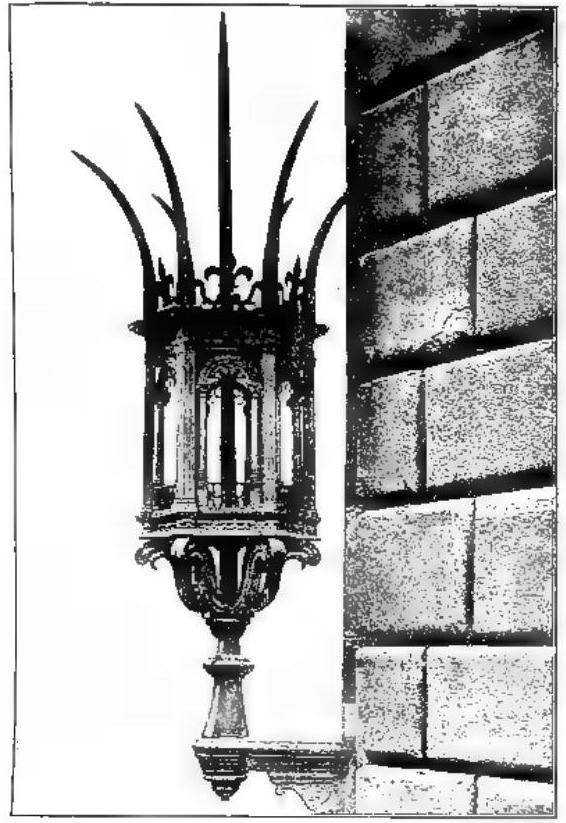
In Florence, the craftsmen working in f. b., united in the guild of blacksmiths since the thirteenth century, constructed practical objects such as lamps, bells, torch-holders and lanterns, including those, also celebrated by Vasari, which Niccolò Caparra forged for the Strozzi family and which are now in Palazzo Guadagni.
From the Gothic experiments, into which the jagged ornaments in f. b. could be inserted with greater ease, there was then a transition to the more serene Renaissance forms. Among others, one may recall the grille of the Cappella Castelli in S. Petronio in Bologna, from 1483.
In the sixteenth century the decoration became even more sober, in accordance with the inspiration of the architecture of Bramante, the Sangallo family, Michelangelo, Vignole, Sansovino, etc.
Decorative abundance instead regained strength in the Baroque period, with an exuberance analogous to that of the Gothic period, especially beyond the Alps. Balustrades were constructed for balconies and windows (magnificent examples are found in the houses of Siena, Lucca, Genoa and Venice, and in the synagogue at Padua, among others), as well as richly ornamented grilles such as those of the Bertoliniana Library in Vicenza, Palazzo Aldovrandi in Bologna, the former convent of S. Maria in Gradi in Viterbo, Palazzo Salvadego in Brescia, and the churches of the Missione and S. Francesco in Turin.
Baroque and Rococo f. b. follows the same developments as architecture and ornamental sculpture, and directly contributes with them to the decorative effect of the whole.
In the minor arts, too, f. b. had a vast repertoire in those centuries, which asserted itself especially in the making of ecclesiastical furnishings such as antependia (that of the Certosa del Galluzzo near Florence), candelabra, torch-holders, standing candleholders, processional lanterns, etc.
In the nineteenth and twentieth centuries, the use of f. b. declined, and only sporadic brief revivals of craftsmanship occurred, in Italy and abroad. The works, at first inspired by cold Neoclassical decoration, received a genius imprint toward the middle of the last century, on the initiative of Viollet-Le-Duc. Finally, toward the closing years of the century and the beginning of the twentieth, a substantial group of Italian artists resumed this practice and achieved excellent results. Particularly noteworthy are the f. b. works made by A. Gerardi for the basilica of Getsemani. - Vedi tav. LXXX.