Machine translation of the 1948–1954 Italian original. The original text is authoritative.
GIADA. - A hard stone used in China in the industrial arts: it derives from two silicates, nephrite and jadeite, the former of calcium and magnesium, the latter of sodium and aluminium with iron silicate, both of considerable hardness and particular brilliance. Its colour is generally green, in a range extending from light grey with greenish shades to very dark green.
It has been used since the times of the most ancient dynasties
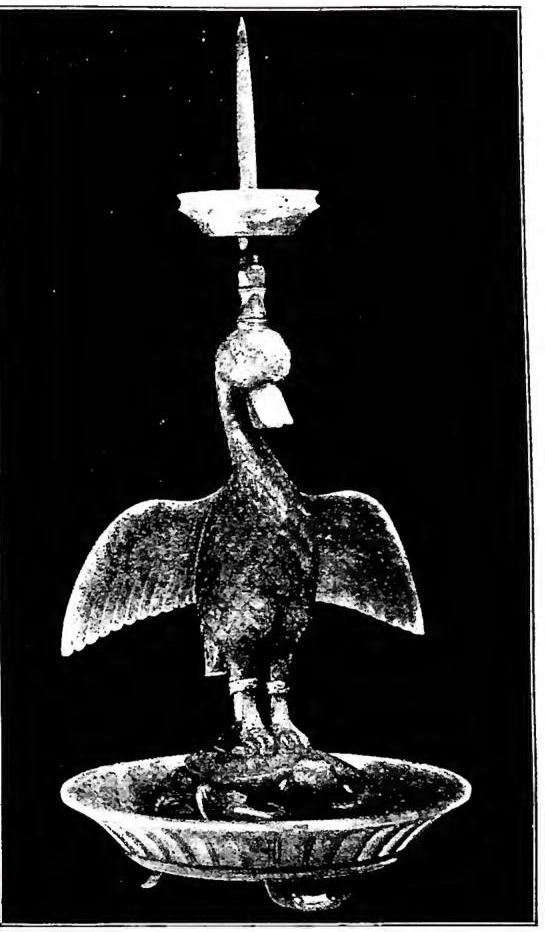
(from St. Charles Nott, Chinese Jade, London DM, pl. II) GIADA - Nephrite candelabrum from the Ch'ion Lung period (c. 1750 B.C.) - London, Lady Lever Collection.for small objects, mostly amulets, jewellery, and personal ornaments; but small votive statuettes, figures of animals, and stylized flowers with a complex symbolic meaning were also carved in jade. It was worked by means of powders of harder stones, such as quartz, emery, etc.
The use of jade in the West was limited, but many ethnographic museums preserve interesting jade objects. In Italy, those in the Museums of Florence and Bologna, and in the Pigorini and Lateran Museums in Rome, should be noted.
BIBL.: Bishop collection, Investigations and Studies in Jade, New York 1905; O. Münsterberg, Chinesische Kunstgeschichte, II, Esslingen 1912, p. 340; J. C. Ferguson, Outlines of chinese art, Chicago 1918, pp. 65-81; G. Vacca, s. V. in Enc. Ital., XVI, pp. 944-45; L. Bachofer, A short history of chinese art, New York 1944.
Giovanni Carandente
Cite this article
“GIADA.” Enciclopedia Cattolica, vol. VI (1951), p. 227. Azione Romana digital edition, https://azioneromana.com/article/giada.