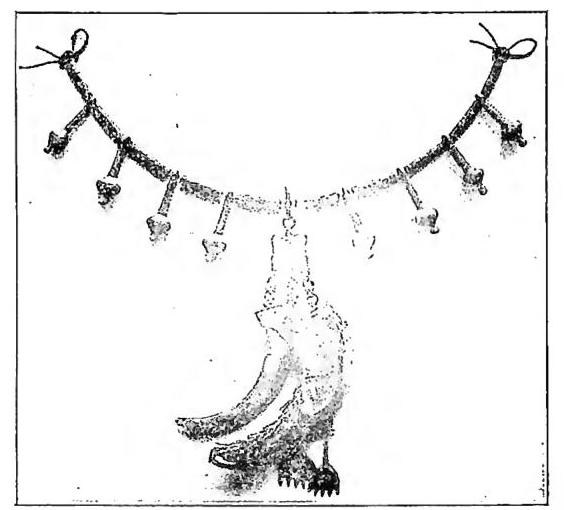
AMULET. — A word of uncertain etymology (from Lat. amoliri, “to remove”?; from Arabic himālah, “pendant, appendage”?) referring to objects erroneously believed capable of warding off harmful influences of every kind from those who wear them. In current usage, a. is taken as a synonym of talisman because both procure an advantage for the person who employs them; the difference consists in this: the a. serves to protect against possible dangers, whereas the talisman guarantees its possessor the attainment of certain goods. A. and talismans constitute a very rich section of magic (v.).
1. THE A. IN NON-CHRISTIAN RELIGIONS. — The use of a. is documented from prehistoric times onward. The material of which a. are made may be drawn from all three kingdoms of nature, and their form is highly varied; generally, form and material are related to what they are meant to procure or ward off by virtue of the impersonal force (mana) believed to be released by them into things. Gold (incorruptible); coral hands and, in general, pointed objects or branches capable of piercing and thus immobilizing the harmful influence; amber, because of its capacity to become electrified; reproductions of genitals, lunar crescents (“lunulae”), etc.; certain kinds of herbs: rue, against envy, cyclamen, favorable to women in childbirth, vervain, used in Rome by the fetiales entering enemy territory; objects of iron (nails, horseshoes, etc.) are the most common examples of a.
2. THE A. IN CHRISTIANITY. — The ancient Christians naturally inherited from the pagans both the practice of this superstition and the use of many a. in particular. But one must beware of defining without qualification as a. practices that had nothing superstitious about them. For example, wearing little crosses, monograms or other forms of the name of Christ, relics of martyrs, and even the Eucharistic species and medals bearing the image of one saint or another, passages from the Gospels (all practices extensively documented) involved no superstition, because such objects possessed an intrinsic virtue or one actually attached to them of preserving from natural evils or diabolical molestation, through the protection of God and the Saints, which was compatible with that reverence and honor. Therefore they are wrongly defined as Christian a. by Protestant and rationalist writers.
Unfortunately, however, the early Christians continued to use many different a. of pagan origin, such as fascina, gorgoneia, horseshoes, bells, precious stones and nails, which are found even in tombs, as well as others often deplored by the holy Fathers, who inveighed against the use of diabolical ligaturae, of phylacteria non angelorum sed daemonum nominibus consecrata (De-
cretum Gelmianum, 10), of signs of the planets and similar superstitions. They also often contaminated pagan practices with Christian religion, as is seen in the frequent incantations (written on sheets of lead, marble, etc.) crammed with strange names of angels, complicated arrangements of alphabetic letters and scriptural phrases, in the numerous abraxus (v.), and in the mixture of pagan figures with Christian signs (a figure of Alexander the Great with the monogram). Perhaps the chrismon, the wheel, the swastika, the fish and similar signs, which so often recur engraved on gravestones, houses and every kind of household object, were sometimes given the character of simple a. by ignorant Christians.
The use of a. grew extraordinarily during the Middle Ages, encouraged by increasing ignorance. Attempts were also made to give it a rational basis that would eliminate its magical and superstitious character and would not conflict with the postulates of the Christian religion, by appealing to the mysterious virtues proper to the planets and transferred by them to certain bodies, such as precious stones, certain rare minerals, and unusual plants and animals. Thus an entire theory of the planets, bestiaries and lapidaries was created. At the same time, belief in the evil eye and in the many means of guarding against it flourished among the common people, together with the practice of numerous a. against illnesses, spells and witchcraft, and even against natural accidents. Moreover, even at the present time many educated people seriously practice the use of the mascot, believe in horseshoes and their virtues, in touching iron, etc.; and generally, the more religious ignorance increases, the more superstition grows as its substitute. Antonio Ferrea
3. DOCTRINE OF THE CHURCH
Although, as was already mentioned (n. 2), one must beware of confusing the use of a. among pagans with the use of devotional objects among Catholics, it nevertheless remains true that deviations from the doctrine of the Church have been and are found among the latter. In formulating a moral judgment on this conduct, a distinction must be made: whoever wears the a. and intends thereby to have recourse to the demon for assistance or defense commits the sin of “magic,” which is always a mortal sin, insofar as it constitutes an explicit invocation of the demon; whoever, on the other hand, does not intend to bind himself to the demon, indeed does not even think of him, but uses the a. to obtain effects evidently disproportionate to the means employed, commits the sin of “vain observance,” which by its nature is a mortal sin, insofar as recourse to the demon is implicit in it; for since the object is incapable of producing that effect by itself, a preternatural intervention is required. In practice, however, account must be taken of the subjective conscience of individuals, because very often the faithful do not understand this implicit invocation of the demon, but act out of ignorance and do not think they are performing an irreligious act, as readily happens in the case of mascots and good-luck objects; in such cases there may be only venial sin, and sometimes no culpability at all (cf. s. Alfonso, Theol. moralis, I. III, n. 15). It nevertheless remains clearly evident that the faithful must be instructed well and plainly so that they may wholly emerge from this deplorable state of ignorance.Ecclesiastical authority has not failed to issue numerous condemnations of the use of a. (cf. J.-B. Thiers, Traité des superstitions, Paris 1741, pp. 329 ff.); it is enough to cite the Council of Constantinople, called “Quinisext” or in Trullo, of 692, canon 61: “Let those who question the clouds, practice divination and sell a. be excommunicated for six years. And if they persist in their guilt, let them be expelled forever from the Church, as the sacred canons decree” (Hardouin, Acta conciliorum, III, Paris 1714, col. 1689; Hefele-Leclercq, III, 1, p. 570).
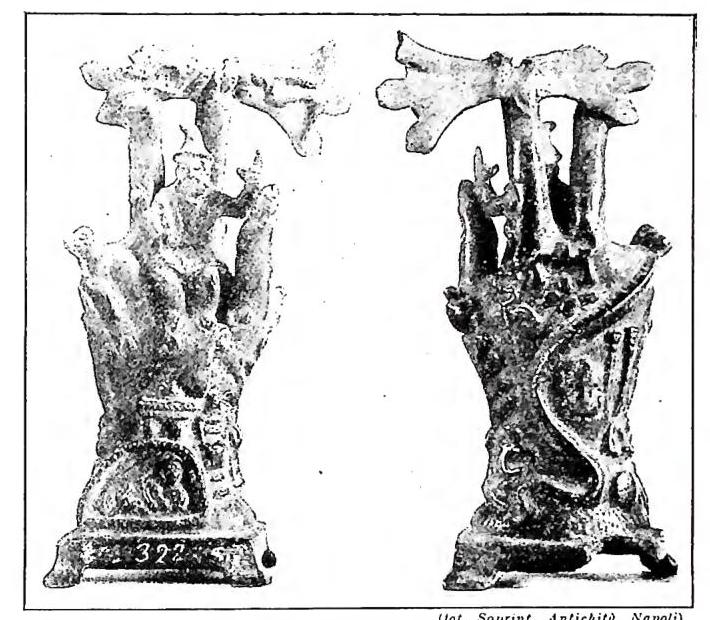
(Ist. Soprint. Antichità, Napoli) AMULETO – Amulet in the form of a panthea hand, viewed from the front and back. Bronze from Herculaneum – Naples, National Museum.
4. THE AMULET IN MEDICINE
The use of amulets is to be regarded as one of the most ancient remedies adopted by human beings to free themselves from diseases. Among specimens from the earliest periods, mention should be made of the disks of bone cut from the skulls of persons who had suffered from those diseases—particularly epilepsy—from which the wearer of the amulet wished to remain immune. Even today, in certain popular traditions, there is the custom of carrying a fragment of the skull bone of a person who had suffered from epilepsy, in order to be cured of that disease. The designation of an amulet is governed by the same general principles that have guided human beings in the search for and selection of medicines. Thus, according to similia similibus, those objects, plants, and animals that, by their color, form, or other characteristics of resemblance, can be connected with a principle of signatura become amulets; thus, according to the principle contraria contrariis, amuletic virtue is attributed to the hangman's rope, the skull, the blood of the guillotined person, the number 13, and so forth. Particular alexiteric and alexipharmic virtues are attributed to gems, concerning which there exists a vast literature extending from the most ancient Indian, Chinese, and Greek texts to modern popular literature. Parts or representations of parts of the human body also have amuletic value (eyes against the “evil eye,” phalli as emblems of generation and therefore of fertility and abundance). Adalberto Pazzini5. THE AMULET IN ART
The highly developed ornamental sense of the ancients, especially of the Greeks, gave amulets an artistic appearance, which changed over the ages but always remained elevated. Since amulets, from their origins to the present day, have served as personal ornaments, and since in this capacity they accompanied their owners into the tomb, those of the ancients have come down to us in great numbers, whether Egyptian, Greek, or Roman. As early as the second millennium B.C., we find in tombs tiny axes of polished green stone, worn around the neck: the stone weapon, characteristic of the preceding period but no longer in use, was already surrounded by an irrational fascination that recommended its use as an amulet. The “bulla,” which boys of the patrician families of Rome wore suspended from the neck until their eighteenth year, evidently contained an amulet and perhaps was itself an amulet. From Greek vases we learn that women used to tie around their thigh an extremely thin thread, which they never untied and whose function as an amulet is evident.