
MAGIA. —
I. IN NON-CHRISTIAN RELIGIONS
It is the art of dominating the forces of nature and life. The name derives from the Magi (μᾶγα), who were one of the six tribes of the Median people; their members, perhaps belonging to the priestly class, must have opposed Zoroaster in his work of reforming the country’s ancient religion. When the Persians under Cyrus seized Media (550) and then Babylonia (539), the Magi also came into contact with Persia and Mesopotamia, and subsequently with the immense territory that the conquest (333) of Alexander the Great opened to Greek culture, the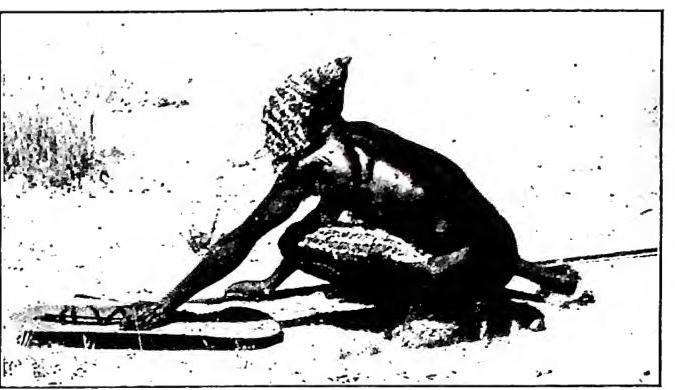
Magic, as an art, consists in a body of experiences recognized as effective and therefore invariably repeated with the same means, verbal and practical, while avoiding any innovation in this regard under penalty of failing to achieve the desired effect. Thus, even if it arose from a spirit of observation (Frazer), it cannot be regarded as the mother of science, whose progress is due to a spirit of inquiry and to enrichment through a variety of attempted experiments.
Magic does not necessarily presuppose the activity of a magician, because in many cases it is the obvious conclusion of elementary reasoning based on the sophism “post hoc, ergo propter hoc” or on the innate sense of an affinity believed to connect situations, objects that are similar or related to one another as parts of a whole. The magician intervenes when an action is required to exercise dominion over the forces of nature and of life, which he can command by virtue of the occult means at his disposal through inheritance or initiatory investiture. In this respect, magic is entirely different from religion, because in religion the priest, conscious of his own incapacity, implores the higher Powers to grant what they alone can give.
Another difference between magic and religion is that religion, through the priest representing his group, is always concerned with a social end directed toward the good of the community: escape from dangers and diseases, an increase in the harvest and livestock, victory over the enemy—even if, in order to achieve this end, it makes use of an apparatus of gestures and formulas of a magical type—whereas the magician, feared but abhorred, acts for a private end, which is almost always directed to the detriment of others.
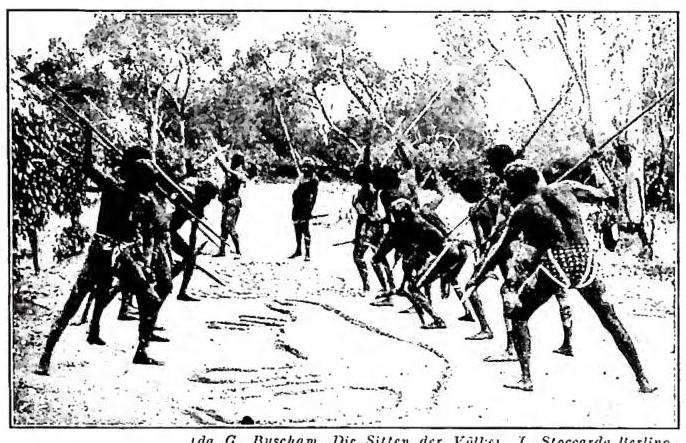
(from G. Buscham, Die Sitten der Völker. I, Stoccarda-Berlino. Lippia s. e., p. 108, fn. 269)
MAGIA - Magical kangaroo hunt (eastern Australia).
There are two fundamental types of magic; they proceed from two different principles: 1° like acts upon like; 2° the part acts upon the whole. In the first case we have imitative magic, also called symbolic, insofar as the magical act is a symbol reproducing what is desired; and homeopathic, insofar as it produces the same effect upon the person or thing toward which it is directed; in the second case we have sympathetic magic, insofar as the magical act, performed upon a part or element belonging to a given person or thing, produces upon that person or thing the effect worked upon the said part or element; this second kind is also called contagious because it is brought about by contact with something belonging to the person or object to be infected.
Cases of imitative magic: Hunting: in order to capture the prey, hunters reproduce its various movements in a magical dance, while one of them wears the skin of the animal to be captured. The inticium of the Australian Arunta tribe, whose ancestral or founding animal of the clan is the kangaroo, consists in capturing the animal and eating it in a communion sacrifice. The figure of the kangaroo is therefore drawn on the ground, and the hunters strike it with a magical rite that will ensure the capture of the animal.
Rain: in order to obtain it, the phenomenon is imitated, either by pouring water from a vessel or by imitating the thunder accompanying the storm. To avert it, the magician directs toward the clouds the noise he makes by beating upon his shield.
Eclipse: eclipses, both solar and lunar, which are believed to be caused by weakening, are averted by lighting fires. The same purpose is served in Christian folklore by the fires of s. Giovanni, lit at the summer solstice, when the sun begins to shorten its daily sojourn.
Moon: its waxing and waning during a lunation is regarded as favorable (or harmful) to the growth of vegetation and also of animal and human life, in accordance with the principle of homeopathy; thus, according to the prescriptions of the Latin peasants, sowing should be done under a waxing moon, «crescente enim luna frumenta grandescunt» (Pliny, Nat. Hist., XVIII, 30); cutting or pruning under a waning moon; but not the things one wishes to reproduce and grow, such as sheep’s wool, the hair of the head, and the grapes of the harvest (Varro, De agr., I, 37).
Cases of sympathetic magic: the part for the whole. The harm inflicted by burning, burying, drowning, etc., upon an object that has formed or forms part of a person (nails, hair, clothing, weapons, a footprint on the ground, figurines representing the person, spittle, blood) is reproduced in that person. The love spell described by Theocritus (Idyll., 11) and imitated by Virgil (Ecl., VIII) is well known: a figurine kneaded from wax and clay, representing Daphnis, is placed in the fire and is to make the young man’s heart harden like clay toward other women, and soften like wax in favor of the sorceress performing the rite.
Cannibalism: eating human flesh, and especially certain organs—eyes, heart, genitals—procures for the one who consumes them the qualities of the person from whom they were taken; it is more effective to eat this flesh when the victim being devoured is still alive.
Name: the name forms an integral part of the individual, whose existence is socially acknowledged and legitimized by the family and the group at the moment of birth; hence to know and invoke it means to have the person who bears it in one’s own possession. Thus, in many tales, knowledge of a person’s name (sometimes kept secret) places that person at the mercy of whoever has acquired II. Thus the true name of Rome was kept concealed by the college of pontiffs; thus, during the siege of Veii, Camillus was able to invoke Juno Regina, patroness of the city, inviting her to transfer to Rome. Even things that inspire terror should not be named, lest they be made present, and they are referred to by euphemistic terms.
The word, whether alone or forming part of a formula, is not a «flatus vocis», but is the immediate expression of reality made present in some way. This category includes the incantations spoken or written on amulets of «powerful» deities or spirits, and the magical tablets (v. DEFISSIONE).
Sympathy at a distance: the action of the part upon the whole also takes place at a distance. When the head or a member of the family goes hunting, those who remain at home must neither perform actions nor touch objects whose contact would harm the hunter—for example, oil or other liquid substances, water, etc., which would cause the prey to slip from his grasp.
M. and religion. - Although they are distinct, they may, as has been said, be associated in the same action. For example, in the Australian ceremony of the inticium, the symbolic killing of the kangaroo is a magical act; but the second part of the ceremony, in which the social meal of the captured animal takes place and in which the group, gathered at the place where the founding ancestors of the clan first lived, listens to the narration of the deeds performed by the totemic animal, has a religious character.
It follows that true magic is only private magic—that is, magic whose operations, directed toward private ends generally antisocial in character, the magician performs by virtue of his special powers. His knowledge comes to him, an individual of abnormal sensitivity and heightened nervous receptivity, not from his own experiences but from the directives of a spirit whom he believes to reside within him. His magical faculties derive either from paternal inheritance, or from a revelation received during an ecstatic sleep prepared by exhausting vigils, as in Australia; or from initiation by other magicians, preceded by a novitiate of fasting, painful practices, and solitude that reduce him to a state of morbid unconsciousness.
Among primitive groups, magicians are gathered into secret societies. They venerate a special patron spirit of the association, into which they are initiated through special rites signifying the death of the old man and his resurrection with a new soul that assimilates him to the others in powers and prerogatives.
II. MAGIC IN THE MIDDLE AGES
From ancient times Christianity transferred to the demon and his cohorts all the phenomena that popular superstition attributed to spirits (βλώνος) and, in general, to the action of occult and supernatural forces; it regarded the divinities of paganism as demons, and their sanctuaries and statues were subjected to prohibitions even by the civil authorities after the victory of Christianity. Nevertheless, Christianity always warned, in the writings of its prelates and theologians, against the increasingly widespread belief in the evil power that men, and especially women, could exercise after having agreed (compactum) with the demon to surrender their souls after death in exchange for supernatural powers to be exercised during life.That this was an unhealthy ferment arising from animistic conceptions associated with traditions of official paganism is demonstrated by the fact that the nocturnal gatherings of witches, carried through the air astride a broom or a stick after anointing themselves with oil to facilitate flight, took place under the leadership of Diana (or Minerva or, in Germany, Holda), who, with her retinue of devils and witches, held the gathering (sabbath) in the woods or beneath some tree (in Italy, the walnut tree of Benevento; in Germany, on the Brocken in the Harz); and thereafter under the presidency of the demon himself, who in the form of a goat directed the licentious dances, banquets, and obscene couplings between devils and witches. The first sabbath was described by Stefano di Borbone (1230); the first witchcraft trial dates from 1258, and the first condemnation to the stake was issued in 1275 by Ugo de Banyol.
The Council of Braga (563), in its canon 8, anathematizes those who believe in the demon’s power over atmospheric phenomena; St. Agobard, archbishop of Lyon (c. 840), refuted the same prejudice in Contra insulam opinionem de grandine et de tonitruis; St. Gregory VII did likewise in a letter to Eroldo, king of Denmark (19 April 1080). The Canon episcopi, a Frankish capitulary from the end of the ninth century, falsely attributed to a Council of Ancyra and reproduced in the Decree of Gratian (Corpus Iuris Canonici, ed. E. A. Friedberg, I, Leipzig 1879, col. 1030), denies the reality of witches’ sabbaths, attributing them to the fantasies of wicked women.
In the twelfth and thirteenth centuries, with the spread of the Gnostic-Manichaean sects (Albigensians, Cathars, Albanians), which assigned particular prominence to the principle of evil, terror of demonic powers increased. Owing to ignorance of medical science, phenomena caused by pathology of the nervous system were attributed to these powers, while epidemics, spreading among an impoverished and poorly nourished population, in turn predisposed people to seek the cause of so many misfortunes in bewitchments brought about by the perfidy of demons. It therefore seems reasonable to conclude that the spread of magic and witchcraft from the thirteenth century onward is chiefly attributable to the misery of the social condition.
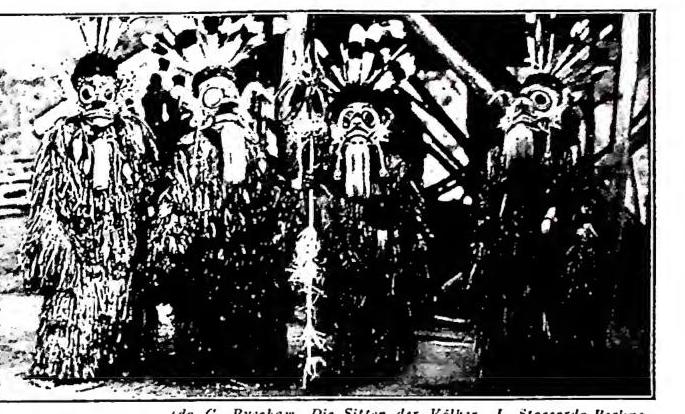
(after G. Burcham, Die Sitten der Völker, I, Stuttgart–Berlin–Leipzig, n.d., p. 156, fig. 283)
MAGIA — Group of magicians in ceremonial dress — Kenjah (Indonesia).
(Bologna 1582), which suggests suitable remedies “for the maleficial infirmities of demons and sorcerers.”
Lutheranism, with its belief in the power of the devil and his arts, likewise intensified the persecution of witches. Confessions of witchcraft were extorted through indescribable tortures that induced innocent victims to confess their nonexistent crime; there was also the test of the mark (sigillum diaboli), that is, the insertion of a long pin into some part of the body, most often the left shoulder. The victim’s lack of a painful reaction (in reality, the effect of insensitivity caused by the hysteria from which these unfortunate women were generally afflicted) provided an unequivocal verdict of witchcraft, followed by condemnation to the stake.
There were also solitary voices raised against this unlawful and inhuman procedure: J. Wier, De praestigiis daemonum et incantationibus ac veneficiis (1564), following the thought of his teacher, the astrologer Cornelio Agrippa di Nettesheim; R. Scott, Discovery of Witchcraft (1584); Eh. Thomasius, Theses de crimine magiae, though with little result, although in some countries the persecution of witches had been abolished: in Holland in 1610, in Geneva in 1632, in Sweden in 1649, and in England in 1682 (Rudwin).
The 16th and 17th centuries were the most terrible for the persecution of witches, especially in Germany (in the Slavic countries, the accusation of vampirism was more prevalent). But in Catholic countries too—Spain, France, Flanders—the witch-hunt raged; only Italy had a smaller number of trials.
In the present-day folklore of various countries, and in the customs associated with certain religious feasts—30 April in Germany (Walpurgis Night); 24 June (s. Giovanni Battista); 31 October (the eve of All Saints)—memories of the spirit world of the Middle Ages are still alive.
Nicola Turchi
III. MAGIC IN HOLY SCRIPTURE
In the Bible, magic is severely condemned. The magic of the Egyptians is emphasized (Ex. 7, 11 ff.; Wis. 17, 7) and that of the Babylonians (Is. 47, 12 f.; Dan. 1, 20; 2, 10-12), among whom it held great importance. With regard to the Hebrews, both the legislative and the prophetic texts are as emphatic as possible in condemning this degradation of religious feeling.
The legislation becomes even more precise in Deut. 18, 9-14, where the extermination is ordered of anyone who practices divination (Heb. qōsēm qēsāmīm), the prognosticator (mēōnēn), the augur (mōnahēl), the magician (mĕkhāšĕph), the soothsayer, and the necromancer. Such insistence documents not only the profound aversion of the Hebrew religion to magic, but also the necessity for such severity on account of the people’s natural inclination, since they were attracted by Egyptian, Canaanite, and Babylonian magical rites. This contrast is wonderfully documented by the well-known episode of Saul, who, after promulgating a severe law against such diviners, had recourse to a necromancer to evoke the spirit of Samuel (J. Sam. 27, 3 ff.).
The prophetic writings abound in reproaches against resorting to magic (cf. Os. 4, 12; Is. 2, 6; 3, 2 f.; 57, 3; Jer. 27, 9; Mal. 3, 5), and this aversion persists in the writings of the New Testament (Acts 8, 9; 13, 6.10; 19, 19). This demonstrates how deeply rooted the tendency toward magic was among the people; in the Hellenistic period it is also evident from the numerous Greek magical papyri, in which formulas containing more or less corrupted Hebrew terms frequently recur, and from the Solomon (v.), who was regarded as one of the most powerful magicians in history.
According to the evolutionists, in the history of religions the Hebrew people, too, originally practiced only magical rites and only later passed through the other imperfect forms of religion in order to attain the purest monotheism under the influence of the prophets. Among recent authors most explicit in affirming the magical substratum of the Hebrew religion are A. Lods, W. O. E. Oesterley, and Th. H. Robinson, who still follow, more or less, the system advocated by W. Frazer. Some, such as A. Lods, also regard the symbolic actions of the prophets as magical acts.
But it is impossible to find a biblical text that in any way approves the use of magic, which is systematically condemned. Rachele, who seeks a remedy for sterility in the mandrakes (Gen. 30, 14 ff.), does not intend to perform a magical rite (cf. J. Chaine, Le livre de la Genèse, Parigi 1949, p. 327 f.).
The simplicity and sobriety of the prophets’ symbolic actions make it impossible to discern magical rites in them, since such rites are usually directed by an extremely meticulous ceremonial and formula. Moreover, this interpretation conflicts with the idea of strict monotheism evident on every prophetic page, as well as with the frequent reproaches against superstition and magic. The various symbolic actions of Geremia and Ezechiele imply no extraordinary effect such as one would expect after a magical rite; rather, they intend only to impress upon the minds of the listeners the idea or prophecy, which was usually elucidated by a brief sermon or oracle.
F. Schmid, Die Zauberei und die Bibel, in Zeitschr. für kath. Theologie, 26 (1902), pp. 107-30; R. Jirku, Die Dämonen und ihre Abwehr im Alt. Test., Lipsia 1912; G. Beer, Welches war die älteste Religion Israels?, Giessen 1927; A. Lods, Israël, Des origines au milieu du VIIIe siècle, Parigi 1930; id., Les prophètes d'Israël et le début du judaïsme, there 1935; A. Guillaume, Prophecy and divination among the Hebrew and other Semites, Londra 1938, pp. 233-89; R. Criado, Tienen alguna eficacia real las acciones simbólicas de los profetas?, in Estudios bíblicos, 7 (1948), pp. 167-217; W. O. E. Oesterley-Th. H. Robinson, Hebrew religion. Its origin and development, Londra 1949, pp. 71-78.
Angelo Penna
IV. M. ACCORDING TO MORAL THEOLOGY. – In moral theology, m. is understood as the art of obtaining effects that are, or appear to be, superior to their natural causes, and therefore mysterious, or apparently so.
divination (v.) only in that, in the latter, the mysterious effect lies within the sphere of knowledge of hidden things, whereas in m. it lies within the sphere of producing unusual things. When m. harms one’s neighbour, it is more properly called malefice.
There are various forms of m. White m. consists in conjuring tricks. Natural m. is similar to it, except that it involves not tricks but serious and useful things. In both, however, the surprising effects are proportionate to their natural causes, which are generally also known to the person who employs them; yet, remaining unknown through illusion or ignorance, they arouse the wonder of the uninitiated. Morality has nothing specific to reproach in these ingenuous forms of m. Natural m. is morally connected with all those extremely varied practices in which—because of ignorance of the natural sciences—objectively insufficient means are employed, in the complete good faith even of those who use them, on the assumption that they possess the power to produce certain effects; for example, the therapy, practised even in uncivilized countries, of ritual bindings against certain diseases.
Black or diabolical m., or simply witchcraft, consists in an occult power that enables the magician to obtain effects superior to the efficacy of the means actually employed. He either has, or believes he has, this power permanently at his disposal, or only for the time and in the cases in which he practises m. It derives—or he certainly believes it derives—not from God, nor from known or unknown natural forces, but from the demon or, in any event, from a false god. It is precisely in this communication with the demon, whether real or, as more often happens, presumed, that the sinful element of m. lies. It is an evident injury to God. Indeed, it presupposes and fosters distrust in Divine Providence, as though it were insufficient for human needs; it establishes relations of friendship with God’s irreconcilable enemy; it exposes one to the danger of serious illusions and harm to supernatural and natural life; and, if it goes so far as to attribute to the demon the omnipotence proper to God, it constitutes the gravest form of superstition. Therefore, because of this communication with the demon, m. is always a sin.
This sin is also grave when the certainty—at least subjective—of such diabolical communication is based on the explicit invocation of the demon or even on a permanent pact with him. But sin is present also when, without explicitly invoking the demon, the magician, by the very practice of m., places his trust in him. For, by using means disproportionate to superior ends, he cannot expect them from the natural forces that he knows to be insufficient for this purpose; nor can he trust in God, whom he does not invoke and whom he knows he must not put to the test; therefore—whether he says so or not—by his manner of acting he places his trust in the demon as in a god. And this clearly offends the true God. The offence will be grave or less grave according to the degree of trust placed in diabolical power. Indeed, there will not even be the guilt of superstition when the magician acts while doubting whether the means he uses are naturally capable of producing the desired effects.
Through cooperation with the magician, the person who requests his services also sins by superstition, but only if, and to the extent that, he knows of the magician’s sin. Moreover, by exposing himself to the danger of harm, especially spiritual harm, he may also offend against the charity that each person owes to himself. – Vedi tav. CXXII.