
MANILIO. — In the manuscripts also Mallius, Manlius, with the praenomen M. and C., a Latin poet who lived at the end of the reign of Augustus. Nothing is known about him except the composition of a poem in five books, in hexameters, dedicated to Augustus, entitled Astronomicon, but in reality astrological in content (v. ASTROLOGIA).
Of the five books, the first, more properly astronomical, deals with the origins of the world, the geocentric cosmic system, the celestial spheres, etc.; the second describes the signs of the Zodiac: their form, instincts, associated deities, and mutual relations with other constellations; the third teaches how to cast a horoscope, that is, to observe which stars are on the horizon at the moment of birth, which is done by turning toward the East and determining the position of the sun and the planets, especially of the heavenly body that rises at the precise moment of birth: there are twelve fundamental influences to which the individual is subject, corresponding
to the number of the zodiacal signs; but the other stars associated with the zodiacal ones can also exert partial influences; the fourth describes the influences emanating from each heavenly body, both on individuals (temperament, aptitudes, profession, good or bad fortune) and on the earth (climate, race, civilization, seasons, tides, etc.); the fifth is devoted to the extra-zodiacal constellations that rise together with the sign of the Zodiac: for example, with the zodiacal sign of Leo, the constellation of the Dog rises, and whoever is born under it will be violent and quarrelsome.
The entire poem is profoundly pantheistic and strictly deterministic in inspiration. The fates govern the world according to immutable law, and the destiny of human beings is fixed from the moment of birth: «nascentes morimur, finisque ab origine pendet» (Astron., IV, 14-22).
According to M., therefore, it is better than a useless rebellion to steep oneself in astronomical knowledge, the only knowledge which, by teaching us to submit to cosmic law, will free us from the burden of destiny.
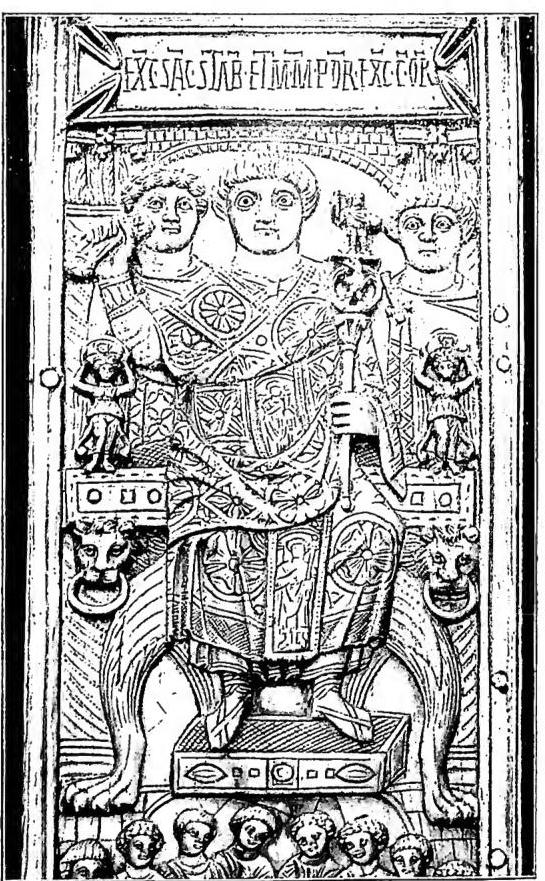
(phot. A. G.)
MANIPOLO – Ivory diptych depicting a consul holding the mappula (5th–6th centuries) – Paris, Cluny Museum.
its arts to dominate the course of fate: this explains the spread, during the imperial period, of mystical cults and theurgical practices.