
ZODIAC. — The name derives from the Greek (ζωδισκός κύκλος), the term by which Greek astronomers and astrologers designated that region of the celestial sphere in which the course of the sun, moon, and principal planets appears to take place.
It is divided into twelve signs, called ζώδε by the Greeks, each measuring 30° and each traversed by the sun in one month; corresponding to the signs, more or less exactly, are twelve groups of stars or constellations, namely Aries, Taurus, Gemini, Cancer, Leo, Virgo, Libra, Scorpio, Sagittarius, Capricorn, Aquarius, and Pisces; on the celestial sphere, the zone bounded by two circles parallel to the ecliptic, each 9° from it, one to the north and the other to the south, is 18° wide; the zodiacal band includes all the points in the sky at which the moon and the planets may appear.
The history of the z. is very ancient; its origins must certainly be traced back to a series of lunar stations or mansions, and go back to the Sumerians, since the oldest names of the twelve zodiacal constellations are Sumerian; the Babylonians subsequently developed and more precisely defined what they had received from the astronomical science of their predecessors in the valley of the two rivers. The celestial constellations are the product of Mesopotamian imagination, which believed that it saw, together with images of deities and sacred animals, in the stars of the celestial vault; they were venerated as divine beings and considered by astrologers particularly significant of future events. They therefore had great importance not only in the religion of the Sumerians, Babylonians, and Assyrians, and of those nations whose civilization depended closely upon them, but also in the astronomy and astrology of the Western peoples, especially the Greeks and Romans, and down to our own day, so that it may be stated that most of our zodiacal signs are still the same as those which the Sumerians and Babylonians had
traced in the sky. It is not certain that all the Sumerian names of the zodiacal constellations should be traced to the Sumerians themselves. The names nevertheless demonstrate that they arose as a consequence of Sumerian, Babylonian, and Assyrian religion, myths, and legends. Quite a few zodiacal constellations are represented by images of the gods or of the objects whose names they bear on boundary stones, kudurru, dating predominantly from the Middle Babylonian period; the preference given in such artistic representations in bas-relief to this or that divine figure was not, however, determined by astronomical or astrological reasons, but by religious ones. That is, those figures of deities were represented on the kudurru—including figures of zodiacal constellations—which, for reasons unknown to us, were considered especially suited to preserve the stone itself from harm and to inspire respect in any would-be evildoers; the kudurru therefore do not offer reproductions of the z. itself, but of a certain number of deities, among which certain zodiacal constellations were also included. In any case, it is found that the boundary stones contain images, according to some scholars, of approximately half of the constellations in question, namely Aries, Taurus, Gemini, Scorpio, Sagittarius, Capricorn, and Virgo (?), perhaps also Leo, though this is not certain, since the predominantly zodiacal figures of the kudurru in some cases differ considerably from those of the beings indicated by the names of the constellations in question; some image of a zodiacal constellation is found on tablets or seals.
The Sumerian names of the zodiacal signs are as follows: ARIES: mul-lü-ljun-ga = mercenary; TAURUS: mul-mul = constellation; GEMINI: mul-mai-tab-ba-gal-gal = great twins; CANCER: mul-al-lus = crab; LEO: mul-ur-a = lion; VIRGO: mul-ab-sin = ear of grain; LIBRA: mul-zi-ba-an-na = scales; SCORPIO: mul-gir-tab = scorpion; SAGITTARIUS: mul-PA.-BIL. SAG = Sagittarius; CAPRICORN: mul-sujur-mai = Capricorn; AQUARIUS: mul-gu-la = great constellation (?); PISCES: mul-KUN (mef) = tails. The word mul preceding these names has the meaning of constellation and is their determinative; that is, it demonstrates that the names are names of constellations.
The Babylonians saw various roads in the celestial sphere, which they called ḥarrānu = way, road, because they were traversed by the planets and constellations. They distinguished the roads of Anu, Enlil, and Ea, as well as those of Sin, the Moon, and Shammash, the sun. They called ḥarrān (d) Sin = the road of the Moon, the z., a band extending 10° on either side of the ecliptic. One tablet lists seventeen constellations, the overwhelming majority of them zodiacal, belonging to this road; they «stand in the road of the Moon, and through whose district the Moon passes and which it touches in the course of a month»; moreover, «the road of the Moon is traversed by the Sun and the five planets». This designation of the z. is explained by the circumstance that Sin was a very important god in the Babylonian pantheon. A step forward was taken when the z. was divided into twelve compartments, when the duodecimal z. was created. It is not known exactly how this z. came into being, which is still the z. of the present day. This solar z. certainly does not predate the first millennium B.C., but is the product of a later period. A tablet, dating no earlier than the fifth century B.C., names fifteen zodiacal constellations; at this period, it should have become customary to divide the z. into twelve equal parts and to transfer onto these parts the signs and names of the more or less corresponding constellations. One scholar has maintained that the intention was to establish a perfect correspondence between the solar year with its twelve parts and the z., which at that time was divided into only four parts; consequently, each of its four parts was divided into three parts of equal length, and it was precisely through this division that the zodiacal signs were created. The oldest Babylonian mention of the signs is found in a text from 420 B.C., in which, among other things, it is assumed, for example, that the planets Jupiter and Venus are in the front part of Gemini in the month of Nisānu, Mars in Leo, Saturn in Pisces, and Mercury sets in Taurus; the names of the signs were taken from the constellations they contain, so that the sign
Taurus could be designated by the Pleiades, by Taurus, or by the Hyades + Aldebaran; the Babylonian zodiacal signs were therefore absolutely equal in length; the Babylonians then divided each sign into 30°, and thus the entire circle was divided into 360°. According to an astronomical text, the equinoxes and solstices correspond to the midpoints of the signs Aries, Cancer, Libra, and Capricorn. It is very probable that the method of determining the nighttime by observing the six parts of the zodiacal circle that rise during the night should also be traced back to the Babylonians; they also observed and recorded the stars that rise and set simultaneously, as well as those that rise when others culminate, and it is known that the Greeks observed the stars parana-tellonta, that is, those that rise and set together with the rising zodiacal signs; it is probable that the Babylonians had already determined the times through this observation. The Babylonians called the zodiacal signs (kakkab)lumati, a name that originally designated the thirty-six principal constellations of the celestial sphere. A text from Uruk deals with these twelve signs, whose names are as follows in Babylonian:
ARIES: (kakkab) (amēlu) agru = constellation of the mercenary; TAURUS: (kakkab)sappu = constellation of the tuft of hair (?), the Pleiades; GEMINI: (kakkab)mašū = constellation of the twin; it also bears the name tu'amē = twins; CANCER: (kakkab) alluttu = constellation of the crab; LEO: (kakkab) nēšu = constellation of the lion; VIRGO: (kakkab)shēri = constellation of the ear of grain; LIBRA: (kakkab)zibantū = constellation of the balance; SCORPIO: (kakkab)agrabu = constellation of the scorpion; SAGITTARIUS: (kakkab)mašū suzi (?) = constellation of the archer; CAPRICORN: (kakkab)šūjūrumāšu = constellation of the Capricorn; AQUARIUS: (kakkab) GU.LA = constellation of the giant (?); PISCES: (kakkab)zibāti = constellation of the tails. These are, taken together, the twelve limbs or parts of the z. (kakkab)lu, through which the Moon and the Sun travel. Hence it was also said that “Venus and Mercury pass through the zodiacal constellations.” The Babylonian word lumati passed into Aramaic with the same meaning of constellation in general and of zodiacal constellation in particular, in the form malvašā. The Babylonian z. passed into the astrology and astronomy of all the Eastern nations and into those of the Greeks and Romans.
In Persia, in Zoroastrianism and Mazdaism, the signs have almost the same names. In Mazdean writings, the signs are the ahtar, the twelve captains who belong to the party of Oromasde, while the seven planets belong to the party of Akimane; the twelve are the creators and preservers of the world; all the good in this creation Oromasde transferred into the Sun, the Moon, and the twelve zodiacal signs, and these accepted it in order to distribute it according to right and equity. All the good that those constellations confer upon the creatures of Oromasde, the planets take away from them as far as possible. The signs are among the noblest stars. Their names denote the same objects or persons as those of the Greek z., except for the water vessel (Aquarius); the z. is divided into twenty-eight lunar mansions. In Pahlavi, the names of the signs sound as follows: ARIES: Varak = lamb, ram; TAURUS: Tōrā = bull; GEMINI: Dō-patkar = two fingers; CANCER: Kalakang = crab; LEO: Shēr = lion; VIRGO: Hušak = virgin; LIBRA: Turāzāk = balance; SCORPIO: Gazdūm = scorpion; SAGITTARIUS: Nīmāsp = half-horse, centaur; CAPRICORN: Vahik = goat; AQUARIUS: Dūl = water vessel; PISCES: Māšik = fish.
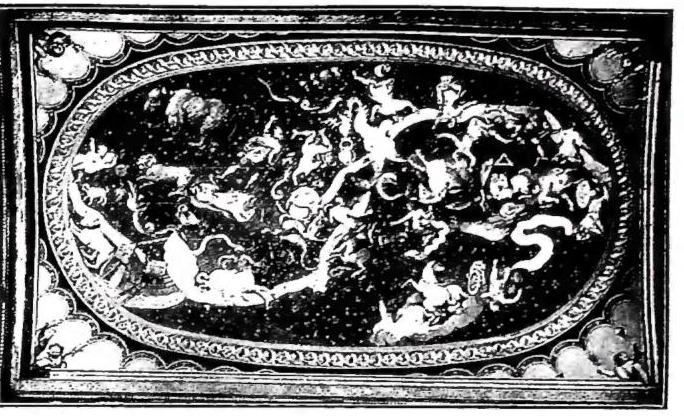
(photo Enc. Catt.)
ZODIACO - The signs of the zodiac painted on the vault of the so-called Bolognese Hall by Giovanni Antonio Vanosino da Verese (ca. 1575; cf. Pastor, IX, p. 921). Apostolic Palace of the Vatican.
Among the Mandaeans (v.) the zodiacal signs are no longer divinities, but demons, constantly intent on doing harm to human beings; this radical change in their nature must be ascribed to the fact that this religion is fundamentally monotheistic and therefore strongly opposed to Babylonian and Greek paganism, and consequently transformed the divinities of the planets and of the twelve signs into demonic beings. Their names in Mandaic are as follows: EMBRA = Ram; TAURA = Bull; SILMIA = Statue (Twins); SARTANA = Crab; ARIA = Lion; SUMBILTA = Ear of Grain (Virgin); QUANA = Scales; ARQRA = Scorpion; HITIA = Mare (Archer); GADIA = Goat (Capricorn); DAULA = Bucket (Aquarius); NUNA = Fish (Pisces). To each sign the Mandaeans assigned a certain number of years and the creation of evil beings or things—for example, to Scorpio, all the wicked reptiles that, with their venom, kill souls. The Twelve, in short, belong to that host of evil beings that continually wages war against Life and light, and which human beings must therefore hate above all, seeking to escape their snares.
The Babylonian zodiac passed into Greek astronomy and astrology and became an important part of it after the Greeks, in the time of Alexander the Great, came into intimate contact with Babylonian civilization; it always retained its character, on the one hand religious and on the other scientific, serving both astronomers and astrologers in their calculations and predictions, and it was also an object of worship, as it had already been among the Babylonians, in the astral religion of Hellenistic Greece and Rome, since this too had divinized the individual zodiacal constellations of Babylonia.
Egypt favorably received Eastern astrology as early as the Persian period, studied it and further developed it with fervor and in an original manner, directing its attention particularly to the zodiac; the Egyptians divided each sign into three equal parts of 10° and assigned the resulting thirty-six sections to a corresponding number of sidereal divinities. The images of the zodiac carved in stone found in Egypt attest to its extensive diffusion (the zodiacs of Denderah, Esneh, and Akhmim, and the frescoes of the tombs).
The Greeks and Romans gave the signs the following names: ARIES: Κριός, Aries; BULL: Ταῦρος, Taurus; TWINS: Διδύμιοι, Gemini; CRAB: Καρδίνος, Camcer; LION: Λέων, Leo; VIRGIN: Παρθένος, Virgo; SCALES: Ζυγός, Libra; SCORPION: Σκόρτιος, Scorpio; ARCHER: Τοξάτης, Sagittarius; CAPRICORN: Αἰγόκερως, Capricornus; AQUARIUS: Ὑδραχός, Aquarius; FISH: Ἰχθύος, Pisces. In the Hellenistic period the doctrines concerning the zodiac and its astrological significance also underwent great development in Rome; among other things, each month and each zodiacal sign was assigned to one of the twelve principal gods; in the same period the Eastern gods were replaced by the δώδεκα θεοί.
The zodiac also played a major role in the mysteries of Mithra; the zodiacal signs often surround the image of this god in the act of sacrificing the bull, or that of Kronos; or they are carved on the body of this lion-headed god, or painted or represented in mosaic on the walls of the temples, often grouped in threes, corresponding to the seasons to which they are assigned. Helios too is surrounded by the zodiac. Reflections of the worship of the twelve signs are found in the twelve garments that the person being initiated into the mysteries of Isis and Serapis successively donned, thereby passing through the twelve signs. Sometimes in representations the sphere of the signs encompasses and surrounds those of the seven planets: for according to the ancients the sphere of the fixed stars embraces the other seven spheres. The concept of the harmony of the spheres is certainly suggested by the image of Pan playing the horn, surrounded by a band bearing the zodiacal signs. In the zodiac, besides the Sun, the moon and the planets are also represented; all these heavenly bodies either have their stations there, or move through it, or combine their influences with its own. Since the treatment of illnesses was thought to depend on the position of the stars, it is not surprising that Asclepius, with or without Hygieia, is sometimes accompanied by the zodiac. Nike too is sometimes represented surrounded by the twelve signs; she is in fact Fortune, in close connection with these, who grants victory to human beings. Even hippodromes were constructed according to zodiacal conceptions: they had twelve starting gates for the chariots, which were the dwelling places of the zodiac that governs the earth, the sea, and the course of human life. Alon sometimes carries in his hand a celestial globe with the zodiac. Often this image signifies that the scene represented is to be situated in heaven; nevertheless, almost always our signs have a precise doctrinal significance; the zodiac may allude to the doctrine of sidereal immortality when the representation is funerary or concerns an apotheosis. The twelve labors of Hercules are also associated with the zodiac.
The zodiac also played an important part in magic. The success of magical operations was thought to depend on the position of the planets in the signs; the symbol of a particular sign was often drawn and invoked in order to carry out the magical spell successfully, and zodiacal representations were used for the same purpose, in which case they were amulets of assured efficacy. In Egyptian magic the thirty-six decans played a major role, since each of them was associated with a part of the human body. For magical purposes the twenty-four letters of the Greek alphabet were assigned to the twelve signs.
As time passed, the doctrine associated with the zodiac became so widespread that its figures were thought to be present in almost all manifestations of human life and became a very common decorative motif; dishes for serving food were even decorated with them, since each sign was associated with a dish that stood in some more or less mysterious relationship to it; and it is not surprising that architects adorned the walls of rooms with the zodiacal band and had it reproduced in floor mosaics.