
SUMERI. - The first people of the ancient Middle East for whom written documents have survived. They possessed a highly advanced culture, born in the temples, which left a decisive imprint on universal history. Their great power of influence endured for millennia in the language, theology, science, and myths of the peoples who succeeded them.
CONTENTS:
I. Origin
II. Language
III. History and archaeology
IV. Literature
V. Religion.I. ORIGIN
The name was coined by modern orientalists, based on Babylonian cuneiform texts, in which the formula (e.g., the prologue of the Code of Hammurabi) larru mât Šu-me-ri-i ü Ak-ka-di-i frequently appears. This, in turn, translates the Sumerian formula LUGAL KI-EN-GI KI-URI and means "king of Sumer and Akkad," two regions occupying the southern part of Mesopotamia. Sumer (KI-EN-GI) was the area around the mouths of the Euphrates and Tigris, then separate; Akkad lay further north between the two rivers. The Sumerians called themselves the "black-headed ones" (SAG-GIG-GA). The origin of the people remains obscure, with only hypotheses possible. In the most remote times, the gods were depicted as standing on mountain peaks; but geologically, the land (KALAM) belongs to the very recent alluvial terrain formed as the gulf receded and, among the lagoons, the marshes gradually consolidated. Therefore, it is generally believed that the oldest cultures were further north (at Jarmo, Hassuna, Samarra, Halaf), and settled in the south only from the period of Obed (= 'Ubaid) onward, unless an even older Eridu phase is admitted. Thus, the question of whether the Sumerians arrived by sea or land remains undecided.The race was determined through specific studies conducted by Keith on the skeletons from the tombs of Queen ŠUB-AD at Ur, that of Prince MEŠ-KALAM-DUG, and others. These studies show that this race was not very different from that of modern Arabs. Queen Šub-ad, who was probably under 40 years old, was 1.51 m tall, had a dolichocephalic head, and a brain volume of 1600 cm³ (250 cm³ more than the average European woman today); Prince Meš-kalam-dug measured 1.65-1.67 m, with an extraordinarily strong bone structure, a long head, narrow nose, and a brain volume of 1550 cm³; he had a long face and was left-handed. However, in sculptural representations, the Sumerians appear rather stocky, with a receding forehead and a very curved nose, fleshy, with good musculature, dressed in a fringed garment, probably made of skins; this type of costume persisted until the Third Dynasty of Ur (ca. 2050-1950 B.C.). The type of the Akkadians, for example, as seen in the stele of Narām-Sîn, is quite different. The Akkadian artist emphasized the somatic differences between the two peoples.
II. LANGUAGE
The language of the Sumerians is not connected to Indo-European, Semitic, or any other known language family. It belongs, for the most part, to the structural type of so-called agglutinative languages.Sumerian possesses nouns, verbs, pronouns, numerals, an enclitic conjunction, and various suffixes, by which case relations are also expressed:
| nominative | LUGAL | "the king" |
|---|---|---|
| genitive | LUGAL-A(K) | "of the king" |
| dative | LUGAL-RA | "to the king" |
| accusative | LUGAL | "the king" |
| comitative | LUGAL-DA | "with the king" |
| ablative | LUGAL-TA | "from the king" |
| terminative | LUGAL-ŠĒ | "toward the king" |
| loc.-term. | LUGAL-E | "near the king" |
| locative | E-A | "in the house" |
The plural is formed with two suffixes: -ENE for persons, HÁ for things; but often the singular has a collective value; a plural that includes all beings of a species is formed by duplicating the noun or adjective: LUGAL-ENE "the kings"; UDU-HÁ "the sheep"; KUN-KUR "(all) the (enemy) countries"; DINGIR-GAL-GAL-ENE "(all) the great gods." Masculine and feminine are expressed through heteronymy rather than grammatical forms: LUGAL "king"; NIN "queen," "princess"; A-A "father"; AMA "mother"; but DUMU "newborn" can be translated as "boy" (son) and "girl" (daughter). There is a clear distinction between the class of persons (gods, heroes, men, and animals, if, as in folk tales, they are personified) and the class of things (everything else). The adjective follows the noun. In the verb, a transitive form is distinguished, which includes the present-future "tense" and the preterite, from an intransitive form, in which there is no division by tense; there are active and passive voices, infinitive, participle, imperative, as well as forms expanded with the infix -ED-. Prefixes (of conjugation) and various preformatives modulate simple narration, the speaker's involvement, negation and emphatic affirmation, the precative and prospective. In the verb, the relationship with objects or preceding dimensional cases is summarized through infixes; every verb can also have a causative meaning. The large number of monosyllabic roots, especially in the verb, is striking.
The root is immutable, and all modifications of meaning are expressed with prefixes or suffixes. The syntax is complex: the pairing of words, the formation of "chains," the possibility of substantivizing any word, clause, phrase, or even entire periods with a simple suffix -A, give a special character to the Sumerian language.
Two stages of the Sumerian language are distinguished: Old Sumerian and Neo-Sumerian. Gudea, prince of Lagaš, stands at the boundary of these two periods. At least two dialects have emerged: the main dialect (EME-KU) and the so-called "women's language" (EME-SAL), used, for example, by goddesses in religious poetry. Sumerian phonetics remains a difficult field: the values of the Akkadian syllabary are known, but the texts belong to a late stage of the language, when neither the consonants closing the syllable (e.g., the g in ŠAG "heart") nor the final syllables were pronounced. Nasal consonants, such as n ("prefect" of a city is written ENŠĒ and E-SĒ) and g (GĀ and MA alternate), are attested.
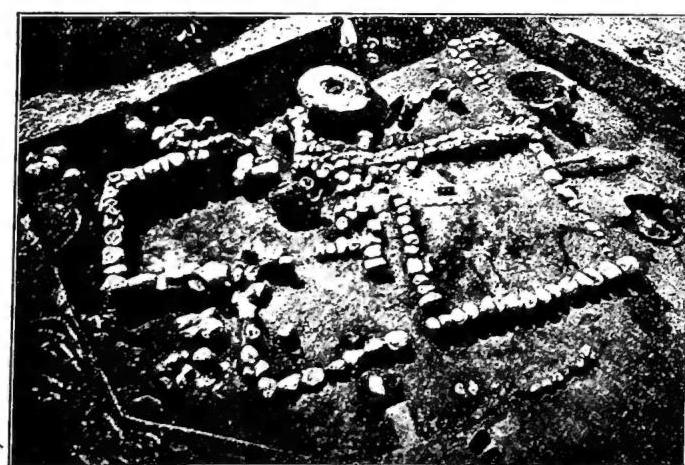
SUMERI - Foundations of a house in the village of Jarmo (perhaps the oldest in the world: ca. 4750 B.C.).
SUMERI - Impression seal, with symbols of the goddess Inanna and an image of the god Dumuzi (ca. 2000 B.C.) - Berlin.
III. HISTORY AND ARCHAEOLOGY
The history of the Sumerians (S.) is divided into three periods: 1) prehistoric; 2) protohistoric; 3) properly historical, distinguished by the invention of writing: only in the protohistoric period do written documents emerge, though still very scarce, while in the properly historical period they become sufficient.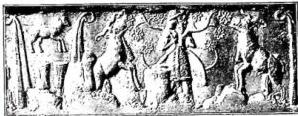
1. The prehistoric period
For Mesopotamian prehistory, we are at the initial attempts of a relative chronology. R. J. Braidwood (Illustrated London News, 15 Dec. 1951, p. 992) provides the following schema:| Barda Balka | tools of Acheulean type. |
|---|---|
| Hazer Merd | industry similar to Levallois-Mousterian. |
| Palegawra | industry similar to Gravettian. |
| Karim Shahir | microlithic industry, copper tools. |
| Jarmo | probably the first village in the world; microlithic industry; preceramic period (Albright: flourished ca. 4750 B.C.). |
| Hassuna | more developed villages; origin and first flourishing of pottery, including painted ware, with beautiful forms at Samarra, the apogee of that period. |
| Halaf (and Eridu) | even more evolved villages; splendid painted pottery, then the principal expression of human culture. |
| Obed ('Ubajd) | (west of Ur) invention of the potter’s wheel; black monochrome pottery; geometric motifs. |
| Warka (Uruk) | already protohistory. |
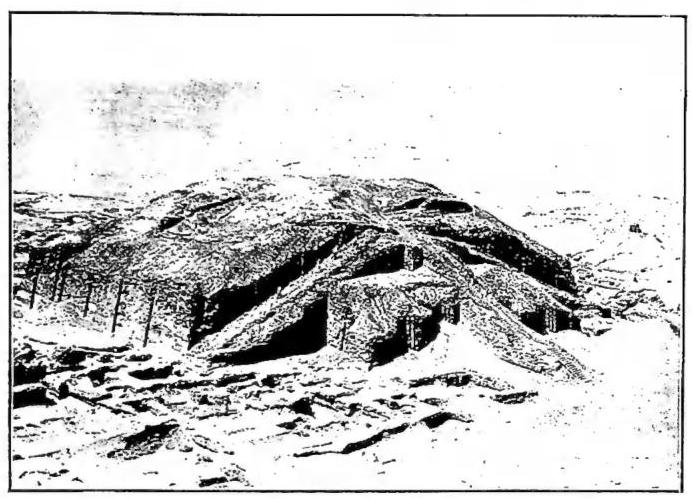
The Neolithic ends in the Hassuna period. The following periods (Samarra-Halaf) form the early Chalcolithic, those of Hāggī Muhammad and Obed I the middle Chalcolithic, and that of Obed II the late Chalcolithic. In the Warka period, the transition (around 3000 B.C.) to the Bronze Age, protohistoric, occurs. The development of architecture is noteworthy, from the village of the first farmers to true cities. Construction begins with rammed clay walls, then with small clay blocks; finally, in the Uruk period, the brick form is invented. Private houses were initially very small and of the simplest plan: alongside rectangular forms, round forms are also found, comparable to the Aegean toloi or the beehive-like houses still existing in the Aleppo region of Syria. Palaces and temples prefer a longer rectangular plan and display all types between the hearth-house and the courtyard-house. In the Uruk period, the first attempt at a zikurrat ("tower") is made: earth is piled up; the lateral slopes are later faced with bricks; at the top, the "high temple" is built. From the Hassuna period onward, pottery flourishes, first hand-modeled, then with a slow-turning potter’s wheel, and later (in the Uruk period) with a fast-turning wheel. The firing technique evolves from open-fire roasting to the use of a well-controlled kiln, which transforms fine clay into very hard pottery, a prerequisite for all high-quality colored ceramics. Decoration also evolves continuously: from simple scratched designs to inlay with especially fine clay, to perfect polishing and monochrome and polychrome painting, as in the splendid examples of the Halaf period, classic for all time. Plastic art is less developed: crude terracottas, especially of female figures ("mother goddesses"), and the eye idols of Tell Brak. Glyptic art knows the button-seal and the stamp-seal; the cylinder-seals of the Halaf period are debated.
Thus, the results of excavations present, for the later periods, the image of an agricultural people who, from the nomadic existence of hunters and herders, progressed to stability, though they still engaged in hunting and fishing alongside agriculture. From small agricultural centers (Jarmo), larger settlements developed, which by the end of the prehistoric period were surrounded by stone walls. In these villages, crafts flourished to the highest degree: primitive spindles, knives, awls, needles, axes, daggers, spearheads, hooks, furnishings of all kinds, clay and stone vessels were made; all this suggests a high standard of living. Dominating, monumental, is the temple, around which the houses cluster almost supplicantly. The temple is also important as a center of cultural and political life; it regulates the life of the people, whose hard work it lightens with the joyful festivals of a religion that venerates fertility. It organizes the struggle against water and for water, because agriculture is based on irrigation, and canal systems are already built, and the distribution of water is regulated.
2. The protohistoric period
It is marked by such a cultural surge that Mesopotamia takes the lead until the time of the Seleucids, so that only Egypt, from its unification onward, will have a civilization comparable to this. The period is represented by levels VI-IV of Uruk (Warka) and, later, by the Jemdet Nasr period; many also include the time of Mesilim, usually attributed to the properly historical period. The Uruk IV period is perhaps the most creative age of Sumerian history. Architecture continues and perfects the models already developed in prehistoric times; however, the zikurrat, the pride of all Mesopotamian religious buildings, now takes its monumental form, comparable to medieval cathedrals. Villages develop into true fortified cities. In place of the splendid Halaf pottery, glyptic art flourishes, better revealing the life of the people. The cylinder-seal is created, which persists until the final days of Mesopotamian culture and is characteristic of the entire Ancient Near East. These seals are small cylinders of clay, or more rarely of precious stones, and very rarely of copper, bronze, or gold, on whose surface the negative of a decoration is engraved, which can be the figure of a person, often with added cuneiform characters indicating mostly the owner. When the seal is rolled over damp clay, the "positive" of a band of figures is formed, which can also serve as a property mark on jars. Naturally, many more impressions than original seals have survived. What is surprising is the richness of the depictions. For the first time, a true "narration" of events is achieved through more extensive figures: man hunting, protecting livestock, fighting wild beasts; scenes of sacrifices in temples, celebrations and banquet scenes, solemn processions of the gods; fierce wars against city enemies led by the king, who was also high priest.Even more important is the other means of expression invented by man: writing. For the first time in
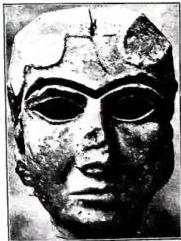
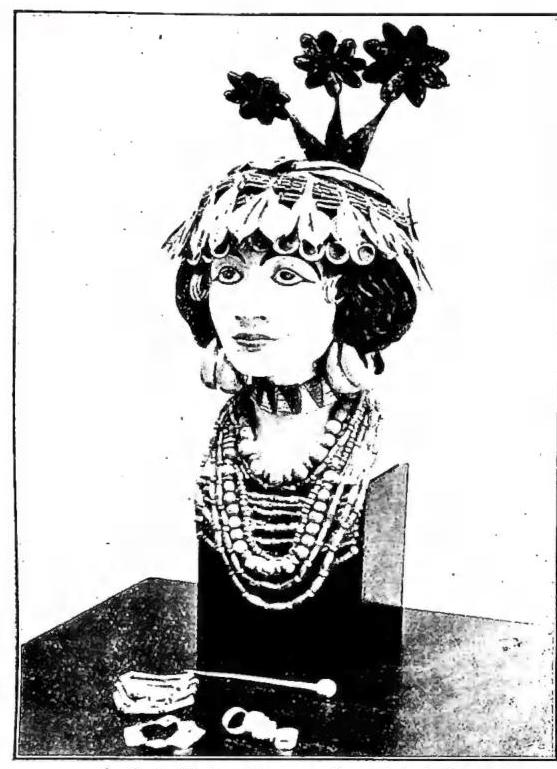
SUMERI - Head of a woman, Sculpture from the Gemdet-Nasr period (ca. 2800 B.C.).
(from C. L. Woolley, Ur excavations, II, Oxford 1931, pl. 111).
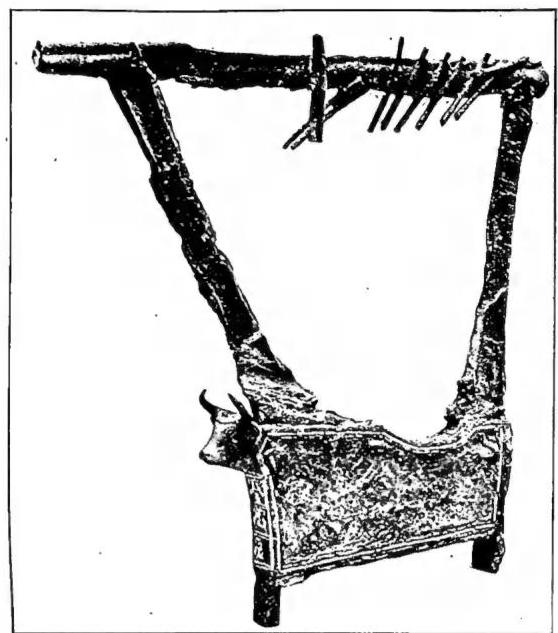
SUMERI - Silver lyre from the royal tombs of Ur
(c. 2500 B.C.).
conventional signs are used in the ruins of Uruk to convey a thought. From the very first examples, the Uruk script (ca. 1000 tablets of still "pictographic" cuneiform), though enigmatic, appears immediately definitive, perfectly suited to the purpose for which it was invented, without precursors. Writing is done on damp clay, a system that will remain in all periods of Mesopotamian culture. The clay is prepared in the form of small cushions, which the scribe holds in his left hand; with his right hand, he impresses the signs using a thin reed stylus, giving the script a three-dimensional character: when one wishes to draw on paper, signs composed of wedges are made, and thus the script is called "cuneiform." This primitive writing is already more than a simple pictography, which leaves the reader free to interpret by adding grammatical relations; rather, it is a logography, that is, a word-writing, because it precisely indicates the most important grammatical relations. It is highly suitable, also for its brevity, for so-called economic texts, that is, lists of objects, animals, workers with respective numbers or wages. It is insufficient, however, for the expression of abstract concepts; but for these, an expedient was soon found: some signs were used no longer according to the meaning of the logogram, but also for their phonetic value (e.g., GA "milk" for the syllable GA; A "water" for the syllable A, etc.), and thus all abstracts and all morphological forms were expressed. To these signs of things were added special signs for numbers, which presuppose a partly sexagesimal system for counting (series 1, 10, 60, 600, 3600) and a partly trigesimal system for measuring (series 1, 10, 100, 300, 3000).
The Gemdet Našr period, the second part of protohistoric time, continues the Uruk IV period. It is an age of expansion and irradiation of Sumerian culture. The name derives from the excavated site of Gemdet Našr, 84 km northeast of Kiš, where a new type of painted pottery was found. The neck and shoulders of the vase are divided into parts, comparable to Greek metopes, also adorned with figures; it is possible that this new manner of decoration is due to Iranian influences. Thus, the apogee of creativity and mastery of forms is reached. Temples and ziggurats become even more magnificent, surrounded by the sacred area of the KISAL, which is the temenos. Commercial relations develop, as shown by the jewelry and metals found. Among the rare statues, a female one from Uruk stands out, called "the beautiful woman of the Gemdet Našr period," which can be compared to the most perfect Greek statues.
At that time, even Elam (v. ELAM), or the "high land," comes under the influence of Sumerian culture. The "proto-Elamites" briefly develop a writing system (attested by the tablets of Susa and Tepe Sialk) that adapts the Sumerian one to their entirely different language. At the end of the Gemdet Našr period, for unknown reasons, a certain decline occurs: forms become more rudimentary.
3. The historical period. - a) The Mesilim period. - This phase, which many still include in protohistoric time, is named after the first known Mesopotamian name: on the pommel of a mace is written "Mesilim, king of Kiš" (or "of the totality," a title handed down to the Neo-Assyrian kings?); he is the first king to present himself with his name. A radical change occurs in art: everything becomes schematic, abstract, more like drawing than plastic art, often reduced to mere outline; but architecture presents the first marvel of cities: Uruk is surrounded by high walls pierced by gates, two of which have been excavated so far, with a perimeter of 9.5 km, topped by 900 towers. It is understandable that the construction of such walls was later attributed to the mythical hero Gilgameš.
b) The First Dynasty of Ur. - With the First Period of Ur, in addition to various archaeological finds and names, we have royal inscriptions. There is also another historical source, which, however, must be handled with care: the king lists, composed around 2000 B.C., which extend from the present back to the most remote times. In some sense, they may be compared with Gen 4-5. 11, because they attribute lengths of reign to antediluvian kings that exceed the ages of the biblical patriarchs; they are not very useful for the times preceding Ur I, and even afterward, they must be used with caution. They are comprehensive lists of kings, but without distinction between the more important and the irrelevant or subject dynasties; sometimes contemporary dynasties are placed sequentially; moreover, some kings may be omitted. Given these circumstances, modern historiography must sift and combine all elements from multiple sources, and must also seek synchronisms to obtain a probable relative and absolute chronology—a field that has been extremely debated in recent years. With some caution, a rather low chronology has been chosen here, as it seems more probable, though all controversies are not yet settled. Thus, alongside the First Dynasty of Ur, there was a dynasty of Lagaš, a much less important city, but about which we are better informed thanks to richer inscriptions. Here is the list of kings:
| Ur I | Lagaš |
|---|---|
| Urnanše | |
| Akurgal | |
| Mešannepadda | Eannatum |
| Aannepadda | Enannatum I |
| Entemena | |
| Enannatum II | |
| Enitarzi | |
| Enlitarzi | |
| Lugalanda | |
| Urukagina |
ca. 2350: Lugalzaggisi of Uruk, "emperor."
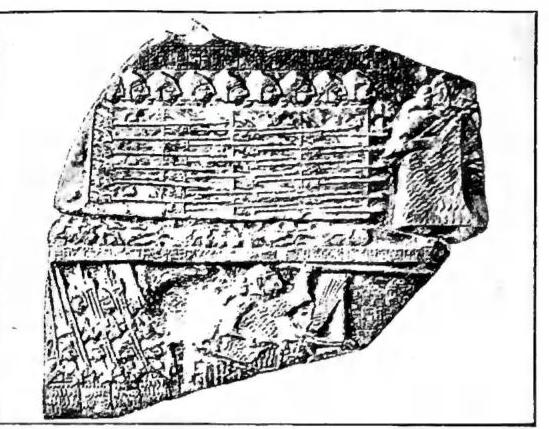
For Mešannepadda of Ur, we also know the name of his consort, Ninturnin, and of his successor, his son Aannepadda, who erected a temple in Obed. The tablets report that Urnanše, for his god Ningirsu, patron of Lagaš, built temples and canals, a wholly traditional act in Sumer. Of Eannatum, the famous "Stele of the Vultures" remains, a limestone slab divided horizontally, which depicts and narrates his battle against Umma, a neighboring city. Unfortunately, much of the slab is destroyed; what remains recounts the invasion by the people of Umma and tells how Eannatum fell upon them like a whirlwind and, with great victory, drove them from his land, by the power of Ningirsu, the warlike hero. But Eannatum also clashed in war with the kings of Elam, Uruk, Ur, and Kiš. After him reigned his brother Enannatum I, succeeded by Entemena, son of Eannatum, who defeated Umma; with his son Enannatum II, the dynasty founded by Urnanše came to an end. Enitarzi, Enlitarzi, and Lugalanda, priests under Entemena, succeeded. From those times remains a strange document of belief in an afterlife in the royal tombs of Ur. When the prince (then the lady Šub-ad) died, the entire retinue—servants and court ladies—accompanied him to the tomb, where it is thought they freely poisoned themselves, falling to the ground alongside the horses that pulled the funeral chariot, to keep the prince company in the realm of the dead. In Lagaš, however, things worsened. The state structure dissolved, and independent and selfish classes asserted themselves; a regime subservient to private interests arose, igniting a struggle for power and the exploitation of the weak. Urukagina successfully led a revolution, followed by social reforms—the first recorded in Asia—and restored "freedom," justice, and social peace, willed by the gods, to his beloved
(from C. L. Woolley, The Development of Sumerian Art, London 1535, fig. 59)
SUMERI - The Stele of the Vultures with the victory of Eannatum over Umma (ca. 2400 B.C.) - Paris, Louvre.
servants. Then the hereditary enemy rose again: Lugalzaggisi, son of Ukuš, enš of Umma, defeated Urukagina and attempted, through cruel methods, to establish a united Sumerian empire with Uruk as its capital; but the attempt failed.
The Semitic king of Akkad, Sargon, achieved what the Sumerians had not: he united the two southern parts of Mesopotamia. The Akkadians had long resided in the land, intermingled with the Sumerians, whom they surpassed in culture, and continually received reinforcements from the Semitic population of the Arabian Peninsula. Under Sargon, they rose to command all of Mesopotamia, exercising power forcefully after defeating numerous enemies; for about 150 years, they protected the land from barbarians, but ultimately succumbed to the foreign rule of the Guteans (ca. 2200 B.C.). The Semitic regime completely transformed Sumerian culture, even causing linguistic differences between Old Sumerian and Neo-Sumerian. Sumerian customs and military strategy, along with the language, were suppressed. The temple theocracy evolved into a state of officials controlled by the king, which eventually gave rise to the class-based state. The king began to append the determinative of "god" to his name, as in imperial Rome, receiving liturgical worship in temples, and temples were built for him, as they were for the ancient Sumerian gods. In the pantheon, the astral gods worshipped by the Akkadians were placed in the foreground, though a fusion with the ancient Sumerian gods was achieved.
d) The Third Dynasty of Ur (ca. 2050 or 2070 - ca. 1950 B.C.). - Rulers: Ur-Nammu (ca. 2050); Šulgi; Bur-Sin; Šu-Sin; Ibi-Sin. Toward the end of the Gutean rule, which was unproductive in terms of art, the Sumerian cities recovered. Utu-ḫegal of Uruk succeeded in expelling the Guteans and capturing and killing their last king, Tirigan. However, he failed in his attempt to centralize the empire of all Sumerian lands under himself: he was defeated by his vassal Ur-Nammu, a brilliant politician who knew how to reconcile Sumerians and Akkadians and was more favored by the Sumerian cities. Having defeated the enš Namḫani of Lagaš and that of Kiš, and traversing the entire land by force of arms, he founded the last and perhaps the most prosperous kingdom of Sumer, contemporaneous with the flourishing of Sumerian literature. Also significant in this period was Gudea of Lagaš, who, like Namḫani (killed by Ur-Nammu), had married a daughter of Ur-Bau, enš of Lagaš.
Whether all the "Neo-Sumerian" kings were truly Sumerian, given the names of the latter, is uncertain. However, they considered themselves Sumerian and sought, without alienating the Akkadian elements, to realize the ancient empire of Sumer and Akkad. The scene
(from C. L. Woolley, On excavations, Oxford 1931, rev. 1st)
SUMERI - Female ornaments found in the royal tombs of Ur
politics changes: Elam asserts itself increasingly, and from the west, from Amurru, the Amorites (v.) begins. When the Elamites destroyed the capital Ur, several cities, such as Isin and Larsa, competed for supremacy, until one of them formed the first kingdom of Babylon (v. HAMMURABI (HAMMURAPI)). Particularly valuable are the numerous and extensive inscriptions of Gudea of Lagaš, which demonstrate the Sumerian restoration. Kings, like Gudea, saw themselves as faithful shepherds of their peoples, vicars of the tutelary gods of the city; they were primarily builders of temples, cities, and canals. Literature flourished. Mythical poems received their final Sumerian redaction during this period and in the time of Isin and Larsa, before being reworked, with characteristic changes, by the Babylonians. Art also flourished, as seen in the numerous statues of Gudea; however, a certain Akkadian infiltration is noticeable, both in literature and in art.
In Lagaš, there was even a court of cassation, of which the archive of the DITILLA, that is, of concluded legal proceedings, remains. These DITILLA offer a glimpse into the social structure. The institution of slavery existed, but
slaves were treated more humanely than later among the Semites. If a slave sought liberation, the praesumptio iuris was in his favor, and he had the full right to sue. The "tablet" was the common means of legal proof, sealed with the seals of both parties and the scribes. Additionally, the oath (NAM-ERIM-DAM) and, naturally, witnesses had probative value. There were two forms of oath: the assertory oath already mentioned and the promissory oath, which was called MU-LUGALA ("name of the king") and which, it seems, was also the decisive element in marriage contracts. Marriages without parental consent were invalid. But if the groom had, with the consent of both parents, promised marriage under MU-LUGALA, a lawsuit could be brought for the unfulfilled marriage promise, and the groom could be "condemned" to marriage. Women and, within certain limits, slaves were also capable of legal actions. Divorce was permitted, especially when the "bride price" had not been paid. Furthermore, there are contracts of lease, proceedings for unpaid rents, compensation for damages in cases of naval accidents, divisions of inheritance among heirs, waivers; the whole has a modern aspect. At the end of these documents, the subscription of the MAŠKIM (the king's representative for control), the DIRUD (judges), and in cases of the utmost importance, also of the ENŠI (city prefect), is not lacking; finally, there is the date taken from a notable event of the previous year.
Celebrated in a moving lamentation, the destruction of Ur occurred around 1950 B.C. From that time, Sumerian receded as the language of the people. However, during the time of Isin and Larsa, many royal hymns were still composed in that language. Similar in this to Latin, Sumerian remained the language of priests and educated people. Even in the temples of the Kassites (14th century B.C.), poems were composed in Sumerian, but already by people who spoke Akkadian, so that those poems can even be dated by means of the grammatical errors they contain.
GIOVANNI RINALDI
IV. LITERATURE
The Sumerian tablets discovered number in the tens of thousands. The vast majority are economic texts. These are followed by historical inscriptions (several hundred), inventories of goods, and various classes of administrative documents. More valuable are the literary tablets, comparable to literary papyri in relation to other types of papyri; they reveal the poetry of Sumer and greatly illuminate its religion. However, from the several thousand such tablets, only a limited number of poems can be reconstructed; these are also difficult to interpret, as the tablets are fragmentary. Even if, with the most recent methods, grammatical difficulties can almost always be overcome, lexical challenges remain, as many words are unknown or do not fit into the context according to their known meaning. Furthermore, it is necessary to situate the poems within life, to guess at many circumstances well known to the poets and their audiences but now lost; yet even in this, significant progress is being made day by day.The following literary genres are distinguished: 1) myths; 2) epic songs; 3) hymns; 4) wisdom literature; 5) magical oracles or incantations.
3. Myths
Seventeen notable myths are now known, excluding overly fragmentary remains and those of very recent decipherment (cf. Orientalia, 22 [1953], pp. 190-93, tavv. 49-56), from which it appears that usable texts will increase day by day. It is useful to list the titles modern scholars have given to these myths (the ancient Sumerians cited them by their openings). Ten deal with the origins of the universe, the gods, humanity, and Sumerian culture. The term "myth" is used only for properly so-called myths and "etiological" or explanatory myths; "heroic" myths and the subcategory of "chivalric" myths fall under "epic" songs.a) Enlil and Ninlil or The Generation of Nanna, god of the moon, and of three underworld deities. b) The Journey of Nanna from His Father Enlil in Nippur, to obtain in Ur "abundance" in every sense: the water of the river, grain, grasses, reeds, trees, products of the steppe, honey, wine, and a long life. c) Enten and Emeš, or How Enlil Appointed Enten as the Bestower of Abundance, because Enten, unlike Emeš, was the "expert of living waters" (including animal breeding), thereby producing the greatest abundance in all livestock and plants; according to Falkenstein, Enten would personify the rainy season, winter. d) The creation of the hoe, an explanatory myth: in Nippur, there existed a hoe of gold and lapis lazuli, preserved in the temple Duranki ("bond of Heaven and Earth"); the myth recounts how Enlil determined the fate of that hoe, a useful and powerful invention, gave it to the "black-headed ones" (the Sumerians), along with the basket, to build temples, cities, and houses, to fight enemies, and to weed the fields. The gods give agricultural tools to the people, as if they were zealous even for land reclamation or "agricultural arrangements"; each god inspects diligently through his "black-headed ones" in his domain; humans must respond as good servants, carrying out even the hard labor of canals, fields, and constructions according to the respective decrees of the gods, who are a living force. Thus, the very height of Sumerian culture and its will to subdue the earth and make it fertile are due to Sumerian religion. e) Lahar and Ašnan, or The Dispute Between the God of Livestock and the Goddess of Grain, of great importance also for the creation of humanity. f) Enki and Ninšursag or The Creation of Medicinal Plants. g) Enki and Sumer or How Enki Creates and Organizes Sumer and All Its Living Environment. The poem is full of patriotism:
« O Sumer, great land! Among the lands of the universe, (you are) the one full of stable splendor, (you are) the people, from the rising of the sun to its setting, obedient to divine decrees! Your decrees are lofty decrees, unattainable, your heart is deep, its bottom unfathomable, your... is like the sky, which no man shall ever touch ».
Thus Enki "blesses" Sumer and Ur, its capital, "the standing ox," Melubba, the "black mountain" (perhaps the eastern coast of Africa, as far as Sumerian ships sailed), and blesses especially its parts, the Euphrates and the Tigris, which he fills with water, appointing Enbibulu as their prefect; he makes them teem with fish, appointing Dumu-Keš as their prefect; he gives law to the Sea (Persian Gulf), under the charge of the god Sirara; he calls the winds before him, making Iškur, god of the "curl of the inner sky," their lord; he wishes to make cultivated fields, directs the plow, the yoke, and the seeds toward them, and makes Enkimdu, god of canals and dikes, their master; he wishes to see them full of grain, and entrusts their care to Ašnan, the goddess of grain; but he also wants the region to be full of houses, villages, cities, and temples, as the "proper land of the gods," and therefore determines the decrees for the hoe and the shape of bricks, appointing Kabta, god of bricks, as their inspector; with the tool GUNGUN, the foundations of houses must be made, and thus they will be overseen by Mušdamma, Enlil’s great architect. Of the stables and sheepfolds, rich in milk and fat, the god-shepherd Dumuzi takes charge. h) Enki and Eridu or The Journey of the Water God from His Father Enlil in Nippur, to obtain decrees of blessing for the city of Eridu and the temple E-engur, the "house of the source" (or "of the sea"), of his recent construction. i) Inanna and Enki, or How the Goddess Inanna Transfers the Arts of Civilization from Eridu to Uruk, a myth of great interest for understanding what the Sumerians called culture. Inanna, goddess of love and war, visits her father Enki in Eridu and gets him drunk at banquets. Then Enki allows her to take more than a hundred ME ("models"), forces and competencies according to divine decrees, which constitute the entire civilization of the time, with its good and bad aspects. Sobering up, Enki sends his messenger Isimud to retrieve those ME for Eridu; Isimud stops the "heavenly boat" of Inanna at every intermediate port, but always yields to Ninšubur, Inanna’s messenger and protector. Among these ME are all the elements of the culture of the time, including social and religious hierarchy, the arts, crafts, personal and family events, and agricultural and artisanal activities. l) The creation of humanity (v. under religion). Two heroic myths follow: m) The Deeds of Ninurta, the warrior god, who defeats, with his marvelous weapon ŠARUR, the land of the mountains KUR and changes its name to HURSAG, subjecting it to a benevolent goddess. n) Inanna and Mount Ebih, or How the Warrior Inanna Destroys an Arrogant and Impious Land. Among the miscellaneous myths may be counted: o) The Descent of Inanna into the Underworld, from which she ascends, leading demons with her. p) Inanna and Šukallituda: the latter is punished for having disdained Inanna; q) Inanna Prefers Enkimdu to Dumuzi; r) The Marriage of Martu with the Daughter of Numušda, tutelary god of Ninab; Martu is the free man of the heroic steppe, his bride perhaps symbolizes the culture of Sumerian cities. s) The Flood and Ziusudra, the Sumerian Noah.
4. Epic Songs
Nine notable ones remain; they constitute the cycle of Lugalbanda, Enmerkar, and Gilgameš (son of Lugalbanda). However, they do not form a unified cycle, as in the Akkadian Gilgameš: a) Gilgameš, Enkidu, and the Underworld; b) Gilgameš and Agga of Kiš; c) Gilgameš and the Land of Life (monster Humbaba); d) Gilgameš and the Heavenly Bull; e) The Death of Gilgameš; f) Enmerkar and the Lord of Aratta; g) Enmerkar and Enzukuširanna; h) Lugalbanda and Enmerkar; i) Lugalbanda and Mount Hurrum.There is a stylistic difference between Akkadian epics and Sumerian ones. As Semites, the Akkadians are more active and favor dramatic scenes. The Sumerian, more contemplative, enumerates a succession of vivid images, and thus it is not parallelism that expresses the rhythm of his thought, but rather repetition with only slight variations. He also loves order and a solemn pace, as already seen in the simple grammatical proposition. Therefore, refrains and many hymnic elements are often found in the epics. The Sumerian cycle of Gilgameš, his father Lugalbanda, and Enmerkar is closer to the mythical and legendary than the Akkadian cycle.
5. Hymns
The most notable surviving hymns number around a hundred: they constitute the most extensive field of Sumerian literature, aside from the hymnic pericopes in mythical, epic, and even historical inscriptions (e.g., the cylinders A and B of Gudea, which are the greatest Sumerian works in existence). Some compositions do not exceed 50 lines, while others surpass 300. Short antiphons and more extended refrains belong to the poetic technique. Some display regular strophic structure, for example, in three verses. Important for the integration of hymns into life is the fact that rubrics for their liturgical action are not infrequently present. In other cases, the text often alludes to the actions of the singers of those hymns or to a scenic representation of the content. Classifications of them have even survived, as with the Hebrew Psalms, made by the Sumerians, especially according to musical instruments, and such indications can be drawn from the colophons written at the end of the tablets.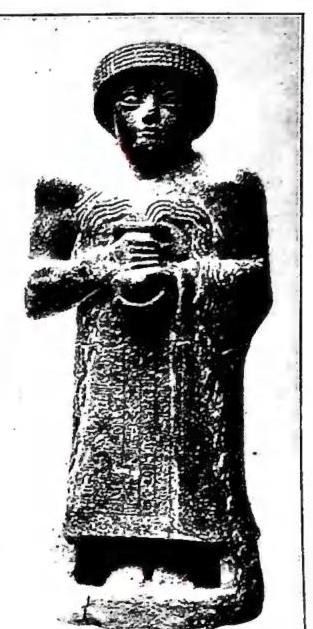
A somewhat altered form of these praises is the prayer proper. In myths and hymns, the Sumerian reflects upon and contemplates the wondrous works of the gods, inserting only brief prayers, e.g., imploring the god to look with a benign eye upon his city and bring it, like a flood, all the light of heaven and abundance, also born in heaven (UÈ-GAL). Most moving is the genre of lamentations, of which four are particularly notable: that of Ur destroyed; that of Nippur and Agade (Akkad); and finally, that which mourns the destruction of the entire land of Sumer. A highly effective element is that all the temples of Sumer are made to lament, for the gods have departed from them, and even the walls and bricks. Those temples also have a "living" function and meaning, protecting the "black-headed ones," striking fear from afar even into the monsters of the mountains and the underworld. On the other hand, they are the work of prayer and human magic: they continually implore the pure abundance of the gods, for example, in the most solemn rite of the hieros gamos, which seeks to compel the gods to pour forth that water of abundance and fertility. Another profound effect is produced by the songs and supplications of the goddesses before the gods assembled in council; but An and Enlil reject the intercession of the tutelary gods; they have a word that no one can ever change. And behold the cruel winds and infernal powers, along with political enemies, who massacre the people of the black-headed ones with clubs like gazelles, and behold the Heavenly Bull roaring from the sky. But though the people scatter and fly away like disturbed birds, though the cities are reduced to being inhabited by flint and no longer by men, all can end well: the tutelary gods regain the favor of An and Enlil, the ritual for the new foundations of the city is performed, and all concludes with a hymn of joy and praise to them, and also to An and Enlil, who have decreed reconstruction (the XI-BI-GI-A). To such lamentations are akin those for Tammuz, seized by demons in the underworld, and other laments of mother and tutelary goddesses.
6. Wisdom Literature
The last genre is wisdom literature, apart from magical texts and those of a more strictly didactic nature, such as the exhortation of the farmer-father to his son to teach him agriculture. Several types are found: the most elementary are proverbs and aphorisms, brief sayings that are profound and often of spiritual wisdom. Another genre consists of fables, in which personified animals or objects contend, such as the bird and the fish, the tree and the reed, the hoe and the cart, silver and bronze.This wisdom literature was partly due to the È-DUBBA (the "house of tablets"), that is, the school, which had been created to train the DUB-SAR, the tablet scribes. In this school, the ADDA-È-DUBBA, the "fathers of the house of tablets," i.e., the professors, also called UMMA, "experts," taught. For discipline, they had a SES-GAL, a "great brother," an assistant even entrusted with the rod. A very human story has survived, rich in simplicity and sincerity, of an unhappy schoolboy of those times. Awakened, he cries to his mother to give him two loaves, and sets off running to arrive on time at school. The young DUMU-È-DUBBA arrives a few minutes late, for which he is punished with blows from the rod. He fails to recite the "tablet" well, after which the action that Sumerian writing expresses with the sign of "stick" on "flesh" occurs again. Afterward, the schoolboy eats his loaves and begins to write a tablet; but as his legs ache, he stands up and leaves the room: this is followed by further punishments from the various overseers of the È-DUBBA. The tablet turns out poorly, hence more blows from the master. In the evening, he must learn other tablets and prepare their writing, always with the result of the rod. He returns home sad and recites to his father a tablet he has truly learned; the latter, full of joy, cannot refuse the boy's proposal to invite the master home to appease him. This is done: the master, poorly paid even then, receives the place of honor, a new garment, a ring, and a fine meal, and already declares that the poor pupil is full of wisdom, assures the father that he writes well, and that he is a capable devotee of the goddess Nisada, mistress of scribes. Perhaps this goliardic poetry should be taken somewhat comically.
RELIGION
The Sumerian religion, in its fundamental ideas, differs from the Akkadian, Canaanite, and Egyptian religions. Perhaps it can be understood by comparing it to the Baalic religion, known in the context of the Old Testament.
Abundance is the central idea in both religions; both are fertility religions, in both the fertilizing water holds primordial importance, and licentious festivals and sexual rites are not absent. However, there is a significant difference: the religion of Baal is the religion of capricious rain that comes and goes, and it involves the veneration of a principle of cosmic order; the religion of Sumer, on the other hand, considers fertilizing water according to a fixed and established order, an order embedded in the hierarchy of the community of gods, who create the "models" of all things, which on earth are forces and competencies. Water is an element full of wisdom, capable of everything, as when it is regulated by canals and enclosed within dikes; such regulated and beneficial water, whose origin is in the heavens, where among the first things the gods fixed its splendid destiny as fresh water, is clearly distinct from the primordial waters, which, like the sea, have disastrous effects. The Sumerians venerate in the gods the benevolent givers of abundance; their religion is thus far removed from a religion of revelation and divine spiritual charity.
The Sumerian cosmogony and theogony, as they appear in mythical, hymnic, and epic texts, first posit the primordial Ocean, personified in NAMMU, the generator of Heaven and Earth, still united as the Great Mountain above the waters. That is, she generates the god Heaven (AN) and the goddess Earth (KI), primordial deities. From the union of An and Ki is produced the god "Air," that is, ENLIL, who separates the two (cf. the Egyptian myth). But since the sky was of the blackest lapis lazuli, a kind of roof for the house of Enlil and also its walls, while the floor was Ki, there was no light in Enlil's house. To obtain it, he generated with Ninlil (consort of the same element) the moon-god Nanna, wanderer of the sky. He, with a counterpart, NINGAL (the "great lady"), generated a son brighter than himself, Utu, the sun-god. Meanwhile, in the earth, fresh water also formed, a beneficial element distinct from the primordial and marine waters, and whose god was Enki. From those four creator gods derives the entire pantheon: there are the Annunaki, companions of An, there are the stars, little brothers of Nanna and Utu, there are also infernal deities generated by Enlil. There is the great goddess Inanna, "Lady of the Heavens," daughter of Enki, and other terrestrial and cultural deities, as described above in the myths. Such deities are created in accordance with the order of the Universe, that is, by agreement and decision of the assembly of the gods, in which An and Enlil, but also other deities, fix the destinies of the model-things for becoming. However, the Sumerian pantheon is anything but primitive; it is the result of a long evolution. It can be affirmed that in the ancient Sumerian period, Enlil was the most active deity, but it seems that later Enki increasingly asserted himself.
The creation of man, servant of the gods—also not identical to the Akkadian one—is truly more solemn: the gods lack worthy houses, food of taste and culture, and clothing. Then, at the intervention of Nammu, mother of Enki, from the clay that is above the abyss, men are fashioned, born, it seems, also from Nammu and Ninmah, aided by all the goddess midwives. They also determine the destiny of man, servant of the gods. This is followed by a joyful banquet of the gods, during which, becoming somewhat exuberant, Ninmah and Enki form from that clay above the abyss six special types of men. The text is legible only regarding the last two types: the sterile woman, destined by Enki for sacred prostitution, and the man who is naturally a eunuch, destined by Enki to serve kings. Other myths about the origin of man describe him as growing like a plant in a sacred place or as produced by the hoe. The result is the idea of the life of the Sumerians: placed in a world of abundance, man must prepare, with his developing culture, the best for the gods, in whose hands he always remains; but they, benevolent and also subject to magic, fulfill all their duties. On life after death, all sources of Sumerian religion are silent; the tombs mentioned at Ur indicate a belief in another life.
The ideas of Sumer are always illuminating, and it is important to know the Sumerian thought on a given subject. This is especially true for the first chapters of Genesis, which have literary genre relations with the "cultural hymns" and to some extent with all the "cultural" literature of Sumer.
A. Pohl
rats et tour de Babel, ivi 1949; A. L. Perkins, The comparative archaeol. of Mesopot., Chicago 1948. Per lo storia sumerica: S. Moscati, op. cit. sopra: A. Scharff-A. Moortgat, Ägypten und Vorderasien im Altertum, Monaco 1950, pp. 205-84 (alle pp. 472-77 è notata la bibl. storica più importante); H. R. Hall, The ancient hist. of the Near East. From the earliest times to the battle of Salamis, Londra 1950. Per la letteratura sumerica la collez. più accessibile è Ancient near eastern texts relating to the Old Testament, ed. J. B. Pritchard, Princeton 1950 (pp. 37-59: miti ed epopee; 159-61: codice di Lipit-Istar; 217-19: documento legale, trad. di T. J. Meek; 265-69: testi storici, trad. di A. L. Oppenheim; 382-92: inni e preghiere; 455-63: lamentazione di Ur; 480-81: lettera di Ibi-Sin; 496: poesia d'amore rituale; questi testi sono tradotti da S. N. Kramer); A. Falkenstein-W. V. Soden, Sumerische u. ahhadische Hymnen, Zurigo 1953 (la migliore trad. di inni sumerici). Cf. inoltre: S. N. Kramer, Sumerian mythol., Filadelfia 1944; M. Witzel, Zu den Eumerbar-Dichtungen, in Orientalia, 18 (1948), pp. 265-84; M. Lambert-R. Tournay, Enki et Ninhursag, in Revue d'assyriol., 43 (1949), pp. 105-36; id., Poésie et art sumér., in Les cahiers d'art, 24 (1949), pp. 9-72; S. N. Kramer, Schooldays, in Tourn. of the Amer. orient. soc., 69 (1949), pp. 199-215; R. Jestin, Textes relig. sumér., in Rev. d'assyriol., 44 (1950), pp. 45-71; S. N. Kramer, Sumerian wisdom literature: a preliminary survey, in Bull. of the Am. Schools of orient. research, 122 (1951), pp. 28-31; id., Bref aperçu concernant les restes littér. sumériens, in Scientia, 86 (1951), pp. 99-109 (il migliore riassunto sull'argomento); A. Falkenstein, Zur Chronol. der sumer. Liter., in Compte-rendu de la Seconde rencontre assyr. internat., Parigi 1951, pp. 12-30; A. Falkenstein-W. von Soden, Sumer. und ahhad. Hymnen und Gebete, Zurigo 1953. Per la religione sumerica manca un'opera aggiornata, che faccia tesoro di tutte le fonti o abbia riguardo alla distinzione dei periodi. Per la religione preistorica: A. Moortgat, Entstehung der sum. Hochkultur, cit. Per i tempi storici: C. F. Jean, La religion sumér., Parigi 1931; L. Legrain, Les dieux de Sumer, in Rev. d'assyr., 25 (1935), pp. 117-24; G. Boson, La relig. sumero-accadica e babilonese-assira, Torino 1936; F. Schmidtke, Urgesch. der Welt im sumer. Mythus, in Bonner bibl. beiträge, 1 (1950), pp. 205-23; S. N. Kramer, Sumerian relig., in V. Ferm., Forgotten relig., Nuova York 1950, pp. 47-62; N. Schneider, Die Relig. der Sumerer und Ahhader, in Christus und die Relig. der Erde, II, Vienna 1951, pp. 383-440; G. Furlani, in Le relig. del mondo, 2ª ed., Roma 1951, pp. 206-209 (gli dèi). Cf. inoltre la massima parte della bibl. sulla cultura e religione della Babilonia e dell'Assiria; quella anche sulle regioni più periferiche, Susa (v.), Nuzu (v.); HURRITI (HURRI) (v.), che trasmiserà parte della cultura e religione sumerica persino agli Hitititi (v.). Fu notevole inoltre l'influsso dei S. sul medio Rufrate (v. MARI) e persino più ad ovest (v. UGARIT), benché, escludendo ogni pansumerismo, si debbano con grande diligenza rilevare le notevoli differenze.
Eugenio Bergmann - Pietro Nober