
GILGAMES, EPIC OF. — Alongside the Enūma eliš, the Babylonians and Assyrians had another national poem, whose central figure was G. (Gišbil-ga-meš), supposedly the most ancient king of the Lower-Babylonian city of Uruk (‘Erekh in the Old Testament), where he is said to have built the walls and the famous temple called Eanna, since it was the dwelling of the god Anu. It is highly probable that G. was in fact a historical royal figure. This poem existed in a Sumerian recension, of which a few fragments have survived, and in an Old Babylonian recension, certainly dating from the period of the first
The E. of G. is a hymn to friendship, to the cordial and profound comradeship that bound the king of Uruk to his most beloved friend Enkidu, heroic like himself and ever ready to fight and give his life for his companion, for his ibru talimu. Grafted onto this principal theme of the epic is another theme: man’s inability to obtain eternal life. This has been reserved by the gods for themselves, and it is therefore entirely useless for G. to seek to obtain it for his dear deceased friend Enkidu.
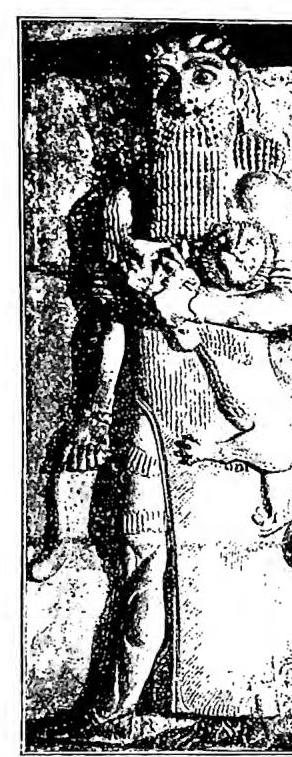
The poem’s opening words, Ša nagbu imuru, «he who saw everything», give the poem its Babylonian title. G., as king of Uruk, treats the inhabitants of the city as a tyrant, and they naturally complain and address their laments to the gods, who charge the goddess Aruru with forming a man, entirely like G., whose task will be to put an end to the King’s abuses. Aruru fashions Enkidu, hero of the steppe, completely covered with hair, who lives among the animals, exceedingly strong and wild. He destroys the hunters’ nets, and one of them, on the King’s advice, takes a prostitute with him and brings her to Enkidu in order to tame him. Indeed, sexual relations with the woman draw Enkidu away from his wild state and make him amenable to her designs. She turns him from a savage into almost a citizen and eventually leads him into the city. There he encounters G., after the King had been informed of his arrival in various dreams. Enkidu clashes with the King when the latter goes to lie with his own lover and succeeds in defeating him: from the enmity between the two there arises an indestructible friendship. They become inseparable companions and undertake a number of heroic exploits, among which the poem describes in detail the one against Humbaba on the cedar mountain, sacred to the goddess Ištar. The exploit ends with the killing of the guardian just mentioned. But this killing arouses the goddess’s anger, and she immediately thinks of taking revenge for the affront she has suffered, especially since, after G.’s return to Uruk, filled with admiration for the King’s heroism, she had offered herself to him as a lover but had been rudely rejected by him. To wash away the dishonor inflicted upon her, she turns to Anu, who sends against G. and his friend the celestial bull; the two, however, seize and kill II. Indeed, Enkidu takes one of its thighs and, climbing onto the city walls, throws it at the goddess. Even more enraged by this new affront, she unleashes a disease against the unfortunate hero, who dies, bitterly and for a long time mourned by his desolate companion and by the whole city. After burying him, G., inconsolable and as if mad, goes in search of Utnapištim, the hero of the universal Flood, who had been made immortal by the god Enlil. He finds him after a long journey and has him recount how he attained eternal life, in order to obtain it for Enkidu and also for himself. But Utnapištim cannot confer it upon him; he does, however, give him a plant of rejuvenation, which is subsequently taken from the hero by a serpent. Returning home, he summons Enkidu’s spirit from the underworld and has him describe the life led there by the dead. With this melancholy note the poem ends: man cannot be immortal.