
NINIVE. — Capital city of Assyria. The name of the city was initially Ninuwā, in the mid-second millennium Ninuwa, but alongside this also Ninua and Nina. Only the latter two remained in use.
The ruins of the ancient city are located northeast of Mossul, today 1.5 km from the Tigris, but at that time on the Tigris. The Choser (Ḥūṣur in Assyrian), a tributary of the Tigris, runs through the ruins. The fortifications of the ancient city form an irregular trapezoid, whose perimeter is more than 12 km. On the southern side of the walls are two mounds of ruins (= tells): Kujundjik (750 × 375 × 30 m) and Nebi Junus (somewhat smaller).
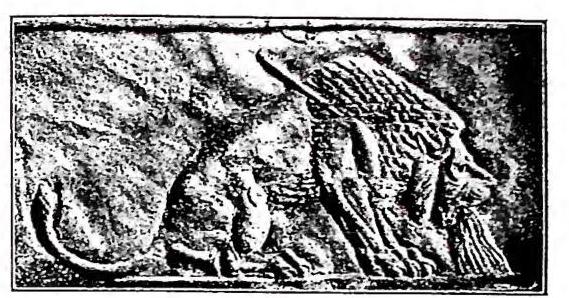
(from C. Bezold, N. und Babylon, Leipzig 1516, fig. 181)
NINIVE – Dying lion. Relief from the palace of King Assurbanipal.
Sennacherib (704–681), in which Assurbanipal
(668–626?) had also carried out restorations. He also excavated many sculp-
tures, reliefs, weapons, and, in two chambers, part of the cele-
brated cuneiform library of Assurbanipal.
From 1852 to 1854 Hormuzd Rassam discovered the “northern palace” of Assurbanipal with its splendid reliefs
of classical Assyrian art, and the other part of Assurbanipal’s
library with the archive of the Sargonids. In this
palace W. K. Loftus continued H. Rassam’s excavations
and brought beautiful reliefs to light. The later excavators
(G. Smith, H. Rassam, A. W. Budge, L. W. King,
R. Campbell Thompson) were chiefly interested in literary
matters, that is, in finding the remains of Assurbanipal’s library.
Thus many thousands of tablets passed to the British
Museum. Finally, between 1927 and 1932, deep excavations
were carried out, yielding unexpected results. The temple
of the goddess Ištar was found, as well as the temple of Nabū
(adjacent to the “northern palace” of Assurbanipal), a palace
of the ninth century (probably belonging to Sennacherib)
with many historical inscriptions, and a bronze mask dedicated
by King Manistusu (ca. 2300 B.C.): it is probably the portrait
of his father Sargon I (twenty-fourth century B.C.). The nearby tell
Nebi Junus has not yet been touched, since the funerary mosque
of the prophet Jonah and a village with its cemetery stand
above II. Only from certain underground galleries
is the existence of the palaces of Adadnirari III, Senna-
cherib, and Assarhaddon known. Various prehistoric cultures
succeeded one another at N.: at a depth of 27.50 m: virgin soil;
27.50–26.00 m: N. I: incised pottery (ca.
3800 B.C.); 26.00–21.30 m: N. II: exceptionally fine painted
pottery with geometric designs in black and red on a yellow
ground (ca. 3500 B.C.); 21.30–20.10 m: intermediate layer without
culture; 20.10–12.80 m: N. III: handmade, polished pottery,
reed huts, the first signs of metal, seal impressions;
12.80–7.90 m: N. IV: wheel-made pottery
of the Uruk type (ca. 3100 B.C.); 9.90–5.50 m: N. V:
pottery with geometric and animal motifs in black
and red, impressions of finely engraved cylinder seals (ca.
2600 B.C.); 5.50–1.20 m: Assyrian period.
When Sargon I of Akkad (ca. 2350–2300) destroyed
Sumerian hegemony and created an empire extending
from Western Asia to Anatolia, the city of N. also
belonged to his kingdom. The first information we possess is that
his son Manistusu built a chapel in the temple of the goddess Ištar
of N. Several centuries later Samsi-Adad I
of Assyria (second half of the eighteenth century B.C.),
a contemporary of Hammurabi, rebuilt the temple
of the goddess. Hammurabi himself says in the prologue
of his stele (IV: 60–63): “the king who in the city of N.,
in the temple of Emesmes, caused the waters of the goddess Ištar
to appear.” Of this temple
(23.8 × 7.6 m.), built of mud bricks upon a
stone foundation, the walls still survive to a height of 3 m.
Under the Mitannian (Hurrian) kingdom, King
Tušratta (ca. 1400–1370) writes to Pharaoh Amenophis III
(1413–1377) of Egypt that the goddess Ištar of N. had declared
herself willing to depart for Egypt, as she had already done
in the time of his father (Suttarna II): let the Pharaoh hold
her in the highest honor and send her back in due time.
After Assyria was liberated from Hurrite domination
under Assur-uballi I (1563–1328), the temple of the goddess
Ištar of N., with its ziggurat (= “tower”), became the
Dopo cominciò l'era aurea per la città diventata capitale del Regno. Sennacherib (704-681) chiamò il suo palazzo (198 x 192 m.) magnificamente ornato «il palazzo senza pari». Circondò la città con una doppia cintura di fortificazioni, con 15 porte ed alte torri di difesa. Nella città costruì strade. Con un nuovo grandioso sistema raccolse le acque di ben 18 fonti dalla montagna del Gebel Mağlub e le portò in città. Così giardini e piantagioni ricchissime sorsero intorno ad essa. L'opera più splendida la crearono gli architetti di Assurbanipal (668-626?) nel «palazzo settentrionale» con i capolavori di scultura assira (specialmente di caccia del re stesso). Assurbanipal inoltre restaurò il santuario della dea Ištar e del dio Nabû e rese le fortificazioni ancor più potenti. Pochi decenni dopo (612 a. C.) la grande città assediata dall'esercito dei Babilonesi e Medi fu ridotta in «un colle di ruderi e di rovine», tanto che neanche Senofonte (ca. l'anno 400) si accorse di trovarsi sul luogo dell'antica capitale dell'Impero assiro.
Nella Bibbia la città è nominata in Gen. 10, 11-12 (Nimrod) e nel libro del profeta Giona (1-3). Il profeta Nahum descrive la ricchezza, la potenza ed il commercio di N. (2,9 sgg.; 3, 16 sg.) e predice la sua fine (3, 1-7), come pure il profeta Sofonia (2, 13).
at Nineveh, in Archaeologia, 79 (1929), pp. 108-48; id., The Site of the Palace of Ashurnasirpal at Nineveh, excavated 1929-30, in Annals of Archaeology and Anthropology (Liverpool), 18 (1931), pp. 79-112; R. Campbell Thompson, The Prisms of Esarhaddon and of Ashurbanipal found at Nineveh 1927-28, Londra 1931; id., The Buildings on Quyunjia, in Iraq, 1 (1934), pp. 95-104; R. Campbell Thompson-R.-W. Hamilton, The British Museum Excavations on the Temple of Ishtar at Nineveh, 1930-31, in Annals of Archaeology and Anthropology, 19 (1932), pp. 55-116; E. Campbell Thompson-M. E. L. Mallowan, The British Excavations at Nineveh 1931-32, ibid., 20 (1933), p. 71 sgg.; M. E. L. Mallowan, The Bronze Head of the Abbadian Period from Nineveh, ibid., 3 (1936), pp. 104-10; C. J. Gadd, The Stones of Assyria, Londra 1936; V. Christian, Altertumshunde des Zweistromlandes, Lipsia 1940; A. Parrot, Archéologie mésopotamienne. Les étapes, Parigi 1946. Alfredo Pohl