
MITANNI. – State in Upper Mesopotamia between approximately 1500 and 1365 B.C. which, especially under its king Saušatar (ca. 1450), dominated Nuzu (v.) east of the Tigris, as well as Assyria, extending westward to the kingdom of Alalah (Tell el-‘Aṭāneh) near the Orontes, and probably as far as the Mediterranean. Its capital was Waššukkani, which was probably situated in the upper region of the Ḥabur River.
Tresor dòn felibrige (1878–86), indispensable for knowledge of the linguistic material of modern Provence.
The name M. is first and foremost political in character. Other names are synonymous with it: Hanigalbat, which is older, is rather of geographical origin; Naharin, also a name of geographical origin and explainable as an originally dual form (but cf. Revue biblique, 57 [1950], p. 448): it was used by the Egyptians (naharin) and by the western Semites (naḥrima of el-‘Amārnah, nahḍrajim of the Bible); Hurri, a much-discussed name in the formula “king of Hurri,” as though it were meant to indicate a kingdom distinct from M.: but it is more probable, as E. Meyer already believed (Geschichte des Altertums, II, 1, Stuttgart–Berlin 1928, p. 372), that, being of ethnic origin, it was used when the people of M. wished to distinguish themselves from foreigners. The use of these names varied according to circumstances.
Various cuneiform documents make known the following kings of M., with the approximate dates of the contemporary pharaohs:
Egypt (18th Dynasty)
Tuthmosis I ca. 1525
Ḥatšepsut 1490
Tuthmosis III 1469–1435
Amenophis II 1435–1414
Tuthmosis IV ca. 1414–1406
Amenophis III ca. 1406–1370
Amenophis IV ca. 1370–Suttarna III
The social and ethnic structure of M. is now fairly well known. M. was a semi-feudal state, as is clearly shown by the title marjannu, which designated the social rank of the nobles, who served in wartime mounted on chariots, and by the adoption contracts of Nuzu, which were formulated to conceal the sale of land held by the State. Then, although ethnically composed of many peoples, M. was above all a mixture of
(courtesy of Massimo Pellice)
MISURATA, APOSTOLIC PREFECTURE OF – Cathedral.
(phot. Museo di Roma)
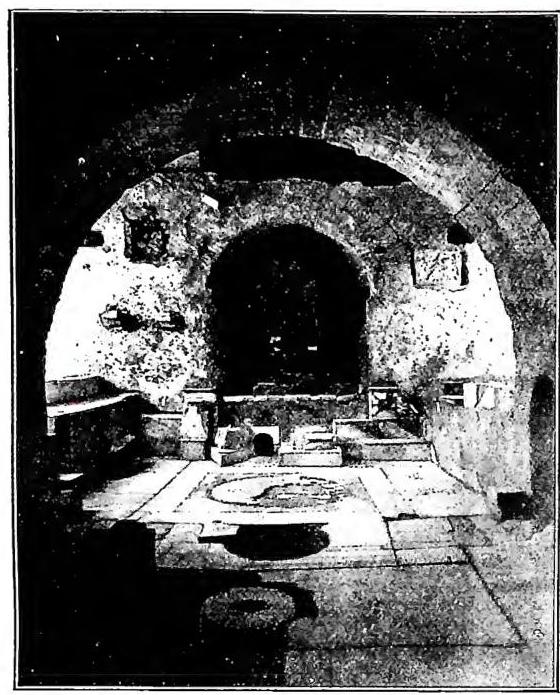
MITHRA AND MITHRAISM – Mithraeum in Via de' Cerchi – Rome.
HURRITI (HURRI) (v.) and Indo-Aryans. The Hurrites, widely dispersed, were related to the Horites of the Bible, and their language, neither Semitic nor Indo-European, apparently was precisely the one used in the kingdom of M. The Indo-Aryans, although a minority, as is shown by the onomastics, nevertheless formed the ruling class: thus the names of the kings of M. mentioned above, as well as those of other leaders in the kingdom, are Indo-Aryan in character. The predominance of the Indo-Aryans is perhaps explained by their greater skill in the use of the horse and the means of warfare.
I MITHRA and MITHRAISM. -
I. MITHRA
He is an Indo-Iranian deity, invoked as the protector of contracts, according to the meaning of his name. In the Vedic years, he is associated with Varuna, god of the sky, and in the Avesta he is found as the companion of Ahura Mazda, of whom he is the eye. Mithra is a god of light, who bestows fertility upon the world and aids his followers in the struggle against the principle of evil.After the conquest of Babylonia, astronomical and astrological theories, along with speculations about the planets and the zodiac, penetrated Mithraism, and Mithra, from a god of light, became a solar god and was identified with Samaš.
II. DOCTRINE
Archaeological monuments are the most important sources for reconstructing the doctrine, as written sources are lacking. At the head of the Mithraic divine hierarchy stands Zervan-Akarana (Infinite Time), depicted with a human body coiled in the folds of a serpent, winged, and with a lion’s head. The serpent’s coils sometimes bear the signs of the zodiac; in its hand, it holds a scepter, or keys, or lightning. This leontocephaline monster is identified with Cronos-Saturn and with Destiny (Heimarmene). Zervan’s successor is Jupiter (Ahura Mazda), from whose union with Juno the other deities are born. Opposed to his kingdom of light is the dark realm of evil, ruled by Ahriman and his treacherous demons. Between Ahura Mazda and Ahriman stands Mithra (Plutarch, De Is. et Osir., 45-47; cf. Pletho, Oracula magica Zoroastris, in C. Alexandre, Traité des lois, Paris 1858, p. 279 ff.). In the struggle between the two principles, the god will emerge victorious and save humanity.III. LEGEND
Mithraic bas-reliefs depict the story of Mithra, whose main outlines can be reconstructed as follows. Mithra is born from stone and covers himself with the leaves of a tree. A flood follows, then a drought, but Mithra saves mankind by causing water to spring from a rock. He goes, obeying an order, to hunt a bull, which first eludes him but is then captured and dragged by its legs into a cave (transitus), where Mithra slaughters it with a knife (tauroctony). From the bull’s blood wheat ears sprout, and from its seed plants and animals arise, a creation vainly hindered by the scorpion’s bite. A pact between Mithra and the Sun follows; the two sit together at a banquet, then ascend together in the solar chariot toward heaven.IV. THE MYSTERY
The Mithraic initiation was secret and preceded by an oath not to reveal the rite’s secret. The frescoes of the sanctuary at Capua (A. Minto, in Not. Scavi, 1924, p. 523) depict the initiate with blindfolded eyes and wrists bound by cords, which the mystagogue cuts with a sword, acting as a "liberator" (Pseudo-Augustine, Quaest. Vet. et Novi Test.: PL 34, 2214).Once admitted as a confrere of the Mithraic community, the initiate could ascend the seven degrees of the hierarchy: raven (corax), bridegroom (nymphus), soldier (miles), lion (leo), Persian (perses), Sun-runner (heliodromus), father (pater). The various Mithraic degrees in hierarchical order are
(from Kurt Weitzmann, Byzantine Art and Scholarship in America, LI, 1917, rev. 103 A)
MITHRA AND MITHRAISM
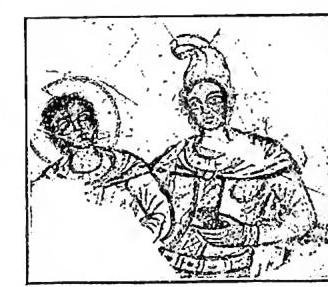
The sun and Mithra. Fresco from the 3rd century from the Mithraeum of Dura Europos – Yale, University Art Gallery.
Listed by St. Jerome in his letter to Laeta (Ep. 107, 2 in CSEL, 55, 292). In the Mithraeum discovered beneath the basilica of S. Prisca in Rome, the initiates clad in these ranks are depicted under the protection of a planet (A. Ferrua, Il mitreo sotto la chiesa di S. Prisca, in Bull. della commiss. archeol. comunale, 68 [1940], pp. 59-66). Some of them belong to the category of servants (ὑπερησόντες), others to that of participants (μετέχοντες). In the graffiti of Dura Europos, preparatory ranks are also mentioned. The head of the Mithraic sanctuary is called poter patrum.