
PLUTARCO di CHERONEA. – Greek philosopher and historiographer, born at Cheronea (Boeotia) between 46 and 50 A.D. He studied philosophy and mathematics in Athens. He spent a long period in Rome. Having returned permanently to Cheronea after 96, he became archon of the town and Delphic priest. He died between 120 and 127. Extremely learned and versatile, he is among the most prolific of ancient writers: some eighty miscellaneous works remain under his name, generically called Ἰθωᾶ (Moralia), some of them spurious or doubtful, as well as 50 biographies of illustrious men. His many other works have been lost.
Among the Moralia, the De animae procreatione in Timaco and the Quaestiones platonicae discuss difficult points of Platonism; the De stoicorum repugnantiis, the De communibus notitiis, and the De paradoxis stoicorum polemicize against the Stoa; the Adversus Coloten, the Non posse suaviter vivi secundum Epicurum, and the De latenter vivendo combat Epicureanism. Works of religious or religious-philosophical subject matter include the dialogue De sero numinis vindicta (the delay or apparent absence of earthly punishment for certain guilty persons does not conflict with Providence), the dialogues De Ei Delphico, De defectu oraculorum, and De Pythiae oraculis (which speculate on matters connected with the Pythian χρηστήριον), and the De Iside et Osiride, which illustrates the Egyptian myth and perceives in it an allegory of the cosmic dualism between Good and Evil. The De Iside (as also the De defectu oraculorum) likewise contains the conception of demons, who reappear in the
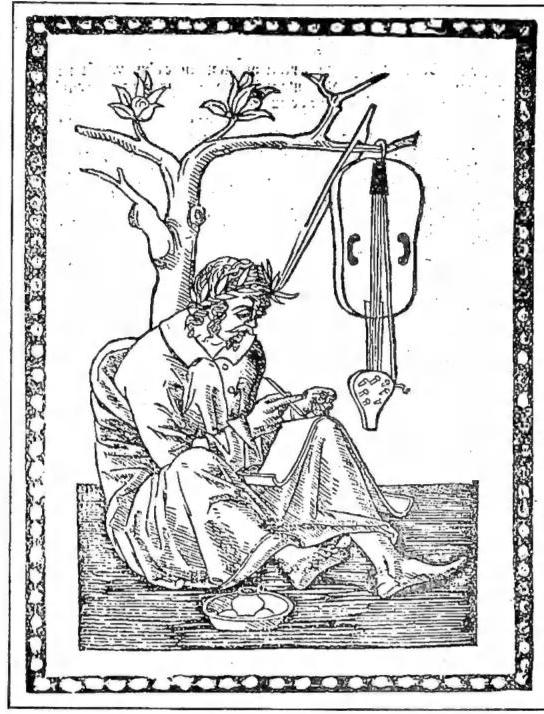
PLUTARCO di CHERONEA – P. writes seated beneath a tree from which a musical instrument is hanging. Woodcut from the Plutarchiae biographiae epithome, Ferrara 1501 – Copy in the Vatican Library.
dialogue De genio Socratis and in the final myth of the De facie in orbe Lunae, a predominantly astronomical booklet. Besides the De facie, other short works attest to P.’s views concerning the natural sciences.
More popular are the properly ethical writings, concerned with that part of philosophy which P. preferred. The De virtute morali advocates Academic-Peripatetic metriopathy; the De profecibus in virtute studies the psychological signs of moral progress; the De exhibendo ira, the De garrulitate, and other short works reveal the symptoms and remedies of the diseases and vices of the soul. Family virtues are treated in the De fraterno amore and the Coniugalia praecepta, friendship in the De adulatore et amico and the De amicorum multitudine (matched in subtlety by the De inimicorum utilitate). The De tranquillitate animi has a more general content (virtue and mastery over the passions bring inner peace), and should be associated with the consolatory writings addressed to a wife, ad uxorem, and to an exile (De exilio). The pedagogical short works De audiendis poétis (on the way in which young people should listen to and understand poetry) and the De audiendo, on how to listen to lessons and speeches, also belong to ethics (the superficial booklet De educatione puerorum appears to be spurious); and the substance of the political treatises (Praecepta gerendae reipublicae, etc.) is ethical, expressing a lofty sense of public life.
P.’s thought is essentially Platonic: he himself calls the Academy ἑστία πατρῶν (De ser. num. vind., 4). But this is an eclectic Platonism, in keeping with the times, with a pronounced Pythagorean coloring (speculations on numbers, demonology), with Aristotelian influences (especially in ethics), and not without a slight neo-Academic strain (v. GRECIA). P. Stoicism (v.) (opposing its pantheism, fatalism, and ethical rigorism); yet he draws many ideas from Middle Stoicism (and particularly from Posidonius). Extremely hostile to the Epicureans, he upholds Providence soul (v.). He admits a supreme and perfect God, definable as true Being (whereas mutable things do not possess full subsistence), transcendent and exalted far above man; and at the same time he admits eternal matter, as well as a universal Soul preexisting, like matter, to the cosmogony, and originally irrational and evil, indeed the principle of evil (whereas matter is neutral in itself). Through the cosmogonic action (which P. conceives as temporal), God, the principle of good, ordered matter by infusing reason into the primitive ψυχή; but the irrational element nevertheless remains within the Soul itself; and thus a ἀρχή κακῶς continues to exist in the universe in evident contrast with God (De an. procr. in Timaro; De Iside et Os.). In this dualism (of Zoroastrian character), P. parts from most Platonists because he refuses to identify evil with matter and makes it a principle in its own right; and he shows originality in reconnecting his Orientalizing conception with Plato himself, with the ἀνακτὲς ψυχή of the Laws (Plato, Leg., 986 E, 898 C), with the Ἀνακτὲς of the Timaeus and the Republic, and with the μεριστὴ οὐσία of the Timaeus (cf. Tim., 35 A). Besides the supreme God, he also admits (despite his profound monotheistic tendency) lesser gods and demons mediating between the Divinity and human beings (including evil demons); and he adheres to the religion of his country, allegorizing the myths and identifying Eastern deities with Hellenic gods (he did not know Christianity). As for man, he professes Platonic spiritualism; but he distinguishes the νῦνς from the soul proper (cf. De gen. Socrétis, 22; De fac. in orbe Lun., 28). In ethics, he does not advocate innate virtue, but rather the Aristotelian μεσάτης; and he sees the teaching of virtue as the philosopher’s highest task (on the predominantly ethical purpose of philosophy, cf. among other passages De prof. in virt., 7; Adv. Colot., 2). In pedagogy he makes no fundamental contributions, but offers only sound thoughts and advice; contrary to Plato, he approves the reading of poets and accepts the education of women.
The Lives are almost all arranged in pairs (Βίοι παραλλήλοι), in which a Greek and a Roman appear for purposes of comparison (e.g., Theseus–Romulus, Pericles–Fabius Maximus, Alexander–Caesar, etc.). There are also 4 isolated Bíos. P. aims essentially to represent the characters of his subjects; consequently, he devotes considerable space to their private lives, anecdotes, and sayings. He pursues an ethical purpose and presents above all examples of virtue (without, however, omitting vices and defects). He narrates history dramatically, but without turning it into fiction. He generally uses good sources and does not like to depart from the truth, although he lacks a profound critical sense. Despite errors and deficiencies, the Lives (naturally excluding those relating to legendary times) prove fairly trustworthy and provide a vivid image of many protagonists of ancient history. Their ethical significance connects them with the Moralia.
P.’s immense influence through the centuries appears justified. As a biographer of “heroes,” he possesses extraordinary effectiveness and appeal (he inspired Shakespeare and Alfieri and was admired by very many great men). As a moralist, he wins affection through his psychological subtlety and the delicate art of a “physician of souls.” With regard to theoretical philosophy, although lacking strong originality, he reveals himself as a thoughtful thinker not without personal views, and occupies a notable place in Middle Platonism.