
PHILOSOPHY. — The term f. (“love of wisdom”), which according to Plutarch is traced back to Pythagoras (H. Diels, Doxographi Graeci, 2nd ed., Berlin and Leipzig 1929, 280 b 18–28; a 2), fluctuated, both in classical culture and in ancient and medieval Christian culture, among the most diverse meanings, and only with modern thought did it acquire an exclusive meaning. F. denotes the search that man undertakes with his reason for the ultimate truth of being, and thus f. is pre-eminently the “science of truth”: φιλοσορία ἀπαντήρη τῆς ἀληθείας (Aristotle, Met., II, 1, 993 b 20).
SUMMARY:
I. NATURE
II. OBJECT
III. METHOD and DIVISION
IV. OUTLINE OF HISTORICAL DEVELOPMENT
V. F., SCIENCE AND RELIGION.I. NATURE
The truth that philosophy seeks is knowledge of being “as being” (ὃν ᾖ ὃν), so that it may provide the ultimate criterion and foundation for the relation of the reality of the world and of the subject (which is man) to the twofold unfolding of being in space (nature) and in time (history). Thus, in philosophy, man sets out in search of the ultimate structures of being insofar as he wishes to find guidance for an answer concerning the first origin and the final destiny of his “own” being: for man would not seek if he already possessed what he desires, but neither could he seek or feel the spur of deprivation if at the same time he were not driven by a primordial impulse toward that which constitutes the immanent end of his rational nature—namely, the truth that satisfies the seeker and closes the circle of the many “ways” of human knowing and acting. At this first stage, that is, understood as the essential orientation of human reason toward being, philosophy belongs to every man: this is its absolute claim, and at this first stage every philosophy is true because it identifies with the innate thirst for knowledge that moves every consciousness as it opens itself to the world, as Aristotle indicates at the beginning of the Metaphysics: πάντες ἄνθρωπα τοῦ εἰδέναι ὀρέγονται φύσει (I, 1, 980 a 21).Philosophy, then, is, or at least seeks to be, the pure journey of the human spirit toward that “truth” of being as such, upon whose attainment depends the truth of the being of the one who seeks: for man cannot be said to be fulfilled in himself and perfect unless, from the manifold and varied appearances of the world, from the tangle of the errors of culture, from the unceasing expansion of science and history, he manages in some way—one that is nevertheless ultimate and definitive for him—to “tear the veil” from the being that surrounds him (truth is ἀλήθειες = unconcealment, as M. Heidegger has often emphasized: Vom Wesen der Wahrheit, Frankfurt am Main 1949, p. 19 ff.).
For this reason, the initial determination of philosophical consciousness, that is, the beginning of pure thinking, was rightly placed by Plato and Aristotle in “wonder” (Theaet., 155 D.; Met., I, 2, 99, b 12: Διὰ τὸ θαυμάζειν ἤρξαντο οἱ ἄνθρωποι φιλοσοφέν. Cf. Rhet., I, 11, 1321 a 32). Indeed, if knowing is the awareness of the presence of being, wonder is the awareness of a divergence between the repeated presentations of being to consciousness and of consciousness to being; hence arises the awareness of an immediate and complete lack of identity, or rather of an incommensurability, between appearance and being as such, from which springs the question, “what is being as being?” Wonder therefore stimulates the awakening of the spirit from the immediate experience of lived life to the concept, and thus determines the first step of reflection and therefore of philosophy itself: as a theoretical moment, wonder contains within itself and satisfies, insofar as it can be satisfied, the demand for “doubt,” or an “absolute” beginning, advanced by modern thought from Descartes onward.
The aim, that is, is to give philosophy, as Hegel observed (Gesch. der Philos., III, 11; Italian trans. by E. Codignola and G. Sanna, Florence 1943, p. 74), an absolute conviction, so that philosophy, precisely because it has being as being for its object, must present itself “without presuppositions” (varonsetzenglos), in order to make within itself the first affirmation concerning being and obtain the first certainty. The “wonder” of the Greeks fulfills this task by virtue of its dialectical structure, which is lacking in Cartesian doubt and in the developments that it underwent in transcendental idealism, especially in Hegelian idealism, which culminates in the identity of being and knowing. Indeed, Cartesian methodical doubt entails the total elimination of previous knowledge, without any possibility of recovery on the part of the object; in Hegelian dialectic, all immediate knowledge is relegated to the sphere of “opinion” (das Meinen: cf. Phän. d. G., section A), which must be “overcome,” that is, removed, in order to obtain the “absolute knowledge” of the pure concept. Wonder, by contrast, is a dynamic synthesis of the positive and the negative; it arises insofar as, on the one hand, the actuality of being, the reality of its existence, and the multiplicity of its forms are held firmly; while, on the other hand, through it consciousness becomes aware that the being of such existence, or the multiplicity and becoming of its forms, no longer “shows,” but rather “veils,” and indeed conflicts with, that unity and necessity of being in which alone truth can be found. It is at this negative moment that the demand for philosophy arises as the search for the absolute truth of being; but this negative moment cannot arise and “operate” except alongside and in function of the positive moment to which it is opposed and which therefore must be preserved (as Hegel himself recognized in his Aufheben: Logik, I, chap. 1, section C, § 3, note; Lasson ed., Leipzig 1932, p. 93 ff.). Certainly, the positive moment within which the negative moment arises and “wonder” is born as the beginning of philosophizing can rightly be recognized in its order as “without presuppositions,” insofar as its positivity relates to the “totality” of being, both of the object and of the subject. But since the positive moment is a dialectical and not a real presupposition of the negative one, it forms a single whole with the latter in the expression of the original presentation that being achieves in reflection. Thus philosophy
begins as an absolute question concerning the absolute truth of being, insofar as it envisages being in its universality and totality.
II. OBJECT
The object of philosophy is precisely this determination of “being as being,” in which, at bottom, all philosophies agree, though they subsequently diverge and oppose one another in the second moment, that of the content and of the respective structure which this being acquires in reflection.(by P. Taeco, Storia dell'utile Untuna, II, Torino DC, 64 (1))
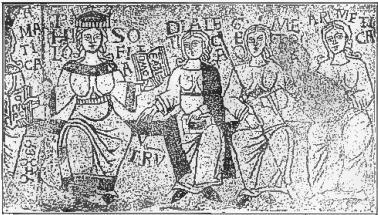
FILOSOFIA — Philosophy among the liberal arts. Fragment of a mosaic pavement from the period of Bishop Varmondo (960–1017) — Ivrea, formerly in the presbytery of the cathedral, now in the seminary.
has always sought, and that, for example, Hegel seeks when, in the Phänomenologie des Geistes (A, 1; ed. Hoffmeister, Leipzig 1937, pp. 79 ff.), he effects the transition from the extracted and improper being of the first stage of immediate consciousness to being in the proper sense, which is that of self-consciousness, up to the complete form of “absolute knowledge” (cf., for a comparison in this sense between these two summits of Western thought: M. Heidegger, Holzwege, Frankfurt a. M. 1950: Hegels Begriff der Erfahrung, pp. 103–194, especially pp. 117, 121, 134, 170 f.).
The problem of philosophy may indeed be viewed in the direction of a twofold convergence or demand: either, starting from the diversity and multiplicity in which consciousness moves, one seeks to find the unity that constitutes its foundation or intrinsic principle; or, proceeding from the unity in which the spirit finds itself, one wishes to proceed from it in order to embrace multiplicity and diversity and recognize them as intrinsic to that same unity. It is therefore in determining the content and structure of this unity that the various philosophies contend with one another: whether it is a unity as a point of arrival or as a point of departure. The object of philosophy, then, is being in this unity of its multiplicity and diversity; and this object must evidently manifest itself as awareness and therefore also as, in some way, the “presence” of such a unity—one that is comprehensive and definitive of being as being, without further reference elsewhere. The object of philosophy, in its proper and ultimate determination, can only be absolute, and therefore is one and ultimate: determining how the Absolute is related to being as it presents itself in multiplicity and diversity is what constitutes the “test” to which every philosophy must submit, and in which the value of its method and the “truth” of its object are inferred. Only in this way is that “truth of being” attained, outside of which all forms of experience become mute and are reduced to purely insignificant events, incapable of emerging from the flow of existence that causes them to vanish. Rightly, therefore, a. Tommaso defends the rational structure of being as the foundation of man’s very salvation: “Oportet ultimum finem totius uni-версi, esse bonum intellectus: hic autem est veritas. Oportet igitur veritatem esse ultimum finem totius universi et circa eius finem et considerationem principaliter sapentiam naistere” (C. Gent., I, 1: with reference to Aristotle, Met., II, 1, 993 b 31). No differently—on this point concerning the essence of the pure theory of being—Hegel expresses himself when he asserts that the Absolute, in the supreme science that is philosophy, must present itself in knowledge as such, and not as though knowledge were its “instrument” or means, while absolute Truth remained outside ordinary truth (cf. Phänomenologie des Geistes, Einleitung; ed. J. Hoffmeister, Leipzig 1937, pp. 63 ff.). The object of philosophy is this absolute truth, which has the meaning of “ground” (Grund), both on the side of being and on that of knowing; for every thing, whenever things appear, receives its innermost reality from the Absolute, and every act of knowledge expresses being as being, precisely insofar as it “reveals” its absolute constituent and its relation to the Absolute. At this point, realist philosophies have specified that being, as such, is not resolved into knowing, and that the forms of knowing may indeed correspond to being but are not identical with it; for human knowing “circles around” being through gradual approaches and does not grasp it all at once. In realism, therefore, it is being that grounds knowing, and consequently provides its criterion of truth. Phenomenist philosophies (whether empiricist or idealist) instead affirm the identity of being with the forms of appearing, or of consciousness or knowing: thus being is within knowing, and the forms of being are determined as a function of knowing. For this reason, D. Hume located the character of reality in impression, both for the external world (“impressions of sensation”) and for the internal world (“impressions of reflection”), and attributed the criterion of reality to the feeling of vivacity (feeling) or conviction (belief) as the source of our persuasion of reality (cf. Treatise on human nature, I, 1, sect. 7; and especially III, sect. 14, ed. Selby-Bigge, Oxford 1928, p. 169 f.).
III. METHOD AND DIVISION
Being presents itself in its truth when it becomes accessible in its structure: the method of philosophy is the course which reflection follows in order to grasp and determine the truth-value of being as being. Such a method evidently corresponds to the type of object upon which a philosophy brings to bear the reality of being; for method is nothing other than the movement of being itself and its articulation into forms, in the way in which these forms present themselves in philosophical reflection.The “intuitive method” predominates in those philosophies in which being as absolute is immediately given, apprehended, or posited, in a particular form of knowledge: this may be intellectual intuition, as in systems with a rationalist background (Platonism, Augustinian illumination, the rationalism of Cartesio, Leibniz, Wolff, Schelling’s intuition of the Absolute, Schleiermacher’s “feeling of dependence” [Abhängigkeitgefühl], etc.). Other, more recent intuitive philosophies have recourse to vital intuition (Bergson’s “durée,” Maine de Biren’s “volo ergo sum,” the German Lebensphilosophie of Nietzsche, Simmel, Spranger, Klages, Max Scheler’s emotional Wesenschau understood as Singfühlung, etc.). On the other hand, those non-intuitive philosophies may be called “rational” which therefore do not begin directly with the Absolute, but place possession of, or contact with, the Absolute at the end of the philosophical journey, so that the determination of the truths of being takes place through a “process” or development of human reason: this takes as its starting point a “demand” for the truth of being, which must be satisfied by the very course of inquiry. To this type of philosophy belong Aristotelian-Thomistic metaphysical realism, in which sense cooperates with intellect and the affirmation of the Absolute requires a demonstrative process (e.g., proofs of the immortality of the soul, of the existence of God, etc.). Hegelian idealism too, insofar as (at least from the methodological point of view) it admits
as the first beginning of thought the phenomenological stage of immediate perception, from which consciousness must rise to absolute Knowledge, falls within this type of philosophy rational in the strong sense. Contemporary existentialism employs a method that might be called “phenomenological-dialectical analysis,” insofar as it investigates the structures assumed by human freedom in relation to the objects it encounters in its situation (e.g., anguish is the being of human consciousness before empty finitude, which offers no support; choice is the breaking through or overcoming of anguish by freedom, etc.). Empiricism has claimed to subject philosophy to the method of experimental science or to mathematical precision, reducing philosophy either to a kind of logic of the sciences or to a compendium of their general results; Kant himself remained, at least in part, captive to this error when, in the Kritik der reinen Vernunft (Introduction: the problem of synthetic a priori judgments), he imposes upon philosophy the requirements proper to science, and thus philosophy loses in advance its autonomy and originality. The distinction between a priori and a posteriori method is less appropriate than that adopted here, since intuitive philosophies may begin either from an a priori beginning or from an a posteriori datum, and the same may be said of rational philosophies. A requirement of the rational method is the establishment of a precise scheme of laws regulating the exercise of thought, and this is what constitutes Logic (an eminent example being Aristotle’s Organon), considered as the propedeutic to philosophy and to scientific thought in general. A requirement common to every philosophical method is the process of “reduction,” by which, from the various aspects of a problem, one determines which is the principal one and, in relation to it, proceeds to determine the meaning of the secondary aspects. Yet in philosophy no method has value in and of itself, prior to its concrete application; rather, it lives, so to speak, and continually “proves itself” in application to its object, which is precisely being in its ultimate instance of truth and in function of the original movement of human consciousness.
The division of philosophy varies from school to school and from system to system, insofar as it concerns the forms according to which, in the various types of philosophy, the inquiry into the truth of being may be conducted. As regards the nature of the object in general, there are spiritualist and materialist philosophies. As regards method, as has been said, there are intuitive and rational philosophies. As regards the modality of the object, there are the various parts or branches of philosophy: whereas the Platonic dialogues dwell upon subjects or aporias concerning the principal problems, Aristotle gave philosophy a rigorous scientific organization which became the model for the systematic philosophies of the following centuries, including modern philosophy and Hegel. The principal parts of philosophy in Aristotelianism are: logic, philosophy of nature, metaphysics, aesthetics, ethics, and politics. Among the Stoics and Epicureans, the principal parts were logic, natural philosophy, and ethics; whereas the Neoplatonists developed above all metaphysics and mathematics (Proclò). But, for Aristotle, the principal division of philosophy is into theoretical and practical (Eth. Nic., VI, 3, 1130 b 16 sgg.): the former seeks the structures of reality, the latter determines the principles of human action. For the Neo-Kantians, opponents of metaphysics, philosophy is divided into aesthetics, logic, and ethics (Windelband, Cohen).
IV. OUTLINE OF HISTORICAL DEVELOPMENT
1. Greek philosophy
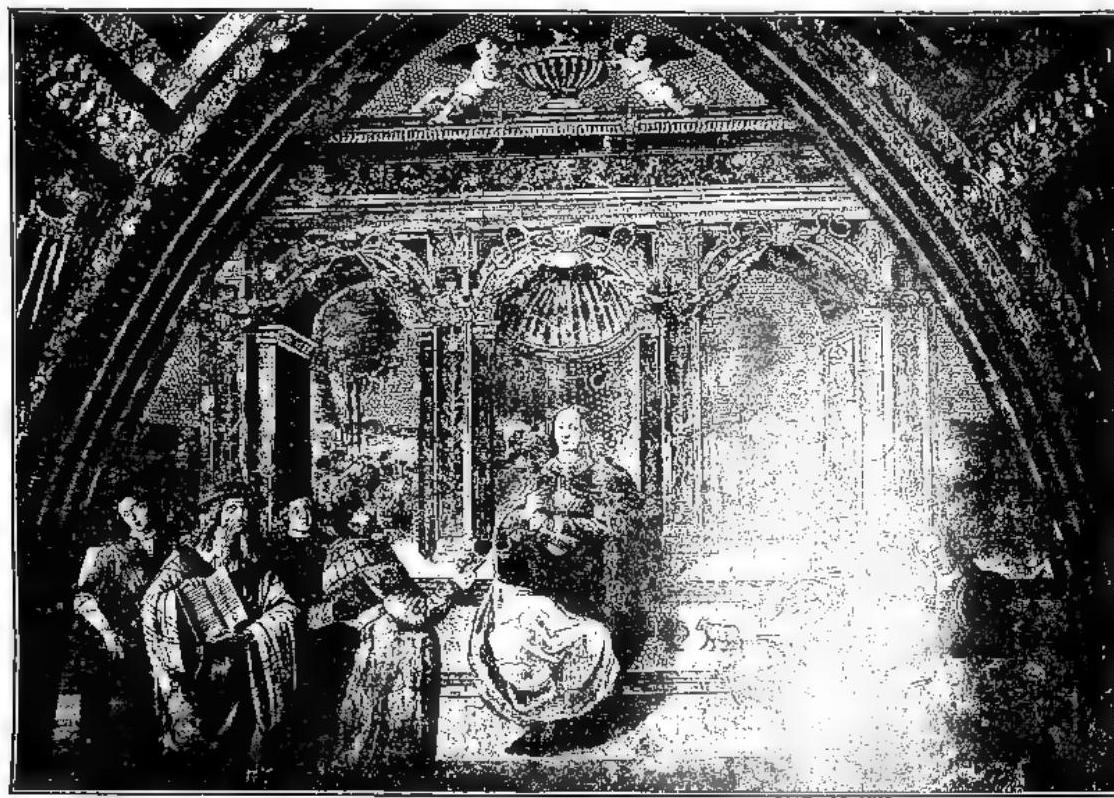
Western thought had its origin and its principal nucleus in Greek philosophy: its merit lies in having conceived the truth of being in terms of rationality and concept, and thus in having secured the presuppositions for a valid conception of man and of his freedom against the Oriental invasion of the mysticism and cosmic pantheism upon which the religions of idols and the politics of tyranny feed. From its very beginnings Greek philosophy appeared as an “education of man” toward freedom of spirit: therefore, just as it has its centre in a metaphysical interpretation of reality, so it displays its summit and fulfilment in an ethics intended to give rational structure to human action according to virtue. Greek philosophy, with the variety and richness of its problems and even with the discordance of its schools, showed the most imposing unfolding of reasonFILOSOFIA - Dialectic, fresco by Pinturicchio (1403-04) - Rome, Vatican Palace, Borgia Apartments.
(daily folio)
With the Ionian school (Thales, Anaximander, Anaximenes), f. became a specific inquiry into truth, and there appeared
within it the first writings of Western f., whose subject and title were nature (φύσις), but whose demand was the determination of the “principle” (ἀρχή) of being as such. The metaphysical demand is presented in its purity in the first fragment of Anaximander (12 B, 1), proclaimed by Heidegger to be the “most ancient text of Western f.,” but whose exact rendering (beginning with Nietzsche, who studied it in 1873) is still controversial in its details. It nevertheless says: “Whence things have their origin, thither also they must find their end according to necessity” (κατὰ τὸ χρεών), since they must render punishment and recompense to one another according to the ordinance of time. In figurative language drawn from the sphere of ethics, the text suggests a rational interpretation of the “becoming” of nature that is immanent in nature itself (W. Jaeger). This text—in its logical core—may give rise both to the metaphysics of becoming of the Socratic systems and to the metaphysics of the “eternal return” of Heraclitus, of certain forms of Neoplatonism, and of Nietzsche: the former metaphysics sought a formal structure for that rationality, whereas absolute becoming accepted it in the immediacy of its making itself. Greek f. oscillated between these two possibilities without being able to attain the definitive solution: the solution was given vital support by Platonism and Aristotelianism, insofar as in these systems the problem of being was directed toward the transcendence of the supreme principle; but the meaning of this transcendence was clarified only with the advent of Christianity.
2. Christian f
The Greek ideal of life was speculation, that θεωρητικός βίος which set the philosopher apart from the common ranks of men in order to contemplate the ultimate nature of things; and this was also the supreme “virtue” (ἀρετή) and the true wisdom of whichsaid St. Paul: «Iudaei signa petunt et Graeci sapientiam quaecunt» (I Cor. 1, 22). With Christianity, the possession of the truth that conferred salvation and blessedness was not confined to an intellectual catharsis reserved for a few privileged persons, but required a radical purification of personal feeling and action which was at once accessible to all and had to be sustained, for each individual—even the most gifted—by supernatural aid. Thus, with the Gospel message, absolutely new aspects and tasks for man came into play, such as the notions of sin, perdition, Redemption, Grace, the Incarnation of the Word of God, individual responsibility, and personal immortality...: all these determinations presuppose a new concept of freedom, both on God’s part and on man’s, which no philosophy had hitherto attained. In the patristic age, it was the greatness of God’s gift to man that the Doctors defended against the survival of classical philosophy, whether in direct opposition (Porfirio, Celso, Giuliano l'Apostata, Neoplatonism, etc.), or in the fragmentation of dogma by heresies at its cardinal points (Trinity, Incarnation, Grace...). Philosophy was not sought by the Fathers of the Church in and for itself as a guide to the truth of nature as such, but only as an “instrument” for illustrating the meaning of dogma and defending it against hostile attacks: the majority of the Fathers therefore attributed a positive value to pre-Christian thought (although not a conclusive one), because original sin had indeed weakened, but not extinguished, the light of natural reason. From this reflection upon dogma, provoked for the most part by polemical contingencies, arose the admirable expansion of patristic theology on which we still live today. Apart from some sporadic rejections by excessive fideists (Tusiano, Ermia...), philosophy thus obtained its legitimate recognition in Christianity: hence the wise men of East and West were able to accept the new Faith not through mere opposition, but as the fulfilment of the truth which they had already sought in philosophy. The attitude of St. Giustino is symptomatic. In the Dialogo col gindeo Trifone, he gives a definition of philosophy in direct continuity with classical thought: “knowledge of being and cognition of truth; happiness, the privilege of this knowledge and wisdom”—ἐπιστήμη ἐστι τοῦ ὄντος καὶ τοῦ ἀληθοῦς ἐπίγνωσις εὐθαυτοῦν δὲ ταύτης τῆς ἐπιστήμης καὶ σοφίας γέρας (PG 5, 481 A). In the prologue of the Coloristica ad Graeco, he observes that the religion of the prophets provides the answer to that problem of the final end upon which not only the poets agree... “but also the philosophers who have communicated to us true and divine knowledge”: ἀλλὰ καὶ φιλοσοφία οἱ τὴν ἀληθῆν καὶ θεῖαν ἐπαγγελόμενοι παρ' ὑμῖν εἰδέναι γνώσιν (PG 5, 241 AC); and among all he recommends Orfeo: “Follow Orfeo and all those who have written concerning the unity of God”—Ὀρφεί πείσθητε... καὶ τοῖς λοιποῖς καὶ τοῖς τὰ αὐτὰ περὶ ἑνὰς θεοῦ γεγράφοσι πείσθητε (loc. cit., 36, 305 CD). In the Apologia he has recourse to the philosophers’ method of rejecting erroneous traditions, and exhorts men not to follow the crowd but those who deserve to be recognized as cultivators of piety and philosophy: εὐσεβεῖς καὶ φιλοσοφίᾳ ἀκολουθώντας (vol. V, col. 329; cf. Apologia II, cap. 13, 460 A): in cap. 6 he defends the philosophers against the charge of atheism (cf. loc. cit., 335, a cap. 13, 345. An identical defence in: Atenagora, Legatio pro Christianis, capp. 5-6, PG 6, 899-903). Nevertheless, both Giustino and Atenagora acknowledge that philosophers often fell into errors: Platone (who had read the Books of Moses in Egypt!), while affirming the soul’s immortality, also called it “uncreated” (ἐγένετο); Aristotele, by making it the “actuality” (ἐντελέγεια) of the body, declared it mortal (Apol. I, cap. 6, 253; cf. Dialog. cum Tryph., cap. 5. Also Atenagora, Leg. pro Chr., cap. 4, 697 sg.). This attitude of positive encounter between philosophy and faith was affirmed and developed by the Alexandrian school: Greek philosophy is called by Clemente Al. “a concurrent cause and collaborator of true knowledge, because it is a search for truth, a preparation of the believer”—συνάκτως καὶ συνεργὸς τῆς ἀληθοῦς κατὰ λήψεως. ζήτησις οὖσα ἀληθείας, προπαύθεια τοῦ γνωστικοῦ (Stromata, II, 63, 8; Werke, ed. O. Stählin, Berlino 1939; cf., for other texts, the Register, IV, 791b-792a).
Early Christian thought therefore recognizes in human reason and philosophy, although they cannot provide certain knowledge of the truth that saves, their own sphere of inquiry, and considers them a normal propaedeutic on the way towards faith: in explaining the relations between reason and faith, the schools of voluntarist orientation (s. Agostino, nominalism, Scotism, Pascal, Laberthonnière, Blondel) tend to diminish the cognitive element; whereas the intellectualist schools (Ps. Dionigi, s. Tommaso, Leibniz) emphasize the rational element, while respecting the originality and absolute transcendence of the content of Revelation and of the act of faith. Stated in these terms, the recently debated problem of the existence of a specific “Christian philosophy” can have only an affirmative answer; but the content and meaning of this answer differ in the two orientations: in the voluntarist one, “Christian philosophy” is the believer’s only philosophy and arises solely as reflection upon the content of divine truth; in the intellectualist tendency, “Christian philosophy” is the extension or consolidation, under the impulse and guidance of faith, of rational philosophy, already operative in the most difficult points, such as the problems of the first origin and ultimate end of beings, and of the origin, life, and destiny of the individual human soul.
(from G. F. Hill, Corpus of Italian medals of the Renaissance, Londra 1929, par. 8) FILOSOFIA - Theology holds Philosophy by the hand. Reverse of a medal of card. D. Grimani, the work of Gian Cristoforo Romano (16th cent.).

3. Modern and contemporary philosophy
The distinctive character of modern thought is the affirmation of the autonomy of human reason (radical humanism), according to which it is impossible to recognize a sphere of knowledge and a criterion of truth that wholly or partly transcends its domain and its powers: its tendency or “cadence” as a method of inquiry is immanentism (gnoseological or ontological), and as the content of being it is pantheism. In G. Bruno, Telesio, and Campanella, the immanentist tendency is predominantly centred upon “nature,” with disdain for a radical critical foundation (Campanella’s cogito). The demand for absolute criticism claims to regard knowledge itself as truth in and for itself, as a closed circle in the identity of object-subject-act within knowing: the principal stages of this absolutization of knowledge are the cogito of Cartesio, Kant’s Bewusstsein überhaupt (“das Ich denke”), Fichte’s pure I, Schelling’s Absolute, and Hegel’s Geist, as the absolute synthesis of subjective and objective.If, in the field of Protestant theology, both Kant and Hegel found followers who believed themselves convinced that they were not betraying Christianity, Catholic theology has always opposed a clear rejection to modern philosophy, because of the subjectivity of its criterion of truth and because of the Spinozist content of the new metaphysics, which Jacobi himself had denounced in Lessing’s Enlightenment, from which Hegel drew inspiration (cf. Jacobi, Werke, IV, 1, Leipzig 1819, p. 217 ff.: critique of Lessing). In the completeness of his system, the breadth of his inquiry, and his understanding of the method of immanence, Hegel represents the summit of modern philosophy, as the boldest attempt in the whole history of thought to take possession, by means of human reason, of the Absolute itself and to apprehend it, as Hegel himself declared, in the innermost core of its eternal essence before its creative process (cf. Legib, ed. Lasson, I, Berlin 1932, p. 31). Therefore philosophy is above all and primarily (as for Aristotle and St. Thomas, though in a very different context) “theology” (indeed theogony), insofar as the Infinite identifies itself, in its dialectical becoming, with the finite (cf. on the object of philosophy: Die Philosophie der Gesch., I, Einleitung; Die Vernunft in der Gesch., 3rd ed. by O. Lasson, Leipzig 1930, p. 18 ff.), and the infinite becomes
the “reality” of the finite (dialectical Absolute). Hegel therefore apparently accepts all the fundamental dogmas of Christianity, but transfers them onto the plane of the ontological immanence of human consciousness; he could thus be regarded as a champion of Christian philosophy, whereas he demolished its foundations, as Kierkegaard vigorously denounced against the compromises of the Hegelian “right” (cf. Papirer, 1857 X⁴ A 429; Italian trans. by C. Fabro, II, Brescia 1950, p. 527). Hegel’s influence was neutralized in the second half of the nineteenth century by the advance of scientific positivism, the irrationalism of Schopenhauer and Nietzsche, and neo-Kantianism; but more than toward Italian (Spaventa, Croce, Gentile), French, and English neo-Hegelianism, contemporary culture now turns toward the problems involved in the dissolution of Hegelianism. Above all, existentialism vindicates the solidity and freedom of the individual; Marxism defends the reality and priority of nature and of material values (man as Natur- oder Gattungswesen); neopositivism, which develops the modern semantic instruments of logistics, disperses every trace of metaphysics from philosophical language and logic, in order to stop at the sign or pure symbol (cf. R. Carnap, Studies in semantics, I: Introduction to semantics, § 38, 3rd ed., Cambridge, Mass. 1948, pp. 242–289. Carnap, however, is more reserved with regard to philosophy than other neopositivists). Alongside these philosophies, determined to reach conclusions concerning truth and to organize themselves into schools, more radical tendencies assert themselves, according to which philosophy presents itself as pure inquiry, as an affirmation of the limitations of every answer that human thought has given to the problem of truth (relativism). If this does not exclude the possibility of a definitive solution to the problem, it is admitted that human consciousness must seek it by another path, deriving it from another source than pure philosophical reason (problematism, for example that of U. Spirito). Thus there returns the integral “doubt” of philosophy, to which Pascal and Kierkegaard opposed, as the sole salvation, existential truth through the “risk” of Faith.
V. F., SCIENZA E RELIGIONE. — L'uomo, che si trova nel mondo, non ha all'inizio che i dati dell'esperienza interna ed esterna sui quali egli esercita la sua riflessione: quando questa riesce a formulare leggi e principi di valore universale, si ha la scienza. La scienza cerca con la deduzione dai principi e con l'artificio dell'esperimento di stabilire le sequenze necessarie dei fenomeni e quali ch'essa pronuncia sulla loro natura è sempre in funzione dell'apparire dei fenomeni stessi dentro i limiti delle coordinate di spazio e tempo. Compito della religione invece, nel suo momento noetico, è di trascorrere la sequela dei fenomeni per portarsi al di là di tutte le determinazioni spaziali e temporali, a così prospettare la prima origine e l'ultimo destino sia del mondo come dell'uomo. La f., come si distingue dall'una a dall'altra, è tuttavia indispensabile per ambedue affinché ottengano il riconoscimento di un valore universale. Se lo scienziato può cogliere le leggi del divenire fisico con l'esercizio del solo metodo proprio del suo campo d'indagine, il significato reale di quelle leggi dipende da un riferimento assoluto che si possa fare del divenire stesso, cioè soltanto qualora esso sia inteso come processo per l'attuarsi di strutture di valore assoluto nel loro ordine. Qui interviene la f., la quale (a differenza di molta f. classica e moderna: si pensi alle « filosofie della natura » di Schelling e Hegel!) non comanda lo sviluppo della fisica, ma se costituisce il compimento per una coscienza che muovendo dal molteplice e vario della esperienza cerca l'unità dell'essere.
La religione, intesa nel suo significato elementare come « aspirazione » della coscienza umana verso l'Assoluto, si trova in un certo senso al polo opposto della scienza e al di là della filosofia. Codesta aspirazione ineffabile ch'è la coscienza religiosa sorge per
una convergenza di richiesta di tutte le sfere della esperienza, esterna e interna, non nel senso di averne le leggi per contemplare il divenire dei fenomeni, ma per appagare quella sete di certezza sul proprio destino che il susseguirsi dei fenomeni non soddisfa e che nessuna scienza può dare. La f., se può essere assente nelle prime manifestazioni della religione, è indispensabile quando si tratta di precisarne l'oggetto autentico (contro la mistificazione sia della scienza e della politica, come delle false religioni!) e di difenderne l'esigenza nel suo momento originario (contro la rapacità delle false filosofie!) come l'aspirazione essenziale di giustizia e verità dell'uomo comune.
Per ciò giustamente ha scritto s. Tommaso che «fere totia philosophiae consideratio ad Dei cognitionem ordinatur » (C. Gent., I, 4). — Vedi tav. LXXXVII.
BIBLI: E. Zeller, Über die Aufgabe der Philosophie und ihre Stellung zu den übrigen Wissenschaften, in Vorträge u. Abhandlungen, II, Lipsia 1877, pp. 415-62; F. Paulsen, Einleitung in die Philosophie, Berlino 1892; trad. II. di L. Gentilini, Torino 1911; W. Windelband, Was ist Philosophie? Über Begriff und Gesch. der Philosophie, in Praetudien, 2^ ed., Tubinga e Lipsia 1903, pp. 1-57; id., Einleitung in die Philosophie, 2^ ed., Tubinga 1920; id., Lehrbuch der Gesch. der Philosophie, ed. H. Heismann, ivi 1915 (Einleitung: §§ 1-2, p. 1-52a); W. Wundt, Einleitung in die Philosophie, 3^ ed., Lipsia 1904; W. Dührer, Das Wesen der Philosophie, in Die Kultur der Gegenwart, I, vi, Berlino e Lipsia 1907, pp. 1-72; Fr. Jodl, Aus der Werkstatt der Philosophie, Vienna 1911; P. Natorp, Philosophie: Ihr Problem und ihre Probleme, Gottinca 1911; A. Mariv, Was ist Philosophie, in Ges. Schr., I, Halle u. S. 1916, pp. 69-94; M. Wetscher, Einführung in die Philosophie, Berlino e Lipsia 1920; K. Vorländer, Einführung in die Philosophie, Lipsia 1920; H. Reckert, Die Philosophie des Lebens (Darstellung und Kritik der philosophischen Modetrömungen unserer Zeit), 2^ ed., Tubinga 1922; M. Schefer, Vom Wesen der Philosophie und der moralischen Bedeutung der Philosophischen Erkenntnis, in Vom Essern im Menschen, 2^ ed., I, Berlino 1923, pp. 38-133; F. De Sarlo, Introduzione alla f., Milano 1928; R. Eisler, Philosophie, in Würtsch. d. phil. B. B. B. B. B. B. B. B. B. B. B. B. B. B. B. B. B. B. B. B. B. B. B. B. B. B. B. B. B. B. B. B. B. B. B. B. B. B. B. B. B. B. B. B. B. B. B. B. B. B.
Sui rapporti fra f. e cristianesimo: Fr. Brentano, Die vier Phasen der Philosophie und ihr augenblicklicher Stand, Stoccarda 1895; A. J. Festugiere, L'idéal religieux des Grecs et l'Evangile, Parigi 1932; R. Jolivet, La philosophie chrétienne et la philosophie contemporaine, ivi 1932; H. Eibl, Die Grundlegung der abendländischen Philosophie, Griechische u. christlich-griechische Philosophie, Bonn 1934; J. Soufflé, La philosophie chrétienne de Descartes à nos jours, 2 voll., Parigi 1934; Bl. Remeyer, La philosophie chrétienne jusqu'à Descartes, 2 voll., ivi 1935; C. Fabro, La religiosité de la f., in Problemi dell'esistenzialismo, Roma 1945, pp. 106-133; id., Coscienza filosofica e coscienza religiosa, in Archivio di filosofia, 1945, pp. 73-91; R. Frank, Philosophical understanding and religious truth, Londra 1945; M. Müller, Das christliche Menschenbild und die Weltanschauungen der Neuzeit, Friburgo in Br. 1945; A. Sarrillanges, Le christianisme et les philosophes, 2 voll., Parigi 1946; trad. II. di P. Sartori Treves, Brescia 1948; E. Gilson, L'esprit de la philosophie médiévale, 2^ ed., Parigi 1947; trad. it., di P. Sartori Treves, Brescia 1948 (cf. id., Christianisme et Philosophie, Parigi 1936); Ph. Wendel und R. Hofmann, Der Mensch vor Gott, Düsseldorf 1948; J. Boissot, E. Rochefort, P. Arbousse-Bastide, I, Bois, P. Ricœur, M. Nacart, Le problème de la philosophie chrétienne, Parigi 1949.
Per un orientamento sui rapporti fra f. e le scienze: W. Wundt, Philosophie und Wissenschaft, in Essays, Lipsia 1885, pp. 1-23; H. Reichenbach, Ziele und Wege der physikalischen Erkenntnis, in Handbuch der Physik, IV, Berlino 1900, pp. 1-80; A. Wenzl, Wissenschaft und Weltanschauung, Lipsia 1936; M. Planck, Religion und Naturwissenschaft, ivi 1938; K. Janens,
Philosophie und Wissenschaft, in Wondling, 3 (1947), pp. 721-33; W. Hoffmann, Physik und Metaphysik, in Symposium, II, Friburgo in Br. 1949, pp. 351-82.
Sul senso del Frammento di Anassimandro (B 1: H. Dieckranz, Die Fragmente der Forsshratiker, I, 1ª ed., Berlino 1934, p. 89, 12 sgs.), cf.; W. Jaeger, Paideia, Die Formung des griechischen Menschen, I, 2ª ed., Berlino e Lipsia 1936, p. 217 sgs.; O. Gigon, Der Ursprung der griechischen Philosophie von Hesiod bis Parmenides, Basilea 1945, p. 81 sgs.; E. Wolf, Grundlagen des adenofäadischen Rechtsgedanken bei Anassimander und Heredith, I, Friburgo in Br. 1948, p. 42 sgs. (bild. aggiornata); M. Heidegger, Holzwerg, Francoforte s. M. 1950: Der Spruch des Anassimander, pp. 206-343. Cornelio Fabro