
KNOWLEDGE. - From the Latin cognoscere (cumnoscere, Greek γινώσκειν and γινώσκειν) it is the act by which a being (subject) becomes aware of or perceives something (object). It is an activity characteristic of the higher degrees of life, which it qualifies and distinguishes through the gradual perfection of its forms.
I. KNOWLEDGE IN GENERAL
1. Concept. - The term knowledge presents different meanings, even if they are complementary and relative to one another. It can in fact designate: 1) the very act of knowing or learning; 2) the content or object of knowing: a sense, this one, that is less frequent and less technical. Italian, although it has two general terms, "knowledge" and "cognition," does not establish a clear difference of meaning between them, even if to express the content of knowing "cognition" is more frequent than "knowledge." Of increasingly rare use, but technically more exact for indicating the act of knowing, is the term "knowing." In relation principally to the content, the term knowledge is for the most part taken in a very broad sense and then designates: 3) every apprehension of an object, whatever its degree, form, or certainty; but it is sometimes restricted to indicating 4) a clear, distinct, and relatively perfect apprehension, approaching the meaning of "savoir" (e.g., to have knowledge of a doctrine, of a science). In any case, to indicate the distinct and essential knowledge of an object, the term "to comprehend" is more exact, distinguished from "to know" as a species from a genus (cf. Gk. γινώσκειν, εἰδέναι and Ger. kennen, wissen). Similarly, although sometimes, especially in modern philosophical language, knowledge is used as a synonym of consciousness (v.), more exactly "consciousness" is a particular form of knowledge, that is, the knowledge that the subject has of its own psychic states and contents as such and of itself as subject. Although, in a very general sense, "consciousness" can also indicate the fundamental and characteristic modality inherent in knowledge, by which its contents are "given" and become "present" to the knowing subject. While thus "consciousness" in a general sense highlights rather the subjective presentness implied in the fact of knowing, it is instead inherent in the original meaning of knowledge, the relationship and the objective direction, insofar as it immediately indicates the subject's referring to an object as the term of apprehension or perception.Knowledge as an original fact springing from the mysterious depths of being and of life cannot, properly speaking, be expressed in more immediate concepts; even if it is possible to clarify the cognitive fact with an analytics and a dialectic of its process, of its conditions, of its postulates, limits, and value (v. knowledge*). Knowledge is in fact an original experience whose character of immediacy is primary and absolute; indeed, in its broadest acceptation it is experience without further qualification, the ground in which every representation, notion, and conscious fact is placed. The explanation of knowledge through metaphysical concepts and sensory analogies undoubtedly serves to bring to light aspects and values implied in it, but it would not suffice to enlighten us about the specific reality of knowledge if one did not refer back to the immediate experience of knowing itself, by which those very concepts and analogies are put into act and given as content of consciousness. Therefore the qualification of knowledge as "image" and "representation," while it contributes to indicating the objectivistic character inherent in the concept of knowing, does not in reality clarify what knowledge is except insofar as the image is said to be the conscious presentation of an object (intentionality). Moreover, "image" and "representation" can here take on an equivocal meaning if one intended to attribute to them a physical consistency, separating them from the cognitive act. Knowledge is "representation" insofar as it is itself "presentness" (note the etymological closeness of the two terms). But "consciousness," "presentness," "intentionality" are terms that do not take on for us a precise and defined content unless referred to the original experience of knowing.
Knowledge therefore, a fact of immediate intuition for common experience (nothing is clearer and more intuitive than these and similar expressions: I see a tree, I know a problem, I know a science), in its radical metaphysical structure is for human thought a reality no less obscure and profound than the objects that are given through it in consciousness; and it is extremely arduous to clarify the first ontic condition that lies at the root of its existing in the world. Its reasons are lost in the very mystery of the Absolute, of which knowledge is certainly a necessary form, but which, having neither causes nor principles, is, in its original determination and reason, incomprehensible to human thought. How it is possible, on what first determinations and properties of being this fact arises—that certain things not only exist but know that they exist and perceive the existence of other things—is just as inexplicable as, at bottom, being is inexplicable. The biophysiological conditions of the cognitive processes that science, within the limits of its possibilities and its aims, manages quite well to clarify, and that materialism considers the ultimate explanation of knowledge, in reality leave intact the problem of the nature of consciousness. Consequently, when it is said that the act of knowing is clear and transparent to itself, this can only be understood within the limits of the conscious presentness of the data or contents and, possibly, of the act of knowing itself when it becomes an object in reflexive knowledge; not at all on the plane of the nature and being of knowledge. The act of knowing, as it is given in empirical immediacy to the subject that expresses it (for the most part without its knowing, as in the whole domain of lower sensitive life), remains in its conditions and causes, like every other process of nature and of life, unknown to itself, until reflection, taking them as its object, clarifies it on the plane of science and philosophy.
Within the limits of the preceding observations, however, the formulas with which, particularly Aristotle and St. Thomas, attempted to translate into conceptual terms the universal fact of knowing undoubtedly have explanatory value. "Concerning sensation," Aristotle states, "one must hold universally that it consists in receiving the sensible forms or images without the matter" (ἡ μὲν ἀσθησία ἐστι τὸ δεκτικὸν τῶν ἀσθητῶν εἰδῶν ἄνευ τῆς ὅλης:
(De an., II, 12, 424 a 17 ff.), just as wax receives the impress of the seal's form without becoming either iron or gold. St. Thomas, commenting on this passage, notes that, at bottom, to receive purely formal determinations is proper to every patient when it undergoes an effect from an agent (e.g., the air when it is heated by fire). But in the case of knowledge what is essentially different is the manner in which the form is received. While in every other physical relation of cause-effect, action-passion the form repeats in the patient the same mode of being, entitative-natural, that it had in the agent, in knowledge, on the other hand, the mode of being of the form in the subject as knowing is different from its mode of being in the object; that is, not entitative-real, but representative-intentional. This depends on the fact that the receptive disposition that is in the knowing subject as such is not a passive potentiality of actualization in the order of being, but an active principle of assimilation — in degrees of possessive consciousness more or less profound — of forms: «Et per hunc modum sensus recipit formas sine materia, quia alterius modi esse habet forma in sensu et in re sensibili. Nam in re sensibili habet esse naturale, in sensu autem habet esse intentionale et spirituale» (In De an., II, lect. 24, ed. Pirotta, n. 553). The ultimate and at the same time the only root of this potentiality is, for St. Thomas, founded in the immateriality and spirituality of the knowing subject, whereby it is not totally restricted within the limits of its own natural being: «... cognoscentia a non cognoscentibus in hoc distinguuntur quia non cognoscentia nihil habent nisi formam suam tantum; sed cognoscens natum est habere formam etiam rei alterius. Nam species cogniti est in cognoscente. Unde manifestum est quod natura rei non cognoscentis est limitata. Natura autem rerum cognoscentium habet maiorem amplitudinem et extensionem... Coarctatio autem formae est per materiam. Patet igitur quod immaterialitas alicuius rei est ratio quod sit cognoscitivi; et secundum modum immaterialitatis est modus cognitionis» (Sum. Theol., 1a, q. 14, a. 1, c.). The principle here enunciated is connected with the general presuppositions of the Thomistic system according to which matter, as such, cannot receive form otherwise than as a metaphysical principle actualizing its essential ontological indetermination and therefore as a real principle.
Consequently, what is given in knowledge, to whatever order of entity it may belong, precisely insofar as it is given in knowledge assumes in the subject an immaterial presence, of value and intensity proportional to the degree of ontological spirituality of the subject itself. Such immaterial presence is, from the point of view of metaphysical belonging, a mode of being of the subject itself: since, at bottom, it is nothing other than the subject's spiritual self-making and becoming, the determining of its representative potentiality in the order of consciousness. The scholastic saying «cognoscens in actu est cognitum in actu» (cf. Sum. Theol., 1a, q. 85, a. 2 ad 1) intended precisely to highlight the degree of extreme unity that is realized in the act of knowledge, between the knowing subject, as objective-conscious actualization, and the content of knowledge itself.
In relation to the notion of knowledge as the subject's formal becoming, Aristotle already noted that the knowing subject, not limited to its own natural mode of being, can in a certain way, through sensory and intellectual knowledge, become all things: ἡ ψυχή τὰ ὄντα πὼς ἐστὶ πάντα (De an., III, 8, 432 a 20): and St. Thomas recognized in this property of knowledge a certain likeness of the soul to God Himself, the metaphysical and conscious synthesis of all reality: «Et sic anima hominis fit omnia quodammodo secundum sensum et intellectum, in quo cognitionem habentia ad Dei similitudinem quodammodo appropinquant in quo omnia praeexsistunt» (Sum. Theol., 1a, q. 80, a. 1, c.; cf. In De an., III, lect. 13, nn. 787-90). Knowledge thus comes to represent almost a surpassing of the necessary limitation and ontological determination of beings to their own degree of reality, broadening them, in the intentional order, into the reality and perfection of the universe (De ver., q. 2, a. 2; q. 23, a. 1).
The notion of knowledge implies of itself the dualism of subject and object, of the principle of consciousness and its content. Even in the possible fundamental identity between subject and object, as in the case of thought that thinks itself and its acts (a reflective power that belongs exclusively to spiritual knowledge), there persists the gnoseological duality between the two terms: the thinking thought (I, mind, spirit) always recedes as subjectivity to the roots of the act and posits the knowing relation only insofar as it distinguishes itself from itself, making itself the object of its own looking and contemplating; a psychological-gnoseological reality clearly rendered in the language that contrasts objects and subjective contents of knowledge with knowing itself: «my seeing, feeling, thinking». The original concept of knowledge therefore does not of itself suggest the idea of positing or creating the object on the part of the subject, but rather of a representative conforming of the subject to the object, whatever their structure and relation may be on the entitative plane. Thus the concept of the gnoseological «otherness» between subject and object is immediately connected with the fact and the idea of knowledge. It indicates the relative opposition of the two terms and must not, as is evident, be confused with spatial distinction or separation. The latter is entirely indifferent to the knowing relation, which is not thinkable in terms of space but solely of consciousness: it is a relation between the principle and the term of an immanent action, between consciousness as an active potentiality of actualization and the «content» in which it is actualized and determined. In this immanent relation even spatial distance is resolved and surpassed when, whether in sensory or in intellectual knowledge, it becomes an object of knowledge.
Dualism, otherness of subject and object necessarily lead to the concept of knowledge as «relation». Indeed, even if, in the purely entitative order, knowledge, as a mode of being and determination of the subject, can and must be referred to the category of quality, nevertheless, because of the intrinsic reference to the «other» that is immanent to it, it, while positing itself as a quality of the subject, is determined at the same time as a relation. But it is necessary to note at once that, since knowledge is accomplished through an immanent process in the subject, the relation that it implies is not mutual but unilateral: it entails a becoming and a positive actualization in the subject, which through it expands intentionally into the sphere of objects, but it implies nothing real in the thing known, which, by the mere fact of becoming an object of knowledge, acquires nothing and loses nothing: to be known is at bottom not a new reality for the object. This does not remove — but this is quite another matter — the fact that becoming an object of knowledge sometimes implies positive consequences for the object itself, when it falls within the sphere of the subject's practical activity. The concept of knowledge as relation immediately opens the analysis toward other important conceptual determinations. As a relation between subject and object, knowledge indeed implies the union of both in conscious representation; as a unilateral relation it entails activity on the part of the subject; as such it poses the problem of the relativity of knowledge. Without delving deeply into the dialectical perspectives opened by these categories, it is easy to see how the most serious gnoseological problems are articulated in them, indeed, in substance, the very problem of knowledge.
The union between subject and object in the knowing act poses first of all the problem of the metaphysical relations between being and consciousness. And since the knowing act tive act, although it implies two terms, is a living unity of object and subject — indeed, at bottom, the subject itself having become intentionally the object — the fact of k. seems to point toward a radical identity of being and consciousness, or at least toward an essential metaphysical implication of the two that would serve as the very ground of the possibility of k. in general. But note: this is a universal metaphysical demand that exists in the absolute order of being and leaves intact the real dualism of human k. In fact, whether in experience or in the intellectual k. of the world and of reality, the gnoseological unity essential to every act of knowing is not resolved, on the plane of human k. and of the human being, into a metaphysical unity. This is precisely what idealism (v. below) has claimed to deny, attempting an explanation of k. in purely absolute terms, but placing itself in conflict with the most evident demands of experience and transferring onto the plane of human immanence what are instead the transcendent grounds and postulates of k. in general.
K. as activity raises the problem of the structure of the knowing subject, and therefore of the conditions that are presupposed in it for the very fact of k. and that thus stand as determining factors of its value. Indeed, even though it is evident to experience and reflection that human k., particularly in the lower degrees in which the ontic duality of subject and object is most prominent, is not accomplished except through a certain influence and determination coming from the object (an influence and action that unfolds, for the most part, below the sphere of consciousness, and in sensation as a purely natural physiological-psychic process), it is nonetheless evident that intentional assimilation is an operative process that actualizes the ontological potentialities of the knowing subject. These potentialities are naturally different according to the degree and value of being in which the subject is situated. Hence the character of relativity and limit that qualifies conscious assimilation from within and that was implicit in the scholastic principle "cognitum est in cognoscente secundum modum cognoscentis" (Sum. Theol., I, q. 12, a. 4, c.), a specific application of a more general principle and fact of experience: "receptum est in recipiente per modum recipientis" (ibid., q. 84, a. 1, c.). But here too it is of the utmost importance to note that the conditioning function inherent in conscious assimilation can, as St. Thomas already specified, concern only the mode of being of the thing known and not at all imply a deformation or transformation of its ontological content (cf. Sum. Theol., I, q. 14, a. 6, ad 1).
Certainly, the scholastic principle referred to above implies that k. is proportioned to the knowing powers of the subject: more or less extensive and adequate to the object, according to the limits of those same knowing powers and their eventual historical development in ascending and mature forms. Senses specifically different from ours, or more refined, can grasp new aspects of the sensible world; deeper intellects can unveil in being more recondite problems and values; but this does not mean that within the limits of our human knowing we do not grasp, albeit limitedly and through a laborious logical-abstractive procedure, true and positive aspects of reality and of being. One cannot therefore conclude from the relativity of the knowing fact to the deforming and therefore purely subjective character of k., particularly where k. (intellectual) reveals itself to itself as expressive of universal and necessary values, and thus opens, within human k., a perspective on the Absolute. To condition is not necessarily to transform. And every conditioning function is overcome when what is given in k. — for example, even the simple self-consciousness of ourselves as thinking beings — asserts its character of absolute and therefore unconditional ought-to-be. In this case it is not the subject that conditions the object, but rather the object that conditions the substance and mode of the knowing act, or better, the object reveals its radical unity with the subject, being with thought. The becoming of reality as object of k. in human thought is then not a self-conditioning or an alienation of reality from its positivity, but rather a clarifying and, as it were, a becoming-conscious of reality itself. And it is precisely by virtue of its unconditional value, emerging in a particular way in the evidence and conscious certainty of its assertive moment, that intellectual k. raises the problem of the absolute and therefore objective structure of human thought and of its metaphysical dialectic toward the transcendent.
2. Division
In relation to the diversity of the object, fundamental is the division of human k. into sensory and intellectual. The first concerns the material properties and qualities of corporeal objects (extension, weight, solidity, colors, sounds, etc.) and the physiological-psychic modifications of the knowing subject himself (the extremely vast complex of organic sensations, whose fundamental species are pleasure and pain); the second refers to values and contents that either abstract from sensible properties (e.g., the value of being, substance, cause) or even deny them (e.g., the concepts of truth, spirituality, God). Intellectual k., in particular, involves a nexus of important problems concerning the formal structure of thought (logic), the subjective conditions and causes of its being and becoming (psychology), and the determination of its value in relation to the objective apprehension of reality in its being, in its causes, in its principles (theory of k.). Analogous, but not at all identical to the preceding, is the division of k. into empirical and rational: the former concerns data and facts of experience (therefore also of spiritual experience); the latter concerns values (concepts, judgments and principles) that lie beyond experience, on the objective plane of intelligibility and rationality, even if they are founded on and derive from experience itself. In relation both to the object and to its own psychic modalities and conditions, k. is concrete (or intuitive) if it apprehends individual reality in the characters, modes and forms of its real existence, abstract (or abstractive) if it apprehends the universal; it is immediate if it concerns objects that make themselves present to the subject for themselves, in their empirical reality or rational evidence, mediated or derived if it concerns contents or values whose character of evidence and certainty consists only insofar as they are connected to original objects and data (experiences and immediate principles). In relation to the different planes on which, in the scale of beings and values, its contents are distributed, k. admits the three principal distinctions into spontaneous, scientific, and philosophical. Regarding the function that the tendencies and affective conditions of the subject have in the origin and qualification of the object, to purely rational k. is opposed affective, sentimental, mystical k. According to the diversity of logical procedures, k. is inductive if from data and facts of experience it proceeds to rational values and principles, deductive if it unfolds rational principles into their consequences and formal derivations. Particularly after Kant, the division of k. into a priori (v.) if it precedes experience, and a posteriori if it derives from experience, is common. Intuitive, even if not free of problems, is the distinction of k. into actual and habitual.II. THEORY OF KNOWLEDGE
Knowledge in general and the forms it assumes in human experience pose for reflection, as has already been indicated, a complex of philosophical problems of supreme value. Theory of knowledge is precisely the systematic treatment of such problems. It can be defined as: the philosophical inquiry into the meaning and metaphysical value of knowledge in general and of the particular forms of human knowledge. The term, which seems the most suitable and comprehensive, is in general use in Italian (sometimes replaced by the Greek equivalent "gnoseology") and in the Germanic language (Erkenntnistheorie), and is by now also more frequent in French, while English prefers epistemology (etymologically = doctrine of science; v. EPISTEMOLOGIA). The term "criteriology," used by Balmes and later popularized by Mercier, is today for the most part abandoned, while the term "critique" (of knowledge), of Kantian derivation, is frequent. Other terms recently proposed ("noology," "noetics," "ideology") have a restricted etymological meaning and have not succeeded in establishing themselves.1. Systems
An adequate survey of the solutions concerning the problem of knowledge would amount in substance to a history of philosophical thought, given the central position that the problem of knowledge, by its particular nature, assumes not only in modern philosophy, but also in medieval and Greek thought. For since nothing has value for man except insofar as and as it is in his knowledge, the problem of knowledge and of its value implies and resolves within itself the problem of every other value, the problem of art, of science, of morality, of religion, of metaphysics, and, at bottom, the problem of being. It is therefore not accurate to say, as was often repeated, that the problem and particularly the "theory" of knowledge are proper to modern philosophy. Modern philosophy has certainly felt in a more mature form one of the particular aspects of the problem of knowledge, namely the question of the "critical" method and process for a valid solution of it, and has attempted, what is not found in the ancients, a development of gnoseology distinct from metaphysics, but there is no doubt that questions and concerns about the value of knowledge already appear at the dawn of Greek philosophy: even if one can and must admit, in broad outline, the fact that human thought turned at first predominantly toward the objective knowledge of the world and the construction of metaphysics, and only through this theoretical inquiry, stimulated by error and by the insistence of an ever more arduous and complex problematic, turned back toward a knowledge more reflective and more mature about itself, its possibilities and its limits.The problem of knowledge is identified in the very earliest Greek philosophy in the antithesis to which cosmological inquiries had led, between an exterior and superficial knowledge of nature, proper to immediate experience, and the deeper knowledge that thought is capable of attaining (φρόνησις, λόγος). The δόξα or opinion, proper to pure experience, and the ἀληθές, to which only the effort of thought that seeks beyond phenomena the principle of nature (ἀρχή φύσεως) can aspire, sum up the terms of a problem that will constitute the substance of Platonic speculation, and through it will be perpetually alive in the history of the problem of knowledge. This gnoseological dualism, toward which reflection on the two fundamental forms of human knowing, sense and intelligence, spontaneously orients itself, is present, albeit with a different meaning, both in Heraclitus and in Parmenides, as also in the first atomists. The accentuation of the value of rational knowledge as against the illusions of experience is very vivid in the school of Elea. According to Gomperz and Burnet, Parmenides was in fact led to the position of being one and identical not by naturalistic concerns, but by the demands that logical thought asserts or discovers in the concept of being: which, by its pure simplicity, excludes from itself its opposite (limit, nothingness). Thus there was explicit in the Parmenidean conception a gnoseological assumption of immense scope, namely the realistic-ontic value of human thought and of its rational demands. These, specified in the principle of identity and contradiction, will be asserted by Zeno with extreme logical rigor, as the sole and absolute criterion of truth. An analogous position was moreover already implicit in the Heraclitean λόγος, understood as a cosmic rational principle that substantiates things with itself, almost an objective rationality of the world, and is also the objective norm of our thought. To these gnoseological positions of high intuition there does not correspond in the Presocratics an equal metaphysical elaboration. Their psychology (Aristotle scarcely makes an exception for the νόος of Anaxagoras) has in fact a clearly sensistic orientation (Aristot., De an., I, 2 passim). For Parmenides himself thought depends solely on the conditions of corporeality (frg. 16); and a wholly materialistic meaning has the principle of Empedocles, susceptible of quite another interpretation in a spiritualistic conception, that "like is known by means of like," that is, the object by way of an analogous physical predisposition existing in the subject: ἡ γνῶσις τοῦ ὁμοίου τῷ ὁμοίῳ (Aristot., Met., II, 4, 1000 b 5-6; cf. De an., I, 2, 404 b 17). The metaphysical basis with a sensistic tendency remained in the Presocratics as a latent principle of dissolution of their gnoseology. It is in fact difficult to maintain the absolute value of reason if the active principle of knowing is reduced entirely to sensation, by its nature relative and variable. Traces of skeptical relativism are thus already found in Xenophanes and Zeno, in Empedocles and Democritus: ("we know nothing with truth; truth lies in the depths," Diog. Laert., IX, 72).
Hence the establishment and finally the prevalence of skepticism in the following critical-reflective moment of the Sophists is explained. Protagoras, having reduced all psychic life to sense perceptions, affirms that the object of perception, the sensed (τὸ αἰσθητόν), is not the thing as it is in itself, but as it determines itself in the perception itself. Consequently, man, in the unstable contingency of his perceptions, is the measure of all things and of every determination of them, whether positive or negative: πάντων χρημάτων μέτρον ἄνθρωπος, τῶν μὲν ὄντων ὡς ἐστί, τῶν δ' οὐκ ὄντων ὡς οὐκ ἔστιν (Diog. Laert., IX, 51; cf. Theaet., 152 a; v. new translation and interpretation of the passage in M. Untersteiner, Sofisti, I, Florence 1949, pp. 73-75). Hence the openly relativistic concept of truth: for each person everything is true, insofar as it cannot be otherwise than as it presents itself in his perception, but everything can at the same time be called false, insofar as the representations of perception have no absolute value (cf. Theaet., 160; Sextus Emp., Pyrrh. Hyp., I, 217-19). More decidedly skeptical is the attitude of Gorgias of Leontini, who pushes Zeno's dialectic to paradox. "Nothing exists; even if something existed, it could not be known; and even if it could be known, it would not be possible to manifest it to others" (Aristot. [ps.], De Gorgia, ch. 3). Thought therefore cannot make reality known to us, it reveals nothing but itself (cf. Sextus Emp., Adv. Math., VII, 77 ff.).
The extreme sophistic relativism is overcome by Socrates through the abandonment of sensism. The concept, expression of what a thing is (τί ἕκαστον εἴη), transcends sense perception and finds its origin in the rational essence of man. The Socratic intuition, which represented, at bottom, the metaphysical justification of the dualignoseological dualism of early Greek philosophy, is elaborated by Plato into a system. True and scientific knowledge (ἐπιστήμη and νόησις) is neither sensation nor opinion, but apprehension of the immutable being of things (Resp., V, 476 ff.; Phaed., 66 a). Such is certainly not the object of perception as it is given in the phenomenal world of cosmic becoming. As the domain of contingency and relativity, the corporeal world cannot contain within itself the immobile eternity of being, of truth, of science. Authentic being belongs instead to an immaterial and ideal world, of which corporeal things are a participation (μέθεξις) and an imitation (μίμησις), and which thought attains in itself, beyond the sphere of sensible perception. As form and, so to speak, a priori object of thought, the world of ideas is known by man through an interior reminiscence (ἀνάμνησις) and, as it were, a return to a primitive spiritual intuition (Phaed., 72 e; Meno, 86 a ff.; Phaed., 247 c-e). The psychological-metaphysical structure in which Plato organized the theory of ideas remains largely precarious: the objective scission that his doctrine entails between sense and intelligence and the absolute transcendence of the idea neglect a profound reality of human knowing and open the way to rationalism. Moreover, the spiritual world, disintegrated into the multiplicity of ideas subsisting for themselves, is not capable of fulfilling the task of absolute metaphysical unification that Plato likewise aimed at. But at the same time the substantial nucleus of his entire thought, namely the affirmation of the idea as form and principle of reality, and therefore as the term of all its motion and aspiration (ἔρως), inserted into the problem of knowledge and consequently into the metaphysical problem the spiritualistic demand that is, in its fundamental meaning, at the basis of Christian thought.
Between the spiritualistic innatism of Plato and the sensism of the Presocratics stands Aristotelian epistemology. Having defined the nature of knowledge as a "formal assimilation" of the knowing subject with things (De an., II, 12, 424 a 18), Aristotle, consistently with his doctrine of the soul as the substantial form of the body, rejects Platonic objective transcendentism, placing the object of intelligence (the form, the idea, the concept) in that same empirical reality from which the sensible representations come to the soul, through a process both passive and active. As for Plato, so also for Aristotle science has as its object the universal and the necessary (Met., X, 8); but since the intelligible in material things is found only in potency, there arises for him too the grave problem of the origin of the idea. His solution is solidly naturalistic, in that it maintains the absolute dependence of intellectual knowledge on sensible representations (De sensu et de sensato, 6, 445 b 16-17; De an., III 8 entire) and rejects in thought any actual a priori: "intellectus animae... nihil est actu eorum quae exstant, antequam intelligat" (De an., III, 4, 429 a 24). And yet a residue of Platonic apriorism remains in Aristotle, in that the active principle of the idea that he is forced to admit in order to overcome the intrinsic potentiality of the intellect, the νοῦς ποιητικός or active intellect, does not seem to free itself totally from the world of Platonic transcendence (cf. De an., III, 5). Human intellectual knowledge is thus, in Aristotle, turned toward the concrete world of experience (not toward the Platonic world of ideas subsisting for themselves), but the productive principle of it seems to remain beyond the human subject. In the doctrine of the νοῦς ποιητικός as something divine (θεῖον: De gen. an., II, 3, 736 b 27-28; θεοτέρον τι: De an., I, 4, 408 b 29) that produces the intelligible in the soul, there is present, as indeed already in Plato, the specific problem of modern epistemology, namely the problem of the a priori of thought.
Both Platonic idealism and the tempered idealism of Aristotle are substantially abandoned in the great schools of the Hellenistic period. For the Stoics sensation is the sole source of all our knowledge, and the concept is nothing but a mental synthesis derived from representations (cf. frg. 60-66; Diog. Laert., VII, 61). The Stoics thus emphasize the link already brought to light by Aristotle between sensation and thought, but they fail to save the true universality of the concept. An empiricist tendency that becomes rigid sensism in the school of Epicurus: all our knowledge is reduced in the end to sensation understood as the passive reception of images. The concept (πρόληψις) is nothing but an association of images preserved in memory. Stoics and Epicureans explicitly treat the question of the criterion (v.) of truth, placed by the former in a special persuasive force inherent in true representations (cf. frg., 60, 63; Diog. Laert., VII, 46-54) and by the latter in the evidence that accompanies every actual sensation (Diog. Laert., VII, 31-34). But any metaphysical interpretation of knowledge is abandoned, and indeed it could not find a place in their conception of knowledge, which was substantially materialistic.
Stoicism and Epicureanism were in their own way forms of dogmatism, but one that carried within itself the dialectical premises of relativism and skepticism. The latter, already alive in the second and third Academy, is defended with vigor and acuteness by Pyrrho: the manifold and insuperable relativity that attaches to knowledge both on the part of the subject and on the part of the object ("we know only our own affections": cf. Pyrrh. Hyp., I, 38 ff. [where the doctrine of the ten "modes" or reasons for the relativity of knowledge is set out]; and Diog. Laert., IX, 69-70); and the vicious circle (ὁ διάλληλος τρόπος: Pyrrh. Hyp., loc. cit., 164 ff. [where also the five "modes" of Agrippa]; cf. Diog. Laert., IX, 88-89) that involves the logical process of demonstration, necessarily lead the wise man to the suspension of every judgment or pronouncement on things (ἐποχή). An accurate document of the subtle criticism that skepticism conducted against the contemporary Greek schools (a criticism of undoubted historical value for having brought into clearer light the internal difficulties of the problem of knowledge, of sensation, of evidence, of principles) is the exposition given by Sextus Empiricus (2nd century A.D.) in the work, in 3 books, Πυρρώνειοι ὑποτυπώσεις.
A frankly metaphysical solution, on the other hand, is given to the problem of knowledge in Plotinus. The intellect (Νοῦς), immediately derived from the One, is the supreme unity of being and thought and therefore the identity of subject and object (Enn., V, 4, 2); and from it, by means of the universal Soul, form and ideal intelligibility are derived in the world. The human soul, the last particle of spiritual light included in matter, contemplates in things the intelligible forms derived from the supreme Intellect, in whose spirituality it itself participates; and it can moreover, through a mystical interior return, directly intuit the ideas in itself. The ontological-rational unity of the world in the One and in the Νοῦς is therefore for Plotinus the explanatory principle of knowledge: the Νοῦς is, as it were, the absolute and divine a priori of human thought.
These metaphysical motifs, corrected in a Christian sense—that is, freed from the monistic perspective—also form the substance of Augustinian gnoseology. Two problems, moreover intimately connected, Augustine felt most vividly, under the influence on the one hand of the Academy and on the other of his Neoplatonic formation: the problem of certainty and that of the eternal and immutable value of truth. For both, with a modern critical attitude, he seeks the solution starting from the immanent experience of the subject: «Noli foras exire, in teipsum redi, in interiore homine habitat veritas» (De vera relig., 39, 72). In fact, in every positive attitude of thought, and therefore also in doubt, the certainty of ourselves as thinking beings and the very value of truth are immanent (De civ. Dei, XI, 26; De Trin., X, 10; Contra Acad., II, 9). For one does not doubt nor seek the truth except insofar as one already knows what it is. The idea of truth therefore reveals an intrinsic objective necessity (which becomes more evident in the universality of metaphysical principles) that transcends the individual human subject, contingent and mutable, prone to doubt and error: «nisi supra mentem humanam essent [the «rationes aeternae»], incommutabiles profecto non essent» (De Trin., XII, 2). The placing of our thought on the absolute plane of the true is therefore explained, for Augustine, only by means of a union of our intelligence with the absolute Reason: this is the divine «light» by which every truth shines in the soul (Sol., I, 1; De magistro, III), the source of all ideal values that man discerns in things; and it therefore has, in Augustinian gnoseology, an analogous function, even if from a metaphysical point of view not exactly determined, to that of the Plotinian νοῦς. Consequently, also in Augustine the absolute a priori of human thought cannot be totally concluded within the immanence of the single subject; it is a divine principle but which, unlike the Neoplatonic Intellect, has with human intelligence a relationship of exemplarity and transcendent causality.
As a metaphysical interpretation of knowledge, the Augustinian doctrine passed to a great part of Scholasticism (cf.
St. Anselm, Prosl., ch. 14; St. Bonaventure, Quaestiones disp. de scientia Christi, ed. Quaracchi, V, 17, 22-27; R. Bacon, Opus maius, III, ed. J. H. Bridges, Oxford 1897, p. 47; G. Peckham, Tract. de anima, ed. Florence 1928, ch. 3). This, as in every other problem, so in that of knowledge presents a considerable variety of tendencies (well known are the skeptical and phenomenalistic attitudes, with denial of the principle of contradiction and of causality, in Nicholas of Autrecourt: cf. H. Denifle and A. Chatelain, Chart. Univ. Paris, II, pp. 576-80) which it is impossible here even briefly to summarize and which manifest themselves principally in the discussions around the problem of universals (v.): the same problem, in substance, that had been central in Greek philosophy from Socrates to Aristotle, and had then, in realism, conceptualism, nominalism, the same substantial solutions already presented in ancient philosophy from Plato to Epicurus. Medieval Scholasticism also has profound investigations into the nature of truth, of certainty, of faith, besides the psychological questions on the conditions, causes and modalities of knowledge.
The most complete and careful gnoseological synthesis is undoubtedly that of St. Thomas. It presents itself as a harmonious valorization of the vital elements contained in Platonic, Aristotelian, and Augustinian gnoseology. It is not easy to gather into brief points the vast contribution brought by St. Thomas to the theory of knowledge. Having defined knowledge as «assimilation and union of the knower and the object known» (C. Gent., II, 77; De ver., II, 1) which is accomplished by means of an intentional representation (I. Sent., d. 36, q. 2 and 3), St. Thomas reaffirms the substantial distinction between sensitive and intellectual knowledge: the concept intrinsically transcends, both on the part of the proximate knowing principle (the faculty) and on the part of the object, the sensible representation (cf. Sum. Theol., 1ᵃ, q. 50, a. 1; q. 57, a. 1 ad 2; q. 75, a. 4; q. 85, a. 1; 1ᵃ-2ᵃ, q. 31, a. 5; 2ᵃ-2ᵃ, q. 8, a. 1). Nevertheless every our concept directly or indirectly derives from the objective contents of sensation. This, which was already a fundamental principle of Aristotelian gnoseology, is also the keystone, from the point of view of phenomenological interpretation, of the theory of knowledge in St. Thomas
(cf. Sum. Theol., 1ᵃ, q. 84, a. 7). Thus Platonic innatism is definitively abandoned: the human intellect, «forma spiritualis in materia», does not have direct intuition of spiritual objects (ideas), but draws the universal from the world of experience: however vast the field of science, it cannot extend beyond the exigencies and postulates of sensible knowledge (ibid., 1ᵃ-2ᵃ, q. 3, a. 6). The strict and indissoluble functional and objective continuity of thought with sensibility founds the objectivity and concreteness of intelligible values and of the whole process of intellectual knowledge. But since intelligible values are not in act in the data of sensation (sensation is not the «totalis et perfecta» cause of intellectual knowledge, but rather «materia causa», insofar as it is given through it that in which intelligible values are contained: cf. Sum. Theol., q. 84, a. 6), St. Thomas too has recourse to an activity immanent to thought, the «agent» intellect, as the active principle of the idea
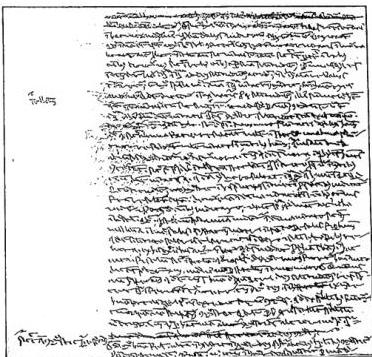
LIN. 8-11 ... sic q̄ die e res | alie ve q̄de dicut i suis natis q̄ q̄ stiludiez illi s̄ume n̄ kit | q̄ e ipā vitas cū sit sui
[CORR.MARG. illum] ee ita id qd p̄ aiaq̄ q̄ntū e v̄ e | q̄ illi sic die vitatis q̄ dā q̄nscit stiludo q̄dā existit i ipō
LIN. 31-32 ... Un n̄ p̄ hac via alit q̄nscit dā alituri m̄ p̄ q̄ [CORR.MARG. sic cā q̄nscit p̄ effom] | p̄ via d̄n̄n̄s q̄ utit sic
sic spectate ad dei q̄ neg e
(phot. and drawing Enc. Catt.)
KNOWLEDGE - Autograph of St. Thomas (c. 1263) of the C. Gent., III, 47 (ed. icon., XII, 127b28-128b26) - Vatican Library, cod. Vat. lat. 9850, f. 49ᵃ, lines 1-32. Diplomatic transcription of the Leonine Commission of St. Sabina.
(cf. Sum. Theol., q. 54, a. 4 and passim). The agent intellect, however, is a virtue proper to individual human intellects: it is immanent, not transcendent. And yet, as the principle of the universal and of the absolute, the agent intellect is in man an argument for a transcendent derivation and causality. In the final analysis, even for St. Thomas intellectual knowledge is not explained except by recognizing in the active principle of the idea a "participation" ("quedam participata similitudo") of the infinite intelligence "in which are contained the eternal reasons of things." This concept is expressed by St. Thomas in different forms and in numerous passages, among which particularly Sum. Theol., 1ᵃ q. 84, a. 5 and C. Gent. III, 47 (the central text of this chapter is given here to facilitate the reading of the diplomatic transcription of the autograph, lines 8-11: "Sicut igitur animae et res uliae verae quidem dicuntur in suis naturis, secundum quod similitudinem illius summae naturae habent, quae est ipsa veritas, cum sit suum intellectum esse: ita id quod per animam cognitum est verum est in quantum illius divine veritatis quam Deus cognoscit, similitudo quaedam exsistit in ipso" [ed. leonina, XIII, p. 128 a 7-14]).
Another important point in Thomist gnoseology is the appeal to the self-reflection of thought as a critical method by which the intelligence becomes aware of its nature and functionality and therefore has certainty of truth, as an intentional "conformity of itself with things" (cf. De ver., q. 1, a. 9; q. 10, a. 12, ad 7; Perih., I, lect. 3, n. 6).
In Renaissance philosophy, particularly noteworthy for its acute intuitions is the gnoseology of Campanella, who reaffirms, against Telesio, the irreducibility of knowledge as consciousness to the physiological fact of sensation, and, together with St. Augustine, finds in the consciousness that the I has of itself ("sensus inditus") the fundamental identity of being and knowing (to know is, for the self-conscious subject as such, to be) and the intuitive experience of certainty (cf. Univ. Phil., I, 32).
In modern philosophy, the problem of knowledge is felt at first as an epistemological problem of the true scientific method (Galileo, Bacon), but very soon acquires its full gnoseological-metaphysical meaning (Descartes, Locke, Kant), assuming in some currents a totalitarian function with regard to the conception of the real and therefore, without qualification, of philosophy.
Descartes, insofar as he starts from the certainty of the self-conscious subject as the basis of science and philosophy, expresses the most fundamental tendency of the modern spirit,
18
DISSERTATIO
quærenda non autem rebus agendis totum me tradere volebam, putavi mihi planè contarium esse faciendum, & illa omnia in quibus vel minimam dubitandi rationem possem reperire, tanquam aperèe falsâ esse rejicienda; ut experire an illis ita rejectis, nihil præterea super-esset de quo dubitare planè non possem. Sic quia non-nunquam sensus nostri nos fallum, quidquid unquam ab illis hauseram inter falsâ numeravi; Et quia videram aliquando nonnullos etiam circa res Geometriæ decillimus errare, ac paralogismos admittere, sciebamque idem mihi posse accidere quod cuiquam alii potest, illas etiam rationes omnes, quas antea pro demonstrationibus habueram, tanquam falsâ rejecti; Et denique quia notabam, nullam rem unquam nobis veram videri dum vigilamus, quin eadem etiam dormientibus possit occurrere, cum tamen tunc semper aut ferè semper sit falsâ; supposui nulla eorum quæ unquam vigilans cogitavi, veriora esse quam sint ludibria somniorum. Sed statim postea animadvertis, me quia cætera omnis ut falsâ sic rejiciebam, dubitare planè non posse quin ego ipse interim essem: Et quia videbam veritatem hujus pronuntiati; Ego cogito, ergo sum sive existo, adeo cæream esse atque evidentem, ut nulla tam enormis dubitandi causa à Scepticis fingi possit, à qua illa non eximatur, credidi me turo illam posse, ut primum ejus, quam quærebam, Philosophiae fundamentum admittere.Deinde attentè examinans quis essem, & videns fingere quidem me posse corpus meum nihil esse, itemque nullum planè esse mundum, nec etiam locum in quo essem; sed non ideò illa ratione fingere posseme non esse; quinimò ex hoc ipso quod reliqua falsâ esse fingerem, sive quidlibet aliud cogitatem, manifestè sequi me esse: Et contra, si vel per momentum temporis cogitare de-fingerem, oriented, unlike the main current of ancient and medieval philosophy, toward subjectivity and immanence. But in Descartes, while the appeal to the immanence of the thinking subject ("cogito ergo sum": Disc. de la méth., part 4; Med., I) is sufficient to resolve the initial problem of certainty, the integral problem instead of objectivity, that is, of the conformity of our sensations and of our thought with reality, finds its solution only in the transcendent Principle, God, as the first cause of reality and of thought. The gnoseological criterion indeed that Descartes discovers in the "cogito" ("true is what I clearly and distinctly perceive"; objectively, the inclusion of one idea in another, of the predicate in the subject, of the "sum" in the "cogito") serves indeed to assure certainty, but only within the subjective sphere of the "res cogitans." The recourse to God (whose real existence Descartes thinks he can find in the thinking and doubting subject (Disc. de la méth., loc. cit.), frees the subject from immanence and assures the ontological foundation of objectivity, since God is posited as the metaphysical center in which being and thought are identified, and as the Principle from which both the world and human reason derive. Hence Cartesian "rationalism," for which human reason bears within itself the norm, and in part the very content, of certainty, truth and objectivity.
The rationalism of Descartes which, in its ultimate ontological grounds, was substantially in line with ancient thought, had its most significant developments in Malebranche, Spinoza, Leibniz. For Malebranche human knowledge is intuition of divine ideas. Since indeed material reality cannot act upon the spirit, and on the other hand the human spirit is not originally and in itself a completed act of knowledge, Malebranche concludes that therefore the intelligence cannot attain its object and idea anywhere other than in its own principle, in God. An absolute gnoseological apriorism that separates human intellectual knowledge from the world of empirical reality (whose existence is admitted only on rational principles), with the intent of transferring it onto the plane of absolute objectivity. Malebranche accentuated the Cartesian dualism; Spinoza resolves it in the monism of the single Substance which is the fundamental identity of God and the world. Knowledge is therefore seen in the perspective of absolute immanence: thought is a necessary mode of the Substance, which follows and reflects in parallel its other mode of being, extension. As such, knowledge is absolute truth and error counts only as a moment and inferior degree of knowledge (cf. Ethica, part 1, propp. 14, 21; part 2, propp. 1-6, 35). Analogous, in a certain respect, despite the substantial difference of the dualistic conception, is the gnoseology of Leibniz. Being, divided into the infinity of monads, is for itself radically conscious. Every monad indeed is, by its very spiritual substance, representative, in different degrees of clarity and distinctness, of the universe. The harmony that the supreme Monad, God, has "pre-established" between the representative act of individual spiritual units and the reality represented, explains together the objectivity, the unity and the universality of knowledge; the pre-established harmony thus serves as the objective a priori of knowledge and of thought.
But the Cartesian appeal to the self-conscious subject, together with the principle of the subjectivity of immediate experience (cf. Med., VI), also developed in a direction opposed to rationalism, that is, in the empiricist direction. In Locke, the positing of the gnoseological problem as prior to any metaphysical use of thought is explicit, in terms that foreshadow the Kantian formulations (it is well known that Locke's Essay was known to Kant). In the Essay concerning human understanding he indeed proposes to "inquire into the origin, certainty, and extent of human knowledge"; "the limits between opinion and science," with the aim "of discovering the powers of the intellect, how far they reach, to what things they are in some way proportioned, and where they fail us" (I, 1, §§ 2-4). In fact, "in the pretension of ranging over the immense ocean of being, human thought extends its inquiries beyond its own capacities, whence arise insoluble questions and disputes, fit only to confirm men in doubt and skepticism" (ibid., § 7). Consequently, the first step toward seriously answering the questions to which the intelligence is inclined is
(It. Enc. Catt.)
KNOWLEDGE - R. Descartes, Dissertatio de methodo, Amsterdam 1650, p. 28, with the well-known passage "Ego cogito, ergo sum." Rome, copy from the National Library.
"to take a view of our own understanding, examine our faculties and see what things they are adapted to." Locke's epistemology is therefore, in its intentions, a science of the possibilities and limits of human thought. Locke carries out his inquiry adhering to the pure psychological-genetic method of mental analysis and resolution (later pursued with solid results from the psychological point of view by Hume, Bentham, Stuart Mill), and completely neglecting metaphysical inquiry into the nature and absolute conditions of thought. The very method of Locke's inquiry therefore inclined toward empiricism, which in human knowledge sees nothing other than the more or less complex and stable organization of representations derived to consciousness from experience (II, 1, § 4). There is no innate idea or a priori object in thought: sensation and reflection (as the internal perception of the experiences and psychic states of the subject) are the sole source of all our representations. Simple relations and syntheses of representations bring into act the concept ("tree," "substance"), which therefore has no representative value of the essence of reality.
Locke's epistemology, while it represented a timely reaction to every form of innatism, strengthened in the living current of English philosophy the empiricist-immanentist principle (knowledge is limited to our ideas, nor can it go beyond them in extension and perfection, ibid., 3, § 6). This principle is developed into systematic conclusions in Berkeley's immaterialism, for which knowledge is not an apprehension of a reality exterior to the spirit (the material world has no existence in itself; its being consists in being perceived: Principles, § 3), but rather a divine impression of ideas in the human mind. In Berkeley (whose system represents the convergence of Locke and Malebranche), empiricism therefore borders on and in a certain way coincides with an absolute objective apriorism (transcendent, not transcendental). God indeed stands as the supreme objective consciousness who, through his ideas (understood no longer merely as concepts but, universally, as representations of any real object), is present in every human mind (in every finite spirit) and thus accounts for the unity of the representation of the world and the universality of thought.
Empiricism reaches its extreme consequences in Hume. The fundamental form of knowledge, at the sources of all our knowing, is the "impression," the strongest, most immediate, most original state of consciousness. From impressions derive the "ideas," which are like the continuation and echo of impressions in consciousness. The arising of ideas is referred by Hume to two faculties of the mind, memory and imagination: memory is pure reproduction; imagination, on the other hand, is a spontaneous function productive of ideas, which it forms and transforms through an active process of analysis and synthesis, association and dissociation (Treatise of Human Nature, I, part 1, sec. 3). In this procedure the imagination does not always follow its own free productive course: between ideas there in fact subsist intrinsic bonds and relations by which they spontaneously tend to unite in natural associative ties. By way of these relations the human spirit passes easily from one idea to another; it passes from the present impression to the idea or ideas that habit has connected to it (op. cit., I, part 1, sec. 4). On this psychological basis Hume constructs his phenomenalism, seeking in the pure associative structure of experience (for which it makes no sense to speak of different planes of depth and value) the origin of the fundamental ideas of substance, self, and cause. No original impression corresponds to the idea of substance: it is the pure "substratum" that the imagination places beneath a stable complex of "coexisting" ideas. This holds both for material substance and for spiritual substance, the self: the impressions of inner experience, however intimately analyzed, yield only phenomena and states of consciousness, never the self as a substantial principle. As regards the reality of experience, the self is nothing other than the total complex of states of consciousness (op. cit., I, part 4, secs. 2, 6). In this way Hume introduces the phenomenalistic principle into the self, dissolving it as a metaphysical principle; the "esse est percipi" is understood in the most rigorous sense as the identity of being with perceiving itself as experience. Finally, even "causality" as a relation of necessary derivation between cause and effect cannot be grounded: not a priori, since between the idea of effect and that of cause there exists no relation of identity (one can well think the beginning of an existence without including its cause in it); not a posteriori, because every original impression of experience, whether external or internal, gives only a "succession" of facts, not their relation of efficiency (cf. Treatise, I, part 3, sec. 14). The idea of causal connection arises through mere associative habit that binds together two phenomena constantly conjoined in experience: it is a psychological idea that has its subjective roots in an original inclination of the mind [feeling], not a real relation (op. cit., I, part 3, secs. 2-4, 14). The negative critique of the three fundamental ideas of metaphysics involved in Hume (at least in an agnostic sense) the reduction of the real to phenomenon: experience as a series of phenomena and conscious representations is the only reality of which one has certainty, without its being given to know in what relation these phenomena themselves stand to the I and to the source of being. The immanentist principle, with the undue confusion of the idea as subjective form with its object and the final reduction of the latter to sensation as a pure fact of consciousness, thus ended in Hume's subtle critique, of exceptional historical significance, in metaphysical skepticism.
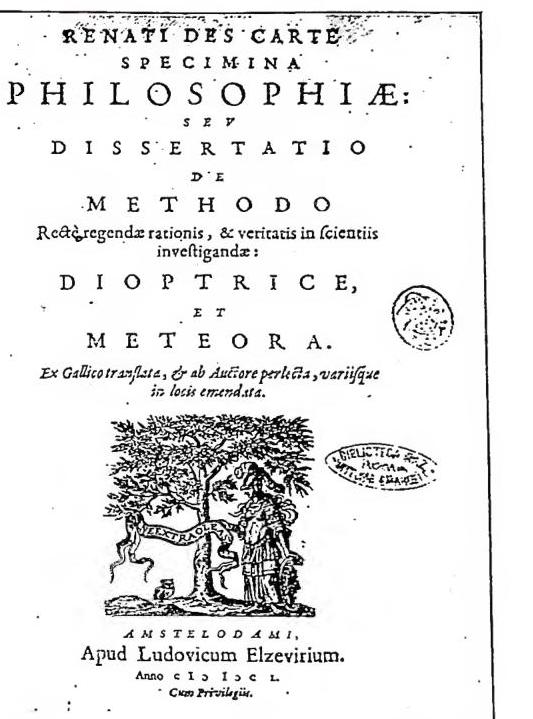
KNOWLEDGE - Frontispiece of R. Descartes' Specimina philosophiae, 2nd ed., Amsterdam 1630 (the 1st ed. is from 1644). Latin version by Étienne de Courcelles revised and corrected by the author. - Rome, copy in the National Library.
Kant, precisely with the aim of remedying skepticism and at the same time overcoming rationalism and Humean empiricism, takes up the problem of knowledge from its foundations and directs it, by the critical-transcendental method, in a new direction, the search for the structure and the a priori forms of our means of knowing. The great Kantian elaboration, carried out mainly in the first Critique, arrives at a conception of knowledge that is, in its specific form, new, even if in some of its aspects it was foreshadowed as far back as ancient sophistry. By it the concept of knowledge as "assimilation" of the subject to a reality given and predefined as object is definitively abandoned. Human knowledge is indeed an apprehension of objects, but insofar as these objects are brought into act by the very process of knowing. Knowledge is therefore "synthesis a priori," that is, the constructive activity of the subject that imposes on the matter of knowing the forms of its own subjectivity ("intuitions" of sense and "categories" of the understanding), which are in it prior to all experience and transcendental conditions of experience itself: space and time, and general concepts (existence, substance, causality, etc.), although applying to a matter that is beyond the subject (realism), thus express not the transcendent being of the object but the objective universality of the subject (transcendental idealism). In this way Kant intends to account for the universality of scientific knowledge by deriving it, in its formal structure, from the subject itself. Such a subject, principle and center of the representations of objects, and therefore of knowledge, is for Kant, in the final analysis, not the individual empirical subject (itself given and constructed by experience), but rather the "Consciousness in general" (überhaupt) or the transcendental unity of reason, the "I think." The Kantian epistemology concluded with the impossibility of metaphysics as science, since reality in itself (the noumenon), which is precisely the supposed object of metaphysics, does not fall within the scope of human knowledge, which by its very nature terminates in phenomenal representations. The objects of metaphysics — the I, the world, God — hold only as ideal terms of the unification of experience: they are a priori "forms" of reason to which no intuition corresponds in experience. The merit of the Kantian critique, besides having marked the condemnation of every rationalism that claims an aprioristic metaphysics, was to have — certainly not discovered, but brought fully into evidence — the character of activity intrinsic to knowledge, and therefore the requirement in the subject of an a-priori, as condition and form of this activity. A problem, one may say, fundamental for every adequate attempt to explain knowledge, ever since Plato. But the Kantian a priori, as objectivity pre-established in act in thought, went beyond the limits permitted by the phenomenology of human knowing, which attests the derivation of the object from experience. And moreover, with the positing of the "I" or "Consciousness" in general as the ultimate condition of the unity and universality of knowledge, Kant, while transferring the a priori beyond the individual human subject, nevertheless enclosed it in a sphere of abstract objectivity that no longer implied any relation of causality with the transcendent. The premises were thus laid for an interpretation of knowledge in an immanentist-idealist sense.
The solution of the post-Kantian idealist conceptions (which are no longer simple "critiques" of knowledge, but a metaphysical development of the postulates of criticism) consists in fact in having elevated Kant's "I think" to an absolute metaphysical position. In Kant the "Consciousness in general" was the supreme principle of the phenomenal representation of the world and of nature, that is, of their organization into an object in human knowledge: the "transcendental I" of the idealists ("Subject" in Fichte, "Absolute" in Schelling, "Idea" in Hegel, "Self-concept" in Gentile) is instead the eternal spiritual metaphysical principle of the world, of being and of consciousness; the principle therefore essentially active and autonomous from which, through a process that is at once real-ideal, ontological-logical, all reality proceeds, both phenomenon and noumenon. At the basis of the systematic elaboration of idealism is the principle already alive in modern philosophy since Descartes (and which Vico had developed in a realist sense by denying the possibility of a science that is not knowledge of the reality that the spirit itself posits, actualizing itself in history), namely that a reality, in order to become an object of knowledge, must not be extraneous to the subject, but must depend on it.
Particular prominence is deserved by the Hegelian system for its absolute immanentist-dialectical conception of the real and the vast influence it exercised on Italian idealism (Spaventa, Croce, Gentile [v. ATTUALISMO]). For Hegel the Spirit or universal Idea is the true concreteness of being; and the forms by which it internally determines and unfolds itself are at the same time the forms and categories of reality. It is the Idea that, through its immanent rational process, gives consistency to the real which, in this way, is resolves itself in the very becoming of the Spirit (historicism). Dialectic is the essential structure of the spiritual process, and contradiction the inner soul of dialectic: every position, moment and category of the spirit and therefore of reality, by the immanent instability that pervades it, tends naturally to resolve itself into negation, which in turn posits itself as the principle of a further dialectical process, and so on without end in the rhythm of the spirit. Beyond the apparent multiplicity of dialectic and of history is the fundamental unity of the spirit, a synthesis of all opposites (absolute-relative, infinite-finite, universal-individual, substance-accidents, etc.), which it feeds from its living spiritual source. The gradual forms by which dialectic unfolds in the world follow the ideal process of the Spirit which, from its original identity externalizing itself in the necessity of nature, through this attains the clarity of absolute self-consciousness. C. is then, in Hegel, the process by which the Idea, having overcome the antithesis of objectivity and subjectivity, brings identity into act (Encycl., §§224-225). It is theoretical activity by which the idea negates the one-sidedness of its subjectivity by receiving the world into itself as content (ibid., § 225). But since the world is in itself and for itself the Idea, and it itself "through activity produces its reality" (ibid., § 235), so knowing is the very doing of the intelligence as theoretical spirit. C. is therefore absolute realizing activity, absolute positing of objects. As is clear, in Hegelian monism c. no longer holds, substantially, as a fact of individual thinking subjects; it is the summit of the absolute dialectical process and therefore its belonging and referability is infinite. Its meaning is radically different from that which it had in the traditional dualist conception. Once the individual human subjects are unified in the absolute Subject, as moments of its becoming and of its cosmic realization, they lose their personal autonomy and together with it the authentic value of subjects as such. Human thought, while thus apparently being transferred to absolute significance, by its substantial identity with the single spiritual principle of the world, is swept up in the irreversible process that the Absolute carries out in history.
Idealism had attempted to rationalize experience in the transcendental absolute. For positivism, on the other hand, experience in its empirical character is the only authentic value of reality and of c. from which our most solid knowledge is constructed; and vain is a metaphysical inquiry that claims to go "beyond" experience. For Taine and Ribot, consciousness is a mere "epiphenomenon" of a form of natural reality, that is, of the physiological facts of the nervous system; and the spirit is nothing but a flux of sensations and perceptions. For Ardigò, consciousness is the expression of an original undifferentiated reality, a synthesis of the physical and the psychic. A similar conception is found in F. Lange and W. Schuppe, for whom consciousness is the pure psychic aspect of a single fundamental reality, unknown in its deep determination. Spencer seeks the solution of the problem of c. in evolution, attributing to its genetic processes and to hereditary transmission the arising and the stabilizing of the forms of consciousness and of thought, which then in the individual present themselves as original and a priori structures; even though Spencer acknowledged, beyond experience, an absolute reality, in itself unknowable. The value of experience as such is emphasized in E. Mach and in R. Avenarius, who highlights the primitive unity of "pure experience" in which the dualism of object and subject, reality and consciousness, is resolved and overcome; and in Ch. Renouvier, who reduces positive reality to the phenomenal world of consciousness, even though such a phenomenal world is open to a possible overcoming of itself through the value that represents the subject as will. With Condillac, and then with Diderot and Helvétius, positivism concludes in pure materialistic sensualism, for which there no longer subsists any true metaphysical problem of c., which is an adequate product of matter in the highest degrees of its organization.
But the Hegelian system itself had given rise, through the "left," to materialistic developments. Idealism in fact, by its absolute immanentist resolution, is already at the borders of materialism. Feuerbach, taking up the position of traditional materialism, sees in consciousness and in the idea an externalization of nature, a reality arcane and profound in which man, with all his spiritual being, sinks his roots. From this fundamental presupposition, and by inserting the Hegelian dialectic and its historicist conception of reality into the materialistic schema, Marx's dialectical materialism was constructed. Consciousness is not an ideal and metaphysical "prius" of reality (Hegel), but instead a naturalistic product of it. Eternal matter, without beginning and without end, has arrived through dialectical leaps at the brain, to which consciousness properly belongs: this, while representing an aspect radically different from extension, is nevertheless in matter, as its own and highest property, nor does it transcend it. It is, at bottom, the "subjectivity" that accompanies the "objective" processes that take place in the brain. But what, beyond the generic materialistic base, most characterizes the theory of c. in Marx and in the last theoretical continuators of Marxism (cf. G. A. Wetter, Il materialismo dialettico sovietico, Turin 1948, especially ch. 5, pp. 335-89) is the interpretation of c. itself in function of the social fact. Consciousness in fact, as Feuerbach already held, properly belongs not to the individual, but to social man. The modes therefore and the forms of consciousness and the values that through it are brought into act are in function of the social being of man and, consequently, of all the factors, causes and conditions on which society depends. And since society, its forms, its developments are essentially in function of economic facts (labor, wealth, modes of production of wealth and the consequent economic relations between classes), so too c. and its values depend ultimately on economic facts and values. It is in this its "historico-social" class-determined concreteness that, according to Marx, human c. qualifies itself from within and assumes its specific objectivity and meaning. It is evident that this objectivity and meaning are relative. In reality, in fact, there is nothing absolute but the dialectical process of the world and of c. itself; on the contrary, every single moment and degree of c. is unstable and relative, both in relation to its object in becoming and to the conscious subjectivity itself, which is also in dialectical becoming in the world and with the world. Categories and concepts are immersed and channeled into social historicism and therefore into economic praxis: truth and falsity are always conjoined in every idea, category, fact, reality, by virtue of the dialectical process that submerges aspects, brings others forth, and these again dissolves in a perpetual rhythm. The only absolute aspect that Marxism recognizes in c. (but in this the contradiction is already involved) is its having discovered and recognized the laws of the dialectical process.
Alongside the movements that were more directly influenced by German idealism, the spiritualist current reasserted itself, particularly in Italian thought of the 19th century. Bonatelli, in the ontological-gnoseological identity of self-consciousness as a spiritual act, and in the infinite dimensions that it potentially encloses, founds the affirmation of the transcendent Principle. Galluppi, in line with St. Augustine and Descartes, seeks in self-consciousness the first reality, the "shore of existence"; and, avoiding on the one hand empiricism and on the other Kantian transcendentalism, he restores to the concreteness of experience the foundation of the ancient categories, first of all substance and cause, while still recognizing the active and mediating function of the intellect that posits them in act through judgment. Rosmini, with the aim of valuing in a Christian sense the demands of criticism, sees in the idea of being the one and supreme form of thought, by which experience is organized into intellectual knowledge. This is an ideal form, not pure subjectivity; almost a perennial intuition of thought, a universal value, which presupposes as its foundation being for itself, God. The idea of being is therefore at once the objective reason for the spirituality of the human subject and the a priori condition of every intellectual knowledge. Gioberti attempts to overcome Rosmini's ideal being by identifying it with the first "Entity," the ontological principle of the world and of the "existing." The human spirit is thus, for itself, in the immediate intuition of being and therefore of truth: a fundamental intuition that is like the a priori of all our knowledge and illuminates from above even perception and sensible knowledge.
The most recent movements of thought, while feeling the broad influence of immanentist idealism, sometimes reconnect directly to criticism by developing one or another of its conflicting motifs. To the negative result of Kantian critique and its declared impossibility of metaphysics are linked the recent anti-intellectualist currents, which share the persuasion of the constitutional insufficiency of conceptual thought to master reality and resolve its problems, such as neo-positivism, the various forms of relativism and agnosticism, pragmatism (James), intuitionism (Bergson), and earlier still traditionalism; these either have renounced metaphysics in the strong sense of the word (turning to life, instinct, existence), or have attempted to reach it by other paths on this side of or beyond the logical-rational processes of thought. In this direction there have been developments of the positive aspects that criticism contained in the Critique of Practical Reason. Blondelian actionism (and other analogous currents), without taking anything away from what is original and new in them, can be considered a valuing in a metaphysical sense of the demands that were already recognized by Kant as "postulates" in action and in the moral problem. In existentialism the problem of knowledge assumes a secondary function, insofar as it too is a function of supposedly more fundamental tendential factors, such as "anguish," "situation," "choice," etc.
In the reduction to absurdity of modern thought as self-consciousness and absolute immanence, and in its failing the historical test, U. Spirito sees the reasons for a new spiritual attitude, "problematicism." It asserts itself as a theoretical position of pure recognition of the problem encountered at the bottom of every process of thought. Problematicism is not skepticism insofar as, while admitting the possibility of a doubt that invests all theoretical and practical values, it is nevertheless a commitment to research, "capable of perceiving the radical inadequacy of an I that knows how to possess neither itself nor reality, and to which there remains only the confession of the consciousness of the limit and the hope of surpassing it" (Il problematicismo, pp. 51-52).
The more strictly Catholic thought of the last century, expressed in the neo-scholastic current, has devoted extensive studies and research to the problem of knowledge. In general it may be said that the many solutions do not present substantial differences, insofar as, by different paths, they all end in the conception of knowledge as an objective "assimilation" — even if imperfect — by a spiritual subject, participated and finite, of a reality independent of it as regards its being, which derives its knowability and intelligibility from the transcendent Rationality, principle and cause of reality itself and absolute identity of being and thought. While the more recent research has produced not a few valuable studies in relation to the metaphysical deepening of knowledge and the critique of gnoseological systems, principally of Kantianism and idealism, numerous investigations have been directed to the solution of the so-called "critical problem," that is, to the search for a critically valid way to ensure the value and objectivity of knowledge in general. Essentially a problem of method, and therefore of undisputed importance, the critical problem has thus been able to receive numerous formulations and solutions, though sometimes of relative value with respect to the metaphysical problem that remains the principal exigency of a theory of knowledge. The gnoseology of the first neo-scholastics (Balmes, Liberatore, Cornoldi, Sanseverino, Farges, Tongiorgi, Palmieri, and later Remer, Gredt, Hugon, etc.) was predominantly anti-skeptical and anti-Kantian in function. For them, in general, the critique of knowledge has a relatively modest task of ascertaining and discerning true knowledge on the basis of the first principles of the metaphysical-logical order and the criterion of evidence (v.). Not sufficiently discussed, even if perceived (Balmes), was the more radical problem concerning evidence itself: what its metaphysical foundation may be; how the "true" evidence can be discerned; whence the frequent character of subjectivity that accompanies it. Mercier attempted a partly new path, approaching the Cartesian starting point and establishing the first certainties in the objective value of the principles of the ideal order.
The various "critiques" of knowledge that followed, numerous in the last fifty years and sometimes of undoubted originality, can be reduced to two general tendencies (even though it must be noted that this classification is inevitably approximate in certain respects and should not be understood with the strict value of an antithesis, on account of the substantial agreements that not infrequently exist among the various authors beyond the predominantly methodological differentiations): the first, which is founded on experience and from the analysis of it draws conclusions about the meaning and value of knowledge; the other, which seeks the solution of the gnoseological problem by starting from the objective content of intelligible values (concepts and principles). Since experience is manifold (sensitive, intellective, subjective, objective, intuitive, theoretical, practical, mystical, religious), the first tendency has given rise to and gives rise to different orientations. In general, the fragmentary, passive and contingent character that accompanies human experience is emphasized, in order to conclude to a transcendent reality and rationality (in both a gnoseological and a metaphysical sense) which may serve as an adequate explanation of it, and therefore to the apprehensive value of knowledge. Particular importance is often attributed to the experience of the I as a spiritual subject of intelligence and will and therefore with an immanent and dynamic relation toward the infinite. Belonging, among others, to this first tendency, albeit with significant differences of approach and method, are De Vries, Noel, Picard, Veuthey, Brunner, Zamboni, Padovani, Stefanini, Guzzo, Vanni-Rovighi, Morandini. The second tendency founds the value of knowledge either in the objective meaning of the idea of being (Lepidi, Gondell, Roland-Gosselin, Olgiati, Garrigou-Lagrange, Jolivet), or in the gnoseological meaning of judgment, whether as the expression of universal objective truth (Rickaby, Sentroul, Romeyer), or as a universal assertive synthetic function in which the objective transcendental conditions and exigencies of human knowledge are revealed (Maréchal).
The two tendencies of Neoscholastic thought that have been indicated reveal two fundamental attitudes that are in part divergent: the one strictly gnoseological, which insists on the absolute priority of the critical moment over the metaphysical one (and consequently of the problem of knowledge over that of being), and therefore within knowledge and through it seeks to reach being and metaphysics (Zamboni, Picard, De Vries, etc.); the other, which defends the priority of the metaphysical moment, in which the critical exigency itself is inserted and finds its absolute justification: it is the problem of knowing that passes into being, that is found within being (Garrigou-Lagrange, Maritain, Masnovo, Olgiati, etc.). Between the two attitudes a third position is gaining ground, which does not aim at the resolution of the critical moment into the metaphysical one or vice versa, but recognizes in both a priority in their own field. This is to be understood in the sense of a "convergence" and mutual foundation, inasmuch as the phenomenology of knowing introduces one to metaphysics, but metaphysics in turn gives the ultimate ground and meaning of the phenomenological functions, structures and contents (Fabro, Rahner). Such a position seems to correspond to the essential structure of human knowing, identified by Aristotle and St. Thomas in the "conversio intellectus ad phantasmata."
2. Problems
The exceptional historical development of the theory of knowledge and the depth to which it has pushed philosophical inquiry are in themselves an argument for the legitimacy of its claims and its problems. Such legitimacy should not give rise to contestation, when one considers even briefly the centrality of the problem of knowledge, whose solution is indispensable in order to be able to proceed to a valid theoretical knowledge of ourselves and of the world, and therefore to a consistent solution of the problem of life. The theory of knowledge is justified precisely as an inquiry into the meaning of experience and of integral human knowledge, in relation principally to the question of the possibility of metaphysics, that is, of an absolute theoretical system of reality. And since human knowledge is an empirically complex fact, the theory of knowledge can neither must identify itself with any of the particular gnoseological problems, but rathermust be a methodical examination of all the substantial problems that concern knowledge. There are conceptions of the theory of knowledge that are partial and therefore inadequate, and these must be rejected. Thus it cannot be reduced to the abstract problem of certainty and truth. For since the planes of human knowledge are manifold and certainty and truth are adapted to them, a solid theory of knowledge must pose the problem of truth and certainty in concreto, that is, in relation to the various forms and modes of knowledge and their intrinsic meaning. Nor can the theory of knowledge be identified with the problem of the passage from subject to object (the question of the "bridge"), and therefore with the problem of the existence of external reality. Such a framing of the gnoseological problem betrays the gratuitous postulate of the subjectivity and immanence of experience, which is at the basis of so many modern gnoseologies that are too yielding toward idealistic principles. Nor is the theory of knowledge the abstract problem of error or of the criterion of truth. For the problem of error comes after the positive inquiry into the possibilities and validity of knowledge, nor are there criteria of truth distinct from the intrinsic characters that truth itself presents in the different objective planes of knowledge, in which it is distributed.
The theory of knowledge is the reflected philosophical inquiry into the forms and structures of knowledge in order to establish critically its value and therefore to pass to a metaphysics of knowledge in general, of man and of being. Its problems are therefore defined and organized in relation to the entire scope of human knowledge: what in general is the meaning of experience; what the objects of sensible knowledge and those of intellective knowledge, the concepts, ideas, principles, really represent; what value the metaphysical notions of being, substance, cause, I, spirit, God have; what the content and validity of the fundamental categories of the scientific, aesthetic, ethical and religious orders are; what the value of the different logical procedures of deduction and induction is; what meaning the historicity of human thought presents; what, in any order of knowledge, are the parts of the subject and those of the object in the genesis and therefore in the structure of cognitive representation; what problems arise from the data of human experience; what gnoseological-ontic structure the data of experience presuppose in the subject; what therefore are the ultimate metaphysical conditions of experience and knowledge, and what value the spirit has in the world. As is clear, a concrete solution of these problems also resolves, by a solid analytic-synthetic process, the questions of truth, certainty, error, objectivity, and the possibilities and limits of human knowledge. Thus the position of the theory of knowledge is delineated in its relations with the other philosophical disciplines with which it shares the field and the material object of inquiry. It cannot be confused with logic (understood in the traditional sense as "pure" or "formal"), which establishes analytically the laws of formal thought but ignores the question of its value as expression and objective adequation with reality. Nor can it be resolved into psychology, which is the study of the genesis of knowledge and of thought as a psychic process; even if the methods of such inquiry are an indispensable aid to gnoseology. Nor is it, in the positing and solution of its initial problems, a metaphysics properly so called, inasmuch as it has precisely the task of leading one toward metaphysics by establishing the meaning of the cognitive processes.
But, for the same reason, every theory of knowledge necessarily opens and is completed in metaphysics, inasmuch as, in investigating the conditions, the principles, and the value of knowledge, it cannot but imply a theory of being which, founded as a dialectical exigency by the fact of knowing, in turn holds as the absolute and metaphysical foundation of knowledge itself.
A question that in the theory of knowledge seems to present itself with a particularly thorny character, and has therefore given rise to endless discussions both in Catholic thought and in other currents, is that of method. Since evidently one cannot make a theory of knowledge except by making use of knowledge itself, a critical examination of the value of knowledge would not seem possible, inasmuch as that value is already implicitly presupposed by the inquiry itself. In reality the antinomy is more apparent than real, since it is caused by an inexact formulation of the problem. For sometimes the problem of knowledge is posed in the general form "whether human knowledge has a value." Now, that human knowledge has a value, for example in the vast order of common experience and of scientific certainty, is not a problem but a fact which the most immediate critical reflection of thought is sufficient to recognize and to raise to the level of a theoretical affirmation, and which therefore cannot be called into question: it is not a matter of knowing whether human knowledge has a value, but of how far that value extends. Already St. Thomas noted "veritatem esse in communi est per se notum" (Sum. Theol., 1ª, q. 2, a. 1 ad 3). The problem of knowledge offers in itself positive data that must constitute the foundation and the starting point of epistemological inquiry. Such are: the very existence of human knowledge, its history, its realizations in practice, in science, in philosophy; the certainty that each one has of the facts of his own experience; and finally the reflection of the philosopher who poses the problem of knowledge. To ignore these data in order to attempt a methodical beginning from universal doubt is absurd. The very problem that imposes itself on the philosopher's consciousness and entails a clear knowledge of what is meant and sought; and the nature of thought, which is by essence affirmation and tolerates no absolute negative state, are the most decisive condemnation of such attempts, which have never, moreover, seriously troubled the greatest thinkers and which are today generally abandoned by neo-Scholastic epistemology. The critical problem, were one to understand it in its broadest and least pregnant expression, as a general interrogation about the possibility for human thought of a true knowledge, is radically resolved in the self-reflection of thought which becomes aware of its intending, its doubting, its seeking, and in this awareness, as moreover in every judgment of existence about the facts of experience, has consciousness of its absolute conformity to reality: at least to that of its own experience. Nevertheless, it is one thing to reject, as a principle of the theory of knowledge, universal doubt, and to affirm or presuppose the universal validity of human reason in any sphere of objects and problems; it is another thing to affirm in general the possibility for human thought of a true knowledge, and the certainty of objectivity and truth in whatever direction human thought commits its forces: for this purpose a methodical and systematic examination of knowledge and of its structures is indispensable. Therefore, while it seems that every epistemology must be rejected which starts from undue dogmatic presuppositions, for example from the metaphysical value of concepts and judgments and of the knowing subject itself (the principle of finality presupposed as the ontological norm of the faculties of knowing), those epistemologies are also insufficient, because they neglect an integral examination of human knowledge in its complex organization, which start from and develop out of a single datum of experience (generally the certainty of the self-conscious subject and its character of ontological contingency).
The true method for a solid theory of knowledge (and this is today more and more generally admitted) starts from a systematic examination of knowledge, and therefore, first of all, from a phenomenological description, or objective analysis, of consciousness and of experience, in all its presentations (sensible, intelligible, spiritual, intuitive, abstractive), developments and implications. Such a method is critically justified because it implies no theoretical presupposition beyond the factual data of the problem. Nor is the value of critical reflection affirmed in advance in the abstract; rather, it is the results of reflection that make themselves valid in concreto through their objective clarifying within consciousness: the phenomenological examination in fact does not entail discursive procedures of reason, but rather it is experience itself that through the reflective process comes to clarify itself in its noetic content. And even the first principles, which in their formal value are an internal condition of thought, clarify their own ontological value by way of the discovery of the objective content of their respective terms, effected by phenomenology. The phenomenological description traverses the different forms, orders, structures, moments and objects of knowledge; it investigates their conditions, both objective and subjective; it sees knowledge in its genesis and in its historical becoming and in its organic insertion into the integral human fact, individual-social, theoretical-practical, logical-affective, as well as psychic, biological, cosmic. In this way it unveils the complexity of epistemological problems and places them in their real-concrete perspective, investigating and identifying the multiple factors involved in the fact of certainty, of truth, of error; and in conclusion it avoids in the treatment of the problem of knowledge all abstractism and virtuosity. Phenomenology moreover does not limit itself to data, but passes spontaneously to a higher stage, namely to problematic positions. In fact the analytic discovers in experience contents and situations of the object and of the subject that open into problems, which belong to experience because they are posed by it, but at the same time transcend it because they find in it no adequate solution. The analytic of experience is thus transformed into a "dialectic" of the same, and to the descriptive-critical method is added the transcendental method which investigates the necessary conditions in the object and in the subject and, if need be, beyond these, in order to explain experience.
A theory of knowledge that develops according to these directives of intent and method seems necessarily oriented toward realism and toward transcendence. The first character indeed that it reveals in the structure of human consciousness is its intrinsic potentiality and its gradual constituting in time in function of the objective contents of sensibility. The critique that empiricism, in agreement on this point with Thomist thought, has directed against the various forms of innatism in the name of the concrete analysis of experience, is definitive. The human intelligence has no contents a priori in act: its contents, ideas, concepts, principles, and consequently every synthesis and elaboration of them, are brought into act in dependence on and continuity with the data of experience. These data, in turn, are a function not of the autonomous becoming of a "pure" subjectivity (which phenomenology shows to be nothing other than a systematic abstraction), but of the manifold perceptual relations that subjectivity comes to actualize with the world and reality, including therein its own empirical-psychic reality. The error of empiricism, derived from the insistence of a methodical process, isolated to a partial aspect of experience, outside its solid and living concreteness, was the reduction of the datum to "phenomenon." Such a reduction presents itself as an unjustified mutilation of experience, whose meaning of contact and relation with reality (albeit through subjectively structured forms) is evident in the perceptual character of sensation. Moreover, the datum of experience in general, merely by being posited in an intellective consciousness, passes over into ontological value: its very phenomenality (understood here as "presence" of data), in the more or less dense planes of values and contents in which it is situated (from that of a simple psychic state such as, for example, a feeling, an emotion, to that pregnant with a personal reality that stands before us and opposes us as an enemy force), insofar as it is given in a thinking consciousness, transcends itself as phenomenon, clarifying itself in its structure of being.
The concept of being (which is at one and the same time the keystone of gnoseology and of metaphysics) can in this way be said to be both a posteriori and a priori. Being, in fact, is not posited as a positive content (being in the strong sense, as an actual act of existence determined in an essence), except insofar as the potentiality of thought is actualized in experience, and precisely in the measure of the objectual intensity of experience itself. But it also has something of the a priori insofar as it is at the center of the intelligence as its transcendental relation to the absolute: an ontological structure of thought that in itself constitutes itself in a radical objectivity. The objectivity of the concept of being has, consequently, a double foundation or, if one prefers, a double meaning: as "value" (the first and most absolute value on which every other value depends), being constitutes the very essence of the intelligence as the power to think the object, and is therefore a universal objectivity that is prior to and independent of contents; whereas as a noetic concept in act, being is determined, for the human intelligence, in the contents that consciousness draws from the world; and it therefore has a "founded" objectivity that is measured against experience. Human intellectual knowledge thus reveals itself as the progressive and historical actualization of a universal potentiality that is at once a passive and an active principle, insofar as it finds in a transcendent reality (in the gnoseological sense) its ontic contents, but universalizes these contents in the absolute value of being, present in thought as an a priori theoretical structure and radical objectivity.
The solution thus envisaged (and which seems to respond to the legitimate demands of both empiricism and rationalism) explains the two fundamental characteristics that human knowledge has constantly revealed to philosophical inquiry, determining precisely, now and again, the prevalence of empiricism or of rationalism: on the one hand its universality, evident in all the absolute values of truth, both theoretical and practical, realized by human knowing, from primitive and spontaneous knowledge to the most mature philosophical conceptualization; on the other hand its empirical character, evident in the essential character of historicity of thought, in its indefinite dialectical rhythm, destined to last as long as the concrete existence of man lasts. Universality is explained by the absolute structure that lies at the roots of thought as the relation of consciousness to being; empirical character is clarified, on the whole, by the becoming of experience, in which the potential structure of human thought is destined, by its very nature, to be actualized. Similarly, it is the absolute structure of thought that accounts for the general conditions of metaphysics, present in every human self-consciousness in the clarity and distinctness of the concept of being and of the first principles included in its positivity; while the essential reference to experience explains the difficulty, for human thought, of actualizing a metaphysics complete from the point of view of the integral demands and principles of being.
Phenomenology, while on the one hand it thus clarifies human knowledge as a progressive conforming to an object and to its necessities, on the other hand, by bringing out the character of universality and absoluteness that must be joined to intellective knowledge (both in its conceptualizing function and in the assertive one of judgment as an unconditional affirmation on the plane of being), poses the problem of the absolute derivation of thought. It is, as could be discerned from the historical exposition, the most serious metaphysical problem posed by human knowledge and experience. Kant and almost all of modern philosophy have attempted its solution on the purely transcendental plane, understood either in an objective sense (the Absolute, foundation of human thought as necessity and abstract rationality: Kant and recently in Italy Carabellese), or in a subjective sense (the Absolute, foundation of human thought as an infinite Subject immanent to it: idealism). But both solutions prove insufficient: the first, because an objective rationality without a subjective Consciousness is inconceivable, as the idealists well saw; the second, because in its substantial identification of human thought with the Absolute it does not respond, as was already hinted above, to the real conditions of experience and of the human subject. The I, in fact, in the clear awareness of consciousness, while it perceives its unity and positive personal individuality, has at the same time the unequivocal experience of its insufficiency, of its dependence, of its effort, of its tendency, never adequately realized, toward an infinite objective actualization in truth and in good. Then the ultimate answer to the problem of knowledge can be glimpsed only in the perspective of a transcendent Rationality as supreme Subject and Object: which may serve, as Augustine and St. Thomas intuited, as the metaphysical principle of the human intelligence and of its transcendental structure; and at the same time as the ultimate term and measure of its possible actualization.
BIBL.: sources
I. CLASSICS: For the Presocratics see the collection of Fragments of Diels (for the sophists the recent edition of M. Untersteiner, Sofisti, I, Florence 1940). Of Plato see especially Parmen; Theat.; Respubl. (VI-VII); Phaedr.; Menon. Of Aristotle see especially De
De anima: De sensu et de sensato; Met. (IV, 3-7; XIII, 4-5); for the Stoics and Epicureans see the collections of Fragments by H. von Arnim and H. Usener. For the Skeptics see Sextus Emp., Pyrrh. Hypot. and Adversus Math. For Plotinus see Enn. (especially V-VI). For St. Augustine see Contra Acad.; De vera rel. (from ch. 29); De diversis qq. 83 (esp. q. 1, 46, 54); Confess. (IV, VII, X); De Trin. (from I, VIII); De Civitate Dei (VIII-XII, XIX, XXII). For St. Thomas see Sum. Theol. (especially 1st, qq. 14-17, 54-58, 58-79, 84-89); C. Gent. (II, 58-78; III, 33-63); Q. disp. de anima; De verit. (especially qq. 1-10); In de un.; De sensu et de sensato; De unit. intellectus v. Avers.; De natura verbi intellectus (doubtful); De differ. divini verbi et humani; De intellectus et intelligibili; De intellectus respectus universalis (these 3 opuscules are spurious but drawn from works of St. Thomas). For Bacon see the Novum organum. For Descartes see especially Discours de la méthode; Meditationes (with objections and replies) and Principia philosophiae. For Locke see the cited Essay. For Berkeley see, besides the Treatise on the principles of human knowledge, Three dialogues. For Malebranche see De la recherche de la vérité. For Spinoza see Ethica (part 2). For Leibniz see Meditationes de cognitione, veritate et ideis and especially Nouveaux essais sur l'entendement humain. For Vico see De antiquissima italorum sapientia (sec. 1). For Hume, besides the cited Treatise (I, 1), see Inquiry concerning human understanding. For Kant, besides the three Critiques see also Prolegomena zu einer jeden künftigen Metaphysik. For Fichte see especially Grundlage der gesamten Wiss. lehre. For Schelling, Der transcendentale Idealismus. For Hegel, Wissenschaft der Logik; Enzyklopädie der phil. Wissenschaft. (especially III, §§ 160-244, 377-86) and Phänom. des Geistes (especially I). For Schopenhauer see Die Welt als Wille und Vorstellung (especially II). For Hamilton, Lectures on Metaph. and Logic. For Spencer, First principles (part 1). For Stuart Mill see especially Examination of the Hamilton's philosophy; System of Logic (I, chaps. 3, 7). For positivism see also A. Bain, The senses and the intellect; H. Taine, De l'intelligence. For Ribot, L'évolution des idées générales. For traditionalism see V. De Bonald, Recherches philosophiques sur les premiers objets des connaissances morales; L. Bautain, L'esprit humain et ses facultés. For Marx see especially Zur Kritik der Nationalökonomie. For Bonatelli see Pensiero e c.; La coscienza e il meccanismo interiore. For Rosmini see especially Il Nuovo saggio e il rinnovamento della filosofia. For Galluppi, Saggio sulla critica della c.; For Gioberti see Protologia (essays I, III, IV) and Introd. allo studio della filosofia. (ch. 4). For sensualism see E. Condillac, Essai sur l'origine des connaissances humaines; H. C. Helvétius, De l'esprit. A. De Tracy, Éléments d'idéologie; J. De la Mettrie, Histoire naturelle de l'âme. For 19th-century Catholic thought see J. Balmes, El criterio and Filosofía fundamental (I); J. Kleutgen, Philosophie der Vorzeit (I); M. Liberatore, Della c. intellettuale; P. Zigliara, Della luce intellettuale e dell'ontologismo. For pragmatism see W. James, Pragmatism; The meaning of truth. For Bergson see L'évolution créatrice; Matière et mémoire; La pensée et le mouvant. For Blondel see L'action et la pensée. For Croce see Logica. For Gentile see Teoria generale dello spirito come atto puro; Logica. For existentialism see, among others, K. Jaspers, Von der Wahrheit. Munich 1947.
II. HISTORY: N. Kaufmann, Die Erk.lehre des hl. Thomas v. Aquin. Fulda 1889; J. Beare, Greek theories of elementary cognition from Alencon to Aristotle. Oxford 1906; E. Cassirer, Das Erk.problem in der Philosophie u. Wissenschaft der neueren Zeit, 3 vols., Berlin 1906 ff., (I, 2nd ed., 1910; III, 1920); D. Lanna, La teoria della c. in s. Tomm. d'A. (bibl., pp. 291-300), Florence 1913; B. Källa, Die Erk.lehre des hl. August., Sarnen 1920; E. v. ASERAH, Gesch. der neueren Erk.theorie, Berlin 1921; K. Dürr, Wesen und Gesch. der Erkenntnis, Zurich 1924; M. Grabmann, Der göttliche Grund menschlicher Wahrheitskenntnis nach Aug. und Th. v. A., Münster in W. 1924; P. Rousselot, L'intellectualisme de st Thomas, 2nd ed., Paris 1924; R. Kynast, Logik und Erk.theorie der Gegenwart, Berlin 1930; id., Gesch. der Logik und Erk.lehre, ibid. 1932; J. Hessen, Augustins Metaphysik der Erkenntnis, Berlin-Bonn 1931; P. Wilpert, Das Problem der Wahrheitsicherung bei Th. v. A., Münster 1931; A. Hufnagel, Intuition und Erkenntnis nach Th. v. A., ibid. 1932; Bl. Romayer, St Thomas et notre connaissance de l'esprit humain, 2nd ed., Paris 1932; G. Siewerth, Die Metaphysik der Erkenntnis nach Th. v. A., Munich-Berlin 1933; L. Keeler, The problem of error from Plato to Kant, Rome 1934; G. Zamboni, La gnoseologia di s. Tommaso d'A., Verona 1934; H. O. Gardell, Les grandes étapes de l'idéalisme, Paris 1935; K. Rahner, Geist in Welt. Zur Metaphysik der endlichen Erkenntnis bei Th. v. A., Innsbruck-Leipzig 1939; J. Santeler, Der Platonismus in der Erk.lehre des hl. Th. v. A., Innsbruck 1939; C. Boyer, L'idée de vérité dans la philosophie de st Augustin, 2nd ed., Paris 1941; J. Maréchal, Le point de départ de la métaphysique, I-IV (extensive historical-critical study), ibid. 1942-49; G. Van Riet, L'épistémologie thomiste (on the theory of knowledge in Thomist Neoscholasticism), Louvain 1946. Further bibl. (with particular reference to journal articles) for the theory of knowledge in St. Augustine, in Scholasticism in general, in St. Thomas see in C. Giacon, Filosofia (Guide bibliografiche, II, 3), Milan 1943, pp. 32-34, 55-56, 125-31.
III. STUDI COMPLESSIVI: W. Schuppe, Grundriss der Erk
theorie und Logik, Berlin 1894; E. Domet de Vorges, La connaissance, Paris 1895; J. Rickaby, First principles of knowledge, London 1901; P. Martinetti, Introduzione alla metafisica, I: Teoria della c., Turin 1904 (repr., Milan 1929); B. Varisco, La c., Pavia 1905; A. Riehl, Logik und Erk.theorie, Berlin-Leipzig 1907; J. Geyser, Grundlagen der Logik und Erk.lehre, Münster 1909; E. Dürr, Erk.theorie, Leipzig 1910; R. Jannière, Criteriologia, Paris 1912; A. Maymon, Analitica e critica della c., Palermo 1913; G. Wendel, Kritik des Erhennens, Leipzig 1914; W. Coffey, Epistemology or theory of knowledge, London 1917; A. D'Emilia, La teoria della c., Spoleto 1919; id., Coscienza e c., Rome 1922; J. Geyser, Grundlagen der Logik und Erk.theorie, Münster 1919; id., Erk.theorie, ibid. 1922; F. Masci, Pensiero e c., Turin 1922; D. Mercier, Criteriologia générale, 8th ed., Louvain 1923; F. Brentano, Versuche über die Erkenntnis, Leipzig 1925; D. Drake, Mind and its place in nature, New York 1925; N. Hartmann, Grundzüge einer Metaphysik der Erkenntnis, 2nd ed., Berlin 1925; M. Sturzo, Il problema della c., Rome 1925; J. Hessen, Erk.theorie, Berlin-Bonn 1926; H. Rickert, Der Gegenstand der Erkenntnis, 6th ed., Tübingen 1928; N. Monaco, Critica, 3rd ed., Rome 1928; J. De Tonquédoc, La critique de la connaissance, 2nd ed., Paris 1929; C. Nink, Grundlegung der Erk.theorie, Frankfurt am Main 1930; G. Mazzoni, L'umano conoscere, Padua 1931; P. Geny, Critica, 3rd ed., Rome 1932; M.-D. Roland-Gosselin, Essai d'une étude critique de la connaissance, Paris 1932; J. Donat, Critica, 7th ed., Innsbruck 1933; A. Naber, Theoria cognitionis criticae, Rome 1933; J. De Vries, Denken und Sein, Freiburg im Breisgau 1937; id., Critica, ibid. 1937; F. X. Maquart, Metaphysica defenistica sen critica, Paris 1938; C. Stumpf, Erk.lehre, 2 vols., posthumous, Leipzig 1939-40; G. Zamboni, La persona umana, Verona 1940; A. Brunner, La connaissance humaine, Paris 1943; F. Morandini, Logica maior, Rome 1946; A. Guzzo, L'io e la ragione, Brescia 1947; G. Calogero, Logica gnoseologia oncologia, Turin 1948; L. Veuthey, La connaissance humaine, Rome 1948; W. H. Werkmeister, The basis and structure of knowledge, New York 1948.IV. SPECIAL STUDIES: F. Salis-Sevis, Della c. sensitiva, Prato 1881; B. Spaventa, Esperienza e metafisica, Turin 1888; Cl. Piat, L'intellect actif, Paris 1890; E. Domet de Vorges, La perception et la psychologie thomiste, ibid. 1892; id., Les certitudes de l'expérience, ibid. 1897; E. Pellaube, Théorie de concepts, ibid. 1895; id., Les images, ibid. 1910; F. De Sarfo, I dati dell'esperienza psichica, Florence 1903; W. Freytag, Die Erkenntnis der Aussenwelt, Halle 1904; C. Guastella, Saggi sulla teoria della c., I, Palermo 1905; A. Farges, La crise de la certitude, Paris 1907; P. Vallet, Les fondements de la connaissance et de la croyance, ibid. 1905; C. Stumpf, Psychologie und Erk.theorie (Abhandlungen d. Königl. Acad. der Wissenschaften, Phil. hist. Klasse, 4), Berlin 1907; G. Canella, Il punto di partenza del problema criteriologico, Monza 1908; G. Fonsegri, Essai sur la connaissance, Paris 1908; A. Messer, Einführung in die Erk.theorie, Leipzig 1909 (3rd ed., 1927); H. Gründer, De qualitatibus sensibilibus, praesertim de coloribus et sonis, Freiburg im Breisgau 1911; A. Tilgher, Arte, c., realtà, Turin 1911; E. v. Hartmann, Das Grundproblem der Erkenntnis, 2nd ed., Leipzig 1914; F. De Sarfo, Il pensiero moderno, Milan-Palermo 1915; J. Volkett, Gewissheit und Wahrheit, Munich 1918; J. Gredt, Unsere Aussenwelt, Innsbruck 1921; G. Zamboni, La gnoseologia dell'atto come fondamento alla filosofia dell'essere, Milan 1922; N. Abbagnano, Le sorgenti irrazionali del pensiero, Naples 1923; E. Landmann, Die Trascendenz der Erkenntnis, Berlin 1923; G. Picard, Le problème critique fondamental, Paris 1923; J. Gredt, De cognitionen sensum externorum, Rome 1924; R. Lazzarini, Teoria della c. e dell'azione morale, Savona 1925; L. Noel, Notes d'épistémologie thomiste, Louvain 1925; H. J. Watt, The sensory basis and structure of Knowledge, London 1925; J. Geyser, Auf dem Kampfeld der Logik, Freiburg im Breisgau 1926; H. Maier, Wahrheit und Wirklichkeit, Tübingen 1926; J. H. Parsons, An Introduction to the theory of perception, Cambridge 1927; M. Pradines, Le problème de la sensation, I, Paris 1928; P. Wust, Dialektik des Geistes, Augsburg 1928; Y. Simon, Introduction à l'ontologie de connaître, Paris 1929; R. Duret, L'objet de la perception, ibid. 1930; L. Fuetscher, Die ersten Seinsund Denkprinzipien, Innsbruck 1930; A. Masnovo, Problemi di metafisica e di criteriologia, Milan 1930; G. Sülungen, Sein und Gegenstand, Münster 1930; H. Dehove, La perception extérieure, Lille 1931; N. Hartmann, Zum Problem der Realitätsgegebenheit, Berlin 1931; G. Mazzoni, L'intelletto umano, Milan 1932; R. Jolivet, Le thomisme et la critique de la connaissance, Paris 1933; Fr. Olgiati and A. Carlini, Neoscolastica, Idealismo e Spiritualismo, Milan 1933; A. Carlini, Il mito del realismo, Florence 1934; Fr. Olgiati, Il problema della c. nella Neoscolastica italiana, Milan 1934; J. Santeler, Intuition und Wahrheitskenntnis, Innsbruck, 1934; E. Gilson, Le réalisme méthodique, Paris [1936]; id., Réalisme thomiste et critique de la connaissance, ibid. 1939; Fr. Olgiati and Fr. Orestano, Il realismo, Milan 1936; V. L'AIA, Il problema della fondazione della filosofia e l'aggettivismo antico, 2nd ed., Rome n.d. (1st ed., ibid. 1936); G. Zamboni, Il realismo critico della gnoseologia pura.
Verona 1936: Various authors, Acta secundi Congressus thomistici internationalis, Turin-Rome 1937; R. Pavese, Le premesse realistiche del problema conoscitivo, Naples 1937; P. Picard, Réflexions sur le problème critique fondamental, Paris 1937; A. Mele, I problemi gnoseologici e metafisici, Pistoia 1938; L. Noel, Le réalisme immédiat, Louvain 1938; T. Moretti Costanzi, Pensiero ed essere, Rome 1939; F. Orestano, Nuovi principi, Milan 1939; id., Nuove vedute logiche, ibid. 1939; V. Kuiper, La sforzo verso la trascendenza, Rome 1940; P. Carabelliese, Critica del concreto, Rome 1940; id., Da Cartesio a Rosmini, Florence 1946; J. Marisain, Les degrés du savoir, 3rd ed., Paris 1940; B. Varisco, Il pensiero vissuto (edited by E. Castelli), Rome 1940; C. Fabro, La fenomenologia della percezione, Milan 1941; id., Percezione e pensiero, ibid. 1941; E. T. Toccafondi, La ricerca critica della realtà, Rome 1941; A. De Coninck, L'unité de la connaissance humaine et le fondement de sa valeur, 2nd ed., Louvain 1947; A. Guzzo, L'io e la ragione, Brescia 1947; Various authors, Attualità filosofiche, Padua 1947; U. Spirito, Il problematicismo, Florence 1948; J. Maquet, Sociologie de la connaissance, Louvain 1949. Extensive bibliography in general in Ueberweg: see especially IV, p. 646 ff. See also AGNOSTICISMO; CERTEZZA; CONCETTO; ERRORE; EVIDENZA; GIUDIZIO; IDEALISMO; INTELLETTO; LOGICA; PSICOLOGIA; REALISMO; SCETTICISMO; SENSAZIONE; UNIVERSALE; VERITÀ. Ugo Viglino