
MONAD. - The term, from the Greek μονάς (“unity”), was already used by Pythagoras and his disciples who, with the theory of number as the essence of things, made the m. the ultimate element of reality (Philolaus: ἡ μὲν μονάς ὡς ἂν ἀρχὴ οὖσα πάντων: ed. H. Diels, Vorsokrat., 32 B 8). Subsequently it was often used to denote either the indivisible particle of things, as a synonym for the more common term atom, or the principle of unity, such as Plato’s ideas and God.
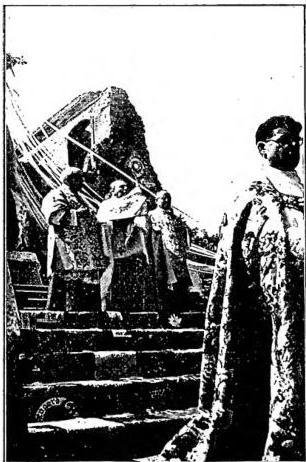
MONACO E FRISINGA, ARCHDIOCESE of - Cardinal M. Faulhaber imparts the blessing with the Blessed Sacrament during the Corpus Domini procession (1951), from the top of the “Maxburg,” formerly the State Ministry, near Pacelliplatz - Monaco.
However, the term is chiefly to be remembered for the Leibniz (v.). In the Leibnizian system, m. are unextended, simple, spiritual substances, endowed with perception and appetition, enclosed within themselves “without doors or windows,” connected with one another by pre-established harmony, each representing, as in a living mirror, the entire universe, and arranged in a continuous gradation from the lowest, which constitute bodies, through soul and mind, up to God, the primitive m.