
SOUL. - “The soul is the principle by which we first live, feel, and understand” (Aristotle, De anima, II, 2, 414a, 12-13).
SUMMARY: I. Doctrine of the soul – II. The soul in Holy Scripture – III. The soul among primitive peoples – IV. The soul in extra-biblical religions – V. The soul in the history of philosophy – VI. Symbolic representations of the soul – VII. The soul in popular tradition and poetry.
I. DOCTRINE OF THE SOUL
1. THE KNOWABILITY OF THE SOUL
The earliest beliefs about the soul are of a religious and obscure nature, blending with the first origins of diverse civilizations and religions. The records of primitive cultures (v. below, n. III), from which Western philosophy and civilization drew their impulse and development, attest to the primacy of the problem of the soul and its role as the key to orienting oneself on other problems of nature and of God. It is difficult to decide whether, in the development of these three problems, there was at the outset a strict relation of derivation, as the logical progression of ideas would suggest, or whether they were rather co-present in a relation of mutual equilibrium and support: the latter hypothesis seems the more plausible, at least with regard to the soul and God. Hence we encounter the curious phenomenon that a large part of those conclusions about the soul and God, around which human thought would tirelessly struggle, were initially held as truths beyond contestation; and the advent of philosophical inquiry almost represents nothing more than a “defensive” function to which man resorted when those first beliefs began to weaken and decay. Such a finding, while it does justice in fact to evolutionary theories and removes them from the field they themselves had chosen, cannot by itself resolve any of the grave problems that arose for philosophical reflection when those convictions were given their own structure of intrinsic evidence on the plane of being.The reality is that in philosophy the problem of the soul has always revealed itself as one of the most complex and contested. In a fragment of Heraclitus (fr. 45, ed. R. Walzer, Florence 1939, p. 82), also cited by Tertullian (De Anima, 2: PL 2, 691), it is affirmed that “the terms of the soul cannot be reached by any journey, by whatever road one sets out, so profound is its reason.” Philo, in the full flourishing of Hellenism, delights in pointing out the paradox: “The mind that is in each of us can understand everything, but it has no possibility of knowing itself” (Legum Allegor., I, § 91, ed. Cohn, I, p. 85). And elsewhere: “The mind that is in each one is unknowable to us: who can know the nature of the soul?” (De Mutatione Nominum, § 10, ed. Wendland, III, p. 158). These confessions of impotence passed to Christian thinkers, even to those in whom the maturity of synthesis and speculative balance had already yielded all that could be expected on the subject, as is the case with St Thomas Aquinas: the knowledge of the soul presents a “greatest difficulty” (In I Sent., d. 3, q.1, a. 2, ad 3); to it “...vix magno studio pervenitur” (ibid., d. 3, q.3, a. 5: “requiritur diligens et subtilis inquisitio” (Summa Theologiae, I, q. 87, a. 1); “cognoscere quid sit anima difficillimum est” (De Veritate, X, 8 ad 8). These are remarkably frank confessions, yet they did not impede unceasing research, for to man every knowledge is little or nothing and every wealth is negligible so long as he does not know who he is and what he contains within himself.
The difficulties of knowing the soul have continually diverted research into an endless variety of opinions, which provided ample occasion for a keen observer of the weaknesses of the human spirit, such as Cornelius Agrippa of Nettesheim, to reproach philosophers for having raved here with greater incongruity than elsewhere (De vanitate scientiarum, ch. 52, in Opera omnia, II, Lyons 1600, pp. 85 ff.). But in this very fact there lies a meaning: the ever-living and ever-resurgent interest of research, which cannot be explained without some initial and always-present evidence to which one seeks to return in order to renew the inquiry itself. St Thomas, with a precise formula, placed the initial evidence in the certainty of existence, and saw the difficulties on the side of the ontological determination of the essence of the soul. This formula seems to open no way out, given the heterogeneity and non-derivability that St Thomas expressly affirms between the two orders of essence and existence. Yet the soul attests to its existence in the concrete and actual exercise of life, and this can constitute a solid starting point even for the investigation of the nature of the soul. That is to say, the vital manifestations—of conscious life, that is—have a twofold character: a) inasmuch as “acts” they attest to the principle that presently produces them; b) inasmuch as they display within themselves a “content,” they can be taken as “signs” and properties that point back to a corresponding nature. The following treatment adheres to this schema.
2. ETYMOLOGY
The origin of the word “soul” is connected with that category of vital manifestations which spontaneous thought found most evident and common. In ancient, classical, and Semitic languages, it is closely akin to “breath,” breeze, wind. In Hebrew (v. IRCANO II), and similarly in Arabic, the terms for “breath,” “wind,” “spirit” are used. In Greek, Plato derives ψυχή from ἀναπνεῖν “to breathe” and ἀναψυγόν “refreshing” (Cratylus, 399-400). Even the Sanskrit Atman, by which the soul is indicated in many passages of the Rgveda, means breath, whence the German atmen “to breathe” (cf. Max Müller, The Six Systems of Indian Philosophy, London 1928, pp. 71-72). Aristotle, along with breath and movement, points to “cooling” κατάψυξις = ψύγειν (De Anima, II, 2, 403 b, 29), which Mondolfo traces back to Philolaus rather than to Hippo, as Diels would have it with Philoponus (E. Zeller-R. Mondolfo, La filosofia dei Greci nel suo sviluppo storico, part 1ᵃ, II, p. 561). The etymology of the soul as “cooling” was accepted by Origen, who interpreted it in a spiritual sense. He calls the soul “that spirit which, having fallen from its original natural and divine warmth through its fault, was punished by being united to the body”: “...inde quod ex illo calore naturali et divino refrixisse videatur, et ideo in hoc quo nunc est statu et vocabulo sita est” (De Principiis, II, 8; PG 11, 222 D, 223 A). This etymology was energetically rejected by Pseudo-Athanasius (cf. De corpore et anima: PG 28, 1432-33) and expressly condemned, at the proposal of Emperor Justinian, by the Second Council of Constantinople under Patriarch Mennas (can. IV). The etymology “soul = cooling” was certainly occasioned by the observation of the effect, so easily seen, that agitated air has upon hot bodies, and it seems to have been favored by the Stoics, though they were not its authors, as H. Karpp suggests (Soraus vier Bücher Περὶ Ψυχῆς und Tertullians Schrift « De Anima », in Zeitschrift für neutestamentliche Wissenschaft, 1934, pp. 43-44). As for modern languages not derived from the classical, note the German Seele: the term is traced to Old High German sêlvolō, which probably shares the same origin as the Greek κῆλος “mobile,” an etymology that reaches one of the earliest and most enduring meanings of the soul, namely as the self-moving principle, as will be discussed in the historical section (cf. L. Klages, Vom Wesen des Bewusstsein, Italian trans. in the volume Anima e spirito, Milan 1940, pp. 258-59).The Latin has anima and animus, connected with the Greek ἄνεμος “wind.” Curious is the etymology of Cassiodorus, set in contrast to the ancient belief that the anima had its seat in the blood: “…Quoniam immortalis est anima recte appellatur quasi ἄνεμος id est a sanguine longe discreta.” On the other hand, “animus dicitur ἀπὸ τοῦ ἄνεμου id est a vento, eo quod velocissime cogitationis eius ad similitudinem motus celeris pervagatur” (De Anima, 1: PL 70, 1282).
The distinction between anima and animus, which is scarcely traceable in the Latin of the Scholastics, had a fairly precise sense in classical Latin, where animus was reserved for the vital principle of man, indeed for his most mobile part, as Macrobius attests: “Animus enim proprie mens est, quam divisiorem anima nemo dubitavit. Sed nonnumquam sic et animam usurpantes vocamus” (In Somnium Scipionis, I, 14). Anima, instead, stands for the vital principle of animals, or for the lower functions of man. In this sense Hugh of Saint-Victor speaks of it in the High Middle Ages (Tract. sup. Magnificat: PL 175, 418 sqq.), following almost verbatim St Augustine (De Fide et Symbolo, X, 23: PL 40, 193-94).
The relationship between anima, animus-spiritus, underwent, in the development of philosophical and scientific thought, a radical transformation, in which Hugh of Saint-Victor’s position belongs to the terminal phase. The researches carried out by Fr. Rüsche and G. Verbeke, extended to the whole of Greek philosophy and the Alexandrian school, have shown the gradual shift that the term animus-spiritus undergoes through various stages.
In the Homeric poems, alongside the anima (ψυχή) is placed the animus (θυμός), which is our “spirit,” understood as courage, ardor, impetus to act. The anima seems to occupy a secondary place in the exercise of vital activities; it is presented almost as inert, and after death it wanders as a shadowy and unsubstantial phantom in the regions of Hades. Predominant, instead, is the function of the θυμός, which is the impulsive principle of vital forces, from which not only feelings and passions arise, but thinking and willing themselves. While the anima does not occupy any special place in the body, but is almost a tenuous replica of the whole. Animus is said to be located in the chest and especially in the precordia, above all in the heart, into which it is introduced with respiration and from which it is expelled with the last exhalation. Hippocrates and the ancient Sicilian medical school derive the θυμός, which is called “spirit” (πνεῦμα), no longer from respiration but from the final exhalation of the blood, and the air inhaled has the sole task of tempering the ardor of the vitality of the blood. Plato and Aristotle adopted these ideas, though bending them to new meanings. In Plato the internal heat becomes the lower function of the irascible part (θυμικόν) situated in the chest. In Aristotle it loses the function of anima and is reduced to a physiological agent: “intrinsic heat” (σύμψυτον, ἔμψυτον θερμόν) as a vehicle (ὄχημα) of the vital heat with which the anima moves the body and operates in it; neither anima nor power, but a “physical instrument” at the disposal of the anima (De Iuv. et Sen., De Vita et Morte, 4, 469 b, 6 sqq., with reference to a refrigerating function; cf. ch. 5. Complete documentation in Fr. Rüsche, Blut, Leben und Seele, pp. 118 sqq.).
After Aristotle, the Stoic Posidonius distinguishes a twofold spirit, corporeal and incorporeal, and conceives the latter as the fifth corporeal nature, “the divine body of the aether and God Himself,” from which human animae are derived as sparks. Philo, who still represents spirituality as a corporeal subtlety, assimilates the “spirit” to light, carried to the highest degree of subtilization. A more decisive advance is seen in Origen, who understands the πνεῦμα as “an invisible and incorporeal substance,” and perhaps for the first time identifies πνεῦμα with νόος, indicating the reason in the fact that it is capable of knowledge. A notion now acquired, which is clarified in Neoplatonism through Plotinus (Enn., IV, 7, 2-11) against the Stoics and which passed into Christian literature through St Augustine (“Quidquid enim corpus non est et tamen aliquid est, iam recte spiritus dicitur”: De Genesi ad litteram, XII, 7, 16: PL 34, 439). Nevertheless, as will be said, the genuine concept of spirituality will still suffer a setback in that Scholasticism which appeals to Augustine (universal hylomorphism), and it will be above all the merit of St Thomas to have freed so important a notion from every possibility of misunderstanding.
3. EXISTENCE
The anima is a “form” that is natural and is the principle of life in living beings. For Aristotle, “it is ridiculous to attempt to prove the existence of nature” (Phys., I, 1, 193 a, 3 sqq.): manifest things show themselves, they are not proved, and it is self-evident “to the senses” and “according to sense,” as St Thomas comments, that there are in reality many things that have within themselves the principle of movement, such as animals, plants, and natural bodies in contrast to artificial things. The difference imposes itself even on immediate perception through the first-evidence characters of the one and the other, on the appreciation of which the normal course of individual life itself is founded.The anima also, and more distinctly than inanimate natures, shares in this evidence of existence: this means that living beings present certain “characters” that are unmistakable, by which they are at once distinguished not only from artifacts but from inanimate natures themselves. The most apparent of these is the capacity that an animal has of “moving itself” to action: “Vivere manifeste animalibus convenit... Dicitur enim animal vivere, quando incipit ex se motum habere, et tamdiu iudicatur animal vivere, quandiu talis motus in eo apparet; quando vero iam ex se non habet aliquem motum, sed movetur tantum ab alio, tunc dicitur animal mortuum per defectum vitae” (Sum. Theol., 1a, q. 18, a. 1). It is the immediate evidence of this character that generates the immediate evidence of life and of the existence of the anima in living beings.
Alongside and prior to the evidence of lower life and of another’s anima, there is the evidence that each person possesses of the existence of his own anima, an evidence that is not bare but lived in acts: “In hoc enim aliquis percipit se animam habere, et vivere et esse, quod percipit se sentire et intelligere et alia huiusmodi opera vitae exercere” (De Veritate, X, 8). In the perception of the object and of the act there is a co-perception of the existence of the anima: “…perceptis actibus animae, percipitur inesse principium taliorum actuum” (ibid., X, 9). Nothing is more certain than this knowledge: “Secundum hoc scientia de anima est certissima, quod unusquisque in seipsum experitur se animam habere et actus animae sibi inesse” (ibid., X, 8 ad 8). Objects and acts, acts and anima, are not “disjecta membra” but form a dynamic totality that presents itself only solidarily, where the components hold one another together. Moderns speak rather of the experience of the Ego, which is evidently the experience of the existence of the anima by which the Ego maintains itself united in itself and affirms itself as an operative center.
However, the soul has been denied: mechanism has asserted that vital functions require no new principle distinct from the forces of the inorganic world; materialism has found inconceivable the existence of a spiritual soul in man. It is therefore necessary to provide a “demonstration” of the existence of life and of the soul that satisfies the objections raised. A demonstration “ostensive,” not deductive, which would make no sense at all; it consists in showing that the exercise of experience, whether spontaneous or reflective, obliges us to recognize certain “signs” in which the existence of life and of the soul is made manifest. Our spontaneous certainty is strengthened and becomes critical and firm in reflection, in which we can gather the following results: 1) Absolute certainty—impossible to renounce without renouncing thought and without denying oneself—of the existence of one’s own soul: there is no consciousness of thought, tendency, feeling, or passion unless an I is perceived that thinks, tends, feels, and is passionate...; and the I, as has been said, belongs first of all to the soul. 2) A very solid certainty, though less intimate than the preceding, of the existence of the souls of other men: too evident is the similarity, indeed the identity, in behavior and bodily form to allow doubt about the presence of principles and forces identical to those that we “live” in ourselves. 3) Less certain, but still well founded, is the conviction regarding the existence of the soul in animals, by the same argument of analogy in behavior and bodily structure; only here the criterion is limited thus far to the manifestations of sensitive life. Vegetative life presents a particular difficulty.
Mechanism has made much of the obscurity in which the functions of vegetative life are carried out and of the presence in it of energies and substances active in the inorganic world. To this real difficulty, no sufficient answer is given when one limits oneself, as is the tendency of contemporary vitalism, to attributing to the living being the characters of spontaneity, form, individuality, and totality (F. De Sarlo, Vita e Psiche. Saggio di Filosofia della Biologia, Florence 1935). Such characters are common to all “nature,” in greater or lesser degree according to the perfection of nature itself. Yet in living beings they are realized in a different “mode,” in a more perfect way, than in inorganic nature. Those characters in the living belong to life because in it they are generated, maintained, and unfolded in an “immanent” way, that is, in such a way that the operations of the living return primarily to the advantage of the living being itself (Sum. Theol., 1a, q. 54, a. 2). Whereas the actions and reactions of the inorganic world return to the advantage of something else and form an operative cycle always open, those of living beings form a cycle that closes in the living being and the more intimately the higher the form of life (cf. C. Gent., IV, 11). Now, immanence is an immediate datum of consciousness for the higher functions such as understanding, willing, feeling, and being passionate: they form the most manifest nucleus of the I and of its specific nature, and we follow with the inner eye the growth in perfection that comes to us with every act. Immanent in its sphere must also be recognized vegetative life, because we observe, and can see and experience, that its effects return first of all to the advantage of the living being. In the embryo it is the living substance that organizes and develops; in the formed organism it is the individual that preserves, repairs, defends, grows, and then multiplies into subjects of the same nature that perpetuate the species. None of this occurs in the inorganic world, and modern biological study, both descriptive and causal, has made immanence evident in a tangible and visible way even in the depths thus far unexplored of purely physiological life. This demonstration, however, is of integrative value and not absolutely necessary, since the characters of life impose themselves upon ordinary observation before scientific observation, and would not be found in the latter if they were not first and more clearly so in the former. For this reason, immediate perception of the existence of the soul has been defended in the manner indicated.
4. DEFINITION
Those bodies are called “animated” in which the operations of life (immanent) appear to be carried out in one of its degrees (vegetative, sensitive, intellective). The bodies are then said to be “animated” and alive by virtue of the soul, and not insofar as they are bodies: otherwise every body would be alive, which is not the case. The soul is therefore that which gives to the living being its nature as such and enables it to operate in this way: it is the first principle that specifies the body and moves it to vital functions. From the viewpoint of functions and perceptual evidence, Aristotle defines the soul as “that by which we first live, sense, and think” (De Anima, II, 2, 414 a, 12–13). Insofar as it is the soul that determines the being of the living as such, the soul is the “first perfection” of the living being itself. However, the soul cannot be the first principle of vital functions in just any body, but in a body capable of performing the works of life, a body therefore “endowed with organs.” Aristotle called the first perfection “act” and “form,” and the proportioned subject that receives it “potency”: “Therefore, in seeking to give the most general definition of the soul as such, one must say that it is the first perfection (act) of a natural organic body” (De Anima, II, 1, 412 b, 5–6).From the functional and essential definition of the soul there follows a threefold causality with respect to the body (De Anima, II, 4, 415 b, 7–17). It is first of all the “substantial form” of the living being, because life is communicated to the body by the soul. It is also the “end” or τέλος of the living being; bodies indeed have organs and structures not for themselves, but in view of the soul that they receive and of the functions that the soul is to unfold, to which they serve as “instruments.” Consequently, the soul is also the first “motive” principle, not only for local progressive movement (a limited actualization found in the more organized animals), but for all the works of life, from the lowest to the highest: all have their root in the soul and from it receive impulse and direction of development. The soul stands to the body “as the cutting edge of an axe stands to the iron of the axe, as the act of vision stands to the eye” (De Anima, I, 1, 412 b, 11 ff.). From this the mechanistic objection is answered, which claims the presence of the soul to be superfluous, on the ground that the works of life also involve physico-chemical forces. The reality is that these forces achieve in the living being “new” effects that they do not achieve in the inorganic world, and they operate in a more perfect way: this means that such forces are not left to the impetus of natural tendency, but are moved to achieve effects of integral value and superior worth by a higher cause. “Natural heat,” to use ancient terminology, burns and consumes without limit as heat: in the living being, however, it builds flesh, humors, and tissues, and not infinitely but according to the structural plan, the size, and the form proper to each species of animal. The mechanistic requirement is satisfied: natural heat intervenes as a cause of vital functions; not, however, as the principal and responsible cause of the effect, but as a secondary and instrumental cause (for Aristotle and St. Thomas see: De Anima, II, 4, 416 b, 25–28; De Part. Animal., II, 652 b, 9; De Generat. Animal., II, 4, 470 b, 26 ff.; In Lib. I De Anima, lect. XIV, n. 200; ibid., Lib. II, lect. IX, n. 348; In Lib. De Sensu et Sensato, lect. X, n. 139 and n. 149; Sum. Theol., 1ᵃ, q. 78, a. 2 and ad 2; Q. De Anima, 13, ad 14 and art. 2; Q. De Spirit. Creaturis, a. 2).
By positing the relationship between the soul and the body as that of act to potency and precisely as form to matter, Aristotle initiated the metaphysical consideration of the soul, in which, if he did not achieve full clarity at every point, he nonetheless outlined its first results with the lucid intuition of an innovator.
1) First, the soul is not coextensive with being, nor even with life: there are forms of being below the soul, namely the entire inorganic world; and likewise the life of spiritual substances is above the soul, which is the principle of life in bodies.
2) The soul is a substance, not in the Platonic sense of a self-sufficient and self-moving subsistence, but in the new sense introduced by the Aristotelian conception of natural essences as syntheses, “synoloi” of matter and form. The substance is the “synolon” itself, the living whole; since the “synolon” implies the union of constitutive principles, these would not constitute it in the dignity and consistency of substance if they themselves did not belong to the substantial order. Substances, therefore, in their own way—i.e., as “principles”—are the body and the soul, and the soul more than the body insofar as act surpasses potency.
3) The soul is a simple substance: a qualification that belongs to every substantial form which is the “first act” of the body. If it were composite in itself, it would be the first act of a matter antecedent to the body, and the substantial unity of the living being would be endangered, as we shall explain.
4) Consequently, the soul is an incorporeal substance: the complete substance is said to be corporeal, not the principle that gives species, being, and unity to the body. The soul may be called material when in its operation it is inseparably bound to matter, but not corporeal. Incorporeal, the soul is in itself unextended, since extension is an attribute of the composite alone.
With this robust doctrine Aristotle left behind not only the pre-Socratics, who made the soul a certain special body and did not attain the genuine notion of the spiritual, but Plato himself, who at once made the soul composite and, under the influence of Orphic and Pythagorean conceptions, viewed the union of the soul with the body as merely accidental and not natural.
Yet the Aristotelian conception itself had its difficulties. For the development of the Christian doctrine of the soul, it must also be borne in mind that while the patristic tradition opposed Aristotle and sided with Plato, the Middle Ages approached Aristotle, and thanks to St. Thomas Aquinas incorporated Aristotelian terminology into the official doctrine of the Church. The Fathers reproached the Stagirite with having made the soul mortal by reducing it to the act and form of a body. In the two most prominent Peripatetic schools, Alexander of Aphrodisias explicitly made the soul mortal, while Averroes (v.) held only the separate intellect as impersonal and immortal. And yet St. Thomas believed he could resist both. This suggests that the bare text was insufficient to shed light on the greatest problems of human existence and to impose one interpretation or another; and at the same time that beneath the harsh surface of that impenetrable style there lay, perhaps implicitly but effectively, the principles that could lead to the definitive Christian solution.
Moreover, the experience of spiritual life is, as has already been said, immediately lived in an intimacy and immediacy of belonging to which the fabric of our life and the originality of the person are bound.
We may attest that of spiritual activity we have an idea incomparably more adequate than any other activity of lower life or of nature. If, therefore, the spirituality of the soul needs to be demonstrated, it is a demonstration that proceeds directly from a tissue of lived contents, of which nothing is more truly ours or clearer to us. The demonstration of the spirituality of the soul can be initiated either from intelligence or from will: this is attested by the development, even under the impulse of idealism, in modern times of the so-called “sciences of the spirit” (Geisteswissenschaften). To many, the most persuasive and swiftest of all proofs may appear to be that drawn from voluntary activity and freedom: in it, indeed, the independence of spiritual life and the character of the human person are affirmed. Yet if instead of seeking the most apparent path we wish to adhere to the surest, it must undoubtedly be taken from the experience of intellectual life, since freedom is founded on reason and voluntary activity presupposes and follows the direction impressed by intelligence.
The Thomistic demonstration essentially follows this schema: immediate grasp of the spirituality of the acts of intellectual consciousness insofar as the spirituality of the objects they bear is directly perceived; passage by argument to the spirituality of the principles from which the acts proceed, namely the soul and its faculties (at this point one may set aside the controversy regarding the identity or diversity of faculties with the soul, which can and will be resolved—as we shall do—later). If here a measure of technicality is unavoidable, it nonetheless has the advantage of making the path shorter and more secure. The operative principles reveal themselves in the nature of the acts they produce; the acts, in turn, are known from the objects they bring to consciousness and from the manner in which they bring them to presence. Acts and objects are co-present and thus co-perceived; yet it must be absolutely recognized that the mind grasps the objects for itself and, conditionally upon them, also the acts that make them present. The intellect is a power and operative principle; every power is known not in itself but through the acts it produces, the nature of which in cognitive powers is revealed
Soul is the principle by which we first live, feel, and understand. It is the form of the body (De Anima, II, 1), the first act of a body that is potentially alive (Sum. Theol., Iᵃ, q. 75, a. 1), and the substantial form of man (Sum. Theol., Iᵃ, q. 76, a. 1). It is not a faculty distinct from the body, but the very act by which the body is alive and capable of sensation and thought. The soul is the substantial form of the body, and as such it is the principle of all vital operations.
The soul is the principle of knowledge and volition. It is the subject of intellectual and sensitive knowledge, and the principle of appetition. The soul is the principle of the operations of the body, and as such it is the form of the body. The soul is the principle of the operations of the body, and as such it is the form of the body.
The soul is the principle of the operations of the body, and as such it is the form of the body. The soul is the principle of the operations of the body, and as such it is the form of the
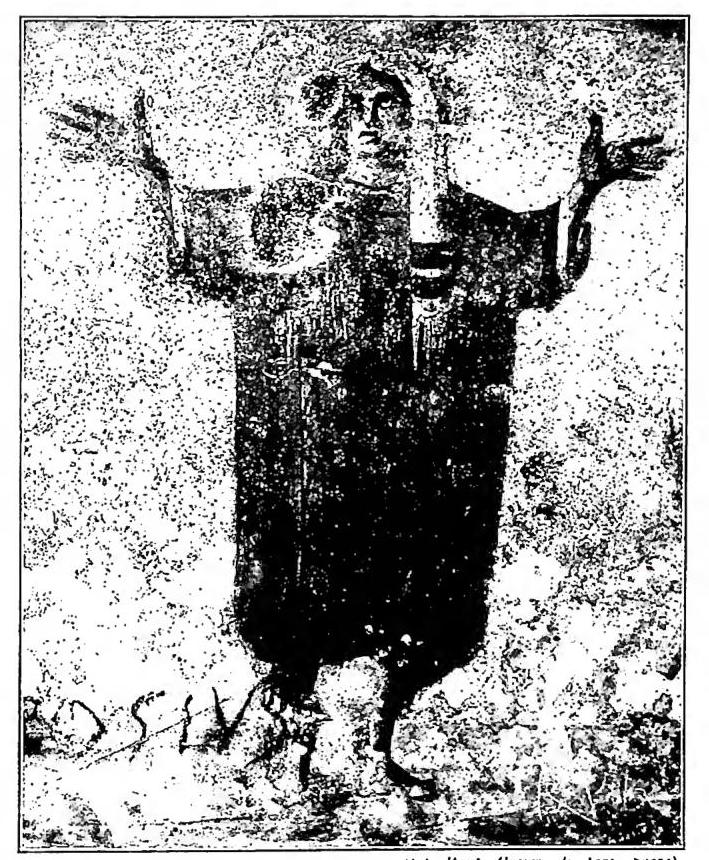
SOUL - Kneeling figure, symbol of the soul in the beatific state.
Precision is not accorded by St Thomas to the knowledge of material things, although this is attained by immediate abstraction, whereas knowledge of the soul is reached through a process of rigorous demonstration and thus mediately (« in alio », i.e., in the intelligible species). Only of the soul indeed can we say that we know its ultimate and proper difference, which gives the perfect measure of its nature and capacity: « Anima humana intelligit seipsam per suum intelligere, quod est actus proprius eius, perfecte demonstrare virtutem eius et naturam » (Sum. Theol., 1°, q. 88, a. 2, ad 3). On the basis of these principles it does not seem impossible to bring to completion within the ambit of Thomism what has been called the « phenomenology of spiritual life » (Brentano, Dilthey, Linke, Pfänder, Scheler), of which, moreover, a notable example may be found in the analysis which St Thomas himself offers in the Sum. Theol. (1°-2°e) of moral life. The results of « Denkpsychologie » (Külpe, Bühler, De Sanctis) must also be recalled, which, through the practice of introspective method, has been able to demonstrate not only the irreducibility of thought to the image-type, but has claimed to have found also a thought entirely pure from images (vorstellungsloses Denken), something which St Thomas does not admit (Sum. Theol., 1°, q. 84, a. 7). The Augustinian tendency is to affirm that the soul « semetipsam per seipsam novit », a tendency recently taken up by B. Romeyer, who wished to win over to his side even the Dominican P. Gardell, who however energetically opposed him (Revue Thomiste, 12 [1920], pp. 520-33). The question has been the object of careful experimental research at the Catholic Institute of Paris by G. Dwelshauvers, whose results were very sober and in full agreement with the Thomist position just outlined (v. del Dwelshauvers, L'étude de la pensée, Paris 1934, lect. XVII, pp. 175-76).
6. THE INTELLECTIVE SOUL AS SUBSTANTIAL FORM OF THE BODY
The spirituality of the soul implies its independence from the body in being and operation; but if it is by nature independent of the body, it is not clear how it can be its act and first perfection, as the Aristotelian definition maintains—a difficulty which nourished the opposition of the Neoplatonists Averroism (v.). Yet both the Platonic position of the soul as a complete substance and the Averroist position of a single separate intellect proved one-sided for at least two reasons: because, in the complex of experiential and conscious data, they sought to account for only a particular group of phenomena, neglecting the others and the unity of the whole, and because they bent the exigencies of principles to a univocal meaning not sufficiently justified. St Thomas, instead, safeguards both the spirituality of the soul and the necessity that precisely the intellective principle be the substantial form of the human body; in a third moment he is concerned to show the « mode » in which the compatibility of the two conclusions can be conceived: it is clear that the difficulty of understanding the « mode of union » cannot impugn the evidence that can be attained regarding the fact of the union itself. For St Thomas this union must be placed beyond all doubt. His procedure essentially reduces to the accentuation of a fact and a principle, both of them unassailable: from them there directly follows the conclusion that « the intellective principle must be in man the unique substantial form of the body ».a) The fact: hic homo singularis intelligit. Each person has a clear and unshakable certainty of being himself, as a single historical and integral subject, to think, to love, to feel passion... when he thinks, loves, feels passion for something. He is persuaded that such states of consciousness are in him and not in others or of others; that not infrequently they are in contrast with those of others; that often they are incommunicable to others, and that to this incommunicability is bound the very character of his own personality, responsibility, and individual morality. Thought, moreover, is the specific activity of man as such, by which he elevates himself above animality and can, unlike brute animals, organize his life according to universal values. The act of thinking is therefore at once what best befits man as man, and at the same time is perceived as the activity most intimate to the individual and without which the exercise of his human life is impossible (De Spiritualibus Creaturis, a. 2).
b) The principle: illud quo primo aliquid operatur, est forma eius. Operations are secondary and derived actualities, which require as their foundation a substantial act, namely the soul: it is in living beings the first principle of vital operations. Now, among the vital operations which man perceives in himself, understanding is the one he feels most intimate and his own: therefore the first principle of understanding must be in him and as his proper and incommunicable form. The Thomist discussion is very complex; above, its central nucleus has been reported, to which the conclusion refers: « Relinquitur ergo solus modus quem Aristoteles ponit quod hic homo intelligit, quia principium intellectivum est forma ipsius. Sic ergo ex ipsa operatione intellectus apparet quod intellectivum principium unitur corpori ut forma » (Sum. Theol., 1°, q. 76, a. 1). All this Thomist doctrine, which will be shown later to be so close and can be said identical with the official formulas of the Church, rests upon the integral understanding and acceptance of the Aristotelian notions of act and potency: conversely, the adversary theories, condemned or tolerated by the Church, have come from the reluctance to accept the original metaphysical meaning of the Aristotelian doctrine.
From this principled position St Thomas passes to other conclusions of notable importance for the metaphysical structure of man, which his adversaries sought in every way to obstruct and which they could no longer understand.
1) The intellective soul, inasmuch as it is form, unites with its body « without intermediaries ». According to Aristotle it is idle « to seek whether the soul and the body constitute a unity »; for they are act and potency, matter and form: if something else were placed between them, unity would be broken and an infinite regress opened (De Anima, 1, 1, 412 b, 6 ff.; cf. De Spiritualibus Creaturis, a. 3). The search for intermediaries is a pseudo-problem arising from the Platonic conception of the soul as a substance complete in itself which unites with the body only as a moving principle (Sum. Theol., 1°, q. 76, a. 6).
2) Inasmuch as form, the soul cannot be localized, as both materialism and exaggerated spiritualism—from Plato to Descartes—claim, in a determinate part of the body. In the living being it is the first perfection both of the whole and of the individual parts, and for this reason it must be said to be « tota in toto et tota in qualibet parte eius » (Sum. Theol., 1°, q. 76, a. 8). This pertains, however, to presence according to the « totalitas essentiae »; for according to the « totalitas virtutis » the soul is variously present in the different parts of the organism according to the different functions which it exercises there (De Spiritualibus Creaturis, a. 4). The higher operations of understanding and willing, which do not directly require a bodily organ, have no localization whatsoever and are accomplished in their respective spiritual faculties which adhere immediately to the soul.
3) The intellective soul is the only soul and the only substantial form of man; this is contrary to Platonic trichotomy, the plurality of forms of the Augustinian Averroists, and Scotus’s “forma corporeitatis.” The thesis that cost him great bitterness in life and condemnations at Paris and Oxford after death expressed, for St Thomas, the only way to understand and safeguard the unity of the person. This unity rests on the unity of being, and being is given and measured by the form: a multiplicity of forms multiplies being and splits the structure of the living being. Indeed, among the forms admitted to precede the rational soul, only the first could strictly be called substantial, so that the following ones, including the rational, would have to be called accidental. From the “single” form, which is the spiritual soul, man therefore derives not only the fact of being “man,” but also of being “sensitive, vital, and an organic natural body” (Sum. Theol., 1°, q. 76, a. 3).
To the most telling argument advanced by opponents—that, on the hypothesis of the unity of the substantial form, Christ’s body “in triduo mortis,” in the absence of the soul in limbo, could not be said to be “the same in number” as the one that had agonized on the cross—St Thomas could reply that the principal and constitutive identity is that which obtains through union in the identical supposit or person, which in Christ remained intact even when, with the advent of death, the union of essence between the soul and the assumed body in humanity was temporarily broken. Both Christ’s soul and body preserved in that time their own union with the person of the Word, and this union is sufficient to preserve the numerical identity of Christ’s body in expectation of the resurrection (Sum. Theol., 3°, q. 50, a. 5; Quodlib., IV, a. 8).
4) The human soul, inasmuch as it is by its nature ordered to be the substantial form of a body, so that it is truly the act of matter, is multiplied and individuated by the body in which it is received: many bodies mean that there are many souls, and many souls multiply intelligences so that there is one for each individual (De unitate intellectus contra Averroistas, cap. 5, § 103, ed. Keeler, p. 67). Separated from the body by death, the souls still retain this individuation, inasmuch as they preserve their own unity as the form of a given body (ibid., § 104).
5) There remained, however, the initial difficulty that had provoked dualist solutions: namely, how to unite a spiritual principle with a material body—“how can realities belonging to opposite genera of being coexist?” In his affirmative answer, St Thomas appeals to the Neoplatonic principle of “the continuity of degrees of being,” which he could read in a source of recognized authority, the works of the Pseudo-Dionysius the Areopagite. Faithful to his Neoplatonic sources, he affirmed the “affinity” or contact of beings at the opposite extremes of their natures: “Divina sapientia coniungit fines primorum principii secundum” (De Divinis Nominibus, cap. 7; PG 3, 873), which St Thomas rephrases as “supremum infimi attingit infimum supermi.” Granted that the human soul is the lowest among spiritual substances and that the human body is the noblest and most perfect of living bodies, there is no reason why they should not be united as form and matter: “Et ideo anima humana, quae est infima in ordine substantiarum spiritualium, esse suum communicare potest corpori humano, quod est dignissimum, ut fiat ex anima et corpore unum sicut ex materia et forma” (De Spiritualibus Creaturis, a. 2, fin.).
6) One difficulty still remained. The spiritual soul, once it is the sole form of man, must be the root and principle of all the operations performed in man, including therefore the sensitive and vegetative ones: how can a spiritual soul possess within itself such diverse energies? St Thomas replies with the principle: “Quanto aliqua virtus est altior, tanto in se plura comprehendit, non composite sed unite... Unde perfectior forma facit per unum omnia quae inferiora faciunt per diversa et adhuc amplius” (De Spiritualibus Creaturis, a. 3). In this way, just as the form of inorganic bodies gives the body being and being-a-body; the form of the plant gives being-a-body and, in addition, life; and the sensitive soul, besides life, gives sensibility: so the rational soul confers on man all of this and, in addition, rational being. To support his position St Thomas adduces two Aristotelian principles: a) “Species rerum sunt sicut numeri” (Metaph., IX, 3, 1043 b, 33), and hence they differ according to degrees of perfection; b) “Sicut trigonum est in tetragono et tetragonum in pentagono, ita nutritivum est in sensitivo (et sensitivum in intellectivo)” (De Anima, II, 3, 414 b, 31). It has been noted that the last inclusion, of the sensitive in the intellective, is missing in the Aristotelian text and that it is therefore an addition made by St Thomas to meet the Averroist position. It should be noted, however, that the Stagirite announces the principle in the more general form: “For always in what comes after there is contained potentially what comes before” (De Anima, II, 3, 414 b, 29-30), and this in itself suggested that extension (St Thomas discusses the question thoroughly in De Unitate intellectus, cap. 1, §§ 48-49, ed. Keeler, p. 32).
A. AND POWERS. — The consequences of the substantial union of the soul with the body are most clearly seen in the dynamic organization of the soul considered in its powers. The soul is only the first and remote principle of operation: to produce its operations, which are accidental actualizations, it requires proximate principles that are accidental activities (Sum. Theol., 1°, q. 54, a. 1-3 and q. 77, a. 1). Every operative sector that cannot be coordinated within the scope of a single formal object stands on its own and demands a particular power, which must not be hypostasized and separated from the soul and from the affinities that link it to the entire organism of the living being’s action. Since it has been recognized that the soul, as the most perfect form, contains “eminently” the lower perfections, it actualizes them in the body through the activity of its powers. Thus, a twofold order of powers can be distinguished in man: a) the order of nature, according to the emanation they receive from the soul, in which the intellectual powers precede and condition the derivation of the sensitive powers, and these in turn condition the derivation of the vegetative powers; b) the order of operation or functionality, according to which the lower powers precede and condition the actualization of the higher ones (Sum. Theol., 1°, q. 77 in its entirety).
The human soul, which is spiritual in the order of substance, is not entirely so—and cannot be so—in the order of action: it does indeed think and will, but before thinking and willing it must first feel; and before feeling, and in order to feel, it must be able to construct the organs of sense and maintain them in a state of efficiency. Now it becomes clearer why the spiritual soul can be the substantial form of the body and why it must be the unique form of man. The human soul, in the ordinary exercise of mature consciousness, displays a sector of operations that entirely exceeds (“omnino excedentem”) the conditions of matter: for this reason it is called a spiritual substance and a form “per se subsistent.” But man also has sensitive and vegetative operations, which, even if they appear less intimately bound to the ego or even unfold below the level of consciousness, are nonetheless indispensable for the exercise of the former and certainly belong to the whole of the person. It is not the body that contains the soul, but the soul that contains the body, for it maintains it in life; and it is the soul that needs the body to form the complete man and to actualize the potentiality of its powers. Though it is spirit, it is “part” of a corporeal nature; and while it is true that in the union the human body attains a higher dignity, it is truer still that the union redounds directly to the benefit of the soul itself. Properly speaking: “Unio corporis et animae non est propter corpus, ut corpus scilicet nobilitetur, sed propter animam quae indiget corpore ad sui perfectionem” (De Spiritualibus Creaturis, a. 6). The soul needs the body precisely for its specific operation, which is understanding: “Anima unitur corpori et propter bonum quod est perfectio substantialis, ut scilicet compleatur species humana; et propter bonum quod est perfectio accidentalis, ut scilicet perficiatur in cognitione intellectiva, quam anima ex sensibus acquirit” (De Anima, a. 1, ad 7; De Spirit. Creat., a. 7, tertia ratio). If the body were not of benefit to the soul for the act of understanding, the union of the soul to the body would be inexplicable and therefore useless (Sum. Theol., 1°, q. 84, a. 4). Here gnoseology and metaphysics meet at the desired point; St. Thomas shows this with evident satisfaction by appealing to St. Augustine: “Anima cum sit pars humanae naturae non habet perfectionem suae naturae nisi in unione ad corpus. Quod patet ex hoc, quod in virtute ipsius animae est quod fluant ab ea quaedam potentiae, quae non sunt actus organorum corporalium, secundum quod excedit corporis proportionem; et iterum quod fluant ab ea potentiae, quae sunt actus organorum, in quantum potest contingit a materia corporali. (Nec) est aliquid perfectum in sua natura, nisi acti explicari possit quod in eo virtute continetur. Unde anima, licet possit esse et intelligere a corpore separata, tamen non habet perfectionem suae naturae cum est a corpore separata, ut Augustinus dicit, XII de Gen. ad litt. (XXXV, 68).” (De Spirit. Creat., a. 2, ad 5, ed. Keeler, p. 22).
The definitive formula according to which the union of the soul with the body is to be conceived is therefore that which affirms: Quod in hoc homine non est alia forma substantialis quam anima rationalis, et quod per eam homo non solum est homo, sed animal et vivum et corpus et substantia et ens (De Spirit. Creat., a. 3). The human soul contains “virtute” the sensitive and vegetative forms: those which in rival theories were taken as souls and forms distinct from one another now take on the nature and task of powers in service to the single form that is the spiritual soul. The spiritual soul is not the immediate subject of the spiritual powers; these are properly found in the animated organs that they move. The soul, therefore, because it is spiritual, must also be called sensitive and vegetative “eminently.”
7. ORIGIN AND DESTINY
Since their natures differ, so too do the origin and destiny of lower souls (those of plants and animals) and of the human soul. For the former, it can be said briefly that they have a cycle of existence entirely similar to that of other natural forms: initially they are found “in potentia materiae,” from which they are brought into existence by the action of a proportionate agent—through one or another of the various modes of reproduction—and return, when the cycle is completed or its development is impeded, to the same “potentia materiae.”It is otherwise with the human soul (Sum. Theol., 1ª, q. 118 in its entirety). Its spiritual nature precludes thinking of it as produced by the forces present in the germinal elements, which are material; nor can it be conceived as a transmission from soul to soul (spiritual traducianism, which left St. Augustine uncertain) through a certain splitting of the souls of children from those of their parents, which would ultimately subject the spirit to the conditions of becoming proper to material things. The origin of the human soul is therefore solely by way of creation (v. CREAZIONISMO) and directly from God, the sole creative cause. Since the soul is the substantial form of the individual body, God creates one soul for each individual in such a way that the causality of the generative act in the human species stops at the formation of the body. This does not detract from the fact that parents are truly father and mother of the entire person who is born, because if the end of generation is properly the nature, the subject is the person itself, in a manner analogous to what is held regarding the divine maternity of the Virgin Mary (Sum. Theol., 3ª, q. 35, n. 1). At all times, spiritual creationists have debated the time and manner of the infusion of the soul into the body or animation: whether at the first instant of conception, or later, and in this second case, how the succession and ascent from life to life are to be conceived. St. Thomas defended delayed animation, basing himself on the principle that, since the soul is the form of an organic body, it cannot be united to the body until at least the principal organs have been outlined. In this second hypothesis, St. Thomas rejected two opinions he judged insufficient (the formation of the fetus by the sole virtue of the seed until the infusion of the rational soul, and the continuous development of all three souls succeeding one another from the same virtue of the fetus) and admitted the succession in the embryo of various generations and corruptions until the infusion of the rational soul (De Anima, a. 11, ad 1; cf. Quodlib., I, 9; IV, 6).
The soul is of a spiritual nature, and therefore does not share the fate of lower souls. The subsistent form is that which has the act of being “per se” and necessarily holds it united to itself. It therefore receives the act of being in itself first, and then communicates it to the body, which “is drawn to be the soul’s” (De Spiritual. Creat., a. 2, ad 8); when the body is no longer capable of serving as its subject and potency, it retains the act of being which it had communicated to the body and continues in being, assuming another form of life.
8. CATHOLIC DOCTRINE
The supernatural mission of the Church is not concerned to affirm and defend any particular philosophical conception of the nature of the soul in general. What the Church has directly taken care to safeguard is right belief regarding the nature, origin and destiny of the human soul and person. Basing itself on the sources of Revelation, it has proposed to the faithful certain precise truths of faith without which it would be impossible for man to be elevated to the supernatural order, for the Incarnation, the Redemption, the immortality and resurrection of the body, and the diversity of destinies which, according to merit, await each person after death. Prompted by the spread of erroneous theories, the official interventions of the Church’s supreme authority aimed, beyond any systematic concern, to protect the faithful from profane novelties and the vanity of pagan philosophy. The brief notes which follow are intended to indicate the most salient moments of the Church’s maternal solicitude in defending the sacred deposit of revealed truth, so as to ensure that her children may walk the right path to eternal life.A first group of heresies concerning the soul is found in Gnosticism. Many Gnostic sects taught the Platonic trichotomy (flesh, soul and spirit), the mediated creation of the soul (by some Aeon), and a form of panpsychism often associated with Manichaean dualism. Among the more prominent advocates are Marcion, Cerdo and Valentinus. A form of Gnostic emanationism is defended by the Priscillianists, against whom is directed the symbol attributed to the First Council of Toledo, though it is considered a private compilation by some bishop of Galicia (5th century), as well as by Gennadius’ De ecclesiasticis dogmatibus: “... We say that the soul of man is not a divine substance or a part of God, but a creature created by the divine will” (Denz.-U., no. 20; cf. the condemnation in can. 11, no. 31).
According to the report of Filastrius (De Haeresibus liber, ed. P. Oehler), the Manichees and Gnostics attributed rationality to animals (ch. 100), placed the body before the soul, and held that the body, not the soul, was created in the image of God (ch. 97). The Manichees, in consequence of their dualism, are said to have admitted two souls in man, one from the principle of good, the other from that of evil; or else to have derived the soul from the principle of good and the body from that of evil, conceiving the soul as a luminous fluid. The Manichaean controversy occupied St Augustine for a long time and intensively; the canons against the Manichees and Priscillianists issued by the Council of Braga are drawn from his works (Denz.-U., nos. 235, 239, 240). Yet it was certainly Origen who caused the greatest upheaval within the ranks of orthodoxy. The Canons against Origen, established by the Second Council of Constantinople, convoked by the patriarch Mennas at the instance of the Emperor Justinian, who had composed a detailed exposition (Liber adversus
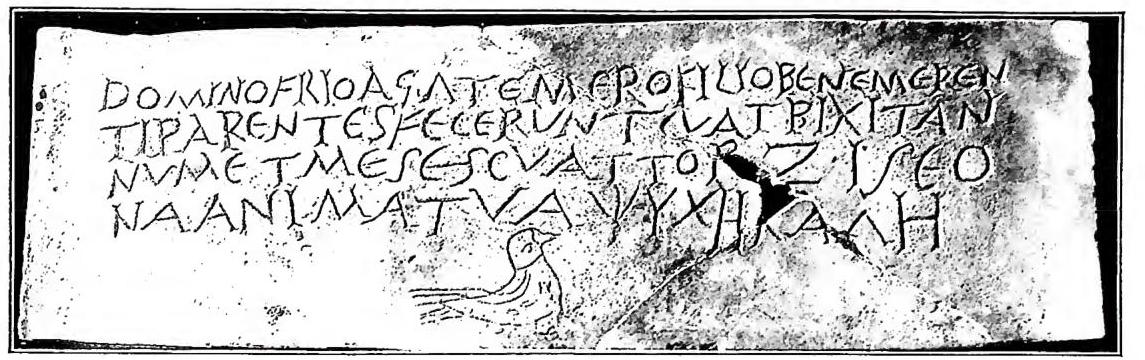
SOUL - Inscription of the child Agathemmerus with the invocation: Anima tua PYXII KAAH (4th cent.).
The Canons against Origen of the Second Council of Constantinople, convoked by Patriarch Mennas at the instigation of Emperor Justinian who had composed a detailed exposition (Liber adversus Origines), attribute to Origen the following errors concerning the soul: the pre-existence of souls; the identity of nature between souls and angels; the transmigration of nature among angels, human souls, and animal souls; the belief that the sun, moon, and stars are fallen spiritual substances; and the assertion that these spiritual substances, originally identical in nature, were bound to bodies following the cooling of their contemplation of the Word, and that, in proportion to their guilt, they were included in dense bodies like ours and in the cold, dark bodies of the lower nature (Canons, I-IV, XIV-XV, in Acta Conciliorum, ed. Harduin, III, cols. 286-87; cf. also Denz-U., nn. 203-204, 208).
The trichotomist doctrine of man, proposed by Plato, taken up by the Gnostics, and spread by the Neoplatonists, attempted in the first three centuries, under the protection of a terminology that easily lent itself to equivocation, to win over even some Christian writers. The heresy of Apollinaris of Laodicea (d. c. 392), attributed to the direct influence of Plotinus and Plutarch, was repeatedly condemned by the ecumenical councils and summarized by the Council of Florence (1441) in the following terms: «... Apollinaris also (is anathematized), who, if the soul that informs the body is denied in Christ, asserts that true humanity was not present there, positing only the sensitive soul, but that the divinity of the Word took the place of the rational soul» (Denz-U., n. 710). A remnant of trichotomy is certainly to be seen in the admission of two souls in man. From Gennadius (De eccl. dogm., ch. 15) we know that it was upheld by a certain «Iscob and others of the Syrians». St. Thomas frequently cites Gennadius’s chapter in defense of his own conception of the soul (cf. C. Gentiles, II, 58; Sum. Theol., I, q. 76, a. 3 sed contra; Q. De Anima, a. 11; De Spiritual. Creat., a. 3; Quodlib., I, a. 6). In the Canons against Plotinus of the Fourth Council of Constantinople (Ecum. VIII, 869-70), the condemnation of the duality of the soul is also included, expressly contrary to Holy Scripture, tradition, and ecclesiastical teaching: «The Old and New Testaments teach that man has one rational and intellectual soul, as do all the God-inspired Fathers and teachers of the Church; yet some, devoting themselves to wicked inventions, have the audacity to dogmatize that man has two souls and, with irrational efforts, to confirm their own heresy through a wisdom that has been made foolish» (can. 11; Denz-U., n. 338).
In the Middle Ages, the most notable deviation is attributed to the leader of the Spirituals, the Franciscan P. G. Olivi (q.v.), who, in his anti-Thomist polemic on the plurality of forms in man, denied that the intellective soul could, as such, be called the substantial form of the body, whose informing was to be left to lower souls and forms. The Council of Vienne in the Dauphiné (Ecum. XV, 1311), held under Clement V, condemned as heretical the doctrine of Olivi and defined as a truth of faith «that the rational or intellective soul is ‘per se’ and essentially’ the form of the human body.» The Viennese definition thus identifies, whereas Olivi had distinguished, the rational and intellective soul, and by using the terms ‘form per se and essentially,’ it marks the terminus in the development of the formulas of Catholic doctrine and is of capital importance not only in the realm of faith but also of theology. «Moreover, we condemn every doctrine or position that rashly asserts or ventures to doubt that the substance of the rational or intellective soul is truly and per se the form of the human body, as erroneous and hostile to the Catholic truth of the faith; and we define, so that the sincere truth of the faith may be known to all and the way to all errors be closed, that whoever in the future shall dare to assert, defend, or pertinaciously hold that the rational or intellective soul is not the form of the human body per se and essentially shall be deemed a heretic» (Denz-U., 481).
A further step forward was taken at the Fifth Lateran Council (Ecum. XVIII, Session VIII, 1513). Desiring to put an end to the plague of the revived philosophical sects of the Alexandrians and Averroists, the Council restated at length the definition of Vienne of 1311, to which it added the Catholic truth to be opposed to the two condemned sects: «... and that it is immortal, capable of being multiplied singularly according to the multitude of bodies into which it is infused, and multiplied, and to be multiplied» (Denz-U., n. 738). At the same time, it condemned the theory of the ‘double truth’ to which those philosophers (especially the Averroists) resorted, who claimed to hold to divine truth even though they were certain that human reason demonstrated the contrary.
The same Viennese definition recurs in the condemnation by Pius IX of the anthropological errors of A. Günther and followers (Denz-U., n. 1655 and note), where it is reaffirmed that the intellective soul is in man the unique vital principle.
Of the forty propositions of A. Rosmini (q.v.), condemned by decree of the Holy Office on 14 Dec. 1887, five concern errors on the origin of the soul and the nature of its union with the body (nn. 20-24; Denz-U., nn. 1910-14), reflecting the consequences of his philosophical system. And in 1865 the Holy Congregation of the Index had required the priest Agostino Bonnetto, founder and director of the Annales de philosophie chrétienne, to subscribe, among other things, to the following proposition: «Reason can prove with certainty the existence of God, the spirituality of the soul, and the freedom of man» (Denz-U., 1650).
For the development of the concepts of ‘soul’ and ‘spirit’: F. Rüsche, Blut, Leben und Seele. Ihr Verhältnis nach Auffassung der griechischen und hellenistischen Antike, der Bibel und der alten alexandrinischen Theologie. Eine Vorarbeit zur Religionsgeschichte des Opfers (Studien zur Geschichte und Kultur des Altertums, 5, suppl.), Paderborn 1930; id., Das Seelenpneuma. Seine Entwicklung von der Hauchscele. Ein Beitrag zur Geschichte der antiken Pneumatik (Studien zur Geschichte und Kultur des Altertums, 18, fasc. 3), Paderborn 1933. On the development of the classical-Christian concept of pneuma cf. now: G. Verbeke, L’évolution de la doctrine du pneuma du Stoïcisme à s. Augustin, Louvain 1943.
On s. Thomas and Christian thought: A. Dupont, La spiritualité de l'âme, Lyons 1887; M. J. Gardair, Corps et âme, Paris 1892; G. T. Driscoll, Christian Philosophy: A Treatise of Human Soul, New York 1898; A. Farges, Le cerveau, l'âme et les facultés, Italian trans., Siena 1900; A. Gemelli, L'enigma della vita, 2nd ed., Florence 1914; G. Mattiussi, Le XXIV Tesi della filosofia di s. Tommaso d'Aquino, Rome 1917; A. Vonier, The Human Soul, London 1920; A. Zacchi, L'uomo, part 1, Rome 1921; J. Gruender, Psychology without a Soul, 3rd ed., St. Louis 1922; id., The Meaning of the Human Soul, in Catholic Medical Guardian, 1927; C. Gutberlet, Der Mensch, sein Ursprung und seine Entwicklung, Italian trans., Florence 1927; A. Willwell, Seele und Geist. Ein Aufbau der Psychologie, in Mensch, Gott, Welt, IV, Freiburg in Br. 1938; B. Nardi, Anima e corpo nel pensiero di s. Tommaso, in Giornale critico della filosofia italiana, 23 (1942), pp. 50 ff. — On the knowledge of the spirituality of the soul: M. Liberatore, Del composto umano, 3rd ed., Naples 1880; C. Fabro, Percezione e pensiero, chap. VIII: La percezione dello spirituale, Milan 1941, pp. 331 ff. — The numerous commentaries, both literal and in the form of “questions,” by the Scholastics on the De Anima should also be consulted for medieval thought; for modern thought, the manuals of psychology by Neoscholastics (especially: Mercier, Remer, Froebes, Maher, De La Vaissière). — On the origin of the soul: M. Th. Coconnier, L'âme humaine, existence et nature, Paris 1890 (a full exposition and defense of the Thomist doctrine of the soul); W. Reany, The Creation of Human Soul. A Clear and Concise Exposition from Psychological, Theological and Historical Aspects, London 1920. — On animation: A. Lanza, La questione del momento in cui l'a. razionale è infusa nel corpo, Rome 1939 (
V. ANIMAZIONE)
On the elementary definition: T. M. Zigliara, De mente Concilio Virenmisti in definendo dogmate unionee in unionee humanae cum corpore, Rome 1879. — Among modern authors: W. Mc Dougall, Body and Mind: A History and Defense of Animism, 4th ed., London n.d.; A. Bain, Mind and Body. The Theories and their Relations, ibid. 1900; A. Binet, L'âme et le Corps, Paris 1910; E. Becher, Gehirn und Seele, in Die Psychologie in Einzeldarstellungen, V, Heidelberg 1911; J. Geyser, Die Seele. Ihr Verhältnis z. Bewusstsein und z. Liebe, Leipzig 1914; D. Feuling, Das Leben der Seele. Einführung in psychologische Schau, Salzburg 1940; it is the first attempt at a comprehensive phenomenology of the life of the soul against the background of Catholic doctrine. Cornelio FabroII. THE SOUL IN SACRED SCRIPTURE
9. IN THE OLD TESTAMENT
1. As with other truths, so with the doctrine on the soul (its existence and nature), the Old Testament does not provide a systematic philosophical exposition but speaks in the language of its time and of the Israelite people. To establish the doctrine actually expressed or implied, one must therefore analyze this popular language. The Old Testament distinguishes in man two elements that are almost constitutive: one material, the other superior (spiritual); thus, for example, Gen 2:7; Job 10:9–12; Eccl 12:7. The material element is called ‘āphār (dust, earth) or bāšār (flesh); to designate the superior element there are several names, particularly rūaḥ (generally translated “spirit”) and néphěš (generally translated “soul”); less frequent are nēšāmāh (breath, Gen 2:7; 1 Kgs 17:17; Isa 2:22) and lēḇ or lēḇāḇ (“heart”; cf. Ps 73[72]:26). The different names express the same psychic reality considered from different points of view; they do not primarily indicate the substance of the soul but the various aspects or activities of it; the usual translations “spirit,” “soul” are therefore not exact and in no way equivalent to the technical terms of our Scholastic philosophy.2. When the Old Testament speaks of rūaḥ, it refers to the life imparted to man by a divine breath (Zech 12:1; Job 12:10; cf. Ezek 37:6, where the vivification of the people is described with terms taken from the life of individuals), residing in him as the principle of vital activities, first of all of animal (sensitive) life, secondarily of intellectual, ethical, and religious life. The communication of life through the divine breath is common to man and brute (cf. Ps 104[103]:29–30); hence one also speaks of the rūaḥ of beasts (Gen 6:17; 7:15); thus Eccl 3:19: “there is but one breath—rūaḥ—for all.” Ecclesiastes confesses ignorance of the fate of this rūaḥ when it leaves the body of man (3:21). That the rūaḥ is a spiritual substance in the Scholastic sense is not clearly stated in the Old Testament, but it is implied by ascribing to it the higher psychic activities—intellectual, moral, religious—especially from the time of Ezekiel. Thus it is said, for example, that the Lord will give, in the messianic age, a “new rūaḥ” (Ezek 11:19; 18:31; 36:26; Ps 51[50]:12); in the rūaḥ thoughts ascend (Ezek 11:5); the rūaḥ seeks, desires the Lord (Isa 26:9), is cast down (Isa 66:2; Prov 15:13), humble (Prov 16:19; 29:23), magnanimous (Ps 51[50]:14).
3. Another aspect of the psychic part of man is expressed by the word néphěš, which originally perhaps meant the throat, then the breath passing through the throat distinguishing the living body from the non-living; hence néphěš also means life, but rather inasmuch as it is more closely bound to the body, indeed to the blood of the living being (Lev 17:11–14). The néphěš is considered primarily, though not exclusively, as the subject of lower vital activities (vegetative, sensitive). It is often used almost synonymously with life (to take away the néphěš “to kill”; to save the néphěš “to deliver”), indeed the use of néphěš instead of a personal or reflexive pronoun is very common (my néphěš dies “I die,” Num 23:10; Jonathan loves David as his néphěš, “as himself”). It also designates man as an individual, a person (70 néphěš, Ex 1:5), especially in the juridical formula néphěš hî (“if anyone”).
Though rūaḥ and néphěš signify life from different points of view, they are often confused in their application to psychic phenomena; not infrequently in poetic parallelism they are used together to designate the “whole man.” In the later period of the Old Testament a new terminology appears, with πνεῦμα (rūaḥ) used to designate the life-giving spirit of God, while ψυχή (néphěš) is the higher principle within man; thus 2 Macc 6:30; 7:37; 14:38; Wis 4:14; 7:27; 8:19–20; 9:15; 10:16.
4. Since néphěš and rūaḥ do not denote two substances but rather two aspects of the activity of a single principle, in the Old Testament one cannot speak of a trichotomy, as for example in the system of Plato (σῶμα ψυχή νοῦς). The Old Testament clearly attests (cf. Gen 27:2; 6:3; 7:22; Lev 17:11; Ps 104[103]:29–30; Job 27:3; 33:3–4; Ezek 37:8) that the constitutive parts of man are only those two which in Scholastic terminology are called “body” and “soul.” The pre-existence of the soul is not found in the Old Testament; in Wis 8:19–20 the context excludes such an interpretation.
5. The problem of the immortality of the soul does not arise
formally in the books of the Old Testament before the Book of Wisdom, lacking the term that signifies exclusively the higher part of man as a substance; rather, one speaks of the immortality of the "man," who even after corporal death has a certain life, albeit diminished and almost shadowy, no longer here on earth but in the še'ôl, where the man "rejoins his fathers" (e.g., Gen. 25, 8). The inhabitants of the še'ôl are never called népheš, nephášôth, and much less rûah, rûhôth, but néphá'îm (the "languid ones"). The obvious conclusion that, once the body is dead and decomposed, it can only be the soul that survives in the še'ôl is not found explicitly before the Book of Wisdom (3, 1-3).
6. The superiority of man over animals in the Old Testament is not derived from the possession of a spiritual and immortal soul, but is expressed through the idea of likeness to God (Gen. 1, 26; 5, 1-3; 9, 6; Ps. 8, 6 ff.; Eccli. 17, 3; Sap. 2, 23). Nevertheless, since this likeness consists in man's being endowed with intelligence and free will, implicitly the likeness to God coincides with having a spiritual soul, essentially superior to the soul of brute animals.
II. IN THE NEW TESTAMENT
The authors of the New Testament do not offer, any more than those of the Old, a systematic philosophical exposition of the nature of the soul. Their conception of man is first of all that of the Old Testament, and their psychological language is that in use in the Septuagint. To designate the higher element of man in opposition to the lower, bodily element (body or flesh), the terms used here and there are almost the same (heart, soul, spirit) and often indicate, like their Hebrew equivalents, only the different aspects of one and the same psychic reality.1. In particular, the heart (καρδία) is the center of all sensible, intellectual, and moral life: man believes, doubts, speaks, discusses with or in the heart (e.g., Mk. 2:6–8; 6:52; 8:17; Lk. 24:25; Rom. 10:8–16).
2. Like népheš, the soul (ψυχή), although it is opposed to the material body (Mt. 10:28; 26:38), is sometimes the subject of purely sensible activities (Lk. 12:19–23; cf. Mt. 6:25; Rev. 18:14), and always maintains a close relationship with the body or flesh. Thus it often denotes life itself, sometimes the living being (Mk. 3:4; Rom. 2:9; etc.), and even seems simply to replace the reflexive pronoun (Mt. 10:39; cf. Lk. 9:24–25; etc.).
3. Alongside ψυχή, the New Testament uses equally πνεῦμα, just as the Old Testament used rûah alongside népheš; but it attributes to “spirit” only properly spiritual activities. Indeed, πνεῦμα is less its subject than its principle, except for rare exceptions generally justified by the context (Lk. 1:47; Acts 17:16; 1 Cor. 14:14; elsewhere it refers to the Holy Spirit). The Fourth Gospel says, for example, that the soul of Jesus Christ is troubled (Jn. 12:27), but that He is troubled in His spirit (13:21). Thus, far from replacing the soul, one can be named alongside the other (1 Thess. 5:23; Phil. 1:27; Heb. 4:12). The Gnostics and later Apollinarius were wrong to base their trichotomic conception of the human composite on these texts, a conception doubtless widespread in the environment in the form νοῦς, ψυχή, σῶμα, but unknown alike to the New and Old Testaments. In St. Paul there is no question of two parts of the soul as if they were two substances, but rather of two aspects: either ψυχή is understood as “the soul in the whole of its functions, above all vital and sensible,” and πνεῦμα as “the same soul in its higher intellectual functions,” or one may prefer to see in πνεῦμα the human soul living the life of supernatural grace, according to an usage dear to St. Paul.
4. Indeed, when St. Paul (the usage is almost exclusively his) wishes to emphasize the properly natural character of human intelligence, he prefers to use another term, taken from the current usage of the time, νοῦς; whether he joins the two terms νοῦς and πνεῦμα (Eph. 4:23), or opposes them to each other (1 Cor. 14:14–19), or finally only νοῦς appears to designate, for example, the corrupted intelligence of the pagan (Rom. 1:28; Eph. 4:17; etc.) or that of the sinful man struggling against the flesh but not yet renewed by the divine Spirit (Rom. 7:23–25). Even in this case one could not speak of trichotomy.
5. Like the Old Testament, the New Testament views the problem of immortality rather from the point of view of man than from that of the soul, and attention is focused more on the resurrection of the body than on the life of the soul separated [from the body]. Yet even when stripped of the body, the soul is not supposed to live in the sleep of še’ôl, but to dwell with the Lord (2 Cor. 5:8; Phil. 1:23). And the fact that this separated soul is no longer called merely ψυχή (Rev. 6:9; 20:4), but also πνεῦμα (1 Pt. 3:19; Heb. 12:23), provides at least a precious indication in favor of its spiritual nature.
### III. THE SOUL AMONG PRIMITIVE PEOPLES.
On the soul among primitive peoples, two groups of problems have in the past presented themselves. First, whether one could recognize in man of nature a soul, and in what sense; second, what concept of it the primitives had.
1. Evolutionism, at one time extended monistically even to the study of cultures, denied primitives, along with rational intelligence, a soul. Modern ethnology, however, has had to come to quite different conclusions on the basis of the facts, for it was easy to observe how even peoples most primitive from the ergological and social standpoint possess clear, deep-rooted, and heartfelt notions of religion and morality, well-established family, kinship, and social organization, a language grammatically and lexically not inferior to any other, singular knowledge of nature, and even marked inventive capacities, as revealed in tools, wheels, carts, agriculture, etc. Today, therefore, it is universally recognized that, for all this, the primitive essentially differs from the animal, and that consequently it is necessary to acknowledge in him a true human psyche. Moreover, within ethnology there arose currents that did not intend to see in this psyche anything more than the result of animal instincts, and that therefore only these guided the primitive in thinking and acting. Others affirmed that, in the supposed ladder of ascent, man of nature had not yet reached the full development of his personality and individuality, remaining at a stage of thinking and acting that they called collectivistic. Some held that his way of thinking still lacked logic, that is, that he was in a prelogical state. Others, while acknowledging logical faculties in him, did not fail to proclaim his intelligence inferior, attributing this inferiority to an essential difference in his psyche. All these a priori opinions have vainly sought confirmation in the facts. Thus, with regard to animal instinct, appeal was made to cruelty, cannibalism, slavery, infanticide, and the harshness of certain initiations of youth. But, on the other hand, it has been seen that the most ancient peoples, who theoretically should have excelled in brutality, are far from manifesting such traits; indeed, they follow customs showing quite the opposite mentality (e.g., conjugal fidelity, love for offspring, assistance to the needy, etc.) and consciously practice and carefully hand them down. Under the influence, then, of pansexualism it was maintained that the primitive was completely enslaved to the sexual sphere, and that this alone governed his thinking and acting. But even on this point objective research has brought to light countless facts and actions that cannot in any way be reduced to that sphere, and proof of this is found, moreover, in reflective thinking about the soul (see also FAMILY; MONOGAMY; PRAYER; SACRIFICE, etc.).
Intimately connected was, as we have said, the theory of prelogism, which traced the formation of ideas in primitive man back to a priori and simplistically magical influences rather than to the natural and spontaneous logical processes provoked by experience (Lévy-Bruhl). But behold: agriculture, hunting, pastoralism, as well as the economic systems organically derived from them, and even more so weapons, tools, simple and complex traps, knowledge of animal habits and their exploitation, knowledge of the curative qualities of certain plants and their application—let alone other things—soon rose to shake the foundations of this elaborate edifice, definitively demonstrating that even the primitive possesses and follows a certain logic.
As for the alleged essential gap between civilized man and natural man, which was said to be arrested at a lower rung of the cultural ladder, lacking any aptitude for further development, it is now clear that the phenomenon depends not on internal causes but rather on external influences, such as prolonged isolation, climatic adversity, etc.; and proof of this is found in the fact that individual primitives show no lesser sensitivity or responsiveness to acculturation, both outside and within their own environment, placing themselves, thus, on the same level as the great amorphous mass of the civilized.
Thus ethnology, based on thorough knowledge of all cultures, has concluded that primitives, even the most ancient, possess an a. that is truly and integrally human, and are therefore endowed with human feelings and will, with fully active reasoning, such as to lead them to understand the world, to organize themselves socially, and to trace back through causes to the origins of creation.
2. As regards the concept of the a. among primitives, we now know that there is no people or race which believes man to be made of body alone. All recognize, instead, alongside and above the body, the existence of an element independent of it, different from it, capable in certain circumstances of existing even by itself, in some way influencing even vegetative life and constituting the center of the spiritual powers and qualities of the individual. All also possess the straightforward and simple conviction that this element will continue to exist even after the death and decomposition of the body. Up to this point, the agreement is unanimous. Opinions differ only with regard to the essence and number of the a., the origin of the individual a., and the modalities of the a.’s existence in the afterlife. We are not equally well informed about all primitives in this regard. We can, however, for now, identify two major groups: more ancient peoples; and matriarchal agriculturalists with ancestor or at least death cults.
Pignei, Old Americans, south-eastern Australians, etc., with few exceptions, hold that man consists of body and a., and they say that this is like the wind (Maidù of California), like the air (Fuegians), like the sky (Wiradjuri in Australia): all attributes that certainly denote immateriality. Scholars use the term soul-breath for such a concept of the a. It is this a. that animates the body and is the center of self-awareness and personality. The individual a. is created and sent by the creator, either at the moment of birth (Fuegians), or beforehand (Semang of Malacca). In myths it is told that the creator awakened the first man to life by breathing his breath into a body already formed but lifeless (Kulin of Australia). If the creator recalls the individual a. to himself, man dies and the a., generally through the Milky Way, returns to the creator. The fate of the a. in the afterlife generally depends on the moral conduct of the individual. Peoples of this group, in general, do not believe that the a.’s return among the living after death.
The matriarchal peoples—better known in this respect are those of Africa and South-East Asia with its islands—believe that man is composed not of two but of three elements: body, the principle that animates it, and the a. For this reason, one sometimes speaks of two a.’s: life-a. and image-a. or shadow. The life-a. (vital fluid, vital force) seems to be conceived in a pantheistic sense. After death, it passes into another living being (man or animal), or returns to the earth and may be subjected to the influence and will of sorcerers and witches. The image-a. or shadow, which stands beside the other and even above it, is considered the center of the spiritual qualities, powers, and functions of the individual. Some peoples seem to see in it a kind of protective spirit, belonging more to an ancestor than to the individual himself. Others, conversely, perceive in it something proper to the individual, which constitutes the deepest foundation of all his life. The entire fate of life—health, illness, death—depends on the presence or existence of this a. As the center of self-awareness, it is what feels, thinks, and wills; it can temporarily exist outside the body even in this life, but even more so and definitively after death. Little is known about the origin of the individual a.; certain peoples certainly consider it the reincarnation of the a. of ancestors. It survives death, and some believe that for a time it lingers near the house or the corpse of the deceased, to be then directed, by means of rites, toward a definitive abode. This is no longer, as in the first group, heaven and the seat of the Supreme Being, but the land of shadows, a kind of Hades, often located in the West, now beneath the earth, now above; on islands, mountains, distant valleys, etc. From there the souls, very differently from the beliefs of the first group, can return among the living, sometimes only through reincarnation, other times to do good or harm.
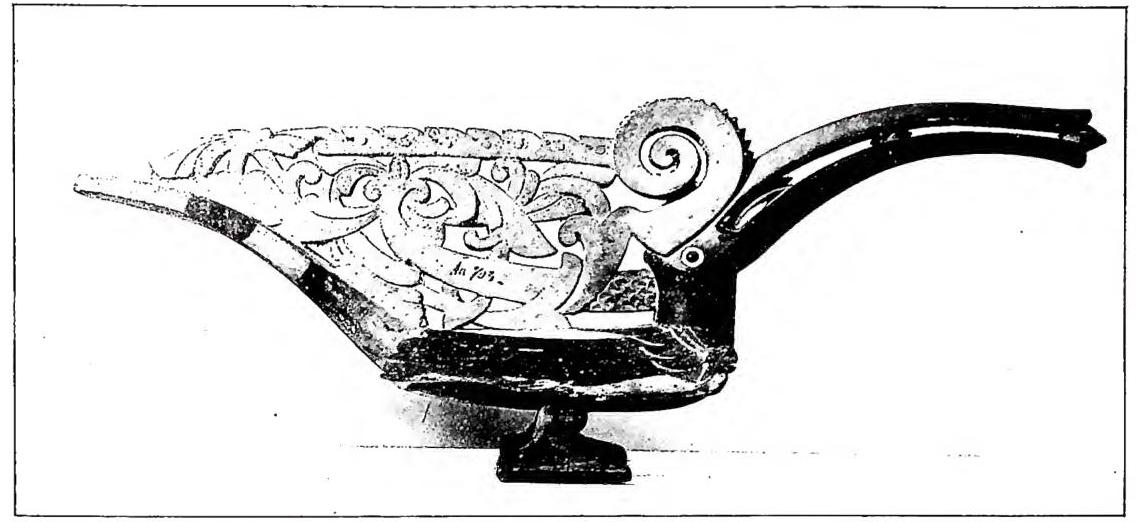
For the origin of the concept of the a. in the primitive, V. ANIMISMO.
B. Ankermann, Totenkult und Seelenplanke bei afrikanischen Völkern, in Zeitschr. für Ethnologie, 1918, pp. 89-153; W. Schmidt, Der Ursprung der Gottesidee, 6 voll., Münster in Vestf. 1926-35; E. Camerling, Über Ahnenkult in Hinterindien und auf den Grossen Sunda-Jusch, Rotterdam 1928; Vr. Bösch, Les Banyanowcz, Münster in Vestf. 1930; K. Th. Preuss, Tod und Unsterblichkeit im Glauben der Naturvölker, Tubinga 1930; H. M. Dubois, Monographie des Betsiles, Parigi 1938. Michele Schulien
#### IV. THE SOUL IN EXTRA-BIBLICAL RELIGIONS
The belief in the survival of the soul, which is found in the beliefs of primitive peoples (v. ANIMISM), is also found in the religions of culturally advanced peoples, whether these be the religions proper to national groupings of the ancient (Egypt, Babylonia, Syria, etc.) and modern world (China, Japan, India, etc.), or whether they be supernational or universal religions (Buddhism, Zoroastrianism, Islam).
10. CHINA
The Chinese have two different words to express the idea of the soul: po'h, which corresponds to the “sensitive” soul of Aristotelian philosophy, the one that presides over vital functions, manifests itself through breath, and departs from the body at death; and hun, which is the rational soul, presiding over the functions of the spirit and, in morbid phenomena and in dreams, seems temporarily to leave the body. The Li ki, or “Record of Rites,” one of the five Chinese classical books, states that after death one of the deceased’s relatives climbs onto the roof of the house and, facing north—the region of the dead—invites the deceased’s soul to return to the body: “after which the mouth of the dead was filled with rice and a piece of raw meat was placed beside him. Then one looked toward the sky and buried the body in the earth. The body and the animal soul go downward; the intelligent spirit goes upward” (Li ki, 7, 1, 7).Further evidence of this belief is found in the cult of the ancestors, which obliges the filial piety of descendants to venerate their parents and ancestors as if they were still living—an obligation that falls upon all, from the head of state, who venerates them in special shrines, to the humblest private citizen, who honors them as present in the tablets placed in a special corner of his home. This custom is so deeply rooted that—provided the tablet is stripped of its idolatrous meaning as a “support of the soul”—it has even been permitted for Chinese Catholics by a special decree (8 Dec. 1939) of the Sacred Congregation of Propaganda.
11. JAPAN
Even Shintoist Japan believes in the survival of the soul without inquiring into its nature or the manner of its survival. This is due to the fact that Shintoism is a purely animistic and naturalistic paganism (as demonstrated by its mythology), upon which Chinese civilization and religious culture, and Buddhist preaching, soon came to be superimposed.Strictly dependent on Chinese influence is the cult of the ancestors, which Japan also practices, venerating them within each home in special caskets (mitama-ya) where the tablet is kept, which serves both as a support and a memorial of the deceased. The ancestors of the imperial family even enter into the category of Kami or superior and divine spirits, protectors of the country.
12. EGYPT
In ancient Egypt too there is a double term to signify the twofold aspect of the soul. The ka (ko, ko') is the vital breath, conceived as identical to the person, which departs when the individual dies but remains near the tomb to which it is almost bound and is nourished by the offerings brought to the corpse. The ba (bai), on the other hand, is only the spiritual part of the soul, not bound to the tomb and capable of moving freely either toward the sky or toward the netherworld; for this reason it assumes the form of a bird and likes to visit the mummy from time to time and alight upon its heart. One reads in the Pyramid Texts: “(The dead) goes toward the sky like falcons, with feathers like those of the goose, he soars toward the sky like the crane and kisses the sky like the hawk, he leaps toward the sky like a grasshopper. Thus the man flies far from you, o men, he is no longer on earth but in heaven, with his brothers the gods...”. This is an affirmation not only of survival but also of the soul’s happy fate.13. BABYLONIA
According to the Babylonians, after the corpse there survives the edimmu, that is, its soul conceived as a spiritual being, winged like a bird, which goes to the land of shadows (arallu) situated beneath the earth. So that this shade may be at peace and not torment the living, it must not lack either burial or care. On the tomb, therefore, the relatives must provide it on the appointed day with the funeral meal (hiṣpu): “Have you seen,” Gilgamesh asks Eabani, “the fate of the edimmu of him whose corpse has no one to care for it?” And Eabani replies: “I have seen it eating the scraps of the pot, the remains of food cast into the street.” But this gloomy vision left open a glimmer of hope for a happier fate, almost a hope for a resumption of life, because it is precisely in the darkness of the arallu that the river of life flows, which the goddess Ishtar goes seeking for Tammuz; and Gilgamesh is moved to his journey by the desire for immortality that is doubled in him by the death of his friend Eabani. Even the myth of Adapa, who, at the advice of Ea, refuses the immortality that the god Anu offers him by presenting him with the food and water of life, demonstrates in its own way the yearning of the Babylonian soul for the privilege of immortality.14. SYRIA
Among the other Semitic peoples too the soul is the vital breath (nèpheś) which, after death, descends into a dark region from which there is no return. But its fate can be alleviated by the funeral rites performed by the living at the tomb, the inviolability of which was a strict law among all Semites. For the otherworldly fate of the soul, the Aramaic inscription of King Panammu dedicated to the god Hadad (excavations at Zengirli, 8th century B.C.) is important, in which explicit reference is made to the abode of the souls of the Syrians near the deity. Panammu indeed commands that this prayer be addressed to Hadad at the moment of sacrifice: “May the soul of Panammu eat and drink with you!”, that is, may it also partake of the sacrifice offered to the god.15. INDO-EUROPEAN
The funerary furnishings of primitive Indo-European peoples, collected for northern Europe in the museums of Germany, Scandinavia, and Slavic countries, demonstrate among the various peoples of this family the belief in the survival of the soul. This is conceived as the breath or spirit (Sanskrit ātman, German Atem) which, at the moment of death, leaves the body and goes to join in their region the “Fathers,” the “ancestors,” the “good ones.” It must not, however, be abandoned, for that would make it angry and therefore harmful; rather, it must be assisted by providing the corpse in which it dwelt with the utensils, weapons, and ornaments used in life, and by bringing food and drink offerings to the tomb. These offerings are made on the third, ninth, and thirtieth (or fortieth) day after death, and are renewed on a day of the year that is commemorative for all the dead and which, among the ancient Greeks, was that of the Anthesteria, among the Romans that of the Lemuria and the Feralia. The souls are invited to partake of the offerings, to return prosperity to the land and livestock in exchange, and finally are entreated to depart (Manes evite paterni! θύραζε σήρας).16. INDIA
Vedism. — The Indian of Vedic times recognizes in the body the presence of an element of aerial, shadowy consistency that can leave its abode either temporarily (and then the body loses consciousness, as in cases of illness or sleep) or definitively at the moment of death (and then the body decomposes, while that shadowy essence acquires an independent life and can assume various forms). The Vedas give two names to this aerial element: asa “breath, puff of air,” something material, therefore, which man shares with animals and which ceases with the expiration of life; and manas, i.e., spirit as the seat of intelligence and will, which dwells in the heart; popular imagination pictures it as a little man the size of a thumb. The two names, however, are often used interchangeably. At death the manas departs to the world beyond, where the ancestors (pitaras) already are, ruled over by Yama, the first man who knew death. Naturally, even here the state of the soul in the other life depends on the piety of the living, whence the complex funerary ritual and the cult of tombs, with their attendant funeral offerings (śraddhā), without which the deceased would suffer and torment the living. There is no clear trace of metempsychosis in the Vedic period.Brahmanism. — In Brahmanism the Vedic notion of the soul, so primitive yet so close to reality, evaporates into a pantheistic vision of the entire cosmic organism, in which there is no longer room for the affirmation of a personal and permanent ego amid the mutable flux of things. The term used to designate the ego, the soul, is ātman “breath, wind,” i.e., the inner principle that sustains the life of the individual. But this same term is also used to express the ego that gives life to the entire universe: the individual ātman and the universal ātman (Brahman) are ultimately identical; the individual souls emerge from the universal soul like countless sparks from a fire, sharing in its nature (Māṇḍūkya Upaniṣad, 1.7; 1.1). Indeed, this identification constitutes salvation (mokṣa), which is precisely an immersion in the universal Being, like a river lost in the sea.
Buddhism. — From this pantheistic volatilization of the individual soul into the universal soul, Buddhism goes so far as to deny the soul altogether, rejecting as rationally unthinkable the idea of ātman, whether universal or individual. It admits, like Brahmanism, that the personal ego and the sensible world are a tissue of appearances in continual transformation, but denies that the Absolute (Brahman) is the sole reality or that the substance of the soul (ātman) is to be recognized in II. The soul is not an individual, permanent spiritual substance, subject of the phenomena of knowledge and consciousness; it is the apparent result of a succession of consciousness-states, detached from one another yet linked in series; just as a torch whirled at one end describes a circle of fire that in reality does not exist. The personal ego does not exist—so the monk Nāgasena tells King Milinda—but only the five elements that make up human existence: name and body, sensation, idea, concept, knowledge; just as the chariot does not exist, but only the pole, the wheels, the yoke, etc., whose assembly is given the name of chariot. The denial of the soul as a permanent individual substance appears to contradict the doctrine of metempsychosis, which Buddhism accepts and which makes the new existence depend on the “law” (karma), i.e., the chain of actions performed in a previous existence; but Buddhism resolves the contradiction by advancing the idea of a “non-permanent continuity” in the process from one existence to another: “continuity” because the new existence in fact continues the previous one, “non-permanent” because, with the denial of a substantial ego, the new personality has nothing to do with the previous one; just as when one flame is lit from another, one cannot say that the first is transmigrated into the second, although in fact a new flame is born. Thus, according to Buddhism, it is not a question of true transmigration, but of rebirth.
Later Buddhism, known as the Great Vehicle (as opposed to the original doctrine called the Small Vehicle), has not substantially altered this fundamental doctrine of the Master, although it has constructed an elaborate speculative and practical Buddhology that has transformed the concepts of the Buddha and of nirvana, diverted the goal of monastic vocation, and organized a veritable cult of the Buddha.
17. PERSIA
Beliefs about the survival of the soul in pre-Zoroastrian Persia were probably not different from those of the other Indo-European peoples mentioned above. A remnant of these beliefs, accepted by later Mazdaism, is to be recognized in the Fravashis, which are to be understood as the spirits of the ancestors, something akin to the Lares and Genii of the Romans who protect the descendants of their own family. Precisely because of this too obviously animistic significance, the Fravashis are not mentioned in the oldest parts of the Avesta (which date from the preaching of Zarathustra) but are found instead in the later Avesta (an entire hymn is dedicated to them), where they appear as the souls of the just functioning as guardian angels who from birth stand beside man and protect him against demons. In place of the Fravashis, Zarathustra introduced the daēnā, i.e., the conscience of the ego, which determines the good or bad destiny of each individual. In Mazdean eschatology the daēnā takes on the aspect of the conscience of the just man, which appears to him in the form of a beautiful maiden who accompanies him to judgment, toward which he moves under the guidance of Sraoša, proceeding to the bridge of Cinvat that arches between earth and heaven. After the weighing of deeds, if the soul is found wanting, it falls from the bridge into the abyss that yawns beneath; if justified, it passes over the bridge and enters the paradise of spiritual delights.18. GREECE AND ROME
Even in that important vestibule of Greek religion constituted by the Mycenaean age, the belief in the survival of the soul is clearly documented: abundant funerary furnishings, clay or marble figurines, vases, blades of obsidian or bronze, seals, gold masks preserving the likeness of the deceased—all this equipment presupposes the reality of a further life for the deceased and the use he can still make of the things he used and loved on earth. But the most eloquent monument of all is the painted sarcophagus of Haghia Triada, whose funerary significance (despite the exegesis of E. Petersen and E. J. Harrison, who see in it rather scenes alluding to the spring awakening of nature) cannot be doubted. The two long sides of the sarcophagus, in fact, depict, one the deceased standing before the tomb receiving the offering of a boat and animals, and the other the solemn sacrifice of a bull. Of the two short sides, one shows a chariot drawn by horses with two women inside, perhaps a scene from real life, the other a chariot drawn by griffins (symbolic animals, often in Minoan monuments, in relation to death) with two men inside, one of whom, certainly the deceased, depicted in a darker hue and entirely wrapped in a garment that imprisons even his arms; above, a bird flies in the opposite direction to that of the chariot and represents the soul of the dead. This sarcophagus demonstrates that the Minoans believed in the survival of the soul, in its journey beyond the grave (boat and chariot), and in the efficacy of funerary ceremonies.Also in Homer the belief in the survival of the soul is clearly affirmed. When the warrior dies, his soul (ἐνὴλ, vital breath) leaving through the mouth and the gash of the wound descends into the invisible underworld (Hades). It retains the form (εἴδωλον) of the deceased, who is indeed recognizable (Achilles in Hades recognizes Patroclo), but is tenuous as a shadow, so that it cannot be grasped in the arms. This psyche lacks consciousness, because psychic activity depends on the viscera of the body from which it is now separated: only blood can restore it, and so Odysseus, before descending into Hades, slaughters the victim whose blood, once tasted, restores to the souls their sense and memory of life.
The funeral ritual of classical Greece likewise presupposes belief in the survival of the soul. With eyes and arms closed, the corpse was washed, dressed, crowned, and laid with the feet toward the door. In later times it was customary to place an obol in the mouth for Charon, and a prayer was not omitted to Hermes Psychopompus, that is, the guide of souls, so that he might kindly perform his office. Whether the body was cremated or mummified, the things cherished in life were placed in the tomb. Upon returning from the funeral, a funeral feast (περίδεπνον) was held, and on the third, ninth, and thirtieth days and on the anniversary offerings of legumes, especially beans, were prepared on the tomb.
For the Romans the soul after death lives an umbral existence in a subterranean region called Orcus. Its condition there depends on how the corpse is treated. It is the duty of the family to provide burial and to appease the Manes of the dead with funeral offerings at the tomb. The tomb is the necessary meeting place for the soul, and to be deprived of it is the most anguishing of fates: hence cenotaphs were erected for the unburied dead and shipwreck victims, inviting three times in a loud voice the wandering soul to enter and dwell within. The summons was also performed at the moment of death after the last breath of the dying had been caught. In Rome too there was the funeral feast (silicernium) on the day of burial, a banquet on the ninth day (coena novendialis), and the parentatio or annual commemoration of the dead.
The spirits of the dead were called Lares and Manes if kindly or favorable to the living, Larvae and Lemures if malignant and tormenting. Their attitude toward the living depended on the manner of treatment accorded the corpse. Three times a year the souls confined in Orcus came to visit the living by passing through a crevice in the mundus, or ritual pit, which connected the world of the living with that of the dead.
19. MYSTERIES
The evolution from the concept of survival to that of the immortality of the soul in Greece came about through the spiritual development of the mystery religions. These were originally agrarian rites designed to ensure the rhythm of the seasons, thus guaranteeing, after the death of vegetation in winter, its rebirth in the new spring. From this original sacred-magical meaning a mystical interpretation naturally arose, in that the divinity, in whom the spirit of vegetation is personified (and to which the initiates assimilate themselves through initiatory ceremonies), guarantees them a similar fate and almost makes them experience it in the ecstasy aroused by the rite, which lifts their souls to a higher region. This particular experience was especially vivid in the Dionysian mysteries, where intoxication reached its peak when, after the frenzied race, the maenads tore apart the kid or fawn, an incarnation of the god.From this rather crude mode of union with the divinity, which gave the soul the experience of a life superior to the ordinary and more desirable, there developed the discipline of the Orphics, who, elaborating the myth of Dionysus and refining his ritual, reduced to a fixed rule of asceticism what had been an ecstatic transport of a single hour.
Orphism holds that man consists of two elements: one divine, the soul, and the other earthly, the body, united together (as the prisoner and his prison) from the day when, from the ashes of the Titans, struck by Zeus for having torn apart and devoured Dionysus-Zagreus, the human race was born. Orphic discipline teaches how to free the divine, Dionysian element, that is, the soul, from the earthly, Titanic element, that is, the body, so that it may return to the bosom of the divinity; especially since the imprisonment is long, for the soul is condemned to pass into other bodies (v. METEMPSYCHOSIS) until complete purification. The Orphic tablets found in tombs of southern Italy and Crete convey a vivid sense of the soul’s divine origin and its longing for liberation, to which it yearns as a thirsty man to a fresh spring of water. “My race is heavenly,” the soul says to the guardians of Hades in the Petelia tablet, “and this you know too; thirst consumes and wastes me: now give me swiftly of the fresh water flowing from the lake of Mnemosyne.” “I fled from the sorrowful and harsh circle,” says the soul in one of the Thurii tablets, “and with swift foot I reached the longed-for crown... Happy and most blessed are you who from man became a god!”
The Orphic belief in the divine origin of the soul and its immortal destiny exercised great influence in the Hellenic world. Pythagoras owed to the Orphics his doctrine of the soul, Plato his psychology and the vision of immortality that shines in the Phaedo, Cicero the consoling certainty that delights his Somnium Scipionis, the Neopythagoreans their firm belief that the soul, like Sappho freed from human allurements, strives, to the sound of the mystic lyre, toward the supernal regions; Neoplatonism, which grew from the Orphic thought, owes to it its doctrine of the soul and its return to the One as illustrated by Plotinus; finally, Gnosticism — that unbalanced ferment of ideas that at the dawn of Christianity unfolded in the East, drawing on the Neoplatonic current, Christian faith, Iranian dualism, and Chaldean astrology — was likewise indebted to Orphic ideas in holding that the soul is a ray of divine light enclosed in the darkness of corporeal matter and that its supreme duty is to win gnosis, that is, the true doctrine that opens the way to salvation.
20. ISLAM
Muḥammad, opposing the paganism of the Arab tribes with his preaching, which contained elements learned from Jewish and Christian communities with which he had come into contact, affirmed not only the survival of the soul, already implicit in the animistic beliefs of the Bedouins, but its immortality. This, however, is not explicitly stated in the Qur’ān, but is implicit in the solemn and oft-repeated affirmation that Muḥammad makes of Allah’s final judgment and the consequent retribution for the good and the wicked. He does not have a clear idea of the spiritual nature of the soul, conceiving it as incapable of thought or action without the support of the body. After death it remains immersed in a state of unconsciousness (as the Seven Sleepers in their cave, Qur’ān 18:8–9) until Allah awakens it, either temporarily in the tomb or definitively on the Day of Judgment. After the angel of death, Isrāfīl, has executed the separation of the soul from the body and the corpse has been laid in the tomb, Allah revives it again so that it may undergo the particular judgment by two special angels (Qur’ān 7:35; 50:16). If the verdict is favorable, it enjoys in advance the joys of paradise, but if it is unfavorable, the deceased undergoes the so-called “torment of the tomb,” consisting of anguish, stench, and remorse. “Even in the tomb,” says thetechismo musulmano - the soul returns to the body, and the Most High creates a kind of vitality for the dead so that they may feel pain and pleasure. On the Day of Universal Judgment, Allah will judge men by means of a great balance that will weigh their actions justly (Cor. 21, 48); the good Muslim will cross the Bridge of Sirah stretched over the abyss and enter Paradise; the unbeliever and the wicked Muslim will fall from the bridge into Hell, the unbeliever forever, the Muslim for a limited period of time.
The philosophical-theological development of the concept of the soul in Muslim theology unfolded along two distinct lines: Avicenna (v.), who deduced the soul’s immortality from its spirituality, and al-Ghazali (v.), who placed living faith in the Qur’an above rational demonstration.
V. PHILOSOPHY
### 1. ANCIENT PHILOSOPHY
The opinions of the pre-Socratics on the soul have been preserved for us by Aristotle (De Anima, 1), by the doxographers, and by the fragments that modern historiography has been able to identify from their lost works. The scarcity of sources and the ongoing controversies regarding the interpretation of this dense and varied period of thought render any attempt at rigorous classification difficult and uncertain. Yet the fact remains that the problem of the soul is present in all thinkers and often occupies the very center of their world-conception, which greatly facilitates any attempt at classification and a substantial understanding of these early solutions.
Aëtius distinguishes two classes of opinions: those that attribute a corporeal nature to the soul and those that make it incorporeal. Among the latter he names Anaxagoras and “his followers,” of whom Stobaeus (Ecl., I, 49) recalls together with Anaximenes also Archelaus, Diogenes of Apollonia, and Anaximander. For them the soul is of an aerial nature, since for them air is the moving principle of nature; this view was supported by the observation of the close connection between the act of breathing and the preservation of life. “Men and other animals,” declares Diogenes, “live by the breathing of air. And this is for them the soul and intellection, as is clear from the fact that when it departs, they die and intellection leaves them” (fr. 4). Yet the soul is a special kind of air, as Diogenes himself declares, warmer than that outside but still much colder than that near the sun (fr. 5). According to Aristotle, some Pythagoreans held the same view because “they said... that the soul is the dust that stirs in the air,” while others said it is the motive principle of that dust (De Anima, I, 2, 404a, 17–19). Isolated opinions are those that make the soul of a watery nature (Hippo, De Anima, I, 2, 405b, 1b, 24), or that, like Homer and Critias, locate it in the blood (ibid., 403a, 31; 405b, 4–7). Hipassus, Democritus, and Leucippus likened it to the nature of “fire,” for among the atomists it consists of fire atoms because they are more mobile and operative. Heraclitus held that the soul was the “hot exhalation” (ἀναθυμίασις: De Anima, I, 2, 405a, 26), while Empedocles is said by Theodoret to have conceived it as a mixture of “ethereal and aerial substance,” or even of all four elements and their ratio or “proportion” (λόγος), as Aristotle hints (De Anima, I, 5, 410a, 1 ff.). Thales, however, is placed by Aëtius at the head of those who conceived the soul as “incorporeal,” having been the first to call it “self-moved and ever in motion” (αὐτοκίνητος καὶ ἀεικίνητος), followed by Alcmaeon, who further declared it “immortal and akin to the gods.” Yet from Aristotle we know that the notion of “incorporeal” is no less present in the other Ionians, despite the apparent contradiction in terms. For them “incorporeal” (ἀσώματος) means “subtle” (λεπτόν: De Anima, I, 2, 405a, 6), penetrating and therefore particularly mobile and capable of moving the body, as befits the soul (De Anima, I, 2, 404b, 31; 405a, 7, 27; 405b, 12).
These and other indications have led to a complete revision of the interpretation, dominant before Zeller, that attributed to early philosophy an exclusively cosmological and strictly physical meaning. Zeller instead characterized it as “hylozoism” because it was entirely centered on the presence of soul in the cosmos. More recently, K. Joël, following a suggestion from Aristotle himself, observed that for the early philosophers, as for every man who begins to move in the world, the beginning of thought is taken from what precedes “quoad nos,” proceeding therefore from ourselves, and not “quoad se,” from an absolute reality foreign to us. The character of Ionian philosophy, therefore, is not only physical and cosmological but essentially anthropological and mystical: “The problem of the soul, that is, of life, is the fundamental problem for the ancient naturalist philosophers, and not merely an addition to the physical problem. There is not one of the so-called φωτιναί that, even in the most meager fragments..., fails to speak of the soul.... Nor do they explain the soul by means of the physical world,” comments Mondolfo, “but rather the reverse: which constitutes (third point, along with the sense of self and the value of soul and life) that anthropomorphism of the mystical and lyrical foundation of natural philosophy that elevates man to the symbol and key of the world” (La filosofia dei Greci, I, 11, p. 32). The analogy is explicit in the fragment of Anaximenes, which seems the only genuine one: “As our soul, being air, holds us together (συγκρατεί), so also air and spirit surround (περιέχει) the whole world....” To sustain, to surround, to activate, to move, to govern are the attributes given to the soul, which lose all meaning in a purely “physical” interpretation. This weakens the “monism” that Aristotle and many others attribute to the early philosophers, as well as the materialism often imputed to them, if we adhere to their own mentality rather than to our own or to a more evolved one such as that of Greek thought after the systems of Aristotle and Plato.
The transition from the concept of “incorporeal” as a subtle and penetrating reality to that of “spiritual” seems to be due to the Pythagorean sects, from whom Plato took it, and the original and common source is probably to be found in the doctrines of the Orphics, to which the Neoplatonists would later expressly appeal. For them too the souls wandered in the “dust” of the atmosphere and entered man through respiration. Yet in seeking to explain their intimate nature, the Pythagoreans posited as the principle of things the “numbers,” that is, intelligible contents, whence the clear—if only intuited—separation of the material and the spiritual. Some of them called the soul “harmony,” an effect of consonance among numbers, as Dicaearchus did; but Pythagoras, Xenocrates, and the majority of the school called it outright “self-moving number” (De Anima, I, 4, 407b, 30; 409a, 6). Another aspect of the Pythagorean conception of the soul, which the Neoplatonists would likewise valorize, is the explanation of the soul as a synthesis or resultant of “finite” and “infinite,” which for them had primarily an ethical-religious significance. Yet the cosmological aspect was not neglected. Already the Ionians, who attributed life to respiration, had conceived the stars as ensouled. In the same way, and more clearly, the Pythagoreans, as is evident from a fragment of Alcmaeon (fr. A12), attributed to each star an immortal soul because of its circular and therefore eternal motion.
The dualism to which the Pythagoreans arrived by introducing the intelligible or spiritual alongside corporeal substance had some vague precedents. Heraclitus regarded the soul as a “reason” (λόγος) that increases itself (fr. 115, ed. Walzer, Florence 1934, p. 146). The same term, as has been noted, appears in Empedocles, for whom—even if one does not accept in full the idealization attempted by Rosmini—if one takes into account his theories regarding the “sphere” or “intelligible cosmos,” the admission found in the poem Katharmoi of higher agents or δεξιονες, and the very contact he could have had with the Pythagorean schools of Magna Graecia, one must admit that he arrived at conceiving forces superior to matter, and such were Love and Strife. Certainly, Anaxagoras’ Nous explicitly posits a substantial heterogeneity with the corporeal, and this is the starting point for the concept of absolute spirituality that Aristotle would later affirm. The heterogeneity of the soul from the body, however, is still lacking.
Of primary importance for the formation of Greek doctrines on the soul are the aforementioned Orphic traditions, which over time came to form a single body with the Pythagorean. Aristotle cites the Orphic poems that attribute to the soul an extrinsic origin and explain its entry into the body through respiration, a conception common to all early Greek thought and perhaps to all primitive human thought (De Anima, I, 5, 410 b, 26–29). Proclus mentions the theory of the cycle of time, of births and of misery, of the wheel of fate and of generation (In Tim., 330 ab, ed. Diels, III, Leipzig 1906, pp. 296–97); a doctrine that would enthuse the neo-pagan Nietzsche. Clement of Alexandria recalls the theory or tradition of original sin: “The ancient theologians and seers also attest that the soul is joined to the body as a punishment for some fault and is buried in it like in a tomb” (Stromata, III, 433, tr. Mondolfo; the doctrine is expounded at length by Plato: Cratylus, 400 bc, where there is a curious play of etymologies; the emphasis on sin is also found in Aristotle: fr. 60 Rose, Berlin 1870, 10 b; in the ed. Walzer, p. 44). To this doctrine follows that of the transmigration of souls referred to by Proclus; a transmigration that can be twofold, because “the same spirits become in turn fathers and sons, and well-ordered spouses and mothers and daughters; according to the cycles the soul of men passes into other animals...” (In Rempubl., ed. Kroll, II, Leipzig 1901, pp. 338–39). All these doctrines recur verbatim and are attributed to Pythagoras by Dicaearchus in the citation made by Porphyry (Vita Pythagor., § 19, ed. Nauck, Leipzig 1886, pp. 26–27). Pythagoras therefore went so far as to say that the souls of animals are of the same nature (ἀνέσθεντος) as ours (Porphyry, De Abstinentia, I, § 19, ed. Nauck, pp. 99, 13). Empedocles is no less explicit, and this confirms the supposition made above regarding the inspiration and character of his doctrines: “There is an oracle of fate, an ancient decree of the gods sealed with mighty oaths: if ever any of the daemons (among which are certainly human souls) that have been allotted a long life defiles its limbs with guilty blood, or, following impious Strife, swears false oaths, it shall wander for ten thousand cycles far from the blessed, being born in the course of time in all mortal forms, traversing the painful paths of life...” (fr. 115). “For I once was a boy and a girl, and a bush and a bird and a mute fish of the sea” (fr. 117, tr. Mondolfo; cf. frr. 136–37, the condemnation of bloody sacrifices).
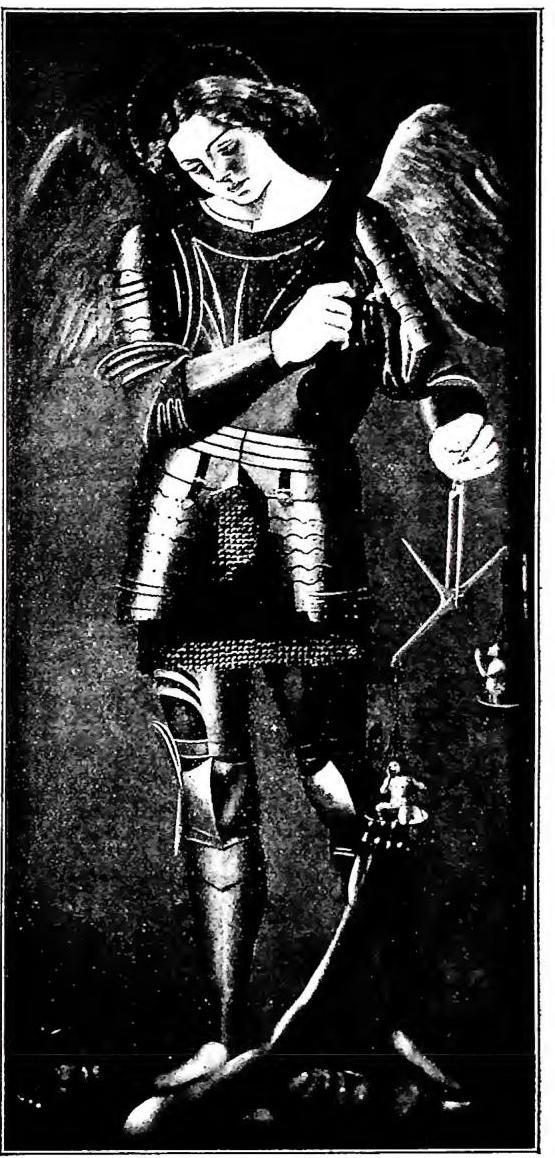
The aspiration to make the soul a substance in itself, self-moving and immortal, which already appears in Thales and in Alcmaeon according to Aetius (Dox. gr., p. 386), finds in Plato its expected fulfillment, down to the most minute details. Yet it is a difficult task, and interpreters still declare that they have not succeeded in offering a coherent exposition of the diverse perspectives of the different dialogues: in this, as in other doctrines—even the most important—Plato never reached a fixed point amid the continuous agitation of his thought. Added to this is the complication deriving from the use of myth, which with regard to the soul is continuous and merges with doctrine.
ANIMA - S. Michael weighing souls, attributed to Cristoforo da Lendinara (15th c.) - Bari, Pinacoteca.
We may set forth the following principles, developing the hints of the Phaedrus (244 c. sgg.): 1) The soul is a substance in its own right, for it must set other things in motion; to it belongs that motion which ranks tenth in the natural order, yet is logically first in origin and power, namely, “to move itself and other objects,” “which never fails... and is not only for itself, but is the source and principle of motion for all other things” (Leges, 894 c. sgg.; Phaed., 244 cd). 2) Consequently, the soul is not only independent of the body and immortal, but pre-existent to the body whose moving principle it is (Leges, 896 c. sgg.), and the perfections of the soul existed before the perfections of bodies. 3) As many as are the motions, so many are the souls: there is, therefore, before all else a “world-soul,” and the sun has a soul and each star its own (Leges, 898 d. sgg.). The cosmic character which Plato attributes to the soul is attested by his ascription of a soul even to the gods.