
VEGETATIVE LIFE. — In contrast to relational and animal life, it consists in the group of activities that tend to guarantee the effective functioning of the individual organs, as well as their mutual coordination for the better maintenance and exercise of vital processes. The purpose, therefore, of all vegetative functions is to ensure for the individual the most favorable conditions of life for his organism.
These functions are under the control of a particular section of the nervous system: neurovegetative system (v.) which, with its diencephalic centers and the two divisions of the orthosympathetic and parasympathetic systems, contributes (in close functional association with certain endocrine glands), together with the relational nervous system, to the regular development of somatic-psychic life.
(Anderson photograph)
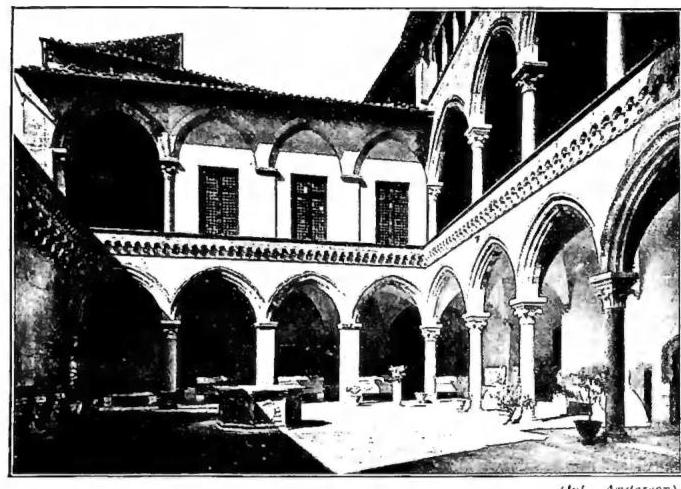
VITELLESCHI, GIOVANNI — Courtyard of Palazzo V. (15th century). A detail of the façade is reproduced at V. FINESTRA — Tarquinia.
The regulating centre of the entire V. V. is today considered to be the neuro-hormonal-diencephalic complex, constituted by the hypothalamic centres of the diencephalon in anatomical and functional relation with the pituitary gland, which constitutes “the principal spring of primitive, vegetative, emotional, reproductive existence” (Cushing). The whole activity of such a complex takes place outside the direct control of the will and intelligence, which can exercise an inhibitory and regulatory action upon it only within narrow limits. Moreover, experience teaches that V. V. can proceed perfectly and remain present with all its instinctive and automatic reflexes even in the most deficient development of the higher psychic function, as is seen in the lower beings of the zoological scale, in the vital activities of the newborn, and in the most serious cases of mental deficiency.
Ceni admits the existence of two different equilibrating systems in the V. V. of evolved beings: one located in the diencephalon, the other in the brain and, more precisely, in the prefrontal areas of the cerebral cortex and in intimate relation with the psychic centres. According to Ceni, the hormones responsible for interglandular correlations would belong to the diencephalic centre, whereas the cerebro-psychic system would contribute a nervous factor capable of acting independently of hormonal influences. While, therefore, the diencephalic system has a very remote origin and is also present in lower animals, in which it presides, independently of external stimuli, over the organisation of matter in harmony with internal and environmental requirements, the cerebro-psychic system is of recent origin and is not inherited but acquired; it represents the fundamental element of all the psycho-organic reactions underlying the emotions, which in man can pass beyond the field of preformism and enter that of consciousness.
From the foregoing, one may appreciate the importance currently attributed to this neuro-hormonal complex, which Pende defines as the “bridge between soul and body”. This zone, in fact, now seems to include all the nervous centres of instinctive-emotional-animal life, that is, of the complex of feelings and passions (hunger, thirst, aggressiveness, wakefulness, sleep, mood, sexual drive...), constituting the area of the brain in which our animal nature unfolds. With the progress of anatomical and physiological knowledge concerning the autonomic nervous system, the complex syndromes determined by the functional alteration of one or another section of the system have been increasingly well delineated. Alongside conditions determined by slight dysfunctions, nevertheless capable of giving a particular imprint to the constitution of an individual (orthosympatheticotonic type and subsequently parasympatheticotonic [V. TIPO]), various pathological alterations have therefore been progressively better defined, such as orthosympathicopathies with excitation or paralysis of one or another section of the sympathetic system (cervical, thoracic...) and orthosympathoses of the sensory, vasomotor, excretory, or dystrophic type, in which a concomitant alteration of the endocrine glands is often associated.
Moreover, in recent times (1950), Pende identified a new morbid syndrome, diencephalosis, whose essence would consist in the heightened and disordered activity of the diencephalic centres, released from the inhibitory influence of the higher cortical centres. According to Pende, “diencephalosis”, produced by cerebral leptomeningitis beginning in fetal life, with external and internal hydrocephalus, particularly of the third cerebral ventricle, together with its irritative, inflammatory, and degenerative phenomena affecting the hypothalamic centres, may explain the profound behavioural anomalies and the notable disturbances of the moral sphere found in subjects who were formerly defined as “born criminals or criminals by inclination” (Lombroso). He even speaks of a “criminogenic diencephaloendocrinosis”, whose importance is unquestionable not only from the standpoint of the individual’s educational formation, but also from the social and moral standpoint, since subjects who should rather be included among genuine cerebropathic individuals cannot be considered fully imputable. These diencephalic alterations, although still not readily classifiable, cannot today be disregarded, since they rest on statistical foundations: through radiological-functional investigation of the skull, brain, and endocrine balance, they have been found in approximately 20% of children who are entirely physically and psychically abnormal or abnormal only in conduct, and in 47% of a group of criminals confined in the prisons of Rome.