
APOLLINARE, bishop of LAODICEA. – Son of the Alexandrian grammarian of the same name, he was born at Laodicea in Syria around 310. He had already been ordained a lector when, around 330–35, he was teaching rhetoric in his native city. Solid learning and exceptional qualities soon made A. one of the most distinguished personalities of the Eastern clergy. Friends and enemies alike paid tribute to his vast knowledge of sacred and profane subjects and to his piety. A man of letters, theologian, exegete, and polemicist, he was one of the principal ecclesiastical writers of his time. Before becoming a heresiarch, he spent many years in the ranks of orthodoxy. A friend and host of St. Athanasius, he was his companion in arms in the defense of the Nicene dogma, and this stance earned him the open hostility of the Arians and of their bishop, Giorgio of Laodicea. To evade the laws of Julian the Apostate, which prohibited Christians from teaching the pagan classics (362), he composed, together with his father, a series of works modeled on Homer, Euripides, and Menander. These works were greatly admired at the time, but judging from the only one that has survived, a Paraphrase of the Psalms in hexameters (PG 33, 1313–38, new ed. by A. Ludwick, Leipzig 1912), they must have displayed little personal inspiration and shone only through the qualities of their correct versification. While taking a stand, in defense of Christianity against Julian the Apostate, with a book On Truth, and refuting Porphyry, A. defended orthodoxy against the Manichaeans, the Arians, Marcello of Ancyra, Eunomius, and other heretics, commented on the Bible, and wrote other works of which only fragments remain today. Around 360–61 the party of the defenders of Nicaea elected him bishop of Laodicea against Pelagius, in circumstances and for reasons that are still not entirely clear. From that moment A.’s doctrinal position began to arouse suspicion, until in the following years he left the Church.
The stumbling block to his orthodoxy was the mystery of the union of the two natures, human and divine, in the person of Jesus Christ. A. was the first to apply the results of the Nicene dogma to Christology and to draw the Church’s attention, hitherto directed toward the Trinitarian dogma, to this problem. In his zeal to safeguard the divinity of Jesus and, on the other hand, concerned that his personal unity might be compromised by the dualism of the Antiochene school of Diodore of Tarsus—which, by insisting on the Savior’s human perfection, led to Nestorianism (v.) Arianism (v.)—A. fell into the opposite error, that of a partial denial of Jesus’ humanity. Starting from the Platonic principle that man is composed of a body, a sensory soul (common to man and animals), and a rational soul (proper to man alone), and appealing to the scriptural principle that “the Word became flesh,” that “God was manifested in the flesh,” etc., he ultimately acknowledged in the Savior a body and a sensory soul, but not a rational soul, because the Word would have taken its place.
Lacking an exact notion of the idea of “person,” the Catholic thesis of an intimate union of the whole of human nature with the divine nature in the same person seemed to him absurd. In this way, however, he believed that the organic unity of the two elements, humanity and divinity, in Jesus was assured; but he preserved it at the expense of man’s most important constituent: the rational part. Once this principle had been established, it followed that: 1) the Word did not become man, but was incarnate in the primary sense of the word; 2) man is saved by the flesh of Jesus united to the Word, but without his merit (since it is neither free nor capable of virtue); moreover, it is impossible to understand how the rational soul, which is the most important part of man, can be saved if it is not assumed by the Word: for A. too admitted that only what is assumed is redeemed; 3) monophysitism is the consequence, even if unintended, of the entire system: the expression una natura Dei Verbi incarnata, later adopted by Cyril of Alexandria (who attributed it to St. Athanasius) and becoming the watchword of the Monophysites, is A.’s creation, because the humanity which, according to him, is united to the Word is not a human nature, since it lacks the characteristic quality of man (rationality); therefore one can speak only of one nature of the Word, which was formerly without flesh and then took flesh. Hence the comparison familiar to A., that the Word is united to the flesh as the soul is to the body, because evidently the union of soul and body can result in only one nature; 4) from this A. deduced one will and one principle of operation in Jesus, which later became the doctrine of Monophysitism. Many other errors were attributed to him without serious foundation, except perhaps millenarianism.
The Church reacted against this mutilated conception of the Savior’s humanity, which limited the redemption of man, and immediately affirmed that the Incarnation was a complete assumption of human nature except for sin. In order to redeem completely, Jesus had to be a perfect man, because “what was not assumed was not healed.”
Although the Council of Alexandria had condemned the Apollinarian thesis in 362 (without naming its author, who was still regarded as orthodox), A.’s position became difficult only later, when the controversy assumed broad proportions (370). By then suspect because of his ideas, he was definitively compromised during the schism of Antioch (375) by his disciple Vitale. The latter had formed an Apollinarian party, to which St. Basil drew the attention of Rome. At first Vitale succeeded in deceiving St. Damasus, who, once better informed, imposed on the priest of Antioch a formal condemnation of Apollinarianism. Vitale refused and established the schismatic community of Antioch, over which A. placed him by ordaining him bishop. In the meantime A. was defining his ideas in a major work, Demonstration of the Divine Incarnation (376), while propaganda for the heresy, until then conducted secretly, was set in motion. At Berytus he installed as bishop another of his adherents, named Timoteo, and intervened with the Egyptian bishops exiled by Valens to Diocaesarea in order to win them to his cause.
At the Roman Synod of 377 Damasus condemned the heresy, and A., together with the bishops who were his partisans, was deposed. The Roman sentence was also promulgated at the Councils of Alexandria (378), Antioch (379), and Constantinople (381). Shortly afterward Theodosius, through a series of decrees issued in 383, 384, and 388, outlawed the Apollinarians, prohibited their assemblies, and deposed their bishops, forbidding the ordination of others. After A.’s death, which occurred at an advanced age around 390, his disciples divided into two currents: one consisting of the intransigent group called the Synusiasts, precursors of Monophysitism; the other, a moderate group led by Valentino, which was subsequently reabsorbed into the Church.
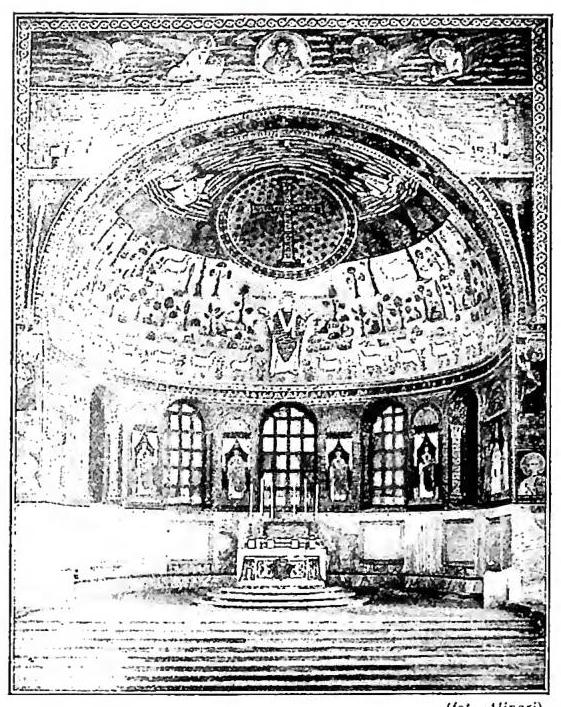
(Alinari photograph)
APOLLINARE, PONTIFICIO SEMINARIO ROMANO PER GLI STUDI GIURIDICI: V. ISTITUTI ECCLESIASTICI.