Machine translation of the 1948–1954 Italian original. The original text is authoritative.
APOLLONIA, Saint, Martyr. — A virgin of Alexandria, martyred in Alexandria of Egypt during a local uprising against Christians shortly before the outbreak of the persecution of Decius (248–49). St. Dionysius, bishop of the city and eyewitness to the events, gives an account of this in a letter to Fabius, bishop of Antioch, extensive extracts of which have been preserved by Eusebius of Caesarea (Hist. eccl., VI, 41). After speaking of the sufferings of other Christians, Dionysius refers to those of A., an admirable virgin; when seized, her teeth were knocked out by repeated blows to her face. A pyre was then lit outside the city, and the pagans threatened to burn her alive unless she uttered blasphemous words. Granted a moment’s respite at her request, A. took advantage of it to hurl herself into the fire, where she met her death. In the eyes of Dionysius, A. was a martyr, and as such she was venerated in the Alexandrian Church. When discussing suicide, St. Augustine (De civ. Dei, I, 26) also addresses the case of those Christians who voluntarily embraced death prepared for them, justifying their act. The Church, however, made no distinction and in her worship has united such martyrs with the others. Venerated also in the West, A. was invoked by popular devotion as the patroness against toothache. Later legends make A. a Roman martyr under Julian the Apostate.
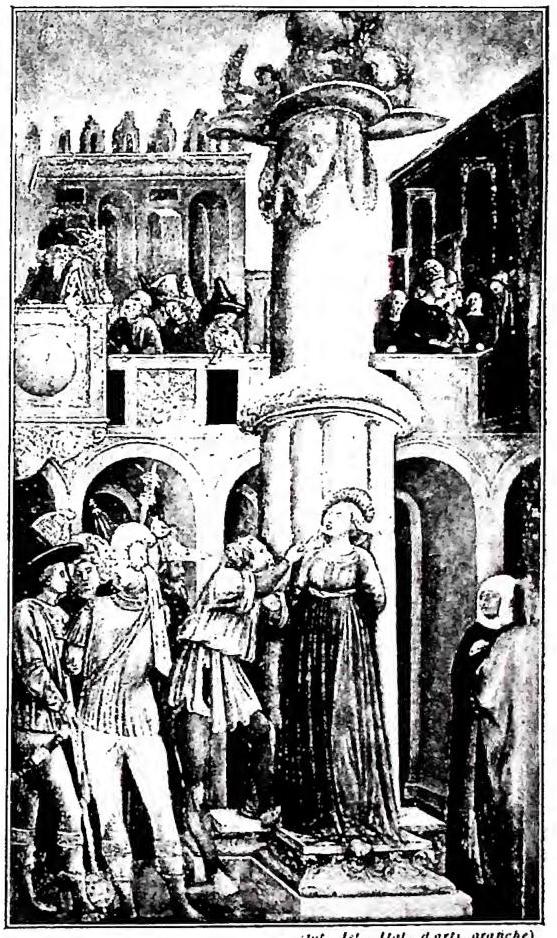
(ut. Ist. Inst. d'art. graphe)APOLLONIA, Saint — Martyrdom of the Saint. Painting by Antonio Vivarini (15th cent.) — Bergamo, Accademia Carrara.
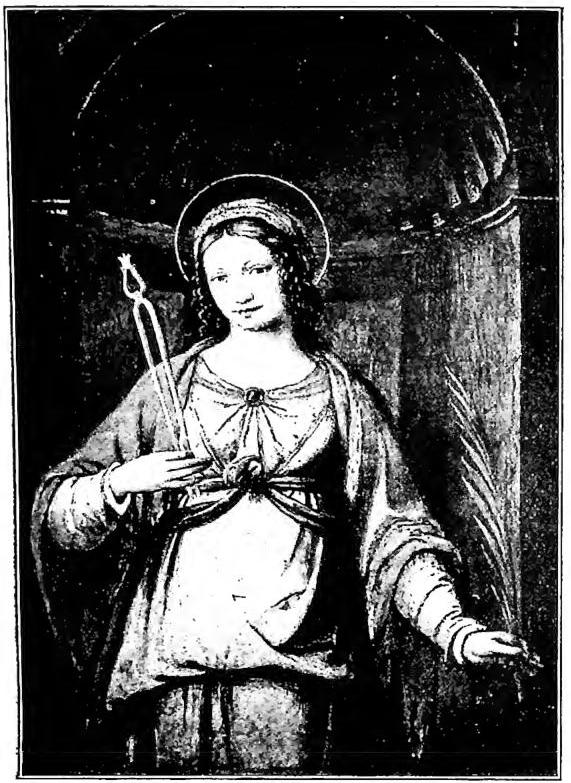
APOLLONIA, Saint — Fresco by B. Luini (16th cent.).
Her name was included in the Martyrology of Florus on 20 February, later arbitrarily changed by Ado to 9 February, which is the date of her current commemoration.
BIBL.:Acta SS. Februarii, II, Antwerp 1648, pp. 278–81; BHL. 638–45; H. Quentin, Les Martyrologes historiques du Moyen âge, Paris 1908, pp. 418, 456, 611; Koneffke, St A., die Schutzheilige der Zahnheilkunde, in Zahnärztl. Rundschau, 1913, fasc. xxx–xxxi; W. Bruck, Das Martyrium der hl. A. und seine Darstellung in der bildenden Kunst, in Kulturgesch. d. Zahnheilkunde in Einzeldarstellung, ed. C. Proskauer, II, Berlin 1915; K. Künste, Ikonographie der Heiligen, II, Freiburg in Br. 1926, pp. 90–93; G. B. Poletti, Il Martirio di s. A., Rocca S. Casciano 1934; excerpt from Archivum Chirurgiae Oris, 3 (1934); cf. Analecta Bollandiana, 54 (1936), pp. 166–67. Mario Scaduto
ICONOGRAPHY. — She is generally depicted as a young maiden, bearing the generic attributes of martyrdom and the specific ones of pincers and a tooth, which allude to her passion and to the particular devotion shown her by sufferers from toothache. From the late Middle Ages to the Baroque period there is an abundance of representations by Italian artists (Luini, Granacci, C. Dolci) and northern artists (Foucquet, Jordaens, G. Crayer, Willmann). The special popularity of the Saint is attested by the numerous representations of her in graphic art, from woodcut and copperplate incunabula to the devotional images of the eighteenth century.
BIBL.: W. Bruck, D. Martyrium d. h. A. u. seine Darstellung in d. bild. Kunst, Breslavia 1915; K. Künste, Ikonographie der Heiligen, Friburgo in Br. 1926; I. Braun, Tracht und Attribute der Heiligen in der deutschen Kunst, Stoccarda 1941, pp. 101-102 (with bibliography). Kurt Rathe
Popular traditions. — With reference to the best-known episode of her martyrdom, St Apollonia is invoked by the people for the healing of toothache. Her legend inspired a short prayer-exorcism, a narrative song, and a Tuscan sacred representation, of which records survive dating back to the fifteenth century.
Cite this article
“APOLLONIA, SANTA, MARTIRE.” Enciclopedia Cattolica, vol. I (1948), p. 979. Azione Romana digital edition, https://azioneromana.com/article/apollonia-santa-martire.