
CHURCH. - "It is the community of all the faithful, united by the profession of the same faith, by participation in the same Sacraments, under the authority of legitimate pastors, especially the Roman Pontiff, vicar of Jesus Christ on earth" (St. R. Bellarmine, De Ecclesia militanti, 2). The term Church also denotes the building where the faithful gather.
OUTLINE: A) THE CHURCH AS COMMUNITY OF THE FAITHFUL:
I. The theology of the Church
II. The Church in patristic texts and early Christian monuments
III. The history of the Church
IV. The historiography of the Church
V. Church and State
VI. Legal status of the Church up to Justinian
B) THE CHURCH AS BUILDING:I. Canon law and Italian law
II. Canonical-liturgical prescriptions
III. Art.A) THE CHURCH AS COMMUNITY OF THE FAITHFUL
I. THE THEOLOGY OF THE CHURCH
OUTLINE:
I. The problem of the Church
II. Biblical and theological concept of the Church
III. Origin of the Church
IV. Purpose of the Church
V. Constitution of the Church
VI. Powers of the Church
VII. The recognition of the true Church
VIII. Romanity of the Church
IX. Duties toward the Church.I. THE PROBLEM OF THE CHURCH
Jesus Christ could have manifested His nature and the divinity of His mission through the sole interior instinct of the Spirit; but He willed that our faith in Him and in the Church be sustained by the preaching of the Apostles, by the external miracles that accompanied it, and by the interior vocation of Grace. Therefore, the problem of the Church resembles the problem of Jesus, which our intelligence cannot fully resolve without taking into account the facts that history critically records, with the duty to investigate its nature to comprehend its full meaning, and with the mysterious and ever-necessary aid of Grace to grasp the presence and design of God in events.With this criterion, we must determine whether the Church is the work of God and imposes itself upon men as a reality originally and essentially divine, or whether it is a human construction that would have usurped unjustified divine titles. In this second case, the Church does not
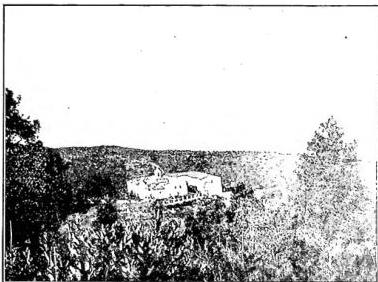
(Courtesy of the Passionist Fathers)
The sophistry maneuvered by human misunderstandings has deceived many scholars and reformers, who, relying on the politics of governments, have shattered some sector of the Church’s external organism upon the fiery stone of nationalisms; but heresy places itself outside the Kingdom of God, misrecognizing the authority that renders the Church divine, and schism miserably withers the branch of the national church, which springs from pride and dies in aridity. Thus, one has the churches of men in contrast to the one Church of Jesus Christ; one witnesses the ever-renewed and ever-failed effort of these churches attempting to justify themselves in the fields of science and religion, changing methods and systems, slaves to nationalisms and to themselves.
As the Jews did not recognize Jesus Christ because He did not correspond to their national ideologies of a conquering and oppressive king, so these modern schismatics do not recognize the true Church of Jesus Christ because it does not conform to the arbitrary picture of their partisan and proud nationalism. In the name of freedom, they become slaves to political power, instead of conforming their conduct to the Gospel by forcing the Gospel to justify their claims and weaknesses. Thus, the problem of the Church, like the problem of Jesus, involves the responsibility of intelligence, the rectitude of will, and the necessity of Grace. The rationalist, the schismatic, the naturalist violate the rights of science, freedom, and Grace, and remain outside the path of salvation.
The theology of the Church has a twofold aspect: the first apologetic and defensive, which tends to highlight the divine value of the Church, its scientific titles to our rational recognition, against heretics and deniers; the other more strictly theological, which investigates the intimate life of the Church in its sacramental characters, in its work of sanctification and expansion, in its social and mystical dynamism, in its conformation to Jesus Christ and its irradiation in the world.
Science alone is not sufficient to recognize the divinity of the Church, but it is necessary: faith includes good will and freedom, but finds its pedagogy in science; Grace constitutes the supreme reason of the believer, who begins by honestly accounting for the facts, proceeds by penetrating their profound meaning, and finally understands and adheres to the revelation of God by virtue of His known and demonstrated testimony.
This is the process of faith, this the spiritual itinerary of all those who find the Lord and can say the words of the dogmatic formula: «I believe in the holy Church».
II. BIBLICAL AND THEOLOGICAL CONCEPT OF THE CHURCH
To grasp the nature of the Church in its essential elements, one must consult the Gospel, the Acts of the Apostles, the Epistles of St. Paul, and the Fathers of the 2nd century.The first word and the first concept that presents itself to our consideration is that of the Church. In profane usage, this word signifies a gathering of the people, a convocation of an assembly; in the Old Testament, it is used as a translation from the Hebrew qāhāl, denoting an indiscriminate class of persons. In the New Testament, its meaning is refined and consecrated in the sense of the society of those who follow Jesus Christ, taking on local and universal aspects depending on whether it refers to a family, a city, a region, or the entire world.
When Jesus says, «Upon this rock I will build my Church» (Mt. 16:19), no one finds the phrase obscure, as it already had its commentary in the language of the Divine Master, who represented His followers under the metaphor of a flock, a sheepfold, a true society. The meaning of this word became increasingly defined in evangelical catechesis and apostolic practice, in the affirmations of the Redeemer and in the events that concretized that doctrine up to the day of Pentecost. If we were to provide even a rough definition of the Church, we could say that it is the «society of the faithful in Jesus Christ.»
The Gospel also designates the Church by the name of «Kingdom.» This word has a broader scope and embraces the entire work of divine Providence in the world. «Kingdom of God» signifies possession, the dominion of God, without restriction of time or space, whereas the Church denotes a special form or a singular aspect of the Kingdom of God.
With this concept of the «Kingdom of Heaven,» the work of Jesus inserted itself into the psychology and aspirations of the Jewish people, and lent itself magnificently to all those purifications and ascensions that the Gospel presents dramatically in the contrast between the teaching of Jesus and the obstinate incomprehension of the Jews.
The Kingdom of God is the truth that shines in the mind and penetrates the heart of the faithful, who adheres to the teaching of the Lord; the Kingdom of God is that society which is built around Him and is expressed under the figure of a banquet, a city, a vineyard. It is the Kingdom of God not only in its temporal unfolding within the condition of wayfarers but also in its ultramundane, eschatological phase, in that eternal banquet of the elect who will enjoy God in beatitude.
All this finds abundant documentation in the Gospel, which modern biblical theology increasingly highlights, also driven by rationalistic falsifications that seek to break the synthesis between the interior, social, and celestial elements of the Kingdom of God.
The Church, in its precise concept, is that special form of the Kingdom of God which is realized in the fullness of time,
as the saving work of Jesus, in its spiritual and social aspect, which operates in time but with extra-temporal intentions and purposes. It is an entirely exceptional kingdom, yet it possesses its constitutional doctrine, its means of social transformation—which are the Sacraments—its peaceful soldiers, who are the faithful, its hierarchy composed of apostles (= bishops), priests, and ministers, its goals of perfection and salvation, and even a visible history, which is the history of the Church. It does not confuse itself with civil society as a cumbersome duplicate, nor does it estrange itself so far from the world as to wander in the abstract. Rather, one can see in the Acts of the Apostles what the presence of this Kingdom of God, which is the Church, signifies in the civil society of the 1st Christian century, making of the present life a conquest of future goods and causing one to walk on earth with one’s gaze fixed on the light of the divine sun.
Another fruitful concept for expressing the meaning of the Church is that of the «(Mystical) Body of Christ» (v.).
In St. Paul, another phrase is found to depict the intimate value of the Church. He states that Christian marriage symbolizes the union of Christ with the Church, and he exhorts the wife to submit to her husband in everything as the Church does to Jesus Christ, and then invites the husband to love his wife as Christ loved the Church, even to the point of sacrificing Himself for her, to sanctify her, to render her pure and glorious, without wrinkle or stain, holy and immaculate (Eph. 5). These words particularly exalt the intimate relationship between Jesus Christ and the Church, even to the point of considering her mysteriously and intimately as His bride. From this union blossoms holiness in every abundance of works and virtues.
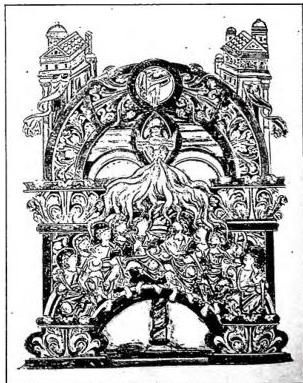
(from V. JALABERT, LOUIS, Les pontificaux des bibl. pub. de France, Paris III, t.p. 3)
CHURCH – Descent of the Holy Spirit. The nativity of the Church. Miniature from the Pontifical of Winchester (late 10th century). Rouen, Municipal Library, ms. 369 (Y. 7), f. 29.
They are fellow citizens of the saints and members of God’s household (Eph. 2, 19-22). Thus, it is the walled city upon the mountain, the mysterious fortress rising above the waves of the sea of life, amid the tumults of men, a beacon to sailors and pillar of truth. No one knows and describes the Church as does this persecutor of yesterday, who becomes its Apostle and martyr today and forever. It is well to remember that the Church is a society, the Kingdom of God, the Bride of Christ, the temple of holiness.
III. ORIGIN OF THE CHURCH – All recognize that the religious movement known as Christianity begins with Jesus Christ; yet not all agree in acknowledging that Jesus Christ is the immediate institutor and founder of the Church, conceived as a society, that is, a hierarchical moral organism for the purposes of salvation.
Some modern critics, misunderstanding the complex nature of the Kingdom of God preached in the Gospel, assert that the first Christians lived in expectation of a kingdom that never materialized, and that in its place the Church emerged through human agency.
Others, convinced that Jesus Christ restricted His work to a simple moral, interior, and individualistic renewal, deny that He intended to found a social organism, claiming instead that each person is the priest of himself.
There have even been those who sought to seize upon the supernatural and temporary phenomena of which St. Paul speaks in I Corinthians, calling them charisms. In the first Christian generation, the outpouring of the Spirit produced exceptional and often miraculous effects in the spread of Christianity and the construction of the Church.
St. Paul is explicit on this point, but some modern scholars have clung to the charismatic Church either to claim that it ceased to exist when the charisms faded or to conclude that the true Church of Jesus Christ is not the juridical and hierarchical one, which today is called Catholicism, but rather a spiritual and mysterious Church composed of the elect, united by the bond of the Spirit without doctrinal determinations or interventions of authority. This Church, without soul or body, may appear flawless, convenient for all, because it holds no value for anyone.
Catholic doctrine teaches that Jesus Christ immediately instituted His Church as a true social organism, which developed gradually but derives none of its essential elements from any other source. The proofs of this truth are found in the Gospel. First, there is a true identification between the Church and the social kingdom preached and founded by Jesus. Beyond its intimate aspect and eschatological phase, the Kingdom of God takes shape in time through the Apostles, through the doctrine of Jesus Christ, through the Sacraments as means of sanctification, and through St. Peter as the depositary of supreme authority. It is through the Church that God is known and glorified, souls are transformed, and eternal life is attained. Jesus founded no other kingdom than this. Whoever misconstrues the Church misconstrues Jesus Christ and the Gospel. The fact is undeniable.
A second argument may be formulated by gathering the scattered elements in Jesus’ preaching. He founds a true society that gathers a multitude of persons to achieve a well-defined purpose, with a program and suitable means for its realization, and with a central governing authority. The entire Gospel teaches nothing other than the duty of all to follow the Divine Master, accept His doctrine, practice His law in the Church governed by the Apostles in view of eternal life. Jesus Christ conferred the power to forgive and to teach, instituted the sacrifice, and promised the Spirit, so that all might become children of God in
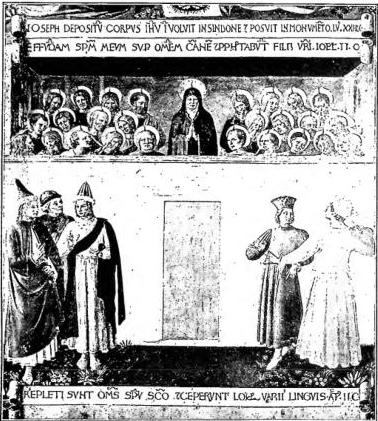
CHURCH - Descent of the Holy Spirit. The birth of the Church.
Painting by the Blessed Angelico in the museum of San Marco - Florence.
There is no doubt that external circumstances contributed to better defining its character and movements; but that this Church arose by the work of men and was not precisely the continuation of Christ's redemptive work is absolutely false.
The Churches founded by St. Paul are not autocephalous, nor do they constitute a federation of independent organisms, but are members of a single moral body, are the Church of Jesus Christ that grows, expands, and progresses toward perfection, toward eternal life. Precision of doctrine, unity of governance, coherence of life with the teaching of the Divine Master, Baptism
of the Holy Spirit and the Eucharistic Table are the essential and vital elements of this divine and human society that extends throughout the world, united and compact.
The apostolic writers of the 2nd century are more dogmatic and ecclesiastical than many later writers.
The Doctrine of the Apostles speaks of the Church that gathers into the Kingdom of Christ from all the ends of the earth; St. Clement of Rome speaks of the Church of Rome and that of Corinth with such a unitary concept that it allows for the suppression of every indiscipline and every schism (end of the 1st century).
St. Ignatius of Antioch tells the Ephesians to look to the bishop as to Jesus Christ, that deacons are not ministers of the Table but of the Church. He praises their union with the bishop, which is like the union of the Church with Jesus Christ, and of Christ with God. All who return to the unity of the Church are of God and live according to the Savior. All the letters of St. Ignatius prove the immediate origin of the Church from Jesus Christ (beginning of the 2nd century).
St. Polycarp, in his Letter to the Philippians, greets the Church of God sojourning in Philippi, admonishes deacons to remain unstained as ministers of God and of Christ, not of men, and emphasizes the duty of submitting to priests as to God and to Jesus Christ (V, 2, 3).
St. Justin, in his Dialogue, tells the Jews that the promises made to the Fathers have passed to the Church, which was born from Jesus Christ, that the faithful of Christ are one single Church, which arose from Him as a new world through faith and Baptism (mid-2nd century).
St. Irenaeus, in his work Adversus haereses, clearly affirms the duty of obeying the priests who have the succession of the Apostles, that the mission of preaching is entrusted to the Church. The classic phrase is: where the Church is, there is the Spirit of God (end of the 2nd century).
It must be concluded that those critics who deny the immediate foundation of the Catholic Church by Jesus Christ place themselves in contrast with the most reliable historical documentation, allow themselves to be carried away by their arbitrary ideology, and, to deny faith, are forced to deny reason.
Some pretend to be scandalized because in the Church there are sinners, that the struggle against capital vices is waged, and not all are saints from the first day. They forget that Jesus Christ came to seek sinners, and all men are such; the danger is not in recognizing them as needing forgiveness and rebirth, but in believing oneself just without even having consciousness of one's own guilt, and without understanding that the Church, founded by Jesus Christ, is precisely the kingdom of justification for wayfarers.
IV. PURPOSE OF THE CHURCH
The Vatican Council aptly expressed the essential purposes of the Church by stating that « the eternal Shepherd and Bishop of our souls, in order to render perpetual the salvific work of Redemption, decreed the foundation of the Church, in which, as in the house of the living God, all the faithful might be united in the bond of faith and charity » (Denz-U, 1821).This doctrine finds its historical demonstration in the Gospel. Jesus Christ affirms: « As the Father has sent me, so I send you » (Jn. 20:21) to preach the Gospel to all men, to forgive their sins, to regenerate them in the bath of life, to make them partakers of every Grace in Eucharistic Communion, to make of all the faithful a royal priesthood and a Church without wrinkle or stain.
To this end, Jesus Christ promises to remain in the midst of His disciples and with His disciples until the end of the world; for the same purpose, He sends the Holy Spirit, who will be the soul of the Church, its invisible and invincible support until the end of the world.
The entire Gospel documents this thought, which, translated into theological language, signifies the purification of souls, the renewal of hearts, the sanctification of society. The Apostles consider themselves ministers of Christ, dispensers of His mysteries, builders of a
new world, which will be the kingdom of Christ, His Mystical Body, will still be Him living and acting in the society of souls who possess Him. He, in the act of justifying sinners through the mysterious infusion of His blood by means of the Sacraments.
This evangelical doctrine does not allow us to indulge in the dream of an invisible Church, made of saints and predestined, as if wandering souls in a heaven of imagined charity; nor does it tolerate that extrinsicist view which sees in the Church nothing but a juridical and hierarchical organism that too closely resembles the reprobate Synagogue and a body without a soul. The Church is founded so that sinful humanity may become redeemed and justified humanity. Faith is sufficient to enter the Church, but faith alone is not sufficient to remain in it duly. Whoever does not transform himself places himself outside the Mystical Body, passing from legality, which does not justify, to inconsistency, which condemns, and sometimes to perdition.
To this doctrine of the purpose of the Church is connected that of the necessity of belonging to it as a condition of salvation. Not only did Jesus Christ say to the Apostles: « He who despises you, despises me; and he who despises me, offends Him who sent me (Lk. 10:16) »; but He added: « He who believes will be saved; he who does not believe will be condemned » (Lk. 16:16; Mt. 10:14). St. Ignatius Martyr frankly tells the faithful: « Do not deceive yourselves: he who lives separated from the society of the faithful and from the doctrine of Christ does not attain the heavenly inheritance » (Ad Philadelph., 3, 3). Origen (3rd century) formulates the saying, which has become classic: « Outside the Church there is no salvation » (Hom. in Iesu Nave, 3, 5), a phrase that must be understood of those who culpably remain outside the Church, while even sincere desire suffices to belong to it morally.
Therefore, the Church is the instrumental cause of sanctification, insofar as it teaches the doctrine of Jesus Christ, communicates His Grace in the Sacraments, and renews souls, disposing them for the final phase of the Kingdom of God, which is eternal life. Its function is divine, exercised in this world in view of the next, militant today in the first phase; glorious tomorrow in the supreme and final phase. This is not a casual purpose, born of circumstances, as if by an arbitrary expedient; but, in contrast to the weakness of men and with supernatural means that only God could provide, the Founder has firmly established a renewal of souls as a necessary condition of salvation for eternity. In a mere man, there would not have been the capacity to conceive such a vast and lofty horizon, much less the capacity to realize II.
The efforts of some critics to reduce this finalism of the Church to a minimal natural level contradict history and remain merely arbitrary and false.
V. CONSTITUTION OF THE CHURCH -
1. Hierarchy
Just as various attempts have been made to deny the immediate institution of the Church by Jesus Christ, particularly in the Protestant world, so too have efforts been made to obscure the true constitution of this divine society, in order to conclude with that individualistic subjectivism which is entirely contrary to the Gospel.Some deny that Jesus Christ willed in His Church a ministerial and jurisdictional power, such that there would be a true distinction between clergy and laity, with the obligation to respect or obey the orders of an authority of divine origin. By forcing and exaggerating the meaning of St. Peter’s words (1 Pet. 2:9), who calls the Christian people a chosen race, a royal priesthood, a holy nation, and a people for his own possession, they concluded that all Christians are priests. Others, confusing the nature and function of the charisms mentioned by St. Paul—which flourished in the early Church as a varied supernatural effusion of the Holy Spirit—affirmed that, with the disappearance of those charisms (which were of a transitory character), hierarchical degrees were substituted by the work of men.
Instead, Catholic doctrine, more clearly formulated at the Council of Trent, teaches that in the Church, by divine institution, there exists a hierarchy composed of bishops, priests, and ministers.
Referring to the relative entries for a more detailed description of individual themes, it can be documented from the Gospel that Jesus Christ did not intend to initiate an amorphous and individualistic movement without hierarchical structure, but a true society, called the Kingdom of God, the Church, the Mystical Body, the House of the Lord.
No one can deny that Jesus Christ revealed His doctrine to the Apostles and invested them with divine powers for the sanctification of souls and the governance of the Church. "You did not choose me, but I chose you" (Jn. 15:16); "As the Father has sent me, even so I send you" (Jn. 20:21); "He who hears you hears me, and he who rejects you rejects me" (Lk. 10:16); "All authority in heaven and on earth has been given to me. Go therefore and make disciples of all nations, baptizing them in the name of the Father and of the Son and of the Holy Spirit, teaching them to observe all that I have commanded you. And behold, I am with you always, to the end of the age" (Mt. 28:18-20).
Here, a power of teaching, ministry, and governance is clearly indicated and conferred, along with the promise of a protection that will never fail.
The conduct of the Apostles practically comments on Jesus’ words. The Apostles founded individual Churches as an expansion of an organic whole, which is the Church of Christ, and governed them in His name and as His ministers; they transmitted their powers to others who would succeed them, so as never to allow initiatives that could not be justified by the teaching and power received from the Divine Master. They taught, celebrated the mysteries of Grace, governed the peoples won over to the Gospel, punished the rebellious, worked miracles in proof of the divine mission they fulfilled, and died in testimony to the revealed truth and for love of the Savior.
At the end of the 1st century, a rebellion broke out in the Church of Corinth. Some audacious young men deposed the elders and took their place. The matter was referred to the Bishop of Rome, who, in the person of Clement, intervened with the Letter to the Corinthians, accusing them of injustice against those venerable priests who, by legitimate succession, governed that Church, and against whom no one had the right to rise up.
The Apostolic Fathers of the 2nd century, and especially the bishop and martyr St. Ignatius of Antioch, describe the hierarchy of the Church with the clarity of today’s theologians. They are learned and holy figures who bear authoritative witness to what they narrate and to the fidelity with which they carry it out. Heresy, always armed against them, could not catch them in error, and here emerges an irrefutable argument of prescription. How did that hierarchy arise if it did not correspond to Jesus’ teaching? To suppose that at the beginning of the Church the enthusiasm of the disciples triumphed and the power of the Apostles did not function, as if everything were charismatic and nothing jurisdictional, is to falsify history.
The Epistles of St. Paul are too well documented to deny the value of his testimony and pastoral practice. Bishops succeed the Apostles with the characteristic of being able to transmit priestly powers, and with residence in a proper see, whereas the Apostle had as his diocese all the Churches he founded. One may question the details of the presbyteral college and ask how the monarchical episcopate was practically manifested; but that the hierarchy of the Church traces back to the Apostles and is of divine origin is not only a dogma of faith but a historically demonstrated truth.
Man is always social, and only in society does he more easily attain his perfection in every field. Providence, which in the economy of its gifts and demands takes into account the native disposition of its creatures, provides for our religious needs by making us citizens of a spiritual homeland that is the Church, in which we more securely know the truth and practice the good than if we were abandoned to our individualism. God confers upon us the honor of collaborating in His work of sanctification; the priest becomes "adiutor Domini" and savior of his brother, the faithful feels himself drawn closer to God through the ministry of a fellow traveler.
The hierarchy ensures the connection of all who compose the Mystical Body of Jesus Christ, and the multitude of the faithful feels itself spiritually compacted and incorporated into the supreme Priest. In the Church, there is no room for pride; honor flourishes in humility. We all receive from Christ the truth and Grace, but we help one another in the conquest and application of His merits. The hierarchy does not replace the freedom of love but cooperates with it as the physician does with the health of the sick. One does not live in the Church with a rubricated legalism, nor does the life of the spirit flourish in disdainful solipsism. The life of the spirit necessarily has three aspects that call to one another: adherence to the source, which is love for Christ; progressive interior renewal of the soul; and luminous and joyful discipline in the society of the faithful. The union of these three aspects signifies the convergence of all the virtues of the Christian life. This is the mission of the hierarchy.
2. Social Perfection of the Church
The hierarchical constitution of the Church raises the question of its social perfection, because to the myopic gaze of the critic it seems a cumbersome duplicate of civil society, and to the pride of rulers it seems to be part of the State.Heresy, which easily allies itself with tyrants, almost always arises with a nationalistic mark and always ends by misrecognizing and denying the true constitution of the Church.
When we Catholics speak of the perfection of this divine society called the Church, we mean to affirm that it possesses in itself all the means necessary to attain its end, which is the sanctification of souls and salvation, and that it does not juridically depend on any other.
As a supernatural society, it presupposes all that man naturally possesses in the individual and social spheres, but this does not compromise its perfection. Just as the human organism does not cease to be relatively perfect, though it needs light, air, and food; just as the State is a perfect society in its order, though it needs international commerce; so too must the Church be recognized as perfect, in the sense that it possesses the means necessary for its life or has the right to take them where they are found, without depending in this on any other authority.
To demonstrate this doctrine, it suffices to consult the Gospel, from which it results that Jesus Christ founded the Church independently of civil society, invested it with autonomous power, and commanded that it be exercised without accounting to the lords of the world: « You will be hated and persecuted for my name: do not fear, for I have conquered the world » (Jn. 16:33; cf. Mk. 13:9; Lk. 21:12). Jews and Gentiles immediately began persecuting these unarmed missionaries of the Gospel, who had only one response to give: « We must obey God rather than men » (Acts 5:29), and did nothing but render to God what is God’s, recognizing to Caesar what is Caesar’s.
The entire history of the Church is a struggle to recognize the rights of God in contrast to human pretensions, in defense of the freedom of the Gospel against the enslavement of every human tyranny.
In chapter 15 of De regimine principum, St. Thomas provides the philosophical and theological rationale for this independence of the Church before civil power. The essential finalism of social life determines the hierarchy of institutions. « Those who are responsible for the care of the ultimate end must be superior to those responsible for intermediate ends... Thus, the blacksmith forges the sword so that it is suited for battle, and the builder designs the house so that it is suited for dwelling ». It follows that civil power, ordered to the common human good, is subject to ecclesiastical power, ordered to the spiritual good, the ultimate end. This reasoning contrasts with the sophistry of passions and all human cupidities, but it is perfectly logical, founded on the nature of man and the absolute primacy of God.
To say that the Church has no territory of its own, no weapons to enforce its right, and that its members are citizens of the State, is to misunderstand the spiritual character of the Church itself, which is not a duplicate of civil society but surpasses and transcends every temporal and human finality. While its mission is the attainment of an absolute and eternal good, it more highly harmonizes social activity itself, which it does not invade but presupposes and transcends, demanding that civil powers not deny what is connected with the spiritual good.
The misrepresented and maligned indirect power of the Church is precisely summarized in these three propositions: « 1° The temporal end must not impede the supernatural end; a good, to be such, must preserve the hierarchy of ends and not oppose the superior good; 2° the society that pursues the temporal end must assist that which tends toward the supreme destinies of man; 3° the latter, therefore, has the right to demand from civil society what, through indirect connection with the spiritual, is necessary for men for the superior good. In other words, Church and State must cooperate for the good of the same subjects in what concerns them most » (A. Ottaviani, Luce di Roma cristiana nel diritto, Città del Vaticano 1943, pp. 39-40).
Even a non-Catholic State can and must recognize the authority of the Church, not only because it does not contradict anything legitimate and reasonable that civil power defends, but also because the Church has titles that must be recognized by all, has a beneficial mission for all, and everyone has the duty to acknowledge and adhere to II. Every persecution of the Church, even before violating the rights of Catholicism, is a violation of the rights of reason, beginning with the trial of Jesus Christ and extending to that of the last persecuted faithful.
3. Indefectibility of the Church
The question of whether the Church is mutable in its constitution or may cease to exist at some point in history is not new.There are two accusations in this regard: one from many who complain because they do not see the Church leading all modern errors and reproach its static or fixed positions in tradition; the other from those who reproach the Church for its excessive changes, so much so that it is no longer recognizable as the one originally founded by Jesus Christ. The extremism of these recriminations suggests the perennial traditional modernity of the Kingdom of God, of which indefectibility is a characteristic.
By indefectibility is meant the fact of the Church’s duration without interruption until the end of the world, the substantial immutability of doctrine, the means of sanctification, and the hierarchy, and an intrinsic indeficient vitality, founded on the promises of Jesus and the presence of the Holy Spirit. This promised stability of the Church is an object of faith and, at the same time, a motive of credibility, because it is humanly impossible to explain the life of the Church in the world without a positive intervention of God to sustain II. This teaching is
founded on the words and presence of the Savior. For « built upon the rock, the gates of Hell shall not prevail » (Mt. 16:18); « I am with you always, until the end of the world » (Mt. 28:20); « I will pray the Father, and he will give you another Paraclete, the Spirit of truth, to remain with you forever » (Jn. 14:16).
After such clear words of the Gospel, it is no longer necessary to invoke the testimony of the Fathers, who express this intrinsic invincibility of the Church, despite its natural weakness, and the perennial incarnation of capital vices in the army of persecutors, who change armaments but retain their guilty spirit.
The problem, which continually resurfaces in human history, finds its straightforward solution in theology. St. Thomas, resolving the question of whether the Church of the Apostles is the same as the Church of today, responds in his discreet Latin: « Dicendum quod eadem numero est Ecclesia quae tunc nata et quae nunc est, quia eadem fides et eadem fidei Sacramenta, eadem auctoritas, eadem professio ». And all the changes that can be noted say that « est alius status Ecclesiae nunc et tunc, non tamen est alia Ecclesia » (Quod., XII, q. 13, a. 19).
Against the claims of Montanus, the Manichaeans, Gioacchino da Fiore, the Jansenists, and the Modernists, he demonstrates that the New Law must last until the end of the world and cannot change « secundum diversitatem legis », because « nullus alius status praesentis vitae potest esse perfectior quam status Novae Legis », which « immediate in finem ultimum introducti ». The attitude toward the New Law may change « secundum quod homines diversimode se habent ad eamdem, vel perfectius vel minus perfecte ». At one time, laws are better observed; at another, they are neglected, but « stultissimum est dicere quod Evangelium Christi non sit Evangelium Regni », « non est expectanda alia lex quae sit Spiritus Sancti » (Sum. Theol., 1a-2ae, q. 106, a. 4).
This doctrine reveals the secret of the Church’s fidelity to the content of divine revelations in that attitude founded on tradition and the transmission of the divine message without arbitrary revisions or manipulations. But it also speaks of that generous effort to ever better understand the treasure of revelation in that dogmatic progress which is the triumph of the soundest theology, and in the ardor of an ascetic life that expresses coherence of love for the known truth, the flowering of Grace in the practice of all virtues.
St. Thomas further establishes the fundamental principles for rightly understanding this progress in sacred science, saying that « quantum ad substantiam fidei non est factum eorum augmentum per temporum successionem »; but « quantum ad explicationem crevit numerus articulorum quia quaedam explicite cognita sunt a posterioribus, quae a prioribus non cognoscebantur explicite » (Sum. Theol., 2a-2ae, q. 1, a. 7).
BIBL.:
A. Ottaviani, Luce di Roma cristiana nel diritto, Città del Vaticano 1943; J. de Maistre, Du Pape, Lyon 1821; J. Balmes, El Protestantismo comparado con el Catolicismo, Barcelona 1842-1844; J. Kleutgen, Die Theologie der Vorzeit, Münster 1867-1874; L. Billot, De Ecclesia Christi, Roma 1927; E. Dublanchy, V. Église, in Dictionnaire de Théologie Catholique, t. IV, Paris 1911; A. Straub, De Ecclesia Christi, Roma 1912; A. Palmieri, De Ecclesia Christi, Roma 1931; G. Thils, Les notes de l'Église dans l'apologétique catholique depuis la Réforme, Gembloux 1937.
F. SPEDALIERI
The Church is thus necessarily traditional and progressive. The invisible presence of its Founder within its organism is the source of those inexhaustible riches of thought and love that have always blossomed into light and conquest. The Holy Spirit inflames a pontiff, raises up a saintly reformer, and immediately a new Pentecost blazes forth. It is not heretics who reform, though they may serve as an occasion for precious rebirths; it is not revolutionaries who make the Church advance toward Tabor, but the insuppressible spirit of Jesus, which invisibly blazes and renews the heavens of the Church and the world.
Fra Girolamo Savonarola warns that "it is irrational to expect a better (religion) to come, for since one cannot find or conceive a better end, nor better and more certain means to attain it, nor a more perfect life, nor greater and more marvelous things than those foretold by the Christian religion, no other religion can come that might surpass it" (Trionfo della Croce, ed. Ferretti, Firenze 1913, p. 391).
VI. POWERS OF THE CHURCH — From what has been said above, the great mission of the Church emerges: that of continuing the work of Jesus by applying Redemption to souls throughout the world, in every age.
Three are the characteristics of the Savior that clearly emerge from the Gospel: He is the divine Teacher, the eternal Priest, and the peaceful King.
As Teacher, Jesus revealed the mysteries of God, promulgated the laws of sanctification, and presented Himself to the world as the revealer of the Father’s will. This character is strongly marked throughout the New Testament. As Priest, Jesus Christ abolished all ancient sacrifices, replacing them with His own, offering His life in redemption, and founding a new priesthood with new precepts and superhuman virtues. As King, Jesus Christ established a perfect society, well-organized, living by His life, in faith and love, constituting a renewed humanity that renders to God the honor and glory that sin had compromised in the world. The characteristics and powers of the Church correspond to those of its Founder and are the power of teaching, the power of ministry, and the power of governance.
1. Power of Teaching. — The Church is a living teaching. The mandate to instruct all nations is affirmed immediately in the apostolate, in the catechesis of apostolic times, in the spread of Christianity, in councils, and in missions. It is a duty and a right that the Church exercises by promulgating divine Revelation, keeping it uncontaminated in the face of rationalist and heretical manipulations, and defending it against deniers and aggressors.
The Codex Iuris Canonici (CIC) effectively expresses this power: Christ the Lord entrusted to the Church the deposit of faith, so that, with the permanent assistance of the Holy Spirit, it might sacredly guard the revealed doctrine and faithfully expound II. It is the duty and right of the Church to teach the evangelical doctrine to all nations independently of any civil authority; all are obliged by divine law to know and embrace the Church of God. With divine and Catholic faith, one must believe all that is contained in Scripture and Tradition and that the Church proposes as revealed, whether the Church does so through solemn magisterium or through ordinary and universal magisterium (cann. 1322-23).
Solemn magisterium refers to definitions issued by general Councils with the Pope or by the Pope alone when speaking ex cathedra; ordinary magisterium refers to pontifical encyclicals, ordinary documents of the Congregations, and the episcopal body.
The Apostles immediately considered themselves as missionaries, as envoys of Christ to the nations to proclaim the Gospel, the truth that liberates from sin and every tyranny, ambassadors of God to men. St. Paul had such a vivid awareness of being a faithful teacher of divine truth that he dared to say to the Galatians: « If even an angel from heaven should preach a Gospel other than the one I preached to you, let him be anathema » (Gal. 1, 8). To Titus, he commands « to speak and exhort and reprove with all authority » (Tit. 2, 15).
The author of the Letter to Diognetus, in the 2nd century, speaks as the Vatican Council: « It is not an earthly discovery that has been entrusted to them, nor do they consider a mortal invention what they guard so jealously, nor have they been invested with the administration of human mysteries... Since He revealed and made manifest to us, through His beloved Son, what had been prepared for us from the beginning, He placed everything at our disposal at once, allowing us to partake in His benefits, to discover and grasp realities that none of them could ever have dreamed of... Having been made a disciple of the Apostles, I have become a teacher of the nations. To those who have accepted to enter the school of truth, I conscientiously impart what has been transmitted to me... It is by virtue of the Son of God that the Church grows in wealth, confers intellectual light, reveals mysteries, and rejoices in the joy of the faithful » (Ad Diognetum, 7, 8, 11).
This teaching authority is first and foremost traditional, in the sense of fidelity to the genuine content of its divine source, to the deposit entrusted to the Church and transmitted to the faithful. From this treasure of wisdom, ancient and new truths continually emerge, for it is inexhaustible in its richness, reflecting the substantial truth of the Word. It is an infallible magisterium, for the very indefectibility of the Church would fail if, hypothetically, it could teach falsehood. The invisible presence of Jesus Christ as the influential Head in the organism of the Kingdom of God, the presence of the Holy Spirit sent on the day of Pentecost as the support and soul of Jesus’ work, guarantees the Church from any defection, beginning in the doctrinal field (v. INFALLIBILITÀ).
2. Power of Ministry (power of order). — Alongside the power of teaching, one must recognize in the Church the power of ministry, which is a sacramental power, conferred by the sacrament of Holy Orders validly administered, ordered to the worship of God and the sanctification of the faithful.
If the magisterium teaches the truth, indicates the path to be followed, the supernatural ideal to be attained—impossible by human strength alone—the ministry confers Grace and thus the strength to realize those doctrines in life, beginning with faith and ascending to the heights of transforming charity and heroic sanctity.
This power Sacraments (v.), which are « the principal means of sanctification and salvation » (CIC, 731) entrusted by Jesus Christ to the Church. Beyond the practice of the Sacraments, one must consider the obligatory observance of the evangelical precepts, which encompass all Christian morality. The Ten Commandments of the Old Testament acquire new breadth and greater understanding in the New and express the coherence of the whole of life with divine faith.
This divine legislation takes systematic form in theological treatises De virtutibus and is realized in the concrete conduct of daily life, in the practice of theological and cardinal virtues. These are not programs but realizations of saving law, the ascent of souls on the paths of justice, the flowering of Grace in the ascending degrees of virtues, duties, and beatitudes.
It is not enough to believe; one must love supernaturally and invest all individual and social virtues with this love, considering ourselves as citizens of a single Kingdom, that of Christ, of a Mystical Body, as is the Church, so as to counter proud and revolutionary nationalisms with the kingship of the children of God.
It is easy to fall short of the height of this divine life, to tear virtue to shreds to clothe oneself more comfortably, to seek dull analogies in the history of religions and in the virtues of pagans for an insipid syncretism. In truth, « what the soul is in the body, Christians are in the world » (Ad Diognet, 6).
3. Power of Governance. — From the indefectible hierarchical constitution of the Church necessarily follows the third power, that of governance, of jurisdiction, which directs the will of the disciples according to the demands of the common good.
Catholic doctrine teaches that « potestas iurisdictionis seu regiminis ex divina institutione est in Ecclesia » (CIC, 196); « Romanus Pontifex, beati Petri in primatu successor, habet supremum et plenam potestatem iurisdictionis in universam Ecclesiam tam in rebus quae ad fidem et mores tam in iis quae ad disciplinam et regimen Ecclesiae per totum orbem diffuse pertinent » (CIC, 218). « (Episcopis) ius et officium est gubernandi dioecesim tum in spiritualibus tum in temporalibus cum potestate legislativa, iudiciaria, coactiva ad normam sacrorum canonum exercenda » (CIC, 335). « Nativum et proprium Ecclesiae ius est, independens a qualibet humana auctoritate, coercendi delinquentes sibi subditos poenis tum spiritualibus tum etiam temporalibus » (CIC, 2214).
The history of the Church has never lacked those who have denied or diminished this power of jurisdiction within the Church, either to appease the excesses of the State or to reduce the social efficacy of the Church in the civil order. Yet Jesus Christ explicitly entrusted this power to the Church, both with the words: « whatever you bind on earth shall be bound in heaven, and whatever you loose on earth shall be loosed in heaven » (Mt. 18:16), and in the command to teach all with authority the practice of His precepts (Mt. 28:20).
The Apostles founded Churches, governing them either directly or through representatives, as documented in their letters, especially the pastoral ones.
Moreover, if the Church is a true and proper society, distinct and not subject to any civil power, it cannot lack this governing authority, without which no society can be conceived.
Legislative power was clearly exercised at the Council of Jerusalem, when the abolition of Mosaic observances was at issue, as recounted in Acts 15. St. Paul, in I Cor. 7:12, promulgated that law known as the « Pauline privilege ».
The evangelical laws, applied in different times and places, entail a variety of adaptations, which can be exemplified in the CIC. Excessive laws may be a defect, but without legislation, there is death. Fundamental concepts governing the life and practice of souls in the infinite demands of faith and perfection require a code, a legislator ever vigilant and intelligent, who between stagnation and revolution ensures the progress of good.
Judicial power is necessarily connected with the first: the magistrate is the living and operative law in society. Jesus Christ indicated this power when He outlined, in a few strokes, the process of correction that proceeds from secret admonition to the tribunal of the Church with its consequent sanction (Mt. 18:15).
St. Paul provides an example of the exercise of this power in the case of the incestuous man of Corinth (I Cor. 4:18) and when he instructs Timothy on how to behave with accusers of priests (I Tim. 5:19). The bishop is necessarily a legislator and a judge.
Coercive power accompanies judicial power. Law is coercive in the sense that it obliges in conscience when rightly interpreted and imposes corresponding sanctions. The Church’s sanctions are in keeping with its spiritual and supernatural nature; thus, they are especially of a moral and spiritual character. St. Paul also exercised coercive power, demonstrating by his example how the citizen of the Church must be kept alert to the fidelity of his commitments, not only through the profound sense of his moral responsibilities before God but also through the threat of ecclesiastical penalties (v. PENA).
It must be admitted that ecclesiastical authority has the right to inflict temporal punishments as well, though always with a view to spiritual good. Why should a heretic not be deprived of the freedom of propaganda when he threatens the faith of Christians? Why should a bad priest or a bad Christian not be punished in a tangible way when justice and the common good demand it?
The Church, as a spiritual society directly ordered to the ultimate end, has the right to request and obtain from the State all those material goods necessary for the fulfillment of its mission, and to use honestly those material means that the wisdom of its governance suggests.
In this delicate area of ecclesiastical law, two possible excesses exist: that of those who would exaggerate the Church’s coercive right, extending it unduly into territory not its own, and that of those who deny the Church any right, even indirect, over temporal goods and sanctions of a temporal order. Theology clearly defines the boundaries within which faith and reason preserve the hierarchical finalism of the two societies.
VII. THE RECOGNITION OF THE TRUE CHURCH — Many Churches exist today in the world that call themselves Christian: which of these is the true one? For an educated Catholic, the question is not difficult: he finds it in his Catholicism; but for a rationalist seeking the path of faith, for a Protestant or schismatic who wishes to orient himself in the religious field and not fail in his relations with God, the matter is very different. The Vatican Council teaches that we have the duty to embrace the true faith and to persevere in it constantly: "for this God instituted the Church with manifest notes so that all may recognize it as the guardian and teacher of revelation" (Denz-U, 1793).
4. The Notes
What are these notes or seals that enable us to recognize the true Church?For the Orientals, in general, the sufficient and necessary note would be fidelity of doctrine to the ancient teaching, to the ancient Church of the Fathers and the first seven ecumenical councils. But this fidelity is no longer a note of the true Church that is sought; in a certain sense, it can also be found in a schismatic church, and finally, it is not possible to know authoritatively whether a newly proposed doctrine corresponds to and conforms with the doctrine of the true Church of Christ (R.-M. Schultes, De Ecclesia catholica praelectiones apologeticae, Paris 1926, p. 165).
Protestants propose two different notes, which are the sincere preaching of the word of God and the legitimate administration of the Sacraments.
But there is no doubt that to understand when and by whom the word of God is preached sincerely and the Sacraments are well administered, it is necessary to know the true Church, so that such notes are more obscure than what they should signify. Apologists never constructed a defense of the institution starting from the doctrine taught; on the contrary, they understood that the doctrine was true because it was taught by legitimate authority.
That the Protestant notes do not help to find the Church of Jesus Christ is proven by the tangle of reformed churches and documented by Bossuet in his History of the Variations and in his polemics with the minister Jurieu.
Catholics present four notes that are traditional: unity, holiness, catholicity, and apostolicity, and reason thus: the Church of Jesus Christ must bear these marks, these evident properties. Where we find them, we will recognize the true Church of Jesus Christ; where they are lacking, we will understand that we are off the path.
These are hinted at in the Gospel, used variously by the Fathers and ancient writers, presented in series in the Nicene-Constantinopolitan Creed (A.D. 381), explained by St. Thomas in the opuscule on the Apostles' Creed, and strongly illustrated by Pius IX in the encyclical to the English bishops (1864).
These notes are evidently connected with the nature of the Church, of which they are evident properties; they are interconnected in such a way that one cannot exist without implying the other; and they are easier to know than the Church itself, so that they serve us as signs or seals of its existence and nature.
2. Use of the Notes. — Of these notes, a twofold use can be made to recognize the true Church. One is that indicated by the Vatican Council, which so pleased Cardinal Dechamps. It is formulated thus: "The Church by itself, that is, by its admirable propagation, eminent holiness, and inexhaustible fruitfulness in every good work, its catholic unity and invincible stability, is a great and perpetual motive of credibility and an irrefragable testimony of its divine mission" (Denz-U, 1794).
In this argument, one takes as a starting point the unity of faith, of its worship, and of its government, its invincible constancy in defending the sacred patrimony throughout the world, and its inexhaustible fruitfulness in every abundance of good, its propagation from the origins to the present day, against all obstacles of force, sophistry, and wickedness.
Once this fact is established in all its amplitude, the question arises as to how the few disciples of the Lord achieved this result. If it is recognized that the work of the Church was continually accompanied by miracles, so that "to the internal aids of the Holy Spirit must be added the external arguments of Revelation, that is, the divine facts and especially miracles and prophecies, which, manifestly displaying the infinite wisdom and omnipotence of God, are most certain signs of divine revelation and suited to every intelligence" (Denz-U, 1790), then one has the invited argument of the divinity of the Church.
But even setting aside other miracles and remaining with the fact of the Church persecuted and victorious, poor and beneficent to the whole world, united and compact despite heresies, schisms, and persecutions, one must say that this fact alone is a motive, an argument that induces every honest intelligence to believe in the divinity of the Church. When a historical effect that lies before our eyes transcends and contrasts with the natural efficacy of the known cause, one must conclude that God has intervened. This is precisely the fact of the Church, in the splendor of its properties and dazzling goals.
This argument has always been present in the Christian consciousness. St. Thomas illustrates it in the Summa contra Gentiles (I, 6) thus: "This marvelous conversion of the world to the Christian faith is the most certain indication of past miracles. Thus, their repetition becomes unnecessary, since they appear luminously confirmed in their effects. Indeed, it would be the greatest of miracles if the world had been induced to believe such bold truths, to perform such difficult deeds, to hope for such high rewards, without miracles, following the word of simple and ignorant men. And yet, even in our times, God does not cease to work miracles in confirmation of the faith through his saints."
There is another way to study and use the notes to arrive at understanding which is the true Church of Christ, de jure and de facto. One must seek in the Gospel and in the primitive Christian sources the essential properties, the genuine imprint, the visible notes of the Church as Jesus Christ willed and established it, for it cannot even be thought that the true Church would not have an unmistakable and recognizable face if one wishes to follow the Savior. With this portrait firmly and clearly fixed in mind, one can and must examine the various Christian confessions that history presents at every time, to discern that Church which bears the imprint of Jesus and which are the churches that are counterfeit, mutilated, or disguised, and which have thus lost every right to appeal to Jesus Christ.
Reading the Gospel, it leaps to the eyes that Jesus Christ impressed upon his Church a seal of unity, so that it would be undivided in itself and distinct from every other. Unity, therefore, in the content of faith, unity in the means of sanctification, unity in the government of this society destined to render perpetual in the world the salvation wrought by the Savior. The Divine Master, who said that every kingdom divided against itself is brought to desolation, and every city or house divided against itself shall not stand, could not have imprinted otherwise his work (v. UNITÀ).
Holiness is the perfection of love for God, which removes from sin and unites intimately with the Lord. It can remain intimate and secret in the soul, but it can also shine forth in the triumph of all virtues and in the splendor of miracles (v. SANTITÀ).
Catholicity is a property of the Church insofar as, being one, it presents itself as numerously conspicuous and recognizable throughout the world. The Apostles are sent to all nations (Mt. 28:19), and the presence of the Savior is promised to them until the end of the world (v. CATTOLICITÀ).
The apostolicity is a property of the Church insofar as, in the uninterrupted succession of its Pastors, it traces back to the Apostles and proceeds from them in the identity of faith, worship, and governance. It is upon St. Peter that Christ founded His Church (Mt. 16:18); it is to the Apostles that He made the promise of His presence until the end of the world (Mt. 28:19); it is upon the Apostles that the Holy Spirit descended at Pentecost, and to the Apostles were communicated the powers to teach, to forgive, to save, etc. (v. APOSTOLICITÀ).
These four marks, within the breadth of theological teaching, are certainly infallible signs of the Church of Christ, and that religious confession which possesses them unaltered and most fully realized can certainly proclaim itself Christian and claim its legitimacy. A discriminative criterion can be formulated thus: wherever heresy and schism break the unity of teaching, nationalize religion, dry up the sources of heroic and miraculous sanctity, and disrupt apostolic succession and mission, there is no true Church of Christ but a human construction, even if built with the stones of a ruined Christian edifice.
By this criterion, it is easy to understand how the dissident Eastern Church cannot claim the title of the true Church of Christ. Having separated from the Catholic Church, of which it was an honored part for ten centuries, it lost the hierarchical unity that ensures the unity of faith and worship, and set itself in contradiction by renouncing that Roman primacy which it had recognized in several previous councils. Although it has preserved the sacraments, and many of these dissidents are in good faith, one cannot deny that the effort of a most solemn worship contrasts with the poverty of Christian practice, which does not flourish in heroic sanctity. In terms of catholicity, the heterodox Eastern Church has failed. Confined almost exclusively to Slavic peoples and subdivided into a series of patriarchates and sects that do not even form a federation, this once-glorious Eastern Church destroyed itself with schism, and the meager life it leads proves that it has been unhinged from its source. Apostolicity is compromised. As for the Sacrament of Holy Orders, the hierarchy of this Church traces back to the Apostles; but with its rebellion against the supreme Pastor, it has lost the apostolic mission, lost the power of jurisdiction, and is like a suspended priest who continues to celebrate to the offense of God and the Church.
By the same path, one can easily recognize how Protestantism is not at all the Christian Church, insofar as it is an organized movement of secession from the Catholic Church in the 16th century.
It lacks doctrinal and hierarchical unity, due to that sola scriptura and free examination which justifies every individualism and every oddity. The so-called Lutheran Reformation was a radical deformation of the Church of Jesus Christ, extending even to various forms of nationalism, false doctrines, denied sacraments, and unrecognized hierarchy—a general upheaval. Sanctity in members of good faith may exist in spite of erosion and schism, but not by virtue of the presumed Reformation, which presents no other spectacle than that of an unbounded proliferation of sects, a propaganda that does not flourish in great virtues or miracles. Catholicity has no place because there is nothing organic or vital of which universality can be sought. Individualism is exalted as a triumph of freedom, but here it is mere arbitrariness and disorientation, nothing more.
Apostolicity is radically denied. Apostolic succession is lacking, as is any connection with the Church of Christ, which is distorted and denied in countless ways. The strong German intellect displays its inventive and complicated skill in forging systems and paradoxical constructions, which are well understood only when they are dismantled.
Continuing the investigation, one arrives at the Roman Catholic Church.
VIII. ROMANITY OF THE CHURCH — At this point, a question arises that seems most grave: how Christianity became Catholicism. The simplest answer would be to say that true Christianity has always been Catholicism, and if a historical problem presents itself, it is precisely that of understanding the various ways and the proximate cause of those movements of people who, detaching themselves from Catholicism and regrouping among themselves in a spiritual manner, have called themselves Christian confessions.
Yet among the churches of the world, there is the Roman Church with a primacy evident to all, and investigating with a pure eye what lies beneath this name of the Romanity of the Church is the very secret of all ecclesiology.
From a methodological standpoint at least, it is advisable not to consider Romanity as a mark of the Church, so that all may be persuaded that the true Church will bear the four preceding marks, but only those who have found and concretely recognized this Church will understand that it is Roman. Therefore, rather than a means of investigation, this Romanity is a result, a conquest, and cannot be taken as a starting point.
Secondly, Romanity does not signify a prestige that the capital of the Roman Empire would have projected onto the episcopal see of Rome, conferring upon it a primacy that would then have imposed itself on the entire Church. This is the thesis of E. Renan in the volume Conférences d'Angleterre (Paris 1880), in which he developed and falsified the theme of the relations between Rome and Christianity. With varied erudition, A. Sabatier embellished the same concept in Les Religions d'autorité et la religion de l'esprit (Paris 1899), and A. Harnack in Das Wesen des Christentums (Leipzig 1900). In Italy, this error echoed in the words of N. Tommaseo, who in the volume Roma e il mondo dared to affirm that « lo scisma e gli abusi moltiplicati nella C. diedero ai vescovi di Roma un'influenza che, in difetto di ciò, non avrebbero mai acquistata ». Alfredo Oriani, in Il Matrimonio, reiterated the same opinion: « senza l'unità reale di Roma, quella ideale del cristianesimo si sarebbe rotta. Roma sola poté, trasformandolo nel cattolicesimo, mantenerlo uno ».
To this insubstantial theory, even Loisy objected in L'Évangile et l'Église (Paris 1902), declaring that if « l'importanza della città ha contribuito all'importanza della sede romana..., non si può dire che l'abbia creata ».
When that heretical expression was repeated in the Italian Parliament, Pius XI, in a letter to Card. Gasparri (30 May 1920), authoritatively recalled that « il mandato alle genti universe è anteriore alla chiamata di s. Paolo; anteriore a questa il mandato di s. Pietro ai gentili; l'universalità si risconta già di diritto e di fatto agli inizi primi della C. e della predicazione apostolica; questa per opera degli Apostoli e degli uomini apostolici è ben presto più vasta dell'Impero romano, che, come è noto, non era di gran lunga tutto il mondo conosciuto; se si voleva soltanto ricordare l'utilità provvidenziale preparata alla diffusione e organizzazione della C. nella organizzazione dell'Impero romano, bastava ricordare Dante e Leone Magno, due grandi italiani, che in poche e magnifiche parole dissero e scolpirono la sostanza di quanto poi innumeri altri ridissero con più o meno abbondante erudizione, disseminata spesso di inesattezze e di errori, massime per subiti riflessi protestanti e modernistici ».
The title of Roman given to the Church in so many pontifical documents from St. Gelasius I (495) to the encyclical of Pius XII on the Mystical Body does not impart a nationalistic hue to the Church; it does not mark a boundary but indicates a center, which is the principle of a solid and harmonious organism. Only a myopic and passionate gaze can distort the meaning of this Romanity to express a narrow nationalistic and partisan spirit, whereas in the best traditional and serious usage, when one speaks of the Roman Church, one means the Catholic Church.
In a positive sense, it must be affirmed that the marks of unity, sanctity, catholicity, and apostolicity belong only to the Roman Church, and that consequently the Romanity of the Church is the concrete and historical realization of the unmistakable features of the Church of Christ. It is easy to observe how the constitution of Catholicism is unitary and compact in a perfect manner. Unity of doctrine without deviation, unity of sanctifying ministry without arbitrary individualisms, unity of government and universal jurisdiction are such pronounced imprints in the Church of Rome that they are often made the object of accusation as if they were compression and authoritarianism. Instead, dogmatic progress and the holy freedom of the children of God are found only in the Catholic Church; and stagnant backwater, mortal staticity in the heretical and schismatic churches, which, by withdrawing from religious authority, fell under political power. By opposing the apostolic mission, they lost contact with Jesus Christ.
The sanctity of the Roman Church is evident not only in all its doctrinal and practical content but in the efficacy of intimate and divine transformations that flourish in the heroic virtue of its saints and missionaries, in the charism of miracles that often accompany the heroic degrees of love and find their scientific recognition in the processes of canonization.
Though sanctity is intimate and not always nor easily recognizable, the Christian sense of the Church recognizes the saints even to the point of anticipating their proclamation, and Providence undertakes to break the silence of men and tombs to surround with glory the brows of so many who lived in the world unknown and often despised.
Universality in space and time is recognizable in the Roman Church with the most evident proofs. Though it is not a physical catholicity in the sense that the Church occupies every point on earth, it nevertheless shines throughout the world in such a way that it is easy to know and to come into contact with II. None of the human powers has been able to confine it within the bounds of national interests or bend it to partisan ends.
By acclimatizing itself to every people, it has not become the slave of any: its missions are the commentary on the command of the divine Master: « andate e predicate a tutte le genti ». Numerically, too, it counts followers in a proportion vaster than all the churches that call themselves Christian. Expansion does not compromise unity; unity facilitates expansion. In Rome, the Congregation and the Athenaeum of Propaganda Fide are the most eloquent symbol of this universality not only in law but also in fact. Along the paths of explorers and conquerors, the missionary preaches the faith and arouses love, and with his merits often makes one forget the wrongs of those who, by force, opened the way for him. The harshest modern ideologies highlight even more the benefit of the catholicity of the Church.
Apostolicity is the most evident mark of the Roman Church. It does not merely signify conformity with the ancient Church but continuity in the hierarchical succession of the Apostles down to our bishops, all united to the Pontiff, as he is united to Jesus Christ. This succession from St. Peter to the present day and the union of the other churches with the Roman one suffice to confound all those who walk by devious ways. St. Irenaeus says it explicitly: «Ad hanc enim Ecclesiam propter potentiorem principalitatem necesse est omnem convenire Ecclesiam» (Adv. haer., III, 3).
The argument of the succession of the Bishops of Rome, from St. Peter to Pius XII, is the cornerstone of uninterrupted apostolic tradition, the center of unity and diffusion, the driving force of every renewal and progress. The notes of the Church of Christ, recognized in the study of the sources, are practically found in the unique Roman Church, which, consequently, is the only true Church to which all must belong. The first meaning of the Romanity of the Church is precisely this historical realization of the notes, hence the synthesis of the distinctive characteristics of the Mystical Body of Christ. In a theological sense, the Romanity of the Church is the correspondence and identity of today’s Catholic Church with the Church founded by Jesus Christ, made evident by the perennial realization of the four fundamental notes.
The Romanity of the Church also signifies the primacy of St. Peter and the Roman Pontiffs within its perennial and universal historical framework.
Had St. Peter not died as Bishop of Rome, after exercising his office as Prince of the Apostles in this city, Rome would certainly have been an illustrious see, the center of a great diocese like Milan and Paris, but no more; and the Catholic Church could not be called Roman, just as today it cannot be called Parisian or Milanese. It is not the greatness of Rome as the capital of the empire that gave St. Peter the primacy of jurisdiction over all Churches, but rather this primacy of St. Peter, transmitted to his successors in the Roman See, that ensured the Bishop of Rome became the bishop of all Churches, and Rome became the center of the Christian world, by virtue of that infallible magisterium and that indefectible and sovereign ministry which Jesus Christ conferred upon St. Peter and his successors.
Rome, the capital of the Christian world, did not Italianize the Church, but contributed to placing the barque of St. Peter at the center of seas and continents, channeling toward the entire Christendom the rivers of all nations. The authority of the Roman See ensures the unity of the Church, which we have seen shattered every time peoples or individuals have withdrawn from that magisterium; it has rendered universality compact by excluding heretical and dissident fragmentations and, by preventing it from dissolving into the indeterminate, has made the sanctity of the Church glorious, which is the coherence of human freedom with revealed truth, with the never-polluted sources of supernatural life; and finally, it has guaranteed the apostolicity of the Church in that succession which runs from St. Peter to Pius XII and in the connection of every episcopal see with this Roman one. The perennial stability of the Church’s government is assured solely by the continuity of the succession of the Bishops of Rome.
That the consular roads aided the mission of the Apostles and the preachers of the Gospel, that Roman law was treasured in the formation of canon law, that classical literature and philosophy influenced the writings of the Fathers and Doctors, that the Latin language became the official language of the Church, and that the Roman Empire itself, after attempting to kill the Church in blood, was converted to the Gospel with a miracle of great moral order—all this is part of the history of the Church, a Latin and Roman hue upon the mantle of the Catholic Church; but it must not be confused with the Church, which is not Roman merely for what it found in Rome or may have assimilated from the culture and the organization of the Empire, but is Roman principally for what it brought and inserted there, that is, the revelation of the mysteries of God, the sources of Grace, the promulgation of love, and that apostolic succession which securely unites us to Jesus Christ in faith and in all life.
It is understandable how the first Christian apologists focused on the Roman See to defend all Churches, and Tertullian exclaimed: «If you go to Italy, you have Rome, whence authority comes to us. Happy Roman Church, to which the Apostles entrusted all doctrine sealed with their own blood!». Fra Girolamo Savonarola, in his book Trionfo della Croce, echoed Pope St. Leo thus: «Since the Roman bishop is the successor of Peter, it is manifest that the Roman Church is the mother and teacher of all others, and that all the faithful must unite in the Roman Pontiff as in their head. Therefore, whoever separates from the unity of the Roman Church, without doubt separates from Christ. But all heretics separate from this doctrine, because they do not wish to adhere to the determinations of the Roman Church, but obstinately follow their own fancies; thus, they are not Christians, as they falsely claim».
It logically follows that adherence to the Roman Church is not an act of more or less obligatory conformism before men, but obedience to Jesus Christ living in His one true saving Church. And the problem of the separated Churches is not resolved by some dreamed-of federalism, but by inscribing oneself into that trunk from which, on an ill-fated day, they separated.
It is useful here to recall the cardinalatial titles of the Roman churches. Through this means, all cardinals, even those from distant regions, officially and juridically constitute the Roman clergy. According to a method in force in the primitive Church, this clergy, during a vacancy of the See, gathers to elect its bishop, the Bishop of Rome. The newly elected, precisely because he is Bishop of Rome, is immediately successor of St. Peter in the primacy of jurisdiction and Vicar of Jesus Christ. He may be swept away by the strangest events: one day a slave in Avignon, another day a prisoner of a despot like Napoleon; but he is always Bishop of Rome and, precisely because such, immediately and necessarily bishop of the universal Church.
St. Thomas expresses this fact by saying that Jesus Christ, «ut suam potestatem magia ostenderet, in ipsa Roma, quae caput mundi erat, etiam caput Ecclesiae suae statuit, in signum perfectae victoriae, ut exinde fides derivaretur ad universum mundum» (Sum. Theol., 3ᵃ, q. 35, a. 7, ad 3; De regimine principum, I, 14).
St. Catherine wrote to Gregory XI, urging him to return to his obligatory See (Lett., 106), and of Rome she said: «Here is the head and the beginning of our faith» (Lett., 362); «Consider that this land is the garden of blessed Christ and the beginning of our faith» (Lett., 347).
The bold phrasing of the Sienese saint finds its justification in the theological reasoning of Melchior Cano (De locis theologiae, VI, 7), which can be summarized thus: «Either the Roman Pontiff is he whom Jesus Christ left to continue the mission of Peter, or the promise of the Gospel has failed. But do we not see the Lord’s promise fulfilled every day in the Church of Rome? All have assailed this citadel of truth, all weapons have been aimed against her, but the Pontiff was not vanquished, and his authority could not be transferred to others. Whoever distances himself from Rome becomes dissident in the eyes of the whole Church. If the Roman Pontiff were to fail in his dogmatic teaching, in the governance of souls entrusted to him by the Supreme Pastor, how could we recognize Christian truth, where seek the secret of the Kingdom of God, the factual proof that the Revealer has not deceived us? To this Romanity is connected the apostolate, so much so that the separated Churches are no longer called apostolic; to this Romanity are invincibly attached in history the characteristics of the true Church of Jesus Christ».
Practically, he who comes to Rome to visit the Palatine, the Forum, the Capitol is a traveler investigating the memories of men; but he who enters Rome to see Peter and assure himself of the doctrine that comes from Christ is the Abercius of all times, the pilgrim who seeks not only to orient himself in the ways of the world, but especially in the ways of God.
The Church Militant has here the center of its battles: «Roma, catholicae unitatis centrum» (Leo XIII, Letter to Card. De Lucis); «As the center of the Church is the See of Peter, so the center of Christendom is the city where that See was established» (v. FORNARI, VITO, Vita di Gesù Cristo, III, Turin 1930, p. 143). Whoever approaches Christian Rome, watered by the blood of martyrs, just as Abercius saw it «beautiful in its golden stole and golden sandals», feels in their soul a kind of moral resurrection joy and becomes like a noble freedman of revealed truth, experiences, as their own, the honor of the Church, that of always suffering for the same cause that made their Master die» (Lacordaire).
IX. DUTIES TOWARDS THE CHURCH - 1. Every intelligent person finds themselves before the Church in an attitude very similar to that taken before Jesus Christ. If the Church has no divine rights to assert, that is, if it is not invested by God with supernatural powers over humanity, humanity has no religious duties to fulfill, and all apologetics of the Church and all criticism of primitive Christianity are merely erudite and insignificant skirmishes.
If the Church has the mission to continue and apply to the peoples the Redemption accomplished by Jesus Christ, it cannot lack characteristics and proofs to make itself recognized and legitimize its work. At the same time, every enlightened and honest intelligence must be able to account for those proofs and understand the duty and the honor of recognizing and embracing them.
The Church is a living magisterium, an operative ministry, a supernatural social organism; to comprehend it requires intelligence, rectitude, and Grace. And the harmony of these three gifts of God is not easy, when one considers that we can do nothing to merit faith, while we can do much to forfeit II. But it is at least a duty for all to understand what the Church is in its intimate structure, not to judge it without having known it, and not to believe one has known it with a superficial glance at the defects of men. Even the history of heresies and schisms can be precious for recognizing the truth, but the fool takes more pride in his errors than in the humble and beneficial acknowledgment of the truth.
2. From the resolution of the preceding question arises either the duty to obey the Church or to repudiate II.
To have the right to repudiate the Church, one must demonstrate that it is false, that it is a construction of men and not a divine work, that the heroic virtues of the saints are natural, that miracles are not authentic, that this history of twenty Christian centuries has no value.
Until an intelligent person has made this demonstration, no hostility or indifference can be legitimate and reasonable. But no one has been able to do so to this day, despite the presence of strong intellect and aggressive will; no one will be able to do so "for the contradiction that does not allow it."
Recognized instead as the truth of the Church and its divine mission in the world, everyone has the duty to obey Jesus Christ and to execute His commandments. No society justifies its titles so luminously, none has such great sanctions: it is a question of salvation or perdition: "He who hears you, hears me; and he who despises you, despises me. And he who despises me, despises Him who sent me" (Lk. 10, 16).
Nor is the duty restricted to the external discipline of those who would save appearances without the interiority of the soul: here duty, love, and freedom merge; what is done for love is accomplished with freedom, what is done without love has no value before God.
Pharisaic legalism and mystical arbitrariness are radically denied; self-centered individualism as well as pantheistic corporatism are anti-Christian.
3. The Church does not interpose itself between God and us, as something we must overcome to approach the divinity, but puts us in contact with God, spiritually inserting us into the Savior as the branches into the vine. From this union arises the sanctification in the souls of all the redeemed world; and to assure ourselves of the realism of this insertion, we appeal to the apostolicity of the Church as a guarantee against pseudo-mystical individualisms. At this point, our life in the Church is an adherence of faith based on the authority of the Revealer, a practice of love in the realization of the New Law of freedom, a regal and divine conduct according to the formulation of the first Pope: "You are a chosen race, a holy nation, a royal priesthood, a people acquired to proclaim the virtues of Him who called you from darkness into His marvelous light" (I Pt. 2, 9).
II. THE CHURCH IN PATRISTIC TEXTS AND EARLY CHRISTIAN MONUMENTS.
The Apostle Paul greets the Church as ἁγία and ἄμωμος, betrothed to Christ as a chaste virgin (Eph. 5, 27). Christ is the spouse of the Church, writes Irenaeus (Fragm. 30 in H. Jordan, Armenische Irenäusfragmente, Lipsia 1913). The Church is the virgin mother, we read in the letter of 177 from the faithful of Lyon (Eusebius, Hist. eccl., V, 1, 45; V, 2, 6). Clement of Alexandria affirms that the Church is virgin and mother, without stain like a virgin, beloved like a mother who surrounds her children and nourishes them with holy milk (Paed., I, 5-6). Tertullian often calls her "Sponsa Christi" (De exhort. cast., 5, 1; Adv. Marcionem, V, 18; De monogam., 6, 1; De fuga, 14; De pudic., 1, 8); Christ Jesus is the "vir ecclesiae" (De cor., 14); the Church is the "mulier Christi" (Adv. Marc., V, 12). Hippolytus will repeat the same (In Gen., fr. 7; In Daniel., 14; De Antichristo, 16). So too will St. Cyprian (Ep., 74; De habitu virgin., 3; De Eccl. unitate, 6).
The expression from the second letter of St. John "electae dominae et natis eius" (II Io. 1) is thus taken up by Tertullian: "domina mater Ecclesia de uberibus suis" (Ad martyres, 1).
Cf. F. J. Dölger, Domina Mater Ecclesia und die «Herrin» im zweiten Johannesbrief, in Antike und Christentum, 5 (1936), pp. 211-17.
This concept of the Church as mother is the one most frequently encountered in Christian literature. Thus Irenaeus (Adv. haer., III, 38, 1), Clement of Alexandria (Paed., I, 5; 3, 15; Stromata, IV, 21, 130), Origen (In Gen. hom., 10, 1), Tertullian (De praescr. haeret., 42, 10; De carne Christi, 7; De monog., 7; De pudicit., 5, 14; Ad martyr., 1; De orat., 2; De Baptismo, 20; De anima, 43), Cyprian (Ep., 10, 1; 15, 2; 16, 3; 41, 2; 44, 3; 45, 1, 3; 46, 1, 2; 47; 48, 3; 52, 2; 59, 13; 73, 19, 24; 74, 6; 75, 14). He repeats that "habere non potest Deum patrem qui ecclesiam non habet matrem" (De eccl. unit., 6; Ep., 74, 7). Later, Ambrose (De obitu Valent., 75), St. Augustine (De cath. rudib.; De Symb. ad cat., 2, 13; In ep. ad Parth., 3, 1), St. Jerome (Ad Eustoch., Ep. 22, 13), Ennodius (Ep., I, 9) will confirm the same concept.
Origen writes that "nos sumus ecclesia Dei" (In Is. hom., 2, 1) "de gentibus congregati" (In Cant. Cant. hom., 2, 3; 45, 22). Tertullian will call the Church "corpus Christi" (De monog., 13), Cyprian declares that the "Ecclesia in episcopo et clero in omnibus stantibus est constituta" (Ep., 33).
The celebrated epitaph of Abercius (v.) repeats the Pauline concept (II Cor. 11:2) and designates the Church as a chaste virgin «Περθένος ἀγνή»; «she customarily serves as food the great pure fish from the spring and offers it to eat every day to her friends, having an excellent wine which she mixes with water together with the bread».
To indicate the entirety of the ancient Christian community in the well-known inscription of Caesarea in Mauretania (Cherchel), it is said: «ecclesia fratrum» (CIL, VIII, 9585, 20958). St. Augustine also explains the name Church in its material sense as the building frequented by the assembly of the faithful: «ecclesia dicitur locus quo Ecclesia congregatur. Nam Ecclesia homines sunt de quibus dicitur ut exhiberet sibi gloriosam Ecclesiam» (Ephes. 5:27). «Hoc tamen vocari etiam ipsam domum orationum idem apostolus testis est» (I Cor. 11:22; Quaest. in Heptateuchum, III, 57; PL 34, 703).
The same doctor then shows that in his time ecclesia was synonymous with basilica: «sicut ergo appellamus ecclesiam basilicam, qua continetur populus qui vere appellatur ecclesia, ut nomine ecclesiae, id est populi qui continetur, significemus locum, qui continet» (PL 33, 863).
In the general sense in ancient Christian epigraphy, the most common attributes for the Church are sancta, sacrosancta (E. Diehl, Inscriptiones latinae christianae veteres, III, Berlin 1930, p. 346); one also finds florens (ibid., n. 1024), veneranda (ibid., n. 1051); more often catholica or catolica in contrast to heretical churches (CIL, III, 8259; VIII, 5176, 9710, 2371, 20905; X, 7972). It is sometimes also called mater in the same sense indicated by ancient Christian literature. Damasus uses the verse «tempore quo gladius secuit pia viscera matris» precisely to indicate the bloody period of persecution in his poems in honor of Sixtus II, Tiburtius, Hippolytus, the 62 martyrs of the New Salaria, and St. Saturninus (A. Ferrua, Epigrammata Damasiana, Vatican City 1942, nn. 17, 31, 35, 43, 46). An inscription from the Lateran Christian Museum of a «Magus puer innocens» reproduces some passages from St. Cyprian, among which the following: «Quam te laetum excipit mater ecclesia de hoc mundo revertentem», taken from the treatise De lapsis, 14 (O. Marucchi, I monumenti cristiani del Museo Pio Lateranense, Milan 1911, pl. LII, n. 31; L. Bayard, Note sur une inscription chrétienne et sur des passages de st Cyprien, in Comptes rendus de l'Acad. des inscr. et belles lettres, 1913, pp. 63-64).
On the architrave of the basilica of St. Lawrence in Damasus, the verse was read: «cunctis porta patet quia por-
porigit ubera mater» (G. B. De Rossi, Inscriptiones christianae, II, Rome 1888, p. 332, 5); but more solemnly it is declared in the verse of Sixtus III in the Lateran Baptistery: «virgineo fetu genetrix ecclesia natos quos spirante Deo concipit, amne parit» (F. J. Dölger, Die Inschrift im Baptisterium S. Giovanni in Fonte, in Antike und Christentum, 2 [1930], pp. 252-57).
The inscription «Ecclesia mater Valentia in pace» is read in a tomb mosaic discovered in a chapel at Thabraca; it represents a Christian basilica in all its details (P. Gauckler, Mosaïques tombales d'une chapelle de martyrs à Thabraca, in Fondation E. Piot. Monuments et mémoires, 13 [1906], p. 177).
The Church has sometimes also been recognized as symbolized by the orans. Thus, some recognize her in the female figure beneath the scene of the Ascension in one of the panels of the wooden door of St. Sabina in Rome, while others recognize in that figure the Madonna. But all doubt is removed in two depictions of the Ecclesia Mater in two Exultet rolls, placed to illustrate the words chanted by the deacon: «Laetetur et mater ecclesia... et magnis populorum vocibus haec aula resultet».
In the central nave of the hall, the mater ecclesia is represented as the inscription on the head of the young woman dressed as a queen states; from the right nave, the populus approaches acclaiming, while from the other, bearing the sacred books, the clerus advances. This scene from the late 11th century, already noted by G. B. De Rossi (Roma sotterranea, I, Rome 1864, p. 348), was illustrated by J. Wilpert, Die Darstellung der Mater Ecclesia in der barberinischen Exultetrolle, in Röm. Quart., 13 [1899], pp. 23-24 and pls. I-II. See the reproduction at cols. 1517-1518. The same representation is repeated in another Exultet, formerly from the monastery of Montecassino, now in the British Museum.
In ancient Christian literature, from the time of Hippolytus (De antichristo, 59), the symbolism of Peter’s ship representing the Church was widespread. Thus St. Ambrose (In Lucam, IV, 68; PL 15, 1633), St. Augustine (De util. ieiun., 9, 11; PL 40, 714), the still uncertain author of the Opus imperfectum hom., 23 (PG 56, 755), Maximus of Turin (Serm., 94; PL 57, 722, 755).
A fragment of a Christian sarcophagus from the 4th century found in Spoleto, now in the Lateran Christian Museum, presents the Church under the figure of a ship: the helmsman on the right, in tunic and pallium, seated on a cathedra, makes a commanding gesture with his right hand; his name is inscribed beside him: Iesus. The artist depicted the scene narrated by St. Luke (5:3): the Lord, sitting in the boat, taught the crowds and then ordered Peter to move away from the shore: «due in altum et laxate retia vestra». But the artist ingeniously placed the evangelists as rowers with their names «Marcus, Lucas, (Joh)annes». In the lost part, the fourth rower must have been «Mattheus» and then the owner of the ship «Petrus», who at the Lord’s command had replied: «... in verbo autem tuo laxabo rete», and his attitude must have been that of drawing the net full of fish from the water, as in homogeneous fragments from Cagliari and St. Sebastian.
For the first time in Christian art, the two Churches—ex circumcisione and ex gentibus—are personified in the apse mosaic of St. Pudentiana from the late 4th century; two women stand to recrown respectively the apostles Peter and Paul (Wilpert, Musaici, pls. 42-44). The two female figures are found again, shortly afterward, on the inner entrance wall of St. Sabina; each is accompanied by an identifying inscription: on the left «ecclesia ex circumcisione», on the right «ecclesia ex gentibus». A drawing by G. G. Ciampini (Vetera Monumenta, I, Rome 1690, pl. 48) shows that in his time St. Peter stood above the «ecclesia ex circumcisione» and St. Paul above the «ecclesia ex gentibus».
In the scene of the Adoration of the Magi on the triumphal arch of St. Mary Major, the second female figure seated on the right on a throne, with an illustrated scroll in her left hand, has received various interpretations; among these, it should be recalled that G. B. De Rossi considered her the «ecclesia ex circumcisione», while L. De Bruyne considered her the «ecclesia ex gentibus», correlating her with the Magi.
At the base of the triumphal arch of St. Mary Major, the two cities of Jerusalem and Bethlehem, indicated by their names Bethleum and Hierusalem, personify the two Churches of the Jews and the Gentiles. The same representations of the two cities are later found in the façade of the apse of St. Sabina, in the apse of SS. Cosmas and Damian in Rome, at St. Vitale, and at St. Apollinare Nuovo in Ravenna.
In the center of the triumphal arch in St. Mary Major, on either side of the throne with the «insignia Christi», stand the apostles Peter and Paul, each holding a book. De Bruyne has highlighted how, both in St. Sabina and in St. Mary Major, the books held respectively by the «ecclesia ex circumcisione» and by St. Peter are in characters proper to Hebrew, while those held by the «ecclesia ex gentibus» and by St. Paul are in a flowing script, allusive to the Western one (Nuove ricerche iconografiche sui mosaici dell'arco trionfale di S. Maria Maggiore, in Riv. di archeologia crist., 13 [1936], pp. 254, 260-63).
BIBL.:
H. Leclercq, DACL, IV, coll. 1515-1520; J. Wilpert, Die römischen Mosaiken und Malereien, I-IV, Freiburg i. B. 1916; F. J. Dölger, Antike und Christentum, Münster 1929-1950; G. B. De Rossi, Roma sotterranea cristiana, I-III, Roma 1864-1877; E. Diehl, Inscriptiones latinae christianae veteres, I-III, Berlin 1925-1931; A. Ferrua, Epigrammata Damasiana, Città del Vaticano 1942; O. Marucchi, I monumenti del Museo cristiano Pio-Lateranense, Roma 1910; P. Gauckler, Mosaïques tombales d'une chapelle de martyrs à Thabraca, in Fondation E. Piot. Monuments et mémoires, 13 (1906), pp. 157-200; L. De Bruyne, Nuove ricerche iconografiche sui mosaici dell'arco trionfale di S. Maria Maggiore, in Riv. di archeologia crist., 13 (1936), pp. 245-278.
A. Amore
---
CHIESASTICA, ARTE
L'arte c. è quella che si propone di esprimere visivamente i concetti della fede cristiana e di servire al culto. Essa ha inizio con le prime manifestazioni artistiche dei cristiani, che si possono far risalire al sec. II, e si sviluppa attraverso i secoli fino ai nostri giorni, seguendo le vicende storiche della Chiesa e adattandosi ai vari ambienti culturali.
Le prime testimonianze dell'arte c. sono costituite dalle pitture delle catacombe romane, dai sarcofagi, dalle lucerne, dagli oggetti di uso liturgico e dalle iscrizioni. Queste opere, pur riflettendo l'influsso dell'arte pagana, presentano già caratteri propri, quali la semplicità delle forme, la sobrietà delle decorazioni, la prevalenza del simbolismo. I simboli più frequenti sono il pesce, l'ancora, la colomba, il Buon Pastore, l'orante, il monogramma di Cristo.
Nel sec. IV, con la pace costantiniana, l'arte c. esce dalle catacombe e si manifesta nelle grandi basiliche, nei battisteri, nei mausolei. Si sviluppa l'architettura cristiana, che adotta la pianta basilicale e quella centrale, ispirandosi ai modelli romani ma adattandoli alle esigenze del culto. La decorazione musiva raggiunge un alto livello artistico, come si può vedere nei mosaici di S. Maria Maggiore, di S. Pudenziana, di S. Costanza a Roma, di S. Vitale a Ravenna.
Nel Medioevo l'arte c. si esprime soprattutto nell'architettura romanica e gotica, nella scultura, nella pittura, nelle arti minori. Le cattedrali gotiche, con le loro vetrate istoriate, i rosoni, le guglie, rappresentano il trionfo dell'arte c. in Occidente. In Oriente, invece, l'arte bizantina continua a svilupparsi con i suoi caratteri di ieraticità e di splendore, come si può vedere nelle chiese di Costantinopoli, di Salonicco, di Ravenna.
Nel Rinascimento l'arte c. si arricchisce di nuovi temi e di nuove forme, grazie all'opera di grandi artisti come Michelangelo, Raffaello, Leonardo da Vinci. La pittura e la scultura raggiungono livelli altissimi, mentre l'architettura si ispira ai modelli classici, reinterpretandoli in chiave cristiana.
Nel periodo barocco l'arte c. si fa più fastosa e spettacolare, con l'uso di stucchi, marmi, ori, affreschi. Le chiese barocche, con le loro cupole, le volte affrescate, gli altari monumentali, rappresentano una delle espressioni più tipiche dell'arte c.
Nel sec. XIX e XX l'arte c. si confronta con le nuove correnti artistiche, cercando di conciliare la tradizione con le esigenze della modernità. Si sviluppano nuove forme di espressione, come l'arte sacra contemporanea, che cerca di interpretare i valori della fede con linguaggi artistici innovativi.
BIBL.:
L. von Sybel, Christliche Antike, I-II, Marburg 1906-1909; J. Wilpert, Die römischen Mosaiken und Malereien, I-IV, Freiburg i. B. 1916; O. Marucchi, Le catacombe romane, Roma 1933; R. Krautheimer, Early Christian and Byzantine Architecture, Harmondsworth 1965; E. Kirschbaum, Die römischen Katakomben, München 1976; G. Matthiae, Mosaici medioevali delle chiese di Roma, Roma 1967; H. Belting, Bild und Kult. Eine Geschichte des Bildes vor dem Zeitalter der Kunst, München 1990.
G. D. Gordini
Both in the Gospels and in the Apocalypse, the lambs represent the faithful; thus, in the allegory of the lambs emerging from the two cities, Jerusalem and Bethlehem—so often depicted in Roman mosaics—is implicit the concept of the universality of the faithful, stemming both from the «ecclesia ex circumcisione» and from the «ex gentibus».
Later, with the apse of SS. Cosma e Damiano (Willpert, Musaici, pl. 102), the representation of the triumphant Church begins. In the Middle Ages, the Church is mostly depicted in church portals in contrast to the Synagogue, which is portrayed with blindfolded eyes. - Vedi Tavy. XC-XCI.
### III. THE HISTORY OF THE CHURCH
SUMMARY:
I. In the Apostolic Age
II. The First Heterodox Sects
III. The Struggle with the Empire
IV. Peaceful Relations with the Empire
V. The Great Theological Controversies
VI. The Church and the Barbarians in the West. Charlemagne. - VII. In the Danube Valley. Islam. -VIII. The Byzantine Schism
IX. The Church and the Germanic Empire: New Forces
X. The Turkish Threat and the Schism of the West
XI. The Catholic Reformation
XII. The Recent Age.I. IN THE APOSTOLIC AGE
On the fiftieth day after the Savior’s resurrection, having received the promised Holy Spirit, the twelve Apostles, with Peter at their head, began the ministry to which Christ had called them: «You shall be my witnesses to the ends of the earth» (c. A.D. 30). Witnesses, that is, of His doctrine and His works, of what they had seen and heard from Him, and thus executors of His commands: to remit sins, to renew the august mystery of the Last Supper, to preach the good news to all. Therefore, the day began with an act of proselytism, and three thousand people on that very day formed the first nucleus that, together with the Apostles, constituted the Church.It began in Jerusalem and among the Jews, one might say at the foot of Golgotha. It began with baptism and with gathering in homes to celebrate the new Sacrifice, that which repeated the Sacrifice of the Cross. Yet initially, the Temple was not abandoned: the one in which the true God had been worshipped. The Apostles went there to pray, to make Christ known as the Son of God, training ever more in polemics against the Jews, and thus becoming the object of the first contradictions, which soon turned into persecutions.
The apostolic work unfolded among Palestinian Jews—whether Sadducees or Pharisees—among Jews who had traveled through all civilized regions, particularly those who had been in direct contact with the Greek world (Hellenists), but who were often even more fanatical in their original nationalism than the former. They also listened to the few proselytes who had, so to speak, become naturalized Jews, and to the many sympathizers who, though remaining Gentiles, did not feel estranged from the allure of Mosaic and prophetic teaching. However, for some years, the Gentiles were not the immediate object of missionary care: the Jews were to be the first to receive the new word. And in this environment, particularly among those who had seen and heard Christ, the first co-workers of the Apostles, the first missionaries, were formed. The zeal of one of them, Philip, carried the preaching even into Samaria; others gradually pushed on toward Damascus and Antioch, preaching, however, only to the Jews. But it was also necessary, in obedience to Christ, to win over the Gentiles. It was Peter who, moved by a special divine command, first admitted a group of Gentiles to Baptism in Caesarea of Palestine, overcoming the prejudices of his countrymen without obliging them to submit to the observance of Mosaic law. But unknown missionaries in Syria were beginning to do the same. For this reason, the Apostles sent their trusted man, Barnabas, to Antioch, who went to Tarsus to fetch Saul, a Pharisee miraculously converted while on his way to stir up persecution against the faithful in Damascus. With him, he organized the new community of converted Jews and Gentiles, and there they were called Christians.
Saul, soon called Paul, without abandoning the conversion of the Jews, took as his specific task the evangelization of the Gentiles, undertaking a series of journeys that, through Asia Minor and Achaia (Corinth), led him as far as Rome.
However, a current had formed among the converted Jews in Palestine and abroad that demanded adherence to Jewish law for all new believers. It was necessary for Peter and the Apostles, together with Paul and the envoys from Antioch, gathered in Jerusalem, to solemnly sanction the right to Christian freedom (A.D. 52). Yet a portion of these converted Jews remained irreducibly attached to their intolerance, forming the party of the Judaizers, who, under the names of Nazarenes and Ebionites, continued their opposition to the new Church, until, amid the schisms and wars that convulsed the Jewish nation, they faded into obscurity. The better part, however, soon amalgamated with what some like to call the Great Church.
While James, called the Less, remained constantly in Jerusalem, where he was put to death by fanatics shortly before the city’s destruction, the other Apostles dispersed among the peoples of the East. Peter, however, after a stay in Antioch and the surrounding regions, moved toward Rome, where he was put to death like Paul as a result of a legal decree issued by Nero in 64, which deemed the profession of the Christian faith unlawful. Thus, after the Jewish persecutions, those of the Empire began. In vain, however; Christianity had already organized itself: the Apostles had established representatives in the cities where there were groups of believers, and these, under the name of bishops, remained their successors with the task of continuing the work. The communities had at their head a college of elders and servants (presbyters and deacons) who were subject to the Apostle’s envoy. The common center of mutual relations was Rome, where the successor of Peter exercised from the beginning a supremacy that encountered no opposition except from those who broke away from ecclesiastical unity.
However, the major urban centers from which the most vigorous missionary propaganda sprang—Antioch, Thessalonica, Ephesus, Corinth, and soon also Edessa and Alexandria—and where Christian penetration was broadest and most robust, also exercised oversight over the surrounding provinces, thus taking the first steps toward provincial or metropolitan organization.
In this age, one also finds itinerant personnel who contributed alongside the local hierarchy with their exhortations, testimonies, knowledge, and virtue, forming a bond of concord and communication among the various places through which they passed.
The diversity of language and custom, however, did not fail to influence the life of the Christian communities. The communities that arose in the principal centers around the Mediterranean can first be distinguished into two circumscriptions: the Hellenistic East and the Latin West, the latter including the entire Danube valley. In these two circumscriptions, two languages were spoken: Greek and Latin. Hellenistic civilization influenced, without absorbing them, the neighboring peoples of inner Syria, Arabia, and Armenia (Antioch) and of Nubia and Ethiopia (Alexandria); Latin civilization, with far greater difficulty, extended toward the semi-barbaric regions of the north and toward Africa (Carthage), holding its ground against the tribes of the desert and the mountains. Hence the two principal Christian literatures in the Greek and Latin languages.
II. THE FIRST HETERODOX SECTS
In its early centuries, the nascent Church faced two struggles: the first against what St. Paul already calls pseudōnymos gnōsis ("false knowledge"), a concern for St. John the Evangelist due to the dangers posed by its alluring propaganda. These were conceptions of Eastern theologies that appropriated Christian concepts to varying degrees, philosophical speculations of the Alexandrian school that, through a contaminated Platonism, targeted revealed and moral doctrines to adapt them to their own systems. Acute and extravagant syncretisms in our eyes, yet they claimed to explain creation, suffering, and sin.These heterodox conceptions would assume the common designation of Gnosticism, over which Neoplatonism would later prevail in the 3rd century, with attempts at mysticism in open contrast with the supernatural conception of Christianity. To this movement, characteristic of an intellectual aristocracy, was added that of an exaggerated spiritualism based on Encratism, which culminated in the systems of Montanism, Marcionism, and Manichaeism. It was a full-scale assault. To these external struggles were added those arising from within: through heretical and schismatic sects, such as that of Novatian in Rome in the mid-3rd century against Pope Cornelius, which gained followers not only in the West but also in the East.
III. THE STRUGGLE WITH THE EMPIRE
From the earliest decades of the Church, the second struggle was with the Empire. It took on different forms throughout the first three centuries. Nero’s decree, which relegated Christianity among illicit religions, remained in force throughout the second century. The concern of the better emperors was to prevent any popular unrest provoked by fanatics or interested parties, keeping persecution within legal forms while also avoiding massacres by granting impunity to apostates. Christians remained barred from public offices and higher military ranks, with the constant danger of accusation before tribunals; meanwhile, it depended on the zeal of magistrates to indulge the public sentiment, always unfavorable toward Christians and easily inflamed against them due to circulating calumnies. It was especially Marcus Aurelius, the philosopher-emperor, who aggravated the application of the laws. At the beginning of the third century, Septimius Severus specifically targeted catechumens and neophytes to discourage new affiliations with the Church. Maximinus Thrax, out of hatred for Alexander Severus—who had shown a kind of tolerance—directed his severity particularly against bishops and the clergy with the intent of disorganizing the communities. Decius took an apparently indirect path: he imposed on all citizens the obligation to participate in sacrifices meant to propitiate the deities amid the disasters threatening the Empire; refusal was considered a capital crime. Persecution thus became general and total. Yet, despite many defections, especially among wealthy and powerful Christians, the Church was not shaken and soon rebuilt itself. Valerian renewed the edicts against the clergy and prohibited assemblies under penalty of death. Finally, after a period of legal tolerance, Diocletian and his colleague Maximian issued, beginning in 303, a series of edicts that progressed from the confiscation of churches and sacred books to the punishment of all who refused to abandon Christianity. The persecution was subject to various vicissitudes and, especially in the East, had longer-lasting repercussions. Imperial legislation on the matter ended with an edict of tolerance in 311 by Galerius, confirmed in 313 by Constantine and Licinius in a highly favorable sense. Thereafter, the Empire not only ceased to persecute but, except for a brief period of malevolence under Julian the Apostate, inaugurated a period of protection that, with the progressive disfavor toward paganism, led Christianity to become the religion of the State. Paganism, having lost all importance, was reduced to the religion of those who could not detach themselves from traditional life.IV. PEACEFUL RELATIONS WITH THE EMPIRE
Certainly, the change in relations with the empire greatly accelerated the pace of conversions to Christianity. The hostile isolation of the upper classes and the murky, immoral attachment to vice and superstition among the others continued to maintain, as before, a spirit of reaction against Christianity within the civilized world; yet truth now fought with greater force than before against indifference and prejudice. Even cults that had previously enjoyed favor and diffusion, such as that of Isis in the Hellenistic world and that of Mithras in the East—and later in much of the empire’s provinces—and others of lesser importance, quickly lost popular support. Christianity, by contrast, not only deepened its conquests where it had only just begun but also expanded into new lands, establishing ever more numerous communities, especially on the extreme margins of the West, where it had lagged behind the East. It is therefore no surprise that among these new, unvetted adherents, there were an excessive number of individuals endowed more with vices than virtues, imperfectly stripped of a sensual paganism and of philosophical and juridical concerns that poorly aligned with the purity of the Gospel.Thus, the struggle was now waged against the enemy lurking within; while political upheavals, civil wars, and—particularly in the West—barbarian invasions made the education of Christian generations even more difficult.
THE GREAT THEOLOGICAL CONTROVERSIES
Already in the 3rd century, after the defeat of the theological fantasies that had attributed to Christ either a purely apparent body or a momentary sojourn in a real body, the problem arose as to how Jesus could properly be called the Son of God, once His humanity could not be denied. This problem was necessarily complicated by another: how the divine Trinity was to be conceived—whether as a triple subsistence or merely as a manner of speaking. Against the Modalists, who denied a real distinction among the divine Persons, it had seemed a good polemical measure to employ terms known to ancient Platonic-Philonic philosophy, terms that were in themselves imperfect and thus dangerous. In particular, the divine Word was endowed, in a manner reminiscent of the Gnostics, with attributes far removed from the Johannine conception, placing Him as a demiurge, an intermediary between the unbegotten Father and creation. Despite every good intention to the contrary, the Son-Word thus came to appear decidedly inferior to the Father and as His creature. At the beginning of the 4th century, Arius, a priest of Alexandria, adopted this mode of conception and became its propagator, but his bishop Alexander expelled him from the Church, though he could not prevent numerous bishops of the Hellenistic East from immediately becoming his supporters, stirring up the intellectual milieu. Constantine, who at this time had also become master of the East, intervened to restore peace and was induced to convene a great ecclesiastical assembly of bishops for this purpose. Thus, with the consent of Pope Sylvester, the bishops gathered at Nicaea in Bithynia around his legates, and in the presence of the Emperor, the first Council called ecumenical was held, as it represented all Christian regions (325). The result was a formula that completed the Apostles' Creed, in which it was stated that the Word was homoousios (consubstantial) with the Father, not inferior to Him.
The Arians, however, did not submit, and, having gained the favor of Emperor Constantius first, then of Valens, they kept the East in turmoil with councils, formulas, and persecutions against the Catholic champions, especially against St. Athanasius of Alexandria. They even succeeded in having Pope Liberius exiled and attempted to draw the West into their cause, installing the Arian bishop Auxentius in Milan. This dispute, which once endangered the unity of Christendom, came to an end thanks to the intervention of Emperor Theodosius. A Council held in Constantinople in 381, later recognized in Catholic tradition as ecumenical, condemned the heterodox formulas, returning to that of Nicaea, and proclaimed that the Holy Spirit, considered a creature of the Son according to the Arian concept, was consubstantial with the Father and the Son. Thus, the Trinitarian doctrine, which had been admirably expounded by St. Gregory Nazianzen and St. Basil, achieved definitive victory.
Another theological problem soon arose to be resolved in the East. Arius had not explicitly addressed the union of the divine Person of the Word with the humanity of Christ. Apollinaris, bishop of Laodicea in Syria, in his struggle against the Arians, put forward the proposition that the Word took the place of the human soul in the person of Christ. In this way, Christ would no longer have been consubstantial with our human nature. This doctrine, skillfully presented, found credence in Alexandria but was immediately opposed in Syria, where the teachings of Diodore, bishop of Tarsus, began to prevail, leading to entirely opposite conclusions. According to these, in the humanity of Christ, the Word would have dwelt as in a temple and operated as in an inspired prophet. Consequently, the Virgin Mary could not be proclaimed Deipara (Theotókos) but only Christotókos. This consequence, publicly proposed by Nestorius, bishop of Constantinople, encountered the resolute opposition of Cyril, bishop of Alexandria, who, in full agreement with Pope Celestine, condemned it (428). Later, at an ecumenical Council convened in Ephesus in 431, he had the doctrine and the person of Nestorius condemned, proposing the true Catholic doctrine of the single divine Person in Christ. Nestorius, defeated for the moment, later found defenders who succeeded in establishing an independent Church in Mesopotamia, which still exists today.
After the death of St. Cyril (444), a tendency emerged among his disciples that was to lead to the worst consequences. Indeed, Eutyches, a Constantinopolitan monk favored at the court of Theodosius II, began to defend the principle that in the divine Person of Christ, only one nature (mía phýsis) was to be recognized (hence the name Monophysites for the adherents of this doctrine). Since the divine nature of the Word could not be subject to change, the integrity of the human nature was sacrificed in the divine union. To what extent, Eutyches did not specify, but he saw no other way to explain the divinity of Christ. He immediately encountered the opposition of Flavian, bishop of Constantinople, in agreement with Pope Leo I, but he had on his side Dioscorus, Cyril’s successor in the see of Alexandria. Eutyches and Dioscorus, supported by the court, held a council at Ephesus, which, due to the violence and injustices committed, was called the Latrocinium. Flavian and Pope Leo were condemned, and the doctrine of Eutyches was approved (449). However, after the death of Theodosius II and the accession of Marcian, a truly ecumenical Council was convened at Chalcedon (451), presided over by the legates of Pope Leo, in which his doctrine was fully approved, and Dioscorus and Eutyches were condemned. This time, too, the entire West was in agreement with Leo; in the East, however, the fanaticism of those who proclaimed themselves followers of St. Cyril rebelled. Indeed, long years of discord followed, and through the work of heretical monks, fierce and bloody struggles raged, especially in Egypt and Syria. During these, the unaltered constancy of the Apostolic See in upholding the truth stood in contrast to the continual compromises of imperial policy, which sought to impose a religious peace founded on ambiguity. The consequence was that by the time the Byzantine East accepted a dogmatic formula proposed by Pope Hormisdas in 519, Monophysite Churches had already firmly established themselves in Egypt and Syria. Armenia was gradually drawn into the heresy, and religious unity in the East was never again restored. This was also a misfortune for the cohesion of the Empire, and to remedy it, the Empire resorted to the most desperate attempts, not excluding the use of force, or to the most unfortunate compromises.
Indeed, Emperor Justinian, in the hope of winning over the Monophysites, had the Fifth Ecumenical Council (the Second of Constantinople) condemn the Three Chapters (554), that is, persons and writings particularly odious to them, compelling Pope Vigilius to sanction this condemnation and thus provoking resolute opposition in the West, which was the origin of long disputes, especially in Italy. Later, Emperor Heraclius, with the same aim, favored (around 640) the spread of Monothelite doctrines, advocated by Patriarch Sergius, according to which only one will and theandric operation were to be recognized in Christ. Peace was only restored at the Sixth Ecumenical Council (the Third of Constantinople) in 681, with the definitive condemnation of Monothelitism, though Monophysitism was not thereby extinguished.
BIBL.:
- Trinità: H. M. Gwatkin, Studies of Arianism, Cambridge 1900; G. Bardy, Recherches sur s. Lucien d'Antioche et son école, Paris 1936; J. Lebon, Le monophysisme sévérien, Louvain 1909; E. Schwartz, Zur Geschichte des Athanasius, in Nachrichten der Göttinger Gesellschaft der Wissenschaften, 1904-1911; A. Puech, Histoire de la littérature grecque chrétienne, Paris 1928-1930.
- Cristologia: J. Lebreton, Histoire du dogme de la Trinité, Paris 1927-1928; G. Jouassard, Nestorius et la controverse nestorienne, Paris 1912; E. Amann, Le dogme catholique dans l'Église grecque au Ve siècle, in Revue des sciences religieuses, 1927; E. Schwartz, Cyrill und der Monophysitismus, in Sitzungsberichte der Wiener Akademie, 1928; J. Tixeront, Histoire des dogmes, Paris 1930.
- Monofisismo e Monotelismo: F. Diekamp, Die origenistischen Streitigkeiten im 6. Jahrhundert, Münster 1899; J. Maspero, Histoire des patriarches d'Alexandrie, Paris 1923; E. Honigmann, Évêques et évêchés monophysites d'Asie antérieure au VIe siècle, Louvain 1951; R. Devreesse, Le patriarcat d'Antioche, Paris 1945.
A. Palmieri
During this long period, discord also arose in the West: the first was that of the Donatists, which remained confined to Africa. Born as a consequence of conflicts that had matured at the end of the Diocletian persecution, it kept all the Churches of the region in turmoil and, despite the zeal of St. Augustine, lasted until the Vandal invasion. In Spain, disputes arose at the end of the 4th century due to the doctrines of Priscillian. The teachings that denied the nature of original sin and the necessity of Grace for spiritual life spread from the Breton monk Pelagius and his disciple Celestius. These doctrines, which occupied St. Augustine’s activity in the last decades of his life, found followers not only in Africa but also among the clergy of southern Italy (Julian of Eclanum), in the metropolis of Aquileia, and in Dalmatia, though they left no trace after the middle of the 5th century. The disturbances caused in Italy in the second half of the 6th century by the schism of the Three Chapters lasted well beyond the 7th century in the Milanese metropolis and until the end of that century in that of Aquileia.
VI. THE CHURCH AND THE BARBARIANS IN THE WEST. CHARLEMAGNE. - The solid organization achieved by the Church during the Constantinian period enabled it in the West to withstand victoriously the impact of the barbarian invasions that raged for centuries within the provinces of the Empire: the Vandals succeeded in establishing themselves in Africa, unleashing a cruel persecution there; the Visigoths in southern Gaul and then in Spain; the Burgundians in eastern Gaul; the Rugians in Noricum; the Ostrogoths in Italy, forming ephemeral kingdoms infected with Arian heresy. The Franks, who descended into Gaul, became Christians at the end of the 5th century and established stable dominion there. The Lombards, who descended into Italy in 568, converted at the end of the 7th century. A special task of the pontiffs, particularly St. Gregory the Great, was to keep that central territory in Italy free from Lombard domination, which was under the influence of the two capitals: Rome and Ravenna. To defend it in a critical moment, they appealed to the intervention of the Franks; thus, Stephen III invoked the aid of Pepin, and Adrian I that of Charlemagne. The Lombard kingdom thus fell, the Papal States were constituted, and Charlemagne was crowned emperor on Christmas Day in the year 800 with the duty of protecting the Roman Church. Thus began that Holy Roman Empire around which the political-religious life of the West unfolded during the Middle Ages.
While the provinces of the empire that had fallen under barbarian rule were being reorganized into civilization, the work of Christian evangelization also began among those peoples who had remained outside the direct influence of Roman civilization. The first to be won over were the Scotti, inhabitants of Ireland, through the work of St. Patrick in the 5th century, and the inhabitants of northern England. At the initiative of St. Gregory the Great, at the end of the 6th century, the conversion of the Anglo-Saxons settled in Britain was undertaken. Through the work of St. Willibrord, the Frisians came to Christianity. By mandate of Gregory II, St. Boniface preached the faith in Hesse and Thuringia in the 8th century. In the following century, St. Ansgar began the evangelization of Denmark and Sweden; from there, the faith spread to Norway, Ireland, and, toward the east, to Finland and Livonia. In all these places, the Catholic hierarchy was established, and monastic institutions were promoted.
Monasticism, which first arose in Egypt at the beginning of the 4th century as a profession of chaste, poor, and solitary life, had spread widely throughout the East under the two principal forms of eremitic and cenobitic life. The West, too, did not remain untouched by this movement; but it was especially at the beginning of the 6th century that, through the work of St. Benedict and with a cenobitic organization, it began to profess a Rule that, combining prayer and manual labor under a strict discipline of obedience to the abbot, created, beginning with Montecassino, an ever-expanding network of foundations in which Christian piety, love of learning, and charity toward one's neighbor contributed greatly to the growth of the new Christian civilization. With admirable adaptability, indeed, the Benedictine Rule not only found a way to expand in already civilized countries and those of new conquest but also to assume those tasks and adaptations that the progress of the times demanded.
VII. IN THE DANUBE VALLEY. ISLAM. — The task at hand was indeed to establish the Christian civilization of the new Europe, for it was necessary that missionary propaganda turn not only toward the north but also toward the East, targeting first and foremost the Slavic populations that thronged beyond the Elbe and the Julian Alps, from the Baltic to the Balkans. Along the Elbe, contacts between the Slavs and the Germanic kingdom established under Louis the Pious were harsh, marked by repeated invasions and uprisings, and only after centuries of struggle did the Germans succeed in imposing their dominance and establishing Catholic hierarchy there. Through the efforts of the two sees of Salzburg and Aquileia, from the 8th century onward, the Slavs of the Drava and Sava rivers were gradually converted. In Dalmatia and western Illyricum, particularly among the Croats, missionaries from the coastal cities had been active since the 7th century. During the 9th century, the two great apostles Cyril and Methodius, in full accord with the popes, evangelized the great Moravian kingdom that had arisen in Pannonia. During the 10th century, the Christian kingdoms of Bohemia and Poland were established. From Moravia, the disciples of St. Methodius brought the Gospel to the Bulgars, who for two centuries had been pressing beyond the Balkans upon the Eastern Empire. Byzantine missionaries from Constantinople and Thessalonica evangelized the Serbs, who, adopting the Byzantine rite, preserved their national language in the liturgy, as occurred among the Bulgars. The same happened among the Russians of Kiev, whose evangelization took place at the end of the 10th century. The Hungarians, who like the Bulgars were not Slavs, supplanting the Moravians in the center of Illyricum, established a kingdom that became Christian through the work of King St. Stephen and under the direct influence of the Pope at the end of the 10th century.
Meanwhile, however, a new and terrible assault was launched from the East against the entire Christian civilization, by the work of Mohammed. Having conquered the national sanctuary of Mecca in Arabia, he gave religious and political unity to the Arab tribes of the region, imposing upon them a monotheism of which he presented himself as the prophet. The caliphs (lieutenants) who succeeded him after 632, keeping alive the fanaticism ignited by Mohammed and proposing to extend their dominion over all the East with the new faith, soon conquered Syria with Damascus (636), Jerusalem (637), and the Persian kingdom of Mesopotamia. In 641 they conquered Egypt, and in the following decades, all of North Africa; then, beginning in 711, they commenced the conquest of Spain, from where their expeditions into Provence seriously threatened Frankish domination. By 830, Sicily had fallen into their power, and, threatening not only the Ionian regions of Italy, they repeatedly attempted to establish themselves in central Italy, plundering Rome and the surrounding territories. Constantinople and all of Asia Minor were in even greater danger, where, however, with alternating fortunes, the Byzantine emperors managed to resist the invasion.
But the entire southern coast of the Mediterranean was lost to Christian civilization, while the dissident churches of Syria and Egypt fell into rapid decline, and the assaults against the northwestern islands and coasts unfortunately contributed effectively to the disorder of Europe in the 10th century and to its progressive estrangement from the East.
VIII. THE BYZANTINE SCHISM
From the 4th century onward, the Church of Constantinople succeeded in asserting its direct supremacy not only over Thrace and Asia Minor but also over the remnants of Orthodox Christianity in Syria and Egypt (Melkite Christians) and over eastern Illyricum (Thessalonica and Greece). Evangelization, extended under its influence into Serbia, Bulgaria, and Russia (Kiev), expanded its jurisdictional zone. Its importance was further enhanced by its location in the imperial capital; and since the Empire proclaimed itself ecumenical, the Church likewise claimed the title of ecumenicity. Church and Empire were conceived as closely linked, thereby setting themselves in contrast with ancient Rome, which had fallen under barbarian rule. Constantinople went so far as to recognize in Rome only a primacy of honor and to demand that all Christian life conform to Eastern customs. A first major conflict on this matter arose in 726, due to the edicts of Leo III the Isaurian against the veneration of images (iconoclasm), which were not accepted in the West. The Second Council of Nicaea (Seventh Ecumenical Council, in 787) resolved the controversy according to the directives of Pope Adrian I against the edicts of Leo III, renewed by his son Constantine V Copronymus; but the prolonged conflict did not cease until 842, through the efforts of Patriarch Methodius, who resumed relations with Rome. A few years later, disagreements renewed when Pope Nicholas I refused to recognize Photius as legitimate patriarch, imposed by Michael III after the unjust deposition of the rightful patriarch Ignatius (861). This led to a new schism, aggravated by the proclamations issued by Photius (866) against Western customs, against the insertion of the Filioque in the Creed, and against the doctrine that the Holy Spirit proceeds as from a single principle from the Father and the Son. A political upheaval that brought Basil the Macedonian to the throne caused Photius’s downfall, as he was deposed at the Eighth Ecumenical Council (Fourth of Constantinople, in 867), and Ignatius was rehabilitated; but, due also to political turbulence, mutual relations between Rome and Constantinople became increasingly rare and distrustful, until in 1054 they erupted into open revolt due to the aggressive spirit of Patriarch Michael Cerularius, who, openly agitating long-standing accusations, insisted particularly against the Western use of unleavened bread in the Eucharist. Thus was constituted in the East that Church which proclaimed itself orthodox in contrast to the Latin Church, which it outright accused of heresy.The Crusades promoted by the pontiffs, beginning with Urban II in 1096, with the aim of liberating Christ’s sepulcher from Muslim rule and simultaneously protecting the Eastern Empire, did not achieve their purpose; the Latin Kingdom of Jerusalem, established in 1099, and later the Latin Empire of Constantinople, founded in 1204, were short-lived and increasingly embittered relations with the East. It is understandable, then, that a union with the Church of Constantinople celebrated at the Second Council of Lyon (1274) ended a few years later with a renewed surge of animosity and distrust toward the Latins.
IX. THE CHURCH AND THE GERMANIC EMPIRE; NEW FORCES
After the fall of the Carolingians (887) and the ensuing discord, the Western Empire was restored by Otto I of the Saxon house in 962 with a distinctly Germanic character. Upon the extinction of the Saxon house, the Franconian dynasty succeeded in 1024 with Conrad II, and during his reign the feudal system reached the height of its organization not only in Germany, Italy, and Burgundy but soon also in France and England, and later in other nations as they rose to civilization. Bishoprics and abbeys acquired political powers over vast territories and took direct part in public and social life, and the emperors arrogated to themselves the right to grant them investiture not only lay but also ecclesiastical.The election of the Roman pontiffs was likewise left to the emperor’s mercy, creating an immediate danger to the freedom of ecclesiastical life. This, in turn, due to the harshness of the times, had become corrupted by the spread among the clergy, alongside ignorance and coarseness, of simony and moral decay. This compelled the pontiffs to engage in a struggle with the Empire known as the Investiture Controversy, for these investitures were deemed the most dangerous abuse and the primary cause of other evils. The struggle had as its principal champion Pope Gregory VII (1073–1083) and concluded under Callistus II with the Concordat of Worms and the First Lateran Council (the first ecumenical council held in the West, in 1123), through which the Church’s freedom was guaranteed and its good relations with the State were secured. A series of disciplinary canons was also initiated for the good governance of the Church in response to new needs that had emerged. This series continued at the Second Lateran Council (1139), convened to extinguish the last consequences of the schism provoked by the antipope Anacletus II in 1130,
and at the Third Lateran Council, assembled in 1179 at the conclusion of the struggle begun in 1154 by Emperor Frederick Barbarossa against the pontiffs Adrian IV and Alexander III.
These struggles could not but have particular consequences for the very structure of the Church. The misconduct of many ecclesiastics, while arousing contempt toward them, led many to turn their sympathies toward a current of errors that, linking back to the ancient Manichaean tradition, presented itself with its own organization of initiates and simple believers in opposition to that of the Church and was called the Cathar or Albigensian heresy, finding numerous supporters especially in northern Italy and southern France. Another reaction of fanatics, though not going as far as the Cathars, sought to reform the Church outside the Catholic hierarchy, appealing to the right of free preaching under direct divine inspiration, with the practice of poverty: these were the Arnoldists, named after Arnold of Brescia, and the Poor of Lyon or Waldensians, disciples of Valdes. Against these heretics were directed the particular concerns of Innocent III and the Fourth Lateran Council in 1215, and later of Gregory IX and the tribunal of the Inquisition, which he promoted to seek out creeping errors, to call their defenders and supporters to penitence, and to punish the obstinate.
This work was effectively supported by the new Orders of friars called Mendicants, because they could possess nothing, neither individually nor in common. The initiator of this new form of religious organization was St. Francis of Assisi (d. 1226), preacher of poverty and peace under the guidance of the Roman Church, while contemporaneously with him St. Dominic of Osma (d. 1221) initiated his religious in an austere life of poverty and study, directing them especially to preach against heretics. To the Franciscans and Dominicans were added in that same century the Hermits of St. Augustine, the Servites of Mary, and the Carmelites; while monastic Orders continued to flourish, such as the reform of the Cistercians, begun at the start of the previous century, the Sylvestrines, and the older reforms of the Camaldolese, Avellanites, Vallombrosans, and others.
In this very era, under the patronage of the Church, the Universities of Paris (philosophy and theology) and Bologna (law) were organized, and the first systematic treatises on sacred sciences appeared. Scholasticism reached its full maturity, with its most distinguished representatives being St. Albert the Great, St. Thomas Aquinas, and St. Bonaventure of Bagnoregio. Under the guidance of the popes, the two great mendicant Orders initiated a new missionary activity directed toward the mysterious regions of Persia, India, and China, which was cut short too soon by the political vicissitudes of those lands.
A new struggle between the Papacy and the Empire, which culminated in the excommunication of Frederick II at the Council of Lyon in 1245 and concluded with the fall of the Hohenstaufen family in 1254, reduced Europe to a complex of nationalities over which Germany retained only a theoretical superiority. The common bond remained the profession of the Catholic faith; however, the dignity and authority of the Roman pontificate appeared to weaken when Boniface VIII (d. 1303) suffered the violence of Philip the Fair, king of France, and when his successor, Clement V, did not leave France, where he was when elected. In Vienne, in the Dauphiné, he convened an ecumenical Council in 1309, and his successors established their seat in Avignon, to the great dismay of all Christendom. Only in 1377 did Gregory XI return to Rome; but the following year, upon Gregory’s death, the election of Urban VI led the French cardinals to provoke the Great Western Schism by opposing him with the French antipope Clement VII, whom they elected at Fondi. Christendom was divided into two obediences, which later became three in 1409 when, in an attempt to end the schism, a third pontiff was elected. To restore unity, at the initiative of Emperor Sigismund, the Council of Constance was convened in 1414, within which Martin V was elected in 1417 as the new pontiff, universally recognized. However, the schism had loosened the bonds of ecclesiastical discipline, fostered grave abuses, and created the conviction that the Council held superiority over the pope. Its effects were seen in the Council of Basel, convened in 1431, which in 1438 rebelled against Pope Eugene IV and dared to oppose him with another antipope, Felix V. Meanwhile, in England, the rebellion of John Wycliffe (d. 1384) had arisen, which in turn inspired that of John Hus, who for many years bloodied Bohemia and neighboring regions with reckless reformist claims and the deepening of a fanatical religious nationalism that paved the way for a deeper fracture in Europe’s spiritual unity.
X. THE TURKISH THREAT AND THE SCHISM OF THE WEST
During these events, a most grave danger was increasingly looming from the East. At the close of the 14th century, the Turks of Asia Minor crossed into Europe, occupied Thrace, and pushing through Serbia and Bosnia, threatened Hungary, reaching with their raids as far as the Julian Alps. The Byzantine Empire invoked Europe’s aid; at the Council of Florence (1438-39), through the efforts of Eugene IV, a union of the Eastern Church with Rome was achieved. However, the lack of concord among Western princes prevented effective action against the Turks, despite repeated papal efforts. In 1430, Thessalonica fell; in May 1453, Constantinople and the Empire ceased to exist. In the following years, war resumed in Hungary, while the Aegean islands fell one by one—lastly Rhodes in 1522, vainly defended by the Knights of St. John. In 1481, the Turks attempted an expedition in Apulia against Otranto and threatened Friuli. Until the first decades of the 18th century, the popes’ constant and tireless concern was to avert the Turkish peril, both by sea and by land, ceasing only when the danger appeared to have been dispelled.Such peril, however, did not impede the evolution of Christian civilization. The revival of culture, particularly of classical letters, the progress of sciences, and new discoveries gave rise to the movement known as the Renaissance. Yet disciplinary reforms and moral improvement did not advance at the same pace. The Fifth Lateran Council (1512-17), which had set such a program, failed in its purpose, in some measure justifying the recriminations that arose everywhere, especially beyond the Alps. The preaching of indulgences for the construction of St. Peter’s in Rome (1517) provided the pretext for Martin Luther, an Augustinian friar, to rebel against the Church and spread new doctrines on original sin and justification. Other teachings regarding the nature of the Sacraments were propagated by Ulrich Zwingli in Switzerland, by John Calvin in Geneva, and by others in the Rhenish cities—all in agreement in suppressing the Catholic hierarchy and placing religious institutions in the hands of princes and city councils. The rebellion spread from Germany to the northern countries, from Switzerland to the Netherlands and Scotland, and seriously endangered Catholicism in France, Poland, and Hungary. In England, Henry VIII proclaimed himself head of the Church while maintaining the local hierarchy; but under Edward VI and Queen Elizabeth, the English Church inclined toward Calvinist doctrines. The Catholic unity of Europe was shattered, and for a time, Catholicism seemed confined to Italy, Spain, and part of Germany.
XI. THE CATHOLIC REFORM
To reaffirm sound Catholic doctrine and provide for an effective reform, Paul III convened the Council of Trent in 1545, which, through various vicissitudes, lasted until the end of 1563, giving rise to a complete reorganization of discipline and, with it, to thatrevival of Christian life that was improperly called the Counter-Reformation. Those congregations of regular clerics were established, which set for themselves special spiritual and charitable tasks: first the Theatines, then the Barnabites, the Somaschi, the Camillians, and particularly important, the Jesuits.
At the same time, the discovery of new lands opened the field to an immense missionary activity, sustained particularly by the Franciscans, the Dominicans, and the Jesuits, thanks to which the faith was firmly organized in South and Central America and in Mexico, and widely spread in India, the Philippine Islands, the Moluccas, reaching Japan and China.
The multiplication of sects among Protestants and the disorders they provoked offered princes the opportunity to arrogate to themselves the right to intervene ever more in religious matters; and since, after the Treaty of Westphalia (1648), many Catholics found themselves included in Protestant countries and vice versa, Catholic princes also claimed not only to settle the disputes of Protestants but also to regulate the status of Catholics independently of the pope. Thus, the tendency known as "Caesarism" or "Febronianism" in Germany and "Gallicanism" in France gained momentum, aiming to create national C. only weakly connected to their center: Rome.
XII. THE RECENT AGE
Nor was this enough: the weariness with religious debates, provoked among Protestants by resurgent controversies and among Catholics by Jansenist and jurisdictional struggles, was followed by a discrediting of Christianity itself and the rise of systems that, appealing to philosophy, claimed to direct society with purely natural principles. This tendency, which originated primarily in England and from there spread throughout Europe at the beginning of the 18th century, took the name of Encyclopédisme in France from the famous Encyclopédie published there by a group of unbelievers, and of Aufklärung (Enlightenment) in Germany.These principles found their practical application with the French Revolution (1789) under the trinomial: liberty, equality, fraternity; and they could no longer be restrained, neither by Napoleonic autocracy nor by the Holy Alliance of the reactionary period that followed (1815).
Religious opportunism, which often poorly concealed political and social concerns, proved powerless to repress the spread of irreligious and revolutionary principles preached as the rights of science, the freedom of peoples, and the elevation of the lower classes, while continuing to hinder the freedom of the Catholic C. under the pretext of preventing its abuses. Concordats were concluded, following the example of the Napoleonic one of 1801, with the aim of defining the practical relations between C. and State on bases that respected the substantial rights of the C. and its Head; but the complete secularization of the State was what was truly aimed at in the more advanced countries of Europe, in order to foster, under the auspices of science and progress, humanity’s apostasy from the revealed Word.
The reaction to this disintegrative activity against Christian civilization, which had not been lacking among the pontiffs of the 18th century, became more active, especially with Gregory XVI, and culminated in the First Vatican Council (1869-70). After targeting the most radical errors, and foreseeing that it might not be able to complete its work, the Council hastened to proclaim the infallibility of the Supreme Pontiff in matters of faith and morals, as if to bind Catholicism ever more tightly in disciplined unity for the struggle against its adversaries.
The capture of Rome (20 September 1870) and the end of the temporal power, at a time when an immense war seemed about to mark the end of France, were greeted by many merely as the completion of Italian national unity, while others saw them as a powerful blow against the vitality of the C. Indeed, there was a sharpening of anticlericalism: Masonic and vulgar in the new Kingdom of Italy, political and cultural in Germany with the Kulturkampf and the Old Catholics. In France, the secularism of the Third Republic led in 1905 to the denunciation of the Concordat of 1801, with the consequent separation of C. and State and the near-total suppression of religious congregations. Thus, in the frantic development of modern society, which claimed to do without any supernatural element, there seemed to be no place left for a revealed religion like Catholicism; and this mindset found expression in the Latin nations in what was called Modernism, which, in the attempt to coordinate with new ideas, undermined the structure of traditional teaching.
Almost contemporaneous with the condemnation of Modernism (encyclical Pascendi of 1907) was the organization of a movement for the union of the C., prompted by the growing disorder among non-Catholic Christian confessions, with the aim of establishing some common doctrines that could serve as mutual bonds and thus prevent their total dissolution. However, the arbitrary origins and functioning of those confessions, along with compromises among their doctrinal tendencies, could not lead to an effective agreement. The schismatic Eastern C. participated in this more in appearance than in reality. Catholicism, without reproaching the dissidents for maintaining divisions born of turbid passions, continued on its path, all the more so since, despite the spirit of the age, its kingdom expanded and took root in distant regions such as North America and Australia; new institutes arose from its bosom, and ancient religious Orders flourished anew. Missions among the infidels, nearly ruined at the beginning of the 19th century, though oppressed by the overbearing political forces of Protestant missions, regained ever deeper vigor after Gregory XVI began to revive their spirit.
Nor did the manifold and varied evils provoked by the great wars of this century have the power to deeply affect its doctrinal and hierarchical structure. None of the recent defections had the strength to create movements comparable to the great errors and schisms of the past. Recent attempts to create, above it, a climate of union—that is, of catholicity among all separated Christian communities—through mutual dogmatic and hierarchical compromises, seemed to find the Catholic C. indifferent; but it, convinced that the "unum ovile" cannot be composed without the "unus pastor", can do nothing but open its doors to all those who, leaving behind useless recriminations or nationalist concerns, set out on the path of serenely and humbly seeking Christ, ever at work in the institution He founded, defended and enlightened by His charisms.
Pio Paschini
IV. THE HISTORIOGRAPHY OF THE C.
SUMMARY:
I. Definition
II. Task
III. Method
IV. Sources
V. Auxiliary Sciences
VI. Partition
VII. Historians of the C.I. DEFINITION
The historiography of the Church sets as its goal the investigation and reasoned, scientific reconstruction of the events that the Church itself has undergone in various countries throughout the centuries of its existence. It presupposes that Jesus Christ founded the Church as a true visible society of all believers, destined to endure until the end of time, and conducts its inquiry using the scientific methods of the most enlightened modern criticism, while constantly keeping in mind the supernatural nature of its origin and its purposes, which are to lead all men to eternal life.II. TASK
Almost as a continuation of biblical sciences, the history of the Church has the function of "providing the real historical basis necessary for the entire edifice of theological science." First and foremost, it concerns itself with external development, that is: 1) the spread of Christianity across the earth: within the spheres of Jewish, Hellenistic-Roman, and later Germanic civilizations, throughout the subsequent centuries and across the five parts of the world (history of missions); 2) the various attitudes the Church has adopted toward converted peoples, toward States, and toward their rulers (Church politics, relations between State and Church); 3) the attacks and persecutions it has faced from hostile forces, the struggles it has endured, and the limitations it has suffered in confronting non-Christian or schismatic confessions. Of even greater importance is the history of its internal development, arising from the structure given by Christ and from the forces and laws He established within it, and comprising: 1) the enunciation of doctrine and theology (while dogma is immutable in its essence, its formulation may change and develop: history of dogma and theology); 2) the organization of the Church (history of its monarchical-hierarchical constitution and its law); 3) worship and liturgy; 4) customs and ecclesiastical discipline; 5) the Church’s cultural activity in relation to sciences, arts, literature, and secular culture; 6) the Church’s charitable activity in response to various emerging needs—individual, national, and social—resulting from wars, famines, oppression of the weak, persecutions, and the like.III. METHOD
The method of Church history is determined by the common norms of historical research, always taking into account the supernatural character of its subject. Church history must therefore be reconstructed with a critical method: based on the most direct, reliable, and trustworthy sources; examining them, verifying their authenticity and credibility, and comparatively assessing their value. It must be objective, that is, impartial, with the strictest respect for truth. Finally, it must be pragmatic-genetic, meaning it must follow events in their genetic development, reveal their internal connections, investigate their causes and effects (avoiding, of course, the dangers of naturalistic determinism), highlight the motives of the acting individuals, identify the psychological forces that, in individuals or collectives, have contributed to those events, and extract and, as far as possible, reconstruct their line of development. Such pragmatism, moreover, is not at all an obstacle to the critical rigor of scientific inquiry, because it rests on reality and truth, and the Catholic scholar aims for a representation free from external preconceptions and in harmony with the true.IV. SOURCES
Sources are divided, with respect to their origin, into divine (Sacred Scriptures) and human; as to their value, into direct and indirect sources; regarding their content, into monumental (archaeological remains and intact monuments) and literary (traditions); finally, with respect to the position of their authors, into public and private. All these sources have been gathered by numerous scholars and critically examined. Collected in large compilations, they are easily accessible to all. Only the principal ones are noted here.A) MONUMENTAL SOURCES. - 1. EPIGRAPHY: G. B. de Rossi, Inscriptiones christianae urbis Romae VII saec. antiquiores (I-II, 1, Rome 1861-88); Suppl., ed. G. Gatti (fasc. 1, ibid. 1915); Nova series, ed. A. Silvagni (2 vols., ibid. 1922-1935); E. Diehl, Inscriptiones latinae christianae veteres (Berlin 1924-31); Inscriptiones latinae (ibid. 1912 [50 pl.]). - 2. ARCHAEOLOGY: G. B. de Rossi, La Roma sotterranea cristiana (3 vols., Rome 1864-77); G. Wilpert, Le pitture delle catacombe romane (2 vols., Rome 1903); id., Die römischen Mosaiken und Malerien der kirchlichen Bauten vom IV.-XIII. Jahrhundert (4 vols., Freiburg 1916); id., I sarcofagi cristiani antichi (4 vols., ibid. 1929-36); Corpus Basilicarum Christianiarum Romae, ed. R. Krautheimer (fasc. I, ibid. 1937; fasc. II, ibid. 1939, in progress of publication in Italian and English); Realenzyklopaedie der christlichen Altertümer, ed. von F. X. Kraus (2 vols., Freiburg im Breisgau 1882-86); DACL, directed by F. Cabrol and H. Leclercq (Paris 1907 ff.). - 3. LITURGY: L. A. Muratori, Liturgia Romana vetus (2 vols., Venice 1748); J. A. Assemani, Codex Liturgicus Ecclesiae universae (13 vols., Rome 1749-66; anastatic ed., Paris-Leipzig 1902; new reproduction, ibid. 1922 ff.); G. M. Drewes and Cl. Blume, Analecta hymnica medii aevi (25 vols., Leipzig 1886 ff.); U. Chevalier, Repertorium hymnologicum (6 vols., Brussels 1892-1920); F. Cabrol and H. Leclercq, Monumenta Ecclesiae liturgica (Paris 1902 ff.); E. Renaudot, Liturgiorum orientalium collectio (2 vols., ibid. 1916); Liturgiegeschichtliche Quellen, collection directed by K. Mohlberg and A. Rücker (Münster in W. 1918 ff.); Liturgiegeschichtliche Forschungen, collection directed by F. J. Dölger, K. Mohlberg, A. Rücker (ibid. 1919 ff.); Jahrbuch für Liturgiewissenschaft, directed by O. Casel (ibid. 1921 ff.); J. Braun, Liturgisches Handlexicon (Regensburg 1924). - 4. PAPAL ACTS AND ANTIQUITIES: Epistolae Romanorum Pontificum... a s. Clemente I usque ad Innocentium III, ed. by P. Constant (the only volume published, Paris 1721, ends at 440); Epistolae Rom. Pont... a s. Hilario usque ad Pelagium II, ed. by A. Thiel (the only volume published, Braunsberg 1868, ends at 523); Corpus iuris canonici, ed. Aem. L. Richter (Leipzig 1839; 2nd ed. by Aem. Friedberg (2 vols., ibid. 1879-81)); Regesta Pontificum Romanorum a condita Ecclesia ad annum post Christum natum 1758, ed. Ph. Jaffé (Berlin 1851; 2nd ed. by F. Kaltenbrunner, P. Ewald, S. Löwenfeld (2 vols., Leipzig 1885-88)); Regesta Pontificum Romanorum inde ab anno 1798, ed. by A. Potthast (2 vols., ibid. 1874-1875); completing Jaffé: J. V. Pflugk-Hartung, Acta Pontificum Romanorum (up to 1798; 3 vols., 1881-88); Bullarium diplomatum et privilegiorum sanctorum Romanorum Pontificum Taurinensis editio, ed. by A. Tommasetti and a group of Roman theologians and canonists (24 vols. in 4°, Turin 1857-72 [extends to 1740]). A Continuatio from Clement XIII to Gregory XVI (1846) was edited by A. Barbèri, A. Spezia, and R. Segreti (19 vols., Rome 1835-57); another Continuatio from Benedict XIV to Pius VIII (1830) was published in 10 vols. at Prato in 1843-67; P. Fr. Kehr, Regesta Pontificum Romanorum: Italia Pontificia, I-VIII, Berlin 1907-1935; Germania Pontificia, I-II, ed. by A. Brackmann, ibid. 1910-35; Regesta Pontificum Romanorum medii aevi inde a saec. XIII edita sunt... a Schola Gallica Romae et ab Instituto historico Belgii in Urbe (Bibliothèque des Écoles françaises d'Athènes et de Rome, Paris 1884 ff.); Analecta Vaticano-Belgica (1st series, 17 vols., Rome-Brussels 1906 ff.); AAS, official commentary (Rome 1909 ff.); Codex iuris canonici Pii X iussu digestus Benedicti XV auctoritate promulgatus (ibid. 1917); Codicis iuris canonici fontes, ed. by Card. P. Gasparri (8 vols., ibid. 1923-38); Codicis iuris canonici interpretationes authenticae (1917-1930, Rome 1935). - 5. COUNCILS: J. D. Mansi, Sacrorum conciliorum nova et amplissima collectio (31 vols., up to 1439, Florence and Venice 1759-98); anastatic ed. with the acts of other Councils up to the modern era (55 vols., Paris 1901 ff.); Ed. Schwartz, Acta Conciliorum Oecumenicorum, 431-879 (Berlin 1914 ff.); Concilium Tridentinum..., ed. by the Görres Society (13 vols., Freiburg 1901 ff.); Collectio Lacensis, Acta et decreta SS. Conciliorum recentiorum (7 vols., for the Councils from 1682 to 1879, Freiburg im Breisgau 1870-90); F. Walter, Fontes iuris eccl. antiqui et hodierni (Bonn 1862); Ph. Schneider, Fontes iuris eccl. novissimi (Regensburg 1895); E. Eichmann, Quellenammlung zur kirchlichen Rechtsgeschichte und zum Kirchenrecht (3 vols., Paderborn 1912 ff.); Ecclesiae occidentalis monumenta iuris antiquissima, ed. C. Furner (Louvain 1930 ff.). - 6. SYMBOLS AND PUBLIC PROFESSIONS OF FAITH: C. W. F. Walch, Bibliotheca symbolica vetus (Lemgo 1770); H. Denzinger, Enchiridion symbolorum definitionum et declarationum de rebus fidei et morum, 21st-23rd ed. by G. B. Umberg (Freiburg im Breisgau 1937; 24th ed., Barcelona 1946). - 7. MONASTIC RULES: L. Holstein, Codex regularum monasticarum et canonicalium (4 vols., Rome 1661; enlarged ed. by M. Brockie, 6 vols., Augsburg 1759); Aub. Miraeus, Regulae et constitutiones clericorum in congregatione viventium (Antwerp 1638); B. Albers, Constitutiones monasticae (3 vols. I-II, Montecassino 1900-03; III, Leipzig 1907). - 8. CONCORDATS: A. Theiner, Codex diplomaticus domini temporalis S. Sedis (3 vols., Rome 1861); A. Mercati, Raccolta di concordati in materie ecclesiastiche tra la S. Sede e le autorità civili (1880-1914, ibid. 1919); A. Perugini, Concordata vigentia notis historicis et iuridicis declarata (ibid. 1934). - 9. CIVIL LAWS: Theodosiani libri XVI, ed. Th. Mommsen and P. M. Meyer (Berlin 1905 ff.; new ed. by P. Krüger, ibid. 1926); Corpus iuris civilis Iustin., ed. Krüger, Mommsen, and others (4 vols., ibid. 1912-20); MGH, Leges (5 vols. in-fol., Hanover 1835-80).
BIBL.:
For general bibliographical orientation, see the works cited above. For further details, V. BIBLIOGRAFIA, BIBLIOTECA, ENCICLOPEDIA, LESSICO, REPERTORIO.
V. AUXILIARY SCIENCES
Particularly necessary are: philology (v.), paleography (v.), diplomatics (v.), epigraphy (v.), numismatics (v.), geography (v.), chronology (v.), statistics (v.).VI. PARTITION
The vastness and variety of the subject matter, along with the progress of research, have led to the formation of special disciplines within the broader field of the history of the Church, each with its own particular treatment. Thus, the following are typically distinguished: patrology, the history of theological literature, the history of dogmas, the history of liturgy and institutions, and the history of missions.Within the general history of the Church itself, certain topics have given rise to specialized treatments, such as: the history of the Popes, of councils, of saints, of monasticism, and of religious Orders and Congregations. Additionally, Christianity in individual regions and dioceses, the life of particular institutions such as parishes and monasteries, or even the lives of notable personalities are treated separately. The entirety of these parts is organized in relation to the general history of the Church according to subject matter and chronology, since the latter remains a fundamental element in the historical field.
General agreement on the distinction of the various ages of the Church has not yet been reached. Nevertheless, there is consensus in identifying the first era as Christian antiquity, that is, the age of the Church’s emergence, its initial preaching, and its first affirmation in the face of the pagan-Roman state and heresy. This era is divided into two major epochs: the first extending until the Edict of Constantine (Milan 313); the second until the barbarian invasions.
The second era comprises the medieval age, the boundaries of which remain a matter of dispute among historians. It spans roughly the period from the evangelization of the barbarians, through the development of the new civilization, up to the pseudo-Reformation of Luther (16th century).
The Renaissance closes the Middle Ages and opens the modern era, which can be divided into two epochs: one extending to the 18th century, the other from the 18th century to the present day.
VII. HISTORIANS OF THE CHURCH - 1. Christian Antiquity. - a) The narrative of the Church's history begins with the Gospels, particularly the Gospel of Luke, and with the Acts of the Apostles, which, based on direct sources, provide the history of the foundation and spread of the young Church. Historical information is found in the fragments of Papias' work on the Sayings of the Lord, in the Authentic Acts of the Martyrs, and occasionally also in apocryphal writings, in the Hypomnemata (commentaries) of Hegesippus of Jerusalem (ca. 170 A.D.), and in the Chronicles of Julius Africanus and Hippolytus of Rome, of which more or less extensive fragments survive (cf. A. Harnack, Die Überlieferung und der Bestand der altchristlichen Literatur bis Eusebius, Leipzig 1893).
b) Eusebius, bishop of Caesarea in Palestine (d. 339-40; V. EUSEBIO), rightly considered the father of Church history, composed a Universal Chronicle, which begins with the birth of Abraham and ends
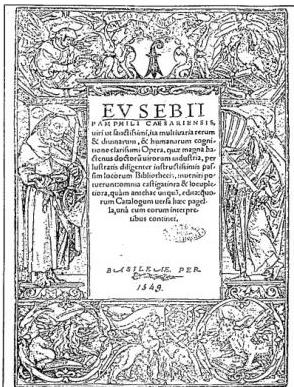
e) Alongside the Greek authors, Syriac and Armenian writers must also be considered. Of the Church History of John of Ephesus, a Monophysite bishop (d. 586), fragments remain (the part covering 561 to 585), which constitute an important source for the secular and ecclesiastical history of the Eastern Empire in the 6th century. Among the Armenians, the most renowned writer is Moses of Chorene, whose history of Greater Armenia, completed in 482, also describes the evangelization of that country. This history includes the well-known letters of Abgar.
f) In terms of Church historiography, the Latin West remains inferior to the East. Its Church historians depend on the Greeks, and their works are either translations or compilations. St. Jerome translated part of Eusebius’s Chronicle into Latin (PL 27; Corpus Berolinense, 24, 34, Leipzig-Berlin 1913, 1926), continuing it until 378; and with the De viris illustribus, he provided the first example of a Christian literary history. Rufinus of Aquileia, in 403, translated Eusebius’s History, abbreviating it not without errors, and continued it in two books up to the death of Theodosius the Great (395: PL 21). This latter part, however, as has recently been demonstrated (cf. Th. Mommsen, Die lateinische Übersetzung des Rufinus, Leipzig
CHURCH - Title page of the Historia ecclesiastica by Eusebius of Caesarea, Basel 1549 - Rome, copy from the National Library.
1903), is nothing but a reworking of the History of the Church by Gelasius, bishop of Caesarea in Palestine (d. 395), which has been lost. His contemporary Sulpicius Severus wrote in 403, in classical style and not without critical acumen, a Historia vel sacra Chronica, in 2 books, which spans from the creation of the world to the end of the 4th century (CSEL, I), and beyond this, a Vita of St. Martin of Tours. More a secular than an ecclesiastical historian was the Spanish priest Paulus Orosius. His Historiarum adversus paganos libri VII (PL 20), composed at the inspiration of St. Augustine, extend from the universal flood to the year 416, and aim to refute the pagan accusation that the Christian religion was responsible for the ruin of the Western Empire and the evils that had befallen it at that time (CSEL, V). The same intent moved St. Augustine in the composition of the De civitate Dei, in 22 books, written between 413 and 426 (PL 20). With this work, St. Augustine is the first Christian philosopher of history, and his thought exerted an enormous influence on the historical conceptions of the Middle Ages. The Historia ecclesiastica tripartita (PL 69-70) by M. A. Cassiodorus (477-580) is nothing but an extract from the first three continuators of Eusebius of Caesarea, but it was the most popular manual of Church history throughout the Middle Ages. The first part of the Liber Pontificalis, a sparse and not always accurate history of the Popes in biographical form, dates back, as is likely, to the 6th century, and more precisely to the pontificate of Boniface II (530-532); the compiler made use of the so-called Catalogus Liberianus of the popes contained in the Roman Chronographer of Dionysius Philocalus of 354. From the 6th century onward, the Liber Pontificalis became a contemporary source, as it was gradually continued throughout the Middle Ages as an unofficial or quasi-official account of individual pontificates. The edition by L. Duchesne also contains the Vitae composed later up to Martin V (d. 1431). The lives of the first bishops of Ravenna were composed by Agnello (v. AGNELLO) of Ravenna (9th century) in the Codex Pontificalis Ecclesiae Ravennatis (new ed., RIS, II, 1).
2. The history of the Church in the Middle Ages. — While in the ancient period Greek writers prevail over Latin ones, in the medieval period the latter take precedence, and the former recede into the background.
a) Among the Greeks, the Chronography of Theophanes the Confessor (up to the 9th century, with extensive later continuations) is noteworthy; as are the historical works of Leo the Deacon (10th century), Anna Comnena, and others. In general, however, the Church history of Greek authors proceeds alongside that of the Byzantine Empire. The most notable ecclesiastical historian of the Greek Middle Ages is Nicephorus Callistus, librarian of the Church of St. Sophia in Constantinople around the mid-14th century. His main work, in 18 books, extends to the death of Emperor Phocas (610). It is written with care but not without inaccuracies and fables; it also contains a list of Byzantine emperors and patriarchs. Valuable historical works were composed in this period in the Church of Syria, where the Ecclesiastical History, already mentioned, of John of Ephesus found learned continuators. The Annals (583-843) attributed to the Monophysite patriarch Dionysius of Tellmahre are only one-fourth his own work, but they constitute a useful source for the ecclesiastical and secular history of the first half of the 9th century. The Chronicle of the Monophysite patriarch of the Jacobites, Michael the Great Qindasī (1126-99), from the 6th century onward, is one of the best sources for the history of the Eastern Church, especially for the period of the Crusades, of which the author was an eyewitness. This work has been preserved both in a 13th-century Armenian translation (French trans. by
V. Langlois: Chronique de Michel le Grand, Venice 1868) and in the original Syriac and Arabic versions edited by J
B. Chabot, Chronique de Michel le Syrien, 3 vols., Paris 1900-10. The greatest Syrian historian, by general consensus, is Gregory Abū 'l-Farāg, also known as Bar Hebraeus (d. 1286). Among his numerous works, the foremost is a great Chronicle of the world, in three parts, of which the first is secular in character, the second deals with the Jewish high priests and the Roman pontiffs, then focuses almost exclusively on the history of the Antiochene and Jacobite patriarchate, which a continuator extended to 1493; the third work is a history of the Church of the Chaldean Orthodox, Nestorians, and Jacobites, from the Apostle Thomas to 1282, and continued by another hand to 1469 (Gregory Bar-Hebraeus, Chronicon ecclesiasticum, ed. J. B. Abbelos and Th. Lamy, 3 vols., Louvain 1872-77). Important information on the history of the Greek Church is found in the long series of secular and imperial Byzantine historians, from 500 to 1500. The best edition is the Corpus scriptorum historiae Byzantinae, 49 vols., Bonn 1828-55; cf. also PG.b) Medieval historians in the West never viewed or wrote history solely as history, but always aimed at religious, ethical, and theological purposes through II. Under the influence of St. Augustine’s De civitate Dei, they saw in the course of history primarily the struggle between the two kingdoms of good and evil, and animated by eschatological and apocalyptic hopes, they almost always relied on the same historical partition into six ages and four kingdoms or monarchies. In a summary outline of the historiography of the Church in the Latin Middle Ages, three fundamental categories can be distinguished: α) works on the history of individual peoples without any separation between secular and ecclesiastical matters; β) general histories of the Church; γ) annals, chronicles, and biographies.
c) The first author of the first category, standing at the threshold of the Middle Ages, is Jordanes (also Jornandes), who wrote, at the invitation of Pope Vigilius, De summa temporum vel origine actibusque gentis Romanorum, a kind of world history from Adam to 551, and De origine actibusque Getarum, in which he summarizes the homonymous work of Cassiodorus in 12 books and inserts many valuable notes on Church history (ed. in MGH, Auct. antiquis., V, 1; RIS, I).
The father of Frankish history is Gregory of Tours (d. 594), with his Historia Francorum in 10 books (PL 71; critical ed. by W. Arndt and B. Krusch, in MGH, Scriptores rerum Merov., I, Hanover 1884), the fifth of which begins the history of his time from 575 to 591, narrated based on his personal experiences and recollections. Gregory lacks mastery of the material and the ability to present it pragmatically, but in compensation, he strives to be faithful and truthful.
A history of the Visigoths (PL 83) up to 621 was written by Isidore of Seville (d. 636), an encyclopedic writer of the late antique period, whose Chronica maiora, later abridged into Chronica minora (PL 83), should also be mentioned.
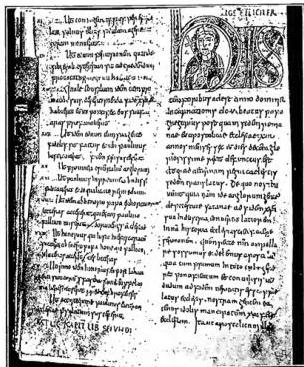
(from A. Staerk, Les mes. latins., from Saint Petersburg, II, pl. 50, Saint Petersburg 1910)
CHURCH - Historia ecclesiastica gentis Anglorum by Bede the Venerable. (9th century) The miniature depicts St. Augustine. Leningrad, State Library, Cod. Q. V. I. 18, fol. 26;
The part preceding 596 is nothing more than a compilation from Paulus Orosius and the Chronicles of Prosper of Aquitaine and Gildas. The original and larger portion of the work is dedicated to the evangelization of Britain, undertaken at the initiative of Gregory the Great by Bishop Augustine (596-731).
The history of the Lombards was narrated by Paulus Varnefridus (more commonly known as Paulus Diaconus), a Lombard of noble origin who lived for a long time at the royal court in Pavia. Having retired to Montecassino, he wrote the history of his people in 6 books, up to the year 744, which is the only source for the religious and secular history of the Lombards. After his death (799), his work was continued by an unknown author up to the year 774 and, in the 9th century, for the Duchy of Benevento, by the monk Erchempert, who extended the narrative to the year 889 (PL 95; critical edition by G. Waitz, in MGH, Script. rer. Langob., pp. 234-264). During a brief stay at the Frankish court, Paulus also wrote, at the request of Charlemagne, the Gesta episcoporum Mettensium (MGH, Scriptores, II, p. 260 ff.).
For the national and local ecclesiastical history, special mention is due to Flodoard of Reims (d. 966), archivist of his church, who wrote a Historia Ecclesiae Remensis, from its origins to 948, a work that is highly valuable for the history of the Church and the French state due to the documents it contains (PL 135; MGH, Scriptores, XIII).
Among the national historians also belongs Adam of Bremen, from 1069 canon and scolasticus of Bremen, who shortly after 1072 wrote a Historia ecclesiastica or Gesta Hammaburgensis Ecclesiae pontificum, in 4 books, and a history of the Scandinavian Church, particularly of the bishoprics of Bremen and Hamburg, from 788 to 1076. A primary source, this work constitutes the first foundation of the history of the Nordic countries (MGH, Scriptores, VII). Nearly half a millennium later, Albert Krantz, canon of Hamburg (d. 1517), wrote a history of the Church in northern Germany (Bremen, Hamburg, Lower Saxony, and Westphalia), in 12 books from 780 to 1504, entitled Metropolis seu historia de ecclesiis sub Carolo M. in Saxonia instauratis (Frankfurt 1576).
β) Among the authors who in the Middle Ages attempted a general narrative of Church history, the first to be mentioned in chronological order is Haimo, bishop of Halberstadt from 840 to 853, author of a Breviarium historiae ecclesiasticae, in 10 books, summarizing the history of the Church in the first four centuries. The work is merely an extract from Rufinus and the Historia tripartita, but it is written, for its time, in good Latin. Almost contemporaneously, Anastasius, learned librarian of the Roman Church, wrote a Historia ecclesiastica seu Chronographia tripartita, a compilation of the histories of Theophanes, Nicephorus, and George Syncellus. The work is not, from a chronological standpoint, as orderly as Cassiodorus' Historia tripartita: the extracts from the three Byzantine authors stand side by side without cohesion; most of the material is taken from Theophanes (Corpus script. histor. Byzantinae, 40, Bonn 1841). Besides this work, Anastasius translated into Latin the Acts of the Councils: VI (680-81), VII (787), and VIII (870) (Mansi, XII and XVI). Around 1142, Orderic Vitalis, abbot of St-Evroult in Normandy, wrote a Historia ecclesiastica in 13 books, from Christ to 1141; a work that reveals great love of truth and rich experience, and is especially important, beyond the ecclesiastical events of that period, for the history of the Normans and the Crusades (PL 188; new edition by A. Le Prevost, 5 vols., Paris 1838-55). Vin-
cent of Beauvais, O.P., in the 31 books of his Speculum historiale (up to 1244), which constitutes the fourth part of the Bibliotheca mundi, the great encyclopedia of the 13th century, collected much material, but also many fables (among the many editions, see that of Venice in 1591). James of Vitry (d. 1240), regular canon, preacher of the Crusade against the Albigensians (1213) and of that for the Holy Land, bishop of St. John of Acre and cardinal, left in his Historia occidentalis and also in his letters valuable information on the University of Paris and the religious Orders of his time, especially on the origins of the Franciscan Order, on circumstances of Italian history and the Curia of Innocent III, on the spiritual and moral situation of the Crusader states, and on the events of Damietta. His Historia orientalis, on the contrary, being a simple compilation, has less value as a source. His Vita Mariae Oiniacensis is an important contribution to the history of mysticism and piety at the beginning of the 13th century (cf. Ph. Funk, Jacob von Vitry, sein Leben und seine Werke, Leipzig 1909). The famous inquisitor Bernard Gui, O.P., besides a Practica inquisitionis haereticae pravitatis (ed. C. Douais, Paris 1886; G. Mollat, 2 vols., ibid. 1926-27), composed a Catalogus seu Chronicon summorum pontificum usque ad Ioannem XXII, a kind of papal history, of particular value for the period of the Avignon exile. A contemporary and fellow Dominican of Bernard was Bartholomew of Lucca (d. 1327, bishop of Torcello in Venice), who wrote a Historia ecclesiastica in 24 books from Christ to the beginning of the 14th century, later continued until 1361 by Henry of Diessenhofen, a reworking of older works of little critical value (RIS, XXI). Last for this age comes the Summa historialis, in 3 folio volumes, by St. Antoninus (archbishop of Florence), which spans from the Creation to 1457 (Quétif-Echard, I, cols. 813-19; II, col. 311; F. G. Walker, The Chronicles of St. Antoninus, Washington 1933). Of little originality, it diligently utilizes older works.
γ) It is in the field of chronicles and biographies that the Middle Ages exercised its greatest historiographical activity. Almost every bishopric, every city, every religious order had one or more chroniclers; personalities, and especially saints, one or more biographers. The concept of chronicle at that time is hardly distinguishable from that of annals; there are, however, chronicles in which the material is ordered and presented over more or less extended periods of time, such as the reigns of an emperor or a pope. Nor are there lacking, here and there, chronicles that offer a relatively complete and unified narrative: such, for example, the Annals of Lampert of Hersfeld. The model for all medieval chronicles was the chronicle of Eusebius, known in the West through St. Jerome. It is found reproduced, either in full or in summary, at the head of almost all the great medieval chronicles.
Among the most valuable chroniclers, it suffices to recall: for the Merovingian and Carolingian ages: Fredegar and his continuators, Einhard, the authors of the Annals of Lorsch, St-Amand, Murbach, Petau, Salzburg, Metz; for the 10th and 11th centuries: Regino of Prüm (d. 915, PL 132), Liutprand of Cremona (d. ca. 970), whose Antapodosis, though tendentious and scandalous, constitutes one of the principal sources of his time, Hermann the Lame, monk of Reichenau (1013-54, PL 143), Rodulfus Glaber (d. ca. 1056) of the Abbey of Cluny (PL
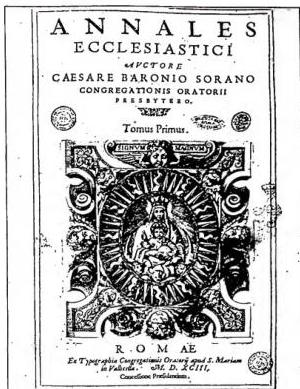
The 15th century produced works such as Ulrich of Richenthal’s Chronicle of the Council of Constance (ed. Buck, Leipzig 1895); Aeneas Silvius Piccolomini, later Pope Pius II, whose historical and geographical writings include the Historia Concilii Basileensis in two books (Basel 1515); Giacomo Filippo (Foresti) of Bergamo, an Augustinian, whose Supplementum chronicorum, first published in Venice in 1483, was later continued; and Bartolomeo Sacchi, known as Platina (1421-81), author of the widely circulated Liber de vita Christi ac omnium pontificum (covering the years 1-1474, Venice 1479, new ed. in RIS, III, II), which was later continued by Onofrio Panvinio. Alongside chronicles, this era also saw the proliferation of countless lives of saints and celebrated figures, their critical value varying according to their authors. A comprehensive overview of these chronicles, annals, and biographies, accompanied by rich critical commentary, can be found in G. Wattenbach’s Deutschlands Geschichtsquellen im Mittelalter bis zur.
CHURCH - Frontispiece of vol. I of Annales ecclesiastici by C. Baronio, Rome 1593 - Rome, copy from the National Library.
Mitte des XIII. Jahrhunderts (6th ed., 2 vols., Berlin 1893-94) and O. Lorenz, Deutschlands Geschichtsquellen im Mittelalter seit der Mitte des XIII. Jahrhunderts (3rd ed., 2 vols., ibid. 1886-87). For biographies, V. Potthast, Bibliotheca historica medii aevi, a guide to historical works of the European Middle Ages from 375 to 1500 (ibid. 1892). Italian historians and chroniclers from 500 to 1500 were collected by L. A. Muratori in his monumental Rerum Italicarum Scriptores, of which a new revised and expanded edition is in progress. Cf. U. Balzani, Le cronache italiane del medioevo (4th ed., Milan 1909); U. Chevalier, Répertoire des sources historiques du moyen âge: Bio-bibliographie; Topo-bibliographie (4 vols., cf. above, n. IV, D).
3. The history of the Church in the modern era. - Modern critical historiography of the Church originated in the age of Humanism and the Reformation. The humanist movement laid the foundations of historical criticism and applied new critical methods to annalistic writing, which in many respects lacked critical sense, leading to a significant intensification of historiographical work. The discovery of printing and a deeper knowledge of Greek letters in the West also contributed greatly to this. A powerful impulse to historical studies ultimately came from the so-called Reformation of Luther. Protestant historiography arose entirely from the needs of confessional polemics and resulted in a corresponding Catholic activity aimed at demonstrating, on the basis of historical sources, the traditional truths.
a) Works of the Reformation era. - The first major attempt to narrate the history of the Church from an exclusively Protestant perspective was made by the Centuriators of Magdeburg around the middle of the sixteenth century.