Machine translation of the 1948–1954 Italian original. The original text is authoritative.
SALIMBENE DA PARMA. — Chronicler, Franciscan, born at Parma in 1221, died after 8 September 1287.
The son of a Guido de Adam, of civic nobility, his vocation—prompted by an environment wholly pervaded by the great thirteenth-century movement of Christian revival, by his deeply religious mother, and by his brother, who preceded him in the Order, which he himself entered in 1238—was bitterly opposed by his father, who tried everything to keep him from it, even appealing to Friar Elia and to the emperor Frederick. His life falls into three distinct periods: the journey from city to city, from convent to convent, from Fano, where he hid from his father’s threats, through Lucca, Siena, and Pisa, to Parma in 1247, during the siege in which the Empire made its last failed attempt against communal liberties; then a stay in France, probably sent there by his fellow citizens to seek aid, where he saw and came to know the protagonists of the century’s great events, and, after his return in 1249, his association with Joachimite circles; finally, after separating himself from them after 1260, the year of the great movement of the Flagellants initiated by Ranieri Fasani, his final years devoted to recollection. And if in his youth he had naively placed his trust in that magical figure of the time to which certain Joachimite currents reduced the expectation of the third reign of the Spirit, he now looks back, astonished, upon the countless things and people he has seen, and understands that the
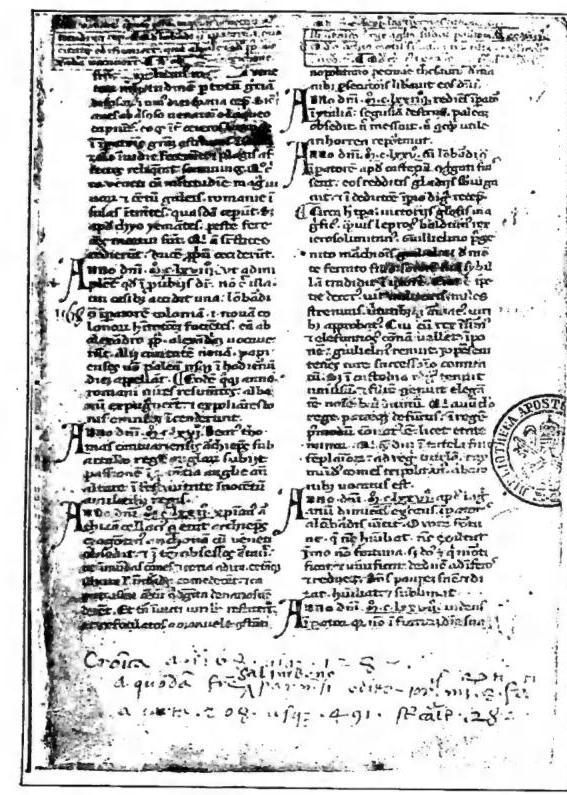
Time is providential aid for an inexhaustible gift of life. (phot. Enc. Catt.) SALIMBENE DA PARMA - Cronica. Page containing the years 1168–72. Vatican Library, cod. Vat. lat. 7260, f. 7 (13th century).His Cronica, the only one of the many works he composed that has survived, though mutilated, ranges across an age in turmoil. He looks and remembers with open eyes and vivid memory, curious about everything because everything is created life. And thus it reveals itself as an indirect, yet astounding, fruit of the efficacy of Franciscan spirituality. It passes alongside the great debates that agitate contemporary thought and politics; but it never rigidifies either the protagonists of that life—popes and emperors, frate Giovanni da Parma and frate Gerardo da Borgo S. Donnino, crusaders and imperial feudal lords—into a doctrinal or political abstraction; or the anonymous masses of the singing alleluia, the combatants in the communal wars, the townspeople and peasants, into an economic and practical abstraction. The chronicler descends with impetuous vigor toward the countless multiplicity of historical life. His gaze circumscribes things in their wondrous evidentness, but does not imprison them; and every creature has a right to life, including the life expressed in his affectionate and curious gaze. If the canon of an intellectualistic historiography is understanding without love and without hatred, the Franciscan also enters the horrific scenes of that turmoil with a fervent, loving aid. And his Latin language, steeped in vernacular forms, is the supple and powerful instrument of this fervent, ingenuous, and bold manner. A monument to the life of thirteenth-century Italy, the Cronica prepares and anticipates the new arts, the new literature, and the new customs.
BIBL.: F. Bernini, Bibliografia salimbeniana, in Studi francescani, 3rd series, 4 (1932), pp. 80–88. Text in MGH, Script., XXXII, 1913, edited by O. Holder-Egger; and in the collection Scrittori d’Italia, edited by F. Bernini, Bari 1942. N. Scivoletto, Fra S. da P. e la storia politica e religiosa del sec. XIII, Bari 1950. Mario Apollonio
Cite this article
“SALIMBENE DA PARMA.” Enciclopedia Cattolica, vol. X (1953), p. 989. Azione Romana digital edition, https://azioneromana.com/article/salimbene-da-parma.