
SACCHETTI, FRANCO. — Poet, born perhaps at Ragusa around 1330, died around 1400. The name appears among those of the oldest and most illustrious families in the canto of the nobility of Florence, the sixteenth of the Paradiso; but their social condition had by then declined, and the life of Franco di Benci unfolded amid various and often dramatic circumstances of politics, in his homeland, of commerce, and of journeys through different parts of Europe, as well as public offices in the city and at Bibbiena, S. Miniato, and Faenza.
A man of grave reflection, wide reading, and lively curiosity, while culture was organizing itself within philological humanism and was already deriving the principles of vernacular classicism from the poetics of the great writers of the fourteenth century, he withdrew from the commitments, but also from the abstractions, of the new men of letters, and devoted himself to composing in two directions that seem opposed: the sincere and often austere religious spirit of the Sposizioni di Vangeli, and the severe morality that emerges from the Lettere (though in every one of his works, at times, there appears the face of a resentful and troubled moralist who sees all too clearly the decline of civic life and customs); and the inexhaustible celebration of a varied and picturesque reality, extremely mobile in the scattered and joyful tumult of its gestures, to which, however, he does not surrender: indeed, he seems to contemplate it from a certain distance, as though recalling it; and it is the play of a memory continually amused, and continually surprised by circumstances, that forms the most persistent theme of the Trecentonovelle.
It is clearly perceptible that he is in crisis between the religious synthesis offered to his life and thought by Christianity, richly experienced and meditated upon, and the dispersive appearance in which reality is shattered and dissipated. Civic culture was the most conspicuous fruit of Christian civilization, and Franciscanism had taught Italy the marvel of a life animated by spiritual inspiration and reconciled to God, the loving creator of a benign nature: the synthesis between divine truth and reality, which is a joyous occasion for spiritual rediscovery, seems in S. to be on the point of dissolving once more. And he sets himself to establish a relation that might reconnect, in an artistically irreproachable formal crystallization, the unity of life and the multiplicity of reality. From this intention, in the Rime, his ballads, madrigals, and cacce receive their light and distinction. S. attempts a limited but highly original formal solution to his conflict, seeking the harmony of a dance and a music that enchant and suspend fleeting reality. That civic life comes to a halt, assumes a mimetic posture, and is summed up in rhythm. Franciscan spirituality, too, had made use of traditional choreutic forms, composed of words, music, and dance, to illustrate the soul’s journey toward God; but the Rime of S. and also his novelle, which, when read through the Rime, reveal how ready he always was for formal solutions, interrupt that upward movement of which Dante had been the greatest poet, and limit themselves to observing anew a reality circumscribed within itself, harmoniously ordered only within limits, often onomatopoeic, yet, in the grace of their poetic purpose, not forgetful of the gift by which spiritual life lends some of its purest cadences to the profane.
(phot. Alineri)
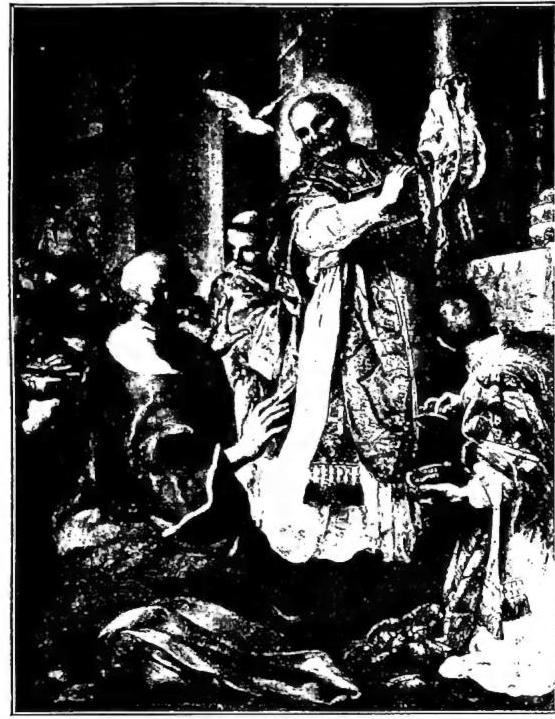
SACCHI, ANDREA — Miracle of St Gregory the Great — Vatican Pinacoteca.
edited by A. Chiari, there 1938; Trecentonovelle edited by E. Li Gotti, Milan 1946; edited by V. Pernicone, Florence 1946; A. Chiari, Some observations on the composition of the « Sermoni evangelici » di F. S., in Convivium, 2 (1930), pp. 341–68; E. Li Gotti, V. Pirrotta, Il S. e la tecnica musicale del Trecento ital., Florence 1935; M. Apollonio, Storia del teatro ital., I, there 1938, p. 129 add.; E. Li Gotti, F. S. uomo « discolo e grosso », there 1940; L. Caretti, Saggio sul S., Bari 1951. Mario Apollonio