
THEATRE. - I. DEFINITIONS: ELEMENTS OF THEATRICS. THE COMPONENTS OF PERFORMANCE. RITUAL. MIME. DRAMA. - Teatro (T.) signifies spectacle: something seen, and something arranged for others to see; it also signifies the place where the spectacle is staged, so that people may gather there. In the memory associated with the term, each of the facts it now encompasses sometimes prevails, sometimes recedes; nor would a history of T. be possible without accounting for this constant shifting of proportions and elements: at times, only the action is recalled from the apparatus, at others, only the word. In common metaphor, T. is a spectacular game: T. was dramatic poetry, when literary dramaturgy prevailed, and the musical language of opera, and choreutic art; even the perspective of trees and foliage in Italian-style gardens was called T., even when empty, even when not intended as a stage, as if the pleasures of memory included pure imagination, without the aid of words, but stimulated by the scene. And the theatrical event had such power in imagination and custom that, in certain epochs, everything becomes spectacle, everything is arranged and remembered according to the modes of that composite art: if "book" had been the most illustrious and frequented metaphor of medieval culture, the Baroque age uses and abuses the metaphor of "T.": in Pedro Calderón de la Barca's Gran teatro del mundo, the World itself is called by the author to stage the spectacle. The word is not without suspicion among moderns, whether zealots of the pure image of poetry or merely heirs to the rigorism of certain strata of nineteenth-century European bourgeoisie (or to the Puritan condemnation among the Victorians of England); yet, blending art and science, "anatomical theatre" was the term for university halls arranged so that dissections might be clearly visible from every point.
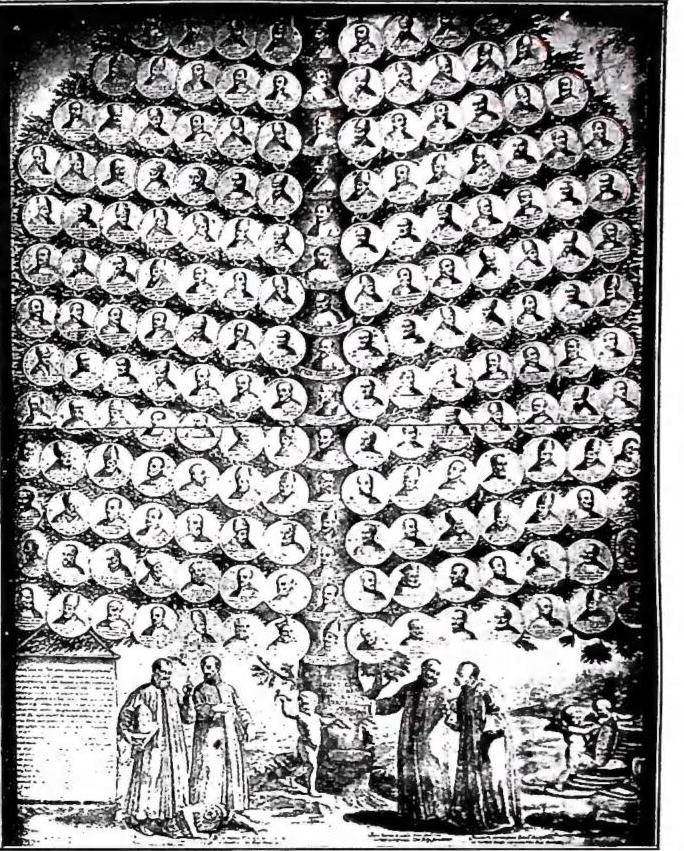
TEATINI - Tree of the illustrious men of the Order. At its base: St. Gaetano Thiene with Gian P. Carafa (Paul IV) and Bonifacio De' Colli with Paolo Consiglieri, co-founders. Engraving from the second half of the 17th century preserved in the Archive of S. Andrea della Valle - Rome.
Meanwhile, these even summary indications allow us to establish the elements of what, in scholastic terms, could be called "theatrics": the technique of theatrical spectacle. And as every art entails a reflective justification and a norm, so theatrics corresponds to a theory and a history. Of theory we speak briefly (as of all that we keep in view: theoria and theatron descend from the same etymon); but a more expansive history will aid us.
A spectacle is called both a fireworks display and a beautiful landscape, especially if observed at a certain hour; these are amplifications extraneous to our subject: not everything one witnesses is theatre, though theatre is never entirely foreign to such metaphors. Indeed, through theatre a habit of reflection takes shape, and an emotional disposition becomes habitual. And if theatre is called this or that building designated for spectacle—the theatre of Dionysus in Athens or La Scala in Milan—too often the modern custom of open-air theatre has demanded an active collaboration with the suggestion exerted by places and monuments, the intercolumniation of the Parthenon or the courtyard of Ansperto. Too often, symbolism and intimism have doubled and inverted to suggest reducing to the extreme, or even abolishing, the most conspicuous scenographies: or any proscenium other than the ideal one of a people united in listening. And in eras of more inventive and daring culture, when literature sought ways to become more promptly active among people, theatre was called a literary genre: Elizabethan English theatre or German Romantic theatre, where the creative word of poets passed onto the stage and shaped, whether fragile or robust, always ephemeral forms of scenic tradition. Yet it resounded far beyond, opening a much vaster human story in history. Essential to theatre, therefore, is not the place, even if it requires a place to gather; nor is it the word, understood in its most common semantics, as it crystallizes and is learned in the formal and historical codifications of literature, though something is always said, even in silence, and the word remains the densest and most fertile of expressive and communicative forms. Essential is the transmission of the proposal that an invisible author, of a theatrical image—whether myth or mime—makes to a concretely gathered public, through artists who embody it in the act.
Author, actors, public. These are the essential elements; and from their varied encounter, now one prevailing, now the others, with the third ever-present and decisively corporeal in its reaction, arise the countless possibilities of theatre and the range of different experiences. This too should be noted: the author-dramatist, having made his proposal, disappears. And if criticism, retracing a tradition backward or more promptly resorting to the text—which in the substance of the word reveals the most and the best of its soul—can identify him, if it can retrace the story of a fable, his own, which, once out of his mind, undergoes so different a fate, it remains true that the fable no longer belongs to the author. As it descends toward the public, presences gain weight: it is the public that decides how much of the ideal truth of a poetic message launched by an author, with or without the intention of accompanying it along the parabola of drama, becomes trite certainty. The author disappears behind the veil of his image, and the public, I would say, takes life: it recognizes itself, at least, learns to discern which zones of its memory open most, which chords of its sensibility vibrate most. It decides; and calls itself satisfied, dissatisfied, sated; but always believes it receives confirmation of itself, to judge as much as suffices. The multorum capitum belua, as it was called by those who did not perceive the profound moral life in the convergence of many toward the message of the word (rather, of the parable: for the fable is a metaphor of a new being, a truth that becomes), may ignore what is truly decided in theatre: whether to remain in the torpor of a satisfied sensuous inertia, or to truly live, which means to transfigure oneself to the word. Operatively hidden, then, the author; and corporeally present the public, which acts as a chorus to the fable; but the interpreters, the intermediaries, are the actors. The center and pivot of theatrical life is the person of the actor, for mimetic suggestion is first exercised in him; and for it to be operative in the many, it is up to him to experience it in himself, to suffer it (and, if capable, to redeem it). Hence the importance of theatre not only in a poetics, but in a moral doctrine of the person: because, given this mimetic condition of theatrical art, in which the material of art is a human creature, the actor may feign to be different from himself, but in reality, as always happens in poetry, he rediscovers his authentic self in the veil of fiction and thus verifies the fable, or he denies himself and imprisons himself in it, obscenely lending himself to the senses and to falsehood. Rediscovery of the person: such is the justification of art and the touchstone of the aesthetic, and thus moral, validity of a work of theatre, for this authentic presence of the man who listens and communicates with his whole self, bending his entire body to expression, in the instantaneity of scenic action and the concentric attention of the many, in the emotion and transvaluation of the chorus, intent and aware and responsible even if silent. And the Latins called persona the theatrical mask, the feigned face upon the true one: such is the fortune of a word.
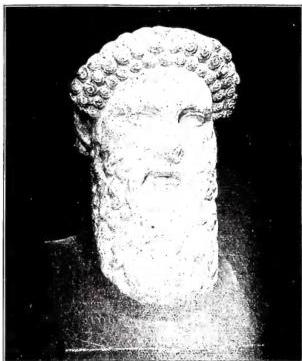
TEATRE - Dionysus. Archaic sculpture - Athens. National Museum.
comically, when the character isolates and closes and fixes itself, when the person becomes mask again and the fiction encrusts upon the living substance of man. At the opposite pole from mime stands ritual; through which the fable unfolds along a directive of transfiguration and transvaluation not merely moral, but religious, and explicitly so, indeed so predisposed as to become the rendering of a tribute, the officiation to the Divinity, liturgy. Between mime and ritual lies drama: this name, which signifies "work," assumes scenic action when it is observed not in the kinesthetic of gesticulation, but in the dynamics of a force in motion; and drama traces its parabola from the servitude of practical relation to the freedom of moral life.
II. PARATHEATRICAL FORMS: RITES AND MIMES OF PRIMITIVES. POPULAR SPECTACLES. DANCE. THE PROCESSION. PUPPETS. - Thus observed in its elements, theatre presupposes such dignity and awareness as to justify its ambition, so frequently repeated over the centuries, to be the artistic work par excellence, the animated poetic synthesis that reflects all of human history and predisposes its action; but where one of the constitutive elements prevails over the others, this very encroachment reflects a decline and fossilization of custom. In this section, we shall indicate some forms precisely where equilibrium is disturbed, and above all those where the chorus, having repelled the intervention of the poet, or even that of the liturgists intent on making ritual of the spectacle, overflows to become itself, orgiastically, actor, introducing paraphrases or extemporaneous variations of the predetermined theme and substituting itself for the author: the three elements of synthesis in one. Such forms were everywhere observed with extreme interest; and often considered as the origin of more complex and more individuated works: whether because every historical and encyclopedic understanding of human reality tends to arrange itself in the perspective of reception rather than suggestion, of response rather than proposal, and in a word of the chorus rather than the author, and such was the method by which Aristotle, the first and deepest historian and theorist of dramaturgy, regarded Greek theatre; or because these investigations were modernly advanced beginning with Romantic culture, and this willingly moved from the presupposition of the preservation not only but of the exclusive popular genesis of all poetic forms.
In reality, tradition means preservation and transmission; and a text, a "libretto," an original indication, even if not fixed in written document, must always be postulated at the origins of a form that, repeated over centuries and millennia, and gradually losing its primordial meaning, has by now become so crystallized in habit as to appear connate.
The social life of primitives is far more circumspect, more attentive, and more bound to traditional forms than the social life of groups organized with greater complexity of relations (between "primitives" and "evolved" no other proportion is seen, for what concerns our subject, than this: excluding every idea of progress, and also renouncing, because too often contradicted, the hypothesis that assigns a fixed time and historical necessity to the process of organization). The primitive social group willingly operates by arranging on the same plane of collective participation the practical necessity, its emotional reflection, and its religious propitiation; thus the tribe, before moving to the hunt of a dangerous beast, attends and participates in the rite of the hunt; where men masked some as hunters, others as prey, anticipate reality, make it true, in the actuality of mimetic fiction, before it is; and thus, even in far more complex societies, the military parade preludes, as a warrior rite, to battle. Whether it comes before or after, whether it is the "libretto" of what is to be done, or the "document" of what has been done, the text naturally splits into poetry and didascalia (it is evident that not all words put into the mouths of characters are poetry: the text "teaches" words too; and not all scenographic and mimetic indications are didascalia: even a gesture can be highly significant: provided, precisely, that it reveals the authentic truth of the human person who provisionally entrusts himself to it). A "book of ceremonies" of the court of Byzantium, where ritualism always superimposed itself, with its crystallized language, upon the immediate exigencies of courtly and political society, is precisely all didascalic; but the Paleolithic paintings of the caves of southwestern Europe, which probably reflect subjects already filtered through a choreutic interpretation (not the hunt as it unfolds in effect, in the unforeseeable accidents of reality, but the hunt mimically configured and arranged and summarized) are masterpieces of such power that didascalia disappears before poetry. We shall not dwell upon these rites and mimes of primitives, which can be adequately studied (and are) within the scope of ethnological science: we wish only to recall attention to their connections with theatrics, and to underline, among the most frequent occasions, those that relate to the change of seasons and those that have death as their subject. The vicissitude of the year, allegorized (it is evident that spectacle is always a form of allegory; as indeed art is always a form of metaphor), composes itself in a succession of deaths and resurrections; let us say better: in establishing the integral relation, that is not merely practical, but integrally human, between man and the year, the poets of primitive liturgies humanize the year in its seasons, and naturalize man: the year, the arboreal life, the light of the sun, declines, disappears, and is reborn; and so is the life of man. The feasts that relate to the cycle of the seasons always maintain this allusive relation; and evoke the infernal life, when they reenact the decline of the sun toward the winter solstice, and the demons of the underworld; and they hymn the supernal life, when the sun surmounts the summit of its arc. Of such seasonal feasts, the most enduring and frequent survival among us is that of Carnival: which can give an idea, with its masquerades, of what the popular celebration of the rite of the year was, with its alternating exorcism and hymn. Even more engaging are the rites of the dead: because, having returned the body to the earth, perhaps composing it in the attitude it had as a fetus in the maternal womb, within the funerary urn, or having dispersed the ashes after the rite of purification by the pyre, the funerary masks preserved a sensible indication of the survival of the soul: whether by enchanting it, wandering, in the fixity of the trait it had
in life, or by calling to the piety of the survivors its human treasure and its faults, its pains and its hopes.
Poetry continuously aids and dismantles, in search of a more moved and soaring participation of the whole being in what it itself proposes; yet language preserves the words of a bygone time. Thus, popular performances recall ancient themes and myths, and certainly not out of archaizing dilettantism; the masks of the Commedia dell’Arte, the most observed, disciplined, and crystallized form of popular myth, retain the memory of bestial disguises common everywhere and documented throughout the Indo-European territory during carnival festivities. Yet no differently did the burlesque processions of ancient Attica recall them, especially during the vintage festivals. The songs of Christmas night are placed within the traditional rites of the winter solstice; and the fires of St. John’s night within those of the summer solstice: games and processions presuppose them, even when they are no longer remembered. Yet, in this brief overview, alongside ritualistic survivals, we must also place properly dramaturgical survivals: sacred dramas that are repeated everywhere, annually or every few years (from Sordevolo to Oberammergau), with a scrupulously preserved libretto or with continuous alterations; and figurative processions, from Sicily to Flanders, which recall, in the summary of the living tableau carried through the village—often on a cart—the more articulated representation of olden times. Figurative art is never entirely foreign to this broader theatrical integration, which considers it the crystallization of a story that more naturally should unfold in drama, making explicit the intervention of the poet and the chorus.
And always seeking the relations of the various expressive forms with that fundamental, explicit or implied, of theatre, one sees how dance constitutes a projection and an isolation of a moment and a figure essential to the dramaturgical synthesis: the actor. A dance is always "figurative dance," establishing a relationship between the dancer’s person and a subject; and insofar as it is observed, it is public: here is the chorus of spectators, whether they remain still or, as often happens in popular festivities, repeat the dancer’s mimetic motif, thus re-establishing the dramaturgical ternary. Sacred dance mimes the relationship between the faithful and the divinity or, to put it better—and to set aside pathological or profane forms that do not concern us here—expresses the sensitive preliminaries of the encounter; and it is, even when reduced to its most reticent and sober form, as in the Christian rite, intrinsic to the liturgy. Profane dance can extend to all subjects: as demonstrated by dance as a theatrical art, whether condensed into the closed rhythm of a choreutic and musical indication, such as classical ballet, with its rigorous repertoire of figures sometimes acrobatic and gymnastic rather than choreutic, or prosodically extended to mimetically modulate a "part" in comedy or drama. But the most widespread and celebrated themes, and those most readily understood and repeated by the chorus, are the theme of love (the invitation, the refusal, the offering: frequent figures in so-called popular dances, and more or less implicit even in worldly dance) and the theme of war.
The most frequent and elementary collective projection of dance is the procession: it will be called a procession when its intention is more explicitly liturgical. In this case, the chorus ceases to observe the mimetic modulations of the actors and becomes an actor itself; or, if it arranges itself processionally behind a mimetic action, it underscores with its movement—and often with gestures and words—the actor’s subject (as in the Roman funeral rite: a mime, with a mask reproducing the features of the deceased, repeated his most habitual gestures; and the praeficae lyrically lamented the loss: the funeral expressed, through clothing and composed demeanor, the memory of the deceased and piety). Even a political procession, a "demonstration," contains, in nuce, a dramatic action: which can immediately transform into political and military action; and can establish a commentary, choral and mimetic precisely, on the speech of an orator. There would remain
to study certain forms of negative and retroverse expression that occur, perhaps unexpectedly even to those who order or tolerate them, when a group is forced into a collective order without that order being attributed a purpose, a meaning, a shared emotion that transcends practical necessity: a school class, for example, that moves, emptied of the disciplined animation of its usual life; or a "queue" waiting in front of a counter or shop; but let such indications serve to underscore how there is a gap between the naturalness with which primitives express their coexistence and the uncertainty with which modern society seeks—and fails—to justify itself in every moment. Aesthetic beauty, in this case, is an index of a fullness of life, and ugliness is the denunciation of an absence, an incompleteness, a fracture.
As for puppets, it suffices to note that they are a cipher and projection of mimetic expression: they presuppose, as do all human figures condensed into plastic form, the relationship, established in memory, between the figure and living reality. The voice that doubles over them and accompanies their movements helps define this relationship. They are more frequent where the authentic synthesis of theatre is more widespread and understood; and they demand either a childlike surrender to illusion or an ability to perceive ironically a distance.
III. GREEK THEATRE: ORIGINS. THE DITHYRAMBIC DRAMA. AESCHYLUS. SOPHOCLES. EURIPIDES. DECLINE OF TRAGEDY. ANCIENT COMEDY: ARISTOPHANES. NEW COMEDY: MENANDER. THE MIME. — Greek culture did not favor historical perspective, but rather mythological: as if the excellence it pursued were either the perfection of nature itself or the gift of a benevolent god; and even of tragedy, it fixed an evolutionary line entirely confined within the Hellenic, indeed Athenian, sphere. In reality, the rites and mimes observed everywhere, wherever, aided by favorable occasions, culture grew within and through them, evolved into more autonomous spectacular forms; nor can it be excluded that Greek performances, as they referred to mythologies and liturgies proper to all Indo-European peoples, may also have been influenced by the interferences of other spectacular forms common to the Mediterranean East. But it is a peculiar trait of Greekness to aim at making the faithful, by participating in the rite, aware of what he must and can do, to liberate him, to exalt him: far from submerging the human and predisposing the faithful to an empty automatism of gestures that deliver him inactive and impersonal to his destiny. Such is the active content of the mysteriesophic cults: but above all in the sphere of the religion of Dionysus, or at the encounter between the currents of ancient theological meditation and the new orgiastic myth and rite, that truth becomes common property, indeed the most richly participated. Dionysus, the hero son of a god, in his passion, death, and resurrection, beyond the tale of every naturalistic mythology that celebrates the perpetual renewal of earthly life, already foreshadows, to a certain extent, deeper truths; and the dithyramb, the choral hymn in honor of Dionysus that celebrated his deeds and those of heroes, remains the nucleus of Greek tragedy. Aristotle speaks of a process of improvisation by which the coryphaeus, becoming a character in the fervor of liturgical, indeed orgiastic, reminiscence, detaches himself from the chorus; but modern antiquarian inquiry, while recognizing that the dithyrambic rite remains at the center of Athenian tragedy, which is always and only staged during the solemn civic festivities dedicated to Dionysus, observes that other cults and customs converge there: principally the funeral rites in use among the Peloponnesians (the origins of the cult of Dionysus were instead Thracian), which celebrated the illustrious dead by molding his portrait in a mask and mimically repeating his words and gestures. An ancient custom, widespread in many places, also among the Romans, who gathered the portraits of the deceased in the lararium, and to which, more or less attenuated by a more active religious consciousness, the belief was linked that it was fitting for the living to shield themselves from the envy of the dead by enchanting their wandering souls in a simulacrum of life.
The chronicle that the ancients traced is quite uncertain in fixing the data of development; in any case, it seems that it was the Athenian Thespis who introduced, alongside the coryphaeus who led the chorus of fifty choreutai, an actor (the protagonist: first actor); and Aeschylus who introduced a second (deuteragonist): both ready to take on more than one role. And it was certainly Pisistratus who, in 534 B.C., regulated the Dionysian festivities in such a way as to ensure the tragic rites a religious, liturgical, and civic character: the entire city participating in the tragic reenactment with its contribution, with its commitment to the rite, with the disposition, indeed vocation, of a people intent, a multiform and concordant chorus around the composed, if noisy and sumptuous, execution of the dithyrambic tragedy. Hymns prevailed, from the "parodos," when the chorus made its solemn processional entrance into the orchestra (the space around the altar of Dionysus reserved for its evolutions), to the "exodos," when it exited. The dialogic action unfolded in the intervals of the choruses, almost a concrete illustration of that event which the chorus commented upon: moving, behind the singing chorus, the other chorus, mute and multiform this one, of the people. But over time, the action prevailed over the chorus, inverting the relationship, and the characters became more independent, and the chorus, descending from its primitive liturgical dignity, participated in the action, becoming itself a character.
Every structural, architectural, and scenic element of Greek tragedy refers back to its liturgical inspiration; and every modification of its animating spirit is reflected in technical changes to the apparatus and performance. The masks that covered the actors' faces and amplified their voices were one with the oratorical costume, sumptuously draped, the high cothurni, the tall and elaborate hairstyle. Realistic elements were not lacking, especially in mute characters, and increasingly so from one to the next of the three great tragedians; but Aeschylus himself reduced the number of choreutai from fifty to twelve, after the Suppliants (490-80 B.C.), instead populating the orchestra with the retinue of Agamemnon, in the Oresteia, when the king returning from war arrives at his palace. More important than following the vicissitude along the interplay of the
(photo: Vatican Museums)
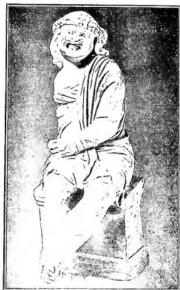
THEATRE - Statue of an actor, with a comic mask and crown on his head, seated on an altar. Hellenistic-Roman sculpture. Vatican Museums.
what matters more than following the story through its external changes is to trace its evolutionary line from within: Aeschylus, the patrician of the sacred city of Eleusis, documents in the seven surviving tragedies the religious spirit and civic dignity of the generation of the Marathon fighters, to which he belonged. He animated tragedy with the breath of the Dionysian cult and the dithyramb; and he did so with a bold and sorrowful spirit of human piety, with a confident and severe reverence. In the Oresteia (458 B.C.), which unfolds in three tragedies—Agamemnon, Choephori, Eumenides—the fate of the descendants of Atreus, between the fires that from mountain to mountain announce the fall of Troy and the torches of the sacred procession in Athens, is sung with an austere passion and a meditation of unparalleled moral force: the chain of murders halts only before the altar of the deity who restores and seals justice, and reclaims vengeance for herself. In Prometheus Bound (undatable), a long theogonic monologue by the demiurge benefactor of mankind, bound to the rock of the overpowering yet fearful dominion of the opposing god, Zeus, lofty imagination rises to challenge the destinies of humanity. And in The Persians (472 B.C.), recent civic history, still fresh with blood and victory, is understood as universal history. Enormous is the poetic animation of Aeschylus, and overpowering his genius. But Sophocles, only slightly younger than he, reflects a more balanced spirit in a more modulated art: his humanism attempts a more serene meditation with more pathetic effects in the luminous melancholy with which he surrounds his creations. Possessed by a power that overwhelms them, the heroes (Ajax, Oedipus) redeem themselves in defeat and are saved through suffering. Less theological and theogonic than the great creator of tragedy, Sophocles nonetheless touches upon the imposing themes of human law opposed to civic law (Antigone goes to her death because, while it is just for the city to punish the rebel who assailed it, it is also just that no enemy wrath survive beyond the pyre). And in the limpid harmony of choral and monodic song, in the transparency of the wondrous words, tragedy soothes horror and rises like his Oedipus (Oedipus at Colonus was composed by the nonagenarian poet and performed [401 B.C.], five years after his death) in the shade of the sacred grove of his native "deme." With Euripides, the parabola is complete: Athenian civilization tests and fractures itself in Sophistic culture, the austere rigor of ancient sacred meditation grows distant, and dramatic liturgies speak less to the new people. Euripides is the poet of new and declining times, and he transforms tragedy into a composition more externally varied, more carefully structured, freer in its bonds: it ceases, or nearly ceases, to be choral tragedy from the moment the chorus disperses into scenic adventure, becoming, as has been said, a character, and ceasing to be the unofficial interpreter of the audience’s moral life. The intervention of a propitious deity, suspended by a stage device (deus ex machina), to resolve the tragic knot is nothing more than a hasty, detached, and sometimes ironic homage to the ancient conception of a providential intervention in human affairs. The structure is more careful, and the technique more fluid: dialogue is conceived as mimetic contrast rather than as a lofty judicial or philosophical debate. The monody willingly escapes into song from the pressures of the plot. The staging becomes dynamic and spectacular. Tragedy (now almost a musical work, made of dialogues, monodies, and songs) opens to a certainly more varied life, but one far less rich; and its profound source dries up. Tragedies were performed in trilogies followed by a satyr play: an intervention of comic mode to relieve tragic tension. The text of Euripides’ Cyclops and the mutilated one of Sophocles’ Trackers survive. Comedy developed from carnival processions that, with the changing of the seasons, saw men disguised as beasts (the myths of satyrs and Centaurs derive from these) spreading through the streets of the villages. Eupolis, Cratinus, and Aristophanes made the old forms current by inserting them into political satire. The chorus of Aristophanes is a masquerade that generally gives its name to the comedy: Clouds, Wasps, Frogs, Birds; and, parallel to the masquerade, a brief mimetic plot unfolds: names of contemporaries, Socrates or Cleon, are directly called into question. In his last comedy, Plutus, he turns to a more documen-
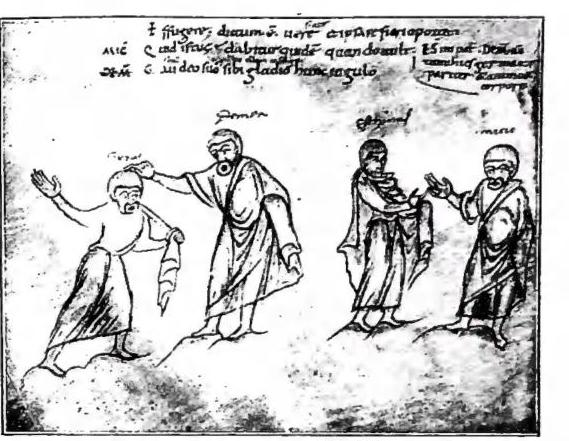
THEATRE - I. Lines 935-57 of Terence’s Adelphoe, featuring the characters: Syrus, Demea, Aeschinus, Micio. Illustrated manuscript from the Biblioteca Ambrosiana, cod. H. 75 inf. (10th century), with miniatures derived from a prototype of the imperial era, probably 3rd century. Milan.
an abstract and typical documentation of the environment; the path that would lead to Middle Comedy and New Comedy with Menander, ensuring the transition from Greek comedy to Latin. But first, the mime must be mentioned: a swift composition that, in its brief and vivid form, encapsulated the minor realities of daily life, attested by papyri and literary summaries by Herodas and Theocritus, and forming the foundation of Plato’s dialogues. The inevitable fragmentation of the mime marks the decline of comedy, just as the pantomime, in which a silent actor dissolves a fabulous reality for amusement and escape.
IV. ROMAN THEATRE: CULTURAL SITUATION AND SCENIC CUSTOMS. TRAGEDY. THE COMEDY OF PLAUTUS AND TERENCE. ATELLANA AND MIME. PANTOMIME. SENECA. - Within a few years, the creative power of the great Athenian theatre culminates and declines; yet when speaking of Roman theatre, if the reference—by name—to a circumscribed place, Rome, even as the metropolis of the Mediterranean world, might suggest a comparison from city to city, one alludes instead to a secular span, from the 3rd century B.C. to the 6th century A.D., and to an immense territory, from Britannia to Africa, and from Asia Minor to Noricum. In reality, this term amounts to an encyclopedic allusion; and if the Mediterranean politeia, politically organized into a unity by Rome, following the line of Hellenistic culture, accepted the hegemony of the Athenian tradition, many contributions of different origins mingled with it; and certainly an infinite distance separates the poetic dignity of the Athenian authors from the vulgar and popular demands of Roman theatres, especially those of the imperial era, in the capital and the provinces: all the more striking when one considers the commitment with which political authority provided for theatrical life, ensuring that the urban plebs never lacked spectacular entertainments, often spending vast sums on scenic apparatuses, and constructing everywhere sumptuous theatres. During the Empire, in fact, the theatre, along with the Baths and the Basilica, encapsulates all that was deemed worthy of expression in the architectural ritualism of the most solemn structures. Progress was slow: the first stone theatre was that of Pompey, in the last century of the Republic. But the political direction of spectacles, the concern—not constructive but hedonistic—to offer the urban plebs, which moreover constituted the electoral mass, adequate amusement, was always present. Initially, religious concerns seemed to be mixed in: when Etruscan actors were imported for certain purification ceremonies during a plague. But it is certain that this was not the common ground; moreover, the urban plebs of Rome was an ethnically and culturally hybrid mixture; nor did there exist in Rome an aristocracy of religion that proposed seeking anything other than the lowest tolerable level of choral concord. When magistrates and candidates for public office organized spectacles intended to enhance their name and magistracy, they readily resorted to eloquence and solemnity, even at the expense of a more sincere or profound human interest. Another common ground was comic play, the grotesque violence of verbal or mimetic satire, not directed—as in Athens—against persons or institutions (which would have been harmful and dangerous, given the interests of the ruling class that promoted and financed the spectacles), but against generic types and masks; and here it was quite easy to trace back, behind the Hellenistic models, to an original comic typology in which different ethnic stratifications could recognize themselves. Eloquence, then, on the one hand, and grotesque vividness on the other: such were the most frequent characteristics of Roman theatricality. The scenographic and spectacular element could prevail; and certain evocations of victories were derived from triumphal processions where, more than anything, what impressed the plebs was the quantity of masses and the richness of spoils: and to this, outside of its literary continuations, which even illustrious politicians attended to, tragedy was reduced. Conversely, comedy thrived on its very poverty: the actors’ stage was quickly erected in a corner of a square, often by an impresario commissioned by a politician; and the gathering was assembled somewhat haphazardly, seated on benches or standing, amid the noises of traffic, with the fickleness of idle and curious minds, easily distracted by anything—a tightrope walker’s announcement, for example. The prologues of comedies are pleasantly full of allusions to this lamentable inconstancy and deeply concerned with every disturbance. The houses depicted on stage, open to the public street and served in the back, one imagines, by an alley, and the conventions easily proposed and accepted (e.g., an actor entering from the spectators’ right was supposed to come from nearby places and the forum; but one exiting to the left was supposed to go to distant places, the fields or the sea), all contributed to giving the spectators the idea that they were merely stopping for a moment, on the street, to watch as curious onlookers the events of common life; and even the time of the performance, around midday, the hour of the crowded market in Mediterranean cities, avoided the sense that the theatre was a rare event capable of suspending ordinary life.
A more precise discussion of tragedy and comedy in Rome during the republican centuries would involve an examination of the texts (of tragedies, only fragments remain) and a comparison with Greek models. Urged by certain authoritative and decorous recommendations, the authors (Livius Andronicus, Quintus Ennius, Marcus Pacuvius, Lucius Accius; but one must also add the political amateurs, such as Quintus Cicero) had, on the one hand, to obey the solemnity of the political and national program, solemnizing events and introducing emotional allusions to Roman current affairs, even when this was not at all required by the Greek model they followed (the praetexta, that is, the tragedy of Roman costume and subject matter, overcame this obstacle); on the other hand, they had to capture the public’s attention, and thus reduced the plot to its most elementary and striking structure, setting aside precisely the supreme spiritual intelligence of the Athenians, the search, through word and image, for truth, which is divine. A disparate organism, therefore, witness to that profound fracture between morality and custom, between politics and religion, between the certainties of history and the truths of the spirit, which had accompanied the long Hellenistic crisis: to which the Romans were able to offer an external remedy, their universal political organization, and to recommend it with sometimes austere eloquence (hence the maxims, such as the famous oderint dum metuant of Accius; which is partly due to the fact that tragedies were often preserved as school texts). And in Seneca, one will see summarized the tradition of a literary dramaturgy that accompanied the tradition of theatrical theatre.
A very different fortune befell comedy at the hands of two great authors: Plautus and Terence: yet even in them,
With the imperial age, which favored theatrical performances in every way—though the multiplicity of occasions did not correspond to an authentic vitality (indeed, it corresponded to dissipation)—the two truly significant voices of theatrical culture were Seneca and the pantomime: opposites of one another. Seneca, even if performed, did not aim to establish a dialogue with an audience; what mattered to him, if he wished to give his words theatrical resonance, was the effect they had on that select circle of friends, admirers, and acquaintances whom the literary author gathered in acromata, the listening halls arranged in libraries, baths, or private palaces. The pantomime, imported to Rome from Magna Graecia (though under Augustus’ reign two Eastern actors, Pylades and Bathyllus, became famous), consisted of the representation of a myth entrusted to a single actor, who, without speaking—and sometimes without choral or musical accompaniment—depicted the entire story. The predominance of literary language in the theater of the auditorium, and the predominance of the actor’s art in the pantomime; and the fracture of that unity which Greek theater had proposed—a fracture all the more serious because the audience of popular theater, which had an immediate impact on social customs, was in a state of total passivity. The play of transfigurations attracted spectators and alienated them from themselves; thus, the actor was at times the cloud pregnant with golden rain of Danaë or the sun that exposes adultery in the fable of Venus and Mars. Yet, to establish the usual and necessary parallel between the extreme tendencies of Roman theater, one could hardly say that Seneca’s tragedy did not itself indicate a terrifying extremity: the pantomime signified the dispersal of the actor’s active and moral personality into an irreparable multiplicity of disinterested attitudes, while the tragedy of Nero’s age proposed a theater of pitiless horrors that overwhelmed and shattered every intent of human dignity, that limited and crushed every freedom. And if the dramaturgical composition of Seneca’s collection still indicates a cathartic process and a possibility of redemption, from the Hercules Furens to the Hercules Oetaeus, the tragic images remain as exemplars of an extreme tendency: inert, at the time they were written, or at least devoid of resonance in the theatrical sphere. But after fifteen centuries, they re-proposed to the tragedy of the Cinquecento the ne plus ultra of evil that awaits, even in its inertia, to be justified. The response proved positive, and from there a great history began, for between that era and this, the Christian centuries unfolded.
V. THE SACRED DRAMA: MIMIC SURVIVALS AND LITURGICAL CULTURE IN THE MIDDLE AGES. CHRONOLOGY. THE LITURGICAL DRAMA. GEOGRAPHICAL DISTRIBUTION. REPRESENTATIVE FORMS OF PARENETIC LITERATURE. THE MYSTERIES. LAUDA AND SACRED REPRESENTATION IN ITALY. — That fracture of the Greco-Roman theatre, whose extreme indices are mime and literary dramaturgy, did not truly reconcile spontaneously: a new culture was needed, a renewed depth of thought, and the rediscovery within the new Christian civilisation spread among the new peoples of Europe of the perfection of that perennial philosophy which the Athenians had naturally intuited by living (which does not mean philosophising naturalistically), which their mysteriosophical circles had suggested to the tragedians, and which their philosophers had enucleated into theoretical propositions. Theatrical buildings were either transformed into fortresses, filled in, or became quarries for cut stone; and the mimes, once gathered in civic theatrical companies, returned to being vagabonds, persecuted when not tolerated, welcomed at markets and fairs, confused with jugglers. The great themes of tragic theatre remain in the custody of high culture, but almost entirely losing the memory of what tragic performances had actually been (tragedy and comedy become terms with new meanings); and the inveterate themes, once placed within the framework of classical comedy, dissolve back into vulgar tradition, or are repeated amateurishly, or collected in anthologies of witticisms, or sometimes, unconsciously, reconnected to the most remote carnival traditions. Thus, both the Church and the new military aristocracies emerging from the dissolution of Roman society and the proliferation of barbarism view theatrical forms with disfavour: profane and immoral entertainments for the former, unworthy amusements for the latter, incompatible with a rigorous conception of the dignity of the free man, that is, of the warrior who knows how to defend himself and attack. And yet, while mime disperses anew, an intention of the highest significance, and of great future importance, even for the purposes of a unitary reconstruction of society, allows tragedy, transfigured, to survive: for Christian liturgy embraces it while celebrating the Passion, Death, and Resurrection of the God-Man, his human and divine life. Certainly, Greek tragedy, like every dramatic intuition, with—
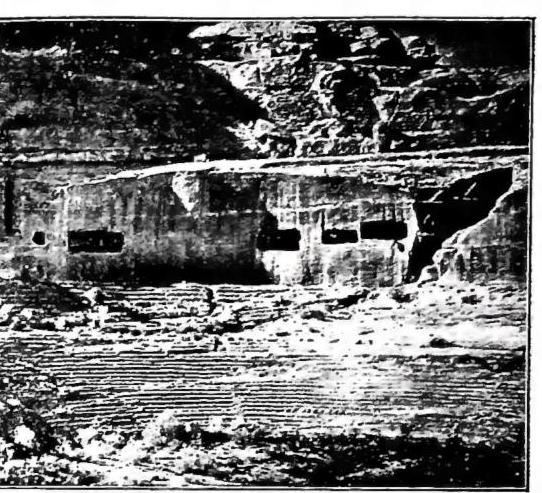
(from Quarterly of Depart. of Antiquities in Palestine, 7 [1838], inv. 26)
Theatre - T. of Petra from the Roman era, carved into the rock.
only allows for a mediated actuality; the event is true solely in the poetic transfiguration of acts and in the receptivity of the chorus; whereas at the centre of the liturgy lies not merely the evocation, but the actual presence (and this suffices to distinguish between liturgy and drama in this paragraph, which insists on the idea of a liturgical dramaturgy); yet the Christian liturgy, while placing the Sacrifice at the centre of the liturgical edifice, does not at all exclude that all human life—words and deeds—should arrange itself around that point; and that to the Eucharistic reality there correspond the words which mark precisely the faithful’s passage from the natural sphere of worship to the supernatural sphere of faith.
Such are the premises of a history that unfolds over a millennium, from the sixth century, when every sign of organised theatre ceases, to the sixteenth century, when theatre becomes the centre of an ideal and total transfiguration of civil society in the nations of the West. A history, one might say; but we would not assert that one witnesses a coherent and continuous process of sacred integrations: nor that profane forms gather of themselves into more complex organisms. Already the chronological terms, in such vastness, say little: and there persists among historians the tendency to backdate the beginning of the new era, the so-called Renaissance, each time they document, or believe they do, the existence of those presumed autonomous forms. The historian may record a more or a less, if attempting to contrast the two worlds of sacrality and profanity, which both contribute to integrating a single reality: a more declared presence, or a more proclaimed absence of one or the other sphere, divided only for the dialectical convenience of discourse—a plenitude of sacred officiation, or an uneasy uprising of the profane. And the Middle Ages are the period that continually sees this integrative exigency re-proposed: we are far from believing that the Renaissance, whether understood as the rediscovery of antiquity or as the immanentistic investiture of human absoluteness, can truly be considered as plenitudo temporum, perfection: which is a clumsy polemical and political inference applied to history. Indeed, to anticipate the conclusion, the compromise solution proposed by the culture of sixteenth-century Italy remained valid or was believed to be so only within the circle of an academic philologism, which believed it could recover the meaning and actuality of ancient tragedy, but was contradicted both by the profound religious intuition of the musical language that replaced literary language in tragedy, and by the inevitable technicalistic limit encountered by the entirely comic and profane solution of the Commedia dell’Arte: the other great theatres of the West continue a meditation that becomes moral and religious even and especially when it attempts the test of absolute human freedom.
The criticism has long studied the dramatic elements of the liturgy, and particularly the offices of the Roman Breviary, to observe them at the centre of a new evolution of dramatic language. But it is not a matter of distinguishing different substances in a conglomerate: the liturgy is a unitary poem, which has an upper, charismatic limit, and a lower, theatrical one; and the same words can be received in their transcendental virtue, operative of supernatural reality, and in their spectacular evidence. This better explains the history of medieval dramaturgy, which in its entirety refers to the liturgy; and avoids the naturalistic prejudice of forms that spontaneously germinate from one another; and better declares the attitude of the Church, which, having condemned the profanities of the decadent pagan theatre, does not reject the collaboration that the persuasiveness and evidence of representative form bring to the sacred itinerary, which illustratively can accompany it; and which, when the illustrations threaten to overshadow the rite, in the flourishing of Renaissance arts, recalls the austerity of pure liturgy, freeing it from the efflorescences that threatened to stifle it or to deviate toward profanity. The relationship established between theatre and liturgy is not ultimately different from that which exists between liturgy and the figurative arts: a mosaic or a fresco that formally seals a moment of sacred history establishes the same point of understanding that the theatrical representation of that same moment does, between history and sacrality, between witnessing an event, which may also be inert, and participation. And the history of such theatre oscillates between iconoclastic rigorism, which would presume to remove every aid of the senses, and profane crystallisation that makes the spectacle an end in itself, content with its own evidence. The culminating moments of the rite, just as they receive confirmation in the stories that illustrate the walls of the temple, can also receive it from fragments of mimetic illustration that prolong the ritual allusion: more easily in the joyous and glorious distension of the Nativity and the Resurrection; the Office of the Crib and the Office of the Sepulchre. Where the sacred intention remains purer, liturgical drama is scarcely more than a figurative variation proposed in sacred vestments, with minimal apparatus (the dialogue between the Holy Women and the Angel at the Sepulchre, who asks, Quem quaeritis? and replies Non est hic, surrexit, etc.; or the dialogue of the Nativity, sometimes, as in the Paduan ordinary, before an altarpiece arranged just below the altar, representing the Virgin and the Son, between «two canons with two copes who are called Obstetrices» and the «masters of the schools and the Cantor... who are called Pastores»). Where the figurative intention increases, the variation assumes greater amplitude, descends from the altar to the churchyard, passes from clerics to laypeople. There is no limit to these extensions, if from the few lines of the «trope» of St. Gall (musical variations from which verbal variations were thought to derive, later augmented with mimetic evidence: this is the thesis of Léon Gautier, valid if not given exclusive character) one moves to the twenty-five days of the Passion of Valenciennes, and from the ninth to the sixteenth century; but always a thread connects the illustrative fragment (no matter how extensive, how mimically prominent, and how indiscreet in its encampment within the play of evidences) to the liturgical text, indeed to the liturgy itself, disposed to summarise within itself the vicissitude of time and the history of men, with its cycles of the year and of the saints.
this poetic intention primarily seeks to transcend place and time: though these theses retain an authentic meaning when one wishes to study Byzantine texts as a conscious reaction to the lofty and exclusive intellectualism of that culture (the most important text is indeed the Christus Patiens, previously attributed to Gregory of Nazianzus but most likely dating to the 11th century: a cento of Greek tragedies; yet no one could believe that its Christocentrism is foreign to the polemic against anti-Trinitarian monotheism, or that its form was elaborated by chance, out of a taste for erudite pedantry, without considering that classical-Christian humanistic syncretism which sought in ancient texts a glimmer of natural revelation of supernatural truth); when Sangallese tropes are traced back to Benedictine culture, itself conciliatory, activistic, and historicist; when "Roman" is understood as "Catholic" rather than a prevalence of national intentions. Having said this, and having inverted the search for a genetic process from chronistic occasions to religious intentions, the distribution of sacred drama forms across Europe, from the Byzantine East to the French West, can become something more than an erudite catalogue.
A process of local definition is also discernible when sacred drama remains within the sphere of the Latin linguistic expression; the liturgical pluralism that permits the variations collected and preserved in the ritual books of churches does not fail to work upon that fundamental concern already observed: to solicit the participation of the choir in the rite. Of the extent of these interferences, the recently discovered Cassinese drama suffices as an example, containing the so-called Officium quarti militis, previously preserved in a rotulum (a role), the part of a single actor transcribed as a projection of the chivalric legend of the Passion drama (De Bartholomaeis). When the language then becomes vernacular and is placed alongside Latin, initially leaving the sung parts in Latin, this is a sign that the liturgist becomes a dramatist and recognizes in the vernacular community the maturity necessary for a more active and conscious participation. The direction, mind you, remains Latin; and in Latin are the stage directions (just as in the Italian sphere the stage directions of dilettante comedies are in literary language); but even in this field, the religious and ecclesiastical direction of popular life is far more concerned than the political and feudal direction with ensuring a full process of individuation for the lay group that participates in the rite and willingly sees itself reflected there in its garments and customs. This occurs over a vast territory and in the most diverse forms: from the Bilingual Unguentarius (where the mime of the charlatan mingles with the Officium Sepulcri and the Latin chants of the Three Marys), to the Provençal S. Agnese, where the characters, even the holy ones, intone words to well-known melodies of profane songs. The texts are numerous and highly significant, not only as imposing testimony of a custom or as linguistic documents: the entire gamut of poetic possibilities unfolds within them, that is, the active intervention of a word to illuminate and thus shape an environment: French texts, first and foremost, and Provençal and English, Iberian texts, with an intensely poetic flourishing, up to the masterpieces of Gil Vicente; and German; and Slavic, from Bohemia, Croatia, and Poland.
VI. PROFANE THEATRE: CARNIVAL FESTIVITIES AND OUTLAW COURTS. JONGLEURS AND MIMES. TRIUMPHS, ECLOGUES, AND ALLEGORIES. — Medieval sacred drama always encompasses a relationship between the human and the divine; and its range, when examining the texts, appears far more varied than what is suggested by those who, proceeding from a highly partial historiographical schema, presume to see the entire epoch rigidly dominated by an exclusivist theocracy, with art deduced according to logical schemes (not to mention that even then there existed both good and bad rhetoric; and that the excellent method of philosophical inquiry then helped, more than it later did, to distinguish between them). Even the most solemn moments of the rite, those that would seem necessarily to bend to the strictest intransigence, open up to the festivity of comic inventions: thus, in the Officium Nativitatis, the scenes of the Obstetrices and the Shepherds; thus, in the Officium Sepulcri, the theme of the Ointment Seller; thus, in the Officium Peregrini, that of the Inn; and when later vernacular compositions prove abundant in such characterizations, one must not forget that the original framework of this mingling was proposed by older texts: indeed, by ancient traditions, if they are even found in the apocryphal gospels, which the Church at times accepted in the more popular and less binding manifestations of the rite: almost a pious contribution of legends. Moreover (as so often demonstrated by musical language, freer from a precise conceptual notion and quicker to echo popular emotion), it was precisely in the most solemn festivities that merriment allowed itself more facile flights of fancy. The important thing, in judging that world, is always to keep that relationship in mind; and the distinction adopted here in two paragraphs should rather indicate a constant interference than a parallelism, and even less an antagonism. Moreover, the distinction is semantic and catalogic.
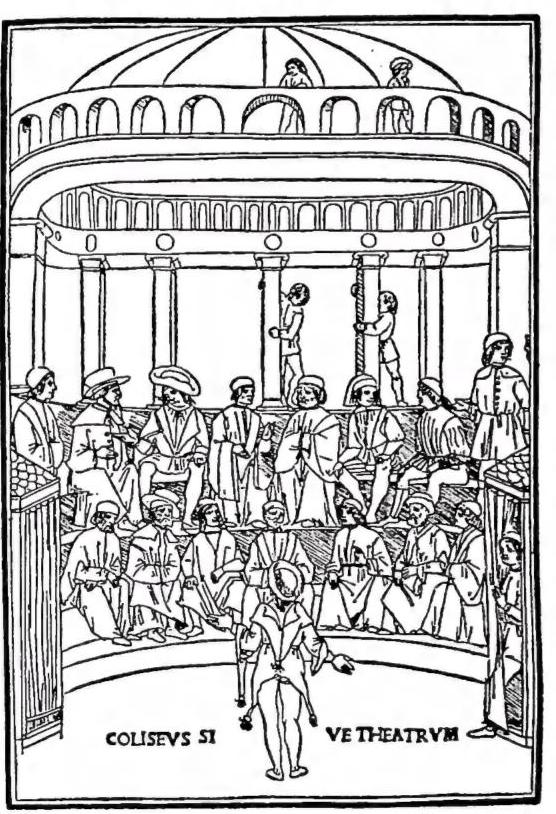
THEATRE - Representation of a comedy by Plautus. Engraving adorning the Comedias XX of Plautus, printed in Venice by Lazzaro Soardo, 14 August 1511 - Exemplar from the Vatican Library.
not intrinsic and categorical; and in every authentic form of poetry, no matter what occasion may have prompted it, even satirical and mocking, the touchstone is always truth; and truth is not divisible.
Thus, even the rite opened itself to laughter; and the liturgical celebration of the Holy Innocents gave rise to the election of the Episcopus puerorum, and the feast of Epiphany to the popular uproar against Herod, and, with a confusion of characters all too understandable, against Herodias, who became the devilish Redodesa of many joyful and frightening rites. Given the syncretism of the prevailing conception in Catholic countries, it was quite easy for these pauses in the rite to accommodate one or another survival of ancient customs: such as the memory of the Saturnalia in the winter solstice festivals. The important thing was to establish a relationship and underline it in time. This was the case with Carnival: upon closer inspection, it received from the rite and the liturgical order in which the seasons of the year were composed an investiture, almost an indirect justification; and thus it came to be part of a rigorously ordered discourse (Carnival does not disappear where a stricter moral judgment intervenes to prohibit it, but where the ideal sense, the rhythmic and spectacular order that the liturgy suggests to the year, is lost: it no longer makes sense if the sacred suggestion fades). The same can be said for a relationship that, outside of liturgy, was established between the hierarchy of the clergy and the hierarchy of the laity: even political life, in its most elevated and reflective forms, whether through Byzantine influence (and the court of Constantinople remained exemplary for all of Europe in that complex of ceremonies that liturgically expressed the sacred investiture of the emperor: Caesaropapism, as we say; and that ceremonial passed to the West, from the court of Burgundy
(fot. Enc. Catt.)
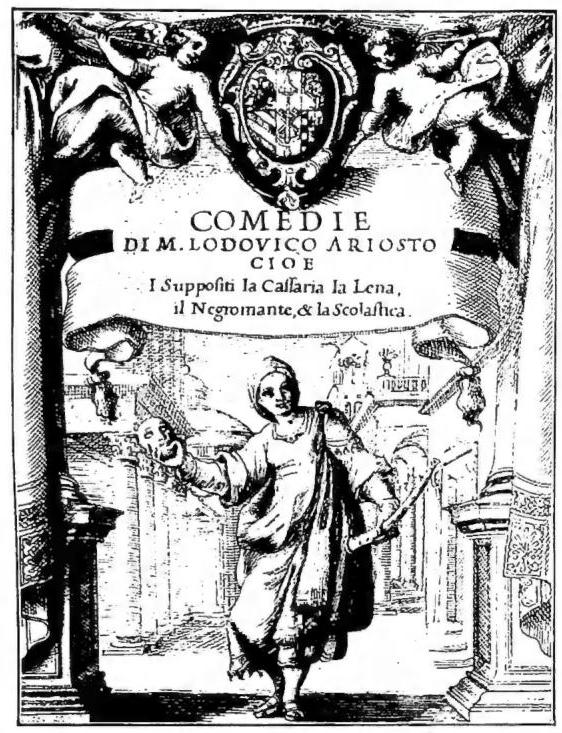
TEATRO - Title page of the Comedie of L. Ariosto, with a pen drawing by Giulio Martinelli of Urbino (1622), reproducing the proscenium with a classical scene in the background and at the center a figure holding a mask and a musical instrument - Vatican Library, cod. Urb. lat. 688, f. 1.
both because it modeled itself on the exalted language of liturgy itself, and because of the dominant religious and unitary conception of life, assumed a theatrical, spectacular form, governed by rigorously established norms—from the "acclamations" that hailed the monarch to the rights of precedence. The pluralism of Western society after the year 1000, and above all the prodigious adaptability of communal civilization in Italy, which preserved the strictest religious unity while multiplying human experiences in every direction, opposed that hierarchical regulation. Yet in its exceptional or outstanding manifestations, even the "courts" of the West repeated that intention: particularly in the "open courts" (corti bandite), which this or that political authority, and even the communal republics, proclaimed on solemn occasions. Then, society as a whole turned away from its occupations (but even war, when it did not become a judgment of God and was not merely carnage, recalled the tournament and the rite of chivalry) and arrived at the feast: power contemplated and celebrated itself, poets and jesters solemnized and enlivened it, the festive pause presumed to renew the golden age. These solemnities were themselves spectacle; but they provided a frame for chivalric and courtly games, convivial mimes (such as the ancient Coena Cypriani, which presented a parade of biblical characters: a display of more or less sumptuous costumes, a pretext), and finally the jests of jesters, who for once paused in their vagabond life and were welcomed into illustrious society.
Entering the court, the jester ceased to be a fragmentary and occasional performer of buffoonish antics and comic or acrobatic games: he too could insert his part into a coherent discourse. One may be inclined, for the sake of emphasis in a historical overview, to isolate the figure and make it representative of a process of validation. Yet the fact remains that every comic moment derives meaning, prominence, and indeed justification, investiture, and the possibility of being effective and active within a circle precisely because it is observed and understood within a broader order. And those jesters and buffoons, who in theory were outlaws of society, thus found reconciliation with it, and on such solemn occasions. Much medieval satirical poetry, from the songs of the goliards to the beast epic, can be examined in relation to the jester’s art; and the jester himself, depending on whether a separatist or a unitary and hierarchical mentality prevailed, could be seen now in the light of the miles de curia, a courtier who aided the prince with wise counsel, sometimes concealed beneath the mask of the natural wisdom of the feigned fool, now in the light of the buffoon. Evidence of this remains both in the traditions collected by storytellers and historians (it is understandable that the most famous of these jesters were attributed a repertoire, or even a comic legend: they became characters in a comic mythography after having been actors, such as the figures recounted in the Novellino, Giovanni Boccaccio, and Franco Sacchetti), and in the texts of vernacular mimes. Among the authors, more distinct personalities include Rutebeuf, who touches on all the themes offered by his profession as a Parisian troubadour, ranging from mime to lament to sacred legend; Adam de la Halle of Arras, who concludes his cycle in Naples and defines himself in a more solidly structured and autonomous theatrical organism (Jeu de la Feuillée, Robin et Marion); and Cielo d'Alcamo, with the mime Rosa fresca, positioned in opposition to the courtly poetry of Frederick II’s curia.
But the court needs to celebrate itself in its supreme tasks; nor can it be content to serve merely as a frame for the inventions of spectacle technicians, such as the jesters. The court, due to the sacral character it assumes—as has been repeatedly noted—in that circle of thought and custom, also wishes to be reminded of its most authentic function: not merely a technical organism for political action, but a ladder to transcendental transfiguration. Hence the Trionfo. And let us keep in mind, in reconstructing this form and ideally participating in it, the illustrious texts of literature and painting: first and foremost, Petrarch’s Trionfi, which openly declare the ladder by which man ascends to the divine and constitute an ideal scenography arranged for many individual representations, proposed also to the understanding of the ancients. In the sarcastic mentality of Florence, the triumph soon became a theme for carnival revelry; but where princely courtliness was more firmly established or more inclined to self-glorification, as at the court of Burgundy and the court of Milan, the triumph remained the appropriate form of courtly celebration. Allegorical representations, often in the form of pastoral eclogues recalling great—or supposedly great—political and dynastic events, were interwoven with it, under that veil of fabulous and arcane echoes that classical literature loved. Politics and literature, the former disposed to homage, the latter hasty to bestow it, accepted a role in that theatrical idea of the court. Fifteenth-century Italy celebrated its deeds in this way, not without eventually suggesting authentic possibilities for a more concrete dramaturgy.
VII. THE COURT THEATRE: SYNCRETISM OF THE EARLY SIXTEENTH-CENTURY ITALIAN. IN SEARCH OF A CONTEMPORARY RELEVANCE FOR ANCIENT COMEDY. THE REPERTOIRE OF THE NEW THEATRE. THE COURT OF FERRARA. FROM COURT THEATRE TO NATIONAL THEATRE. - The early sixteenth century in Italy (since at the turn of the century the culture of the Baroque age begins here earlier than elsewhere in Europe) sees all tendencies converge in a tumult of superimposed forms, the most ancient mingling with the new and the less new, what had been and what would be knotted together. Laude are sung and performed, often expressing the confraternal spirit descended from the religious spirituality of the thirteenth century; grand spectacles are staged in city squares or at sanctuaries, which crowd the stage with characters and draw throngs of people, often, with the vulgarized taste of the fifteenth century, dispersing every concentration of moral life in countless gestures and spaces.
The jesters invade the markets and the lordly halls, are found in taverns and in the palaces of princes, gathering the old jests of the trade and the new fastitiae of Latin anthologies; in universities and academies, scholars recite classical compositions or works modeled on them; in solitary writers, men of letters try their luck with words, and in the cells of monasteries, monks annotate sacred texts and the codices of classical wisdom, considered not hostile to Christianity but rather a path of a single human quest that the truth of revelation does not overwhelm but rather confirms and exalts. Political catastrophe accentuates the tumult and spurs adventure; and the words that are spoken, all words, in whatever form expressed—in paintings and music, in books and buildings—go beyond their occasion, received as they are by an intelligence both flexible and strong, clear in evaluating circumstances and at the same time bold in envisioning consequences, entirely disposed to welcome, not only in the secrecy of meditation but in the open play of multiple attentions, and to judge freely, inclined toward the human and thus, with an illusion that in its enthusiastic sincerity does not always save itself from the precipices of pride and facile improvisations, toward the divine.
Amid such urgency and dispersal of lives, theater, which is also reflection and gathering, must seek a place. The place of religious theater was the church, with its related spaces: the churchyard and the "schools" of the confraternities. The university could open itself to performances by amateur actors as long as the humanistic Latin of students could repeat the intentions initiated by the ecclesiastical Latin of clerics. But what ensures a place for the new secular theater, and the transformation of actors from amateurs into professionals, is the court, with its related spaces of the patrician hall and the academy. It is within the perspective of the court that the new texts must be read: the court that wishes to be the center of civic civilization, extending almost infinitely, adventurously, the correspondences of this beyond the city walls—toward the countryside, regarded with a new eye, not always lingering in the Arcadian idleness of a feigned and artificial earthly paradise; toward the countries of Europe, which participate with new responsibility in a shared life, in new languages that define themselves in new literatures; toward the new continents opened by the voyage of Christopher Columbus. And into the court converge all forms and all currents: the court confirms, if only in words, the religious inspiration of communal civilization, and welcomes, even when decorously bored, the rediscoveries of antiquity. The most important novelty for the historian of theater is this: that a preeminent social group, the one gathered around the prince, accepts the challenge of testing the contemporary relevance of ancient representational forms and proposing new ones. The ancient texts already known, those newly discovered to enrich old catalogues (Plautus takes the place of Terence in the fortune of Latin comedy), and the new texts, which authors compose on precise commission, form the repertoire. The shift is made from Latin to the vernacular: for while in universities the student-spectators understood the learned language of the student-actors, at court it was necessary to express oneself more concretely in the vernacular; and thus ancient comedies were translated, adapted to the sententiousness and allegorism of courtly performances, or interspersed with spectacular or choral scenes, more pleasing to the audience. All the Italian courts of the late fifteenth and early sixteenth centuries undertook this task of theatrical culture; but the preeminent and exemplary one was that of Ferrara, with the dukes Ercole and Alfonso: where not only were all forms of spectacle assiduously experimented with—from sacred representations in the square during religious festivities to triumphal processions for solemn entries, to allegorical celebrations for this or that political or dynastic event—but an understanding and intelligence, and thus a custom, was promoted: favoring the formation of a tradition and the establishment of a spoken and figurative language, in turn favored by the very particular conditions of Ferrarese culture, where a dynasty long established in civic governance but for centuries most open to chivalric culture and recently renewed by humanistic culture reigned. And Ludovico Ariosto, the greatest of court poets, inaugurates the new comedy.
Mythological tales, allegorical eclogues, Terentian and Plautine comedies, and mimetic comedies alternate in princely halls; and the example is soon taken up: if the court of Ferrara, and those linked to it by more frequent political and familial relations—Mantua and Urbino—remain exemplary for a long time, promoting a fashion that will be imitated by the courts of Spain, France, England, and Germany, even the capitals where a court, in the proper sense, does not exist—Florence, Venice, and Rome—welcome the same festivities in their patrician palaces, and disseminate the spectacular language that had been experimented with and recommended in Ferrara, each city with its own manner, its own reinterpretation, its own style. The grandeur of such events rarely corresponds to the intrinsic quality of the texts. But the court is more inclined to stage itself than to open itself to the message of a revelation of the spirit. Civic civilization concludes and leaves to the national civilization that succeeds it a splendid instrument of expression and participation. From then on, the theatre becomes the mirror of national life, capturing its salient manifestations and its most spirited suggestions, and from the theatre are proclaimed the words that will acquire the greatest value in the historical life of the peoples of Europe.
VIII. THE THEATRE OF THE BAROQUE AGE: THE THEATRE IS CALLED TO REFLECT THE LIFE OF THE PEOPLE AND TO CELEBRATE ITS RELIGIOUS AND NATIONAL DUTIES. THE THEATRE IN ITALY: TECHNICAL AND LINGUISTIC DISCOVERIES; THEATRICAL BUILDINGS, PROFESSIONAL COMPANIES, PAYING AUDIENCES. THE COMMEDIA DELL'ARTE. THE THEATRE OF OPERA. THE THEATRE IN ENGLAND. THE THEATRE IN SPAIN. THE THEATRE IN FRANCE. THE THEATRE OF THE EIGHTEENTH CENTURY
(courtesy of the Enciclopedia dello Spettacolo)
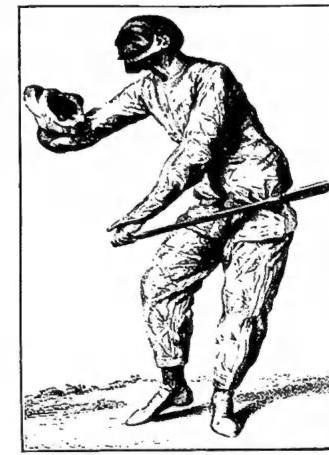
THEATRE - Harlequin’s Reverence.
Engraving by Claude Gillot (1673-1722).
mother of nations, or aligned with her to protect her usurp it; defeated, despoiled, torn, Italy possesses only enough strength to survive. Theatre becomes, especially in Atlantic nations, a far more expansive place than the modest appearance of that enclosed space around a stage jutting into the midst of the audience and exposed to the elements—as in England—or like the corral in Spain. People from every quarter and condition flock there and exchange words of immense destiny, destined for bolder voyages than those of discovery across the oceans. Yet those who oppose this national theatre to the ecclesiastical theatre of the Middle Ages, as if driven by a polemical spirit, as if eager for immanentist and secularist assertions against a religious dramaturgy, are mistaken. The process of integration by which the laity, throughout the history of the new Christian centuries, had moved to seek its own freedom and dignity, striving for concreteness and perfection of life not against but within the Catholic sphere, does not break now that peoples—first those most firmly gathered under the banners of national monarchies—participate in the common work with the immense weight of unitary life. This is the life of the Baroque era, in a religious and national conception; and theatre is the place where this unitary rediscovery is celebrated, where bold words are heard, where the cold calculation of reason is overwhelmed by a visionary enthusiasm, where the creative image of poetry draws around itself untouched forces of sentiment, will, and social life. It is, in the tumultuous ascent of the multitude to become conscious of itself as a people, now the occasion, now the mirror. Of the five major nations of Europe, three—England, Spain, and last but not least France—between the 16th and 17th centuries found and propose a memorable example; yet the choral debate of their dramaturgy revolves around immense themes, with a profound, theologically grounded meditation on religious and moral values. Germany, ravaged by wars of religion, remains almost estranged from theatre—not, however, from the sacred debate, fiercely contested and defiantly fought, over the religious dignity and freedom of the people. Italy alone is the one in which culture assumes a position of alignment without convergence: it elaborates without uniting. Nor could we consider this separatism (which polemical historiography attributes to religious indifference, moral decline, and the fading, even among the people, of the great religious concerns that had once brought even works of beauty back to the work of faith) entirely foreign to a fundamental preoccupation with reform, to the intent of saving the sacred patrimony from the attacks of profanity, and to a cautious, though not skeptical, distinction between the sacred and the profane. The Church, for its part, proves equally diligent in repressing excesses.
In Europe, the custom of a secular theatre thus became established; the representational art was freed from ecclesiastical responsibilities, liberating liturgy from excessive superstructures, and the splendor of dramaturgy was assured to the new literature. The endeavor had barely begun when the great crisis of sixteenth-century life reverberated within it: the discovery of America overturned the old order of Europe from its foundations; nations were swept up in the vertigo of global dominion, peoples either broke away from Rome, or the immorality of the Commedia dell'Arte removed from religious festivities many survivals of the popular sacred theatre of the Middle Ages.
It is fitting to begin with Italian theatre: first in chronological order, as has been seen; but also because, thus confined to seeking its own reasons within itself, it matures and develops an extremely expert technicality—precisely what would later render it suspect to the Romantics. Let us begin, then, with technique: it is Italian theatre that establishes the most observed models and customs—the Italian architecture of the building, the Italian organization of companies, the Italian custom of the audience. Later, and gradually, others, even at the cost of renouncing a treasure of poetry, as did Restoration England, which accepted being Italian and French after having been Shakespearean, followed suit. Theatre imitates the hall of the princely palace, where the first comedies and the first musical works had been performed, later adding tiers of boxes, a compromise between an ancient model echoed by Palladio’s Teatro Olimpico and the Spanish corral. Professional companies take the place of amateurs: certainly less open to new inventions, certainly tied to profit—a financial relationship that weighs and sometimes degrades—but far more expert in expressive means and masters of popular response. And the audience, for the first time in the history of the new theatre, is a paying public, whether in the stanza of the Commedia dell'Arte or in the opera theatre of Venice. Singers and actors are at the center of Italian Baroque theatre, and they remain so, teaching others even at the cost of overwhelming the poetic text or diverting the moral life of the audience toward the allurements of the senses or spectacular escapism.
The three Atlantic nations—Spain, England, and France—remain faithful to the dignity of the word, as every other art form indicates a total commitment to life, but more boldly declares and comments upon it in its rational and moral relationship. Italy evades this: the forms of Italian theatricality in the Baroque age, even as they continue, often with admirable inventions (Tasso, Bruno, Della Valle...), the traditions of literary theatre, are the Commedia dell'Arte and musical opera. The technical skill of the actors triumphs in the Arte: the scheme of comedy, derived from the long reflection conducted by men of letters on Latin texts, is stably fixed in the complementary groups of Servi (Servants), Vecchi (Old Men), and Innamorati (Lovers). The characters become rigid in their fixed costumes, mimicry, and language (the Maschere), and the ways of Carnival ascend the stage—the coarse plebeian jest, the play of dialectal mixtures (popular Italy remains regional and dialectal: though even this Arte is a way of looking down upon this fragmentation and, by ridiculing it, overcoming it). Dialogue is improvised following an action summarily indicated in a scenario or canovaccio, introducing lazzi (comic scenes, these, lines extraneous to the action), dueling in jest with wooden spatulas that have replaced the minstrel’s aulic scepter, dancing, singing, playing. The Zanni (a generic and traditional name for the servant; but soon the roles become specific, dividing into first and second Zanni: the former is Brighella, Buffetto, Pedrolino, etc., the latter Arlecchino, Truffaldino, Pulcinella, etc.) continually interrupt the action with their comic inventions, mocking the old men (Pantalone, the Doctor) and aiding or parodying the Innamorati (Orazio, Flaminio, Livio; Isabella, Lidia, Lavinia, etc.), who also duplicate themselves in pairs.
Quite different is the world of opera: as meditative as it is soaring, as intimate as it is effusive, in the forms of musical language capable of overwhelming with their poetic impetus the poor conventions of the histrionic craft. Here, a sphere of sentimental transfiguration is opposed to the mimetic play of the Arte. Yet even here, the tradition intrinsic to the historical life of the form exerted its weight: for the Arte had gathered from the medieval giulleria the jest and brawl of buffoons, while music had first defined itself dramatically in the Landi, and before accompanying the pathos and ethos of drama, it had guided the Fedeli toward the meditations of sacred drama. Even when the Florentine Camerata dei Bardi had erudely justified the proposal to revive Greek tragedy in the new union of words and music, the ancient dramatic lauda was recalled (Emilio del Cavaliere); and Claudio Monteverdi had sought to scrutinize the secret of the profound soul, giving the stage creatures (Arianna, Ulisse, Nerone) the revelation of musical speech—a nature both austere and sorrowful, profoundly religious. Until the new scenic language received its Roman investiture in the theatre of the Barberini. From then on, it developed, enriching itself throughout the Baroque age: its most active centers were Florence, Rome, and Venice. The advent of the Neapolitan school of opera marked a turning point: just as the Neapolitan actors of the Arte (Pulcinella, Scaramuccia) imprinted upon comedy an audacious exuberance of mimetic forms, different if not opposed to the moralistic bite of the Lombard actors, so Neapolitan musical comedy, opera buffa, expressed a more cheerful sentiment of the world, a more vague indulgence in the feast of a gentle nature, the idea of a serene land populated by human creatures reconciled with their fate.
BIBL.:
- K. Mantzius, Storia del teatro, trad. it., Firenze 1936;
- M. Apollonio, Storia del teatro italiano, Firenze 1938-40;
- A. Nicoll, The Development of the Theatre, London 1927;
- L. Rasi, I comici italiani, Firenze 1897-1905;
- H. Prunières, L'opéra italien en France avant Lulli, Paris 1913;
- E. H. Gombrich, The Story of Art, London 1950 (per l'architettura teatrale);
- V. COMMEDIA DELL'ARTE; OPERA IN MUSICA; TEATRO OLIMPICO.
Another matter is the cycle of theatre in the Baroque age, elsewhere. England, in the brief yet dense and prodigious decades of Elizabethan theatre, traced a parabola worthy of Greek theatre. Here too, one begins with a humanistic experimentation of the ancient; but Italy had already cleared the path; and the university wits, who promoted the first understandings with the new theatrical culture, rapidly surpassed the cautious limits of academism. Seneca offered his models, and the idea of a theatre of horrors, of a pitiless and unredeemed tragedy (Gorboduc by Norton and Sackville, 1562); but a popular drama, mingling tragedy and comedy, kings and fools (so sounded the reproach levelled at it by Sidney), stood alongside it and imposed a prompt response to the expectations of many. A bold genius, Marlowe, propelled it to an extreme condition, towards the idea and image of a more-than-human decision of one’s own fate in comparison with the absolute (Tamburlaine). A prodigious genius, Shakespeare, through a long, daring, and most mobile meditation, an inexhaustible invention, an absolute responsibility before the truth of the word, recomposed it in the image of a universe; and of a universe open to the message of God: among the last words of Shakespeare’s creatures are prayer, compassion, penitence, humble reconciliation with one’s brother man after the titanic wandering. Tragedian of immense speculative force and comedian of winged iridescent fantasy; but in none as in him is the human horizon, traversed by the light of the word, vaster, nor is the divine destiny probed more deeply. Around him a pleiad of authors: Kid, Jonson, Beaumont, Fletcher, Massinger, Ford, Shirley, Marston, Webster, Tourneur, Middleton... A flowering soon interrupted by the Puritan revolution, which closed the theatres. The Restoration, which reopened them, sought pleasure rather than truth, pleasing but superficial forms, varied and clever, sometimes still harsh to the taste. Until the eighteenth century, turning now to comedy of manners (Steele, Goldsmith, Sheridan...), now to the musical opera of Italian import, now to a satirical mixture of both (The Beggars' Opera by John Gay), proposed a coherent narrative once more.
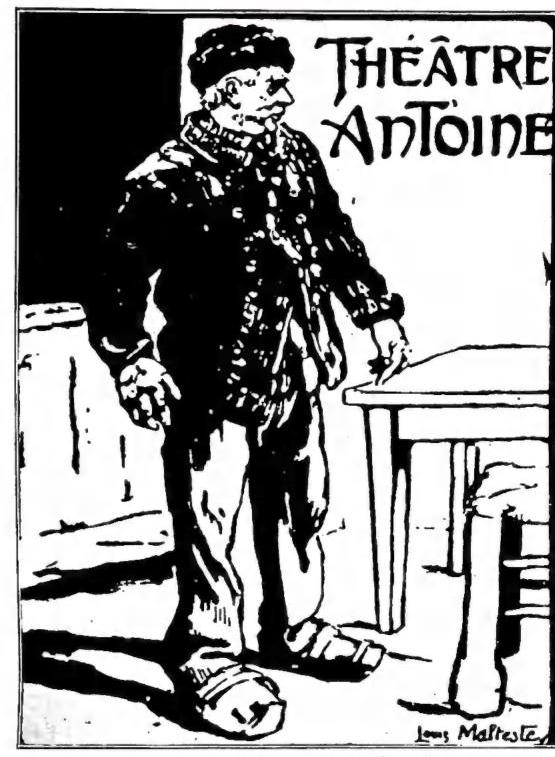
Of such spirit of Spanish theatre, the French beginnings are reminiscent; and the Cid of Corneille. But France transferred into oratorical and procedural debate the wandering inspiration of Iberian theatre: due to a prevalence of classicist inspiration and rational rigour in embracing the inventive freedom of the word; due to the gravitation of France towards Paris, and of Paris towards the Court; due, finally, to an inheritance of the literary tragedy in the Italian manner, which had remained all the more composed the more unbridled, in Italy, was the experience of theatrical theatre. Indeed, the cultural hegemony of France found support in theatre; and that theatre, even in comparison with English theatre, seemed worthy of representing the accord between word and spectacle, and of emulating ancient tragedy and comedy. Corneille, Racine, Molière, ever more obedient to the extrinsic indications of society, custom, and theatricality, are in their innermost selves strenuous and compassionate investigators of the human drama, great moralists, well deserving of being placed at the centre of a difficult and fruitful debate, engaged with the most decisive problems of life and custom. So much the tragedy of heroic will, Corneille, as the poet of passion and the shipwreck of the soul overwhelmed by a terrible and dear obsession, Racine, and even the comedian, Molière, who accepts entering into dialogue and contrast with a reality that seems to impose upon him, by the weight of social evidence or the force of scenic convention, themes and development, translate the theatre of the Baroque age into terms of literary dramaturgy, rich in echoes and prodigious in surpassing all inveterate or mediocre conditions, distancing the old and perennial scenic games, composedly reassembling in strophic perfection the texture of scenic action. The legacy of literary humanism, which had made ancient tragedy and comedy current once more, and which had been elsewhere overwhelmed by mimetic and melic evasion (in Italy) or by the very inventive verve of poetic word (in England and Spain), here recomposes itself in the dominion of intelligence, and we may say of literature, as the place of the word reflectively received and intellectually elaborated, without losing anything of that concreteness of scenic action, music, dance that the culture of the Baroque age had readmitted to theatre, and to which it no longer wished to renounce.
Within this sphere of words suggested and immediately reflected, and in the French custom of a guarded surrender to the suggestions of image and sense, the dramaturgy of the eighteenth century must be observed, in that phase which historically may be isolated as the culture of the Enlightenment. The seventeenth century had adventurously mingled all theatrical forms, superimposing music and dance, mime and prose, art poetry and folk poetry; but the new culture, in all countries of Europe, passes every form through the sieve of criticism, makes history and reason of II. In the century of encyclopaedic erudition, everything is accepted, but everything is placed in a reasonably ordered catalogue; and in the hierarchy of spectacular forms, dramatic literature stands in first place; leaving it to initiate the varied course of theatrical proposal to which the public responds concerning the concrete availability of the actor.
The text is thus gathered in a more circumspect attention and in a constant propensity to respect the
THEATRE - Poster by Louis Malteste for the Théâtre Antoine.
verisimilitude: actors abandon or soften declamatory tones in favor of a more natural diction and acting (the actress Clairon); the audience itself, as the bourgeoisie now prevails over the aristocracy in directing social life, demands to be moved and persuaded rather than transported into a world of supersensible wonders. In France, which throughout the century maintains theatrical primacy, sending tragedies, comedies, and companies across Europe, this evolution is more keenly felt and documented than elsewhere. The tradition of high tragedy continues through Crébillon and Voltaire, rivals in public favor; but Voltaire, ever a curious spirit, occasionally opens himself to the novelty of the larmoyant drama, also called bourgeois tragedy, which unfolds from La Chaussée to Diderot. Meanwhile, France preserves a space dedicated to pure fantasy or whimsy in the Comédie Italienne, where the Italian actors of the Arte, now Gallicized, entertain beyond the rational oversight and intellectual commitment of other theaters; and Marivaux is their poet. In Italy, the same concern, manifested through critiques and polemics from the beginning of the century and through interventions by illustrious figures in the discussion on poetry—such as the great Muratori—initiates a tradition of tragic and comic literature not always effectively connected to a total renewal in performance technique, yet closely followed: the name of Scipione Maffei among tragedians suffices.
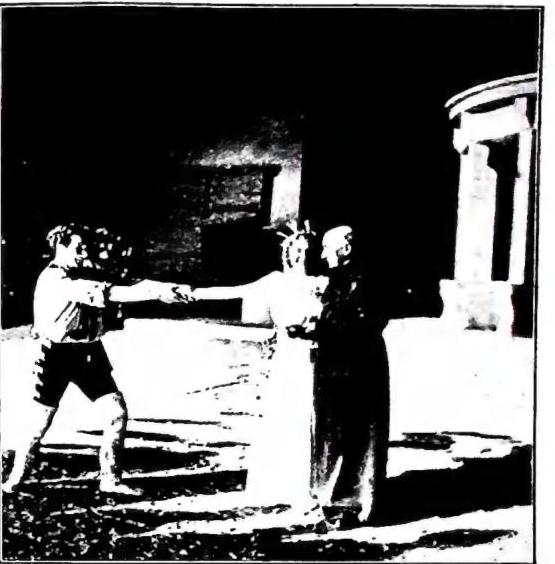
IX. THE THEATRE OF THE ROMANTIC AGE: EUROPEAN LITERARY THEATRE AND ITS EVOLUTION. IN GERMANY. IN ITALY AND RUSSIA. IN ENGLAND AND FRANCE. THE THEATRE OF OPERA. SCENOGRAPHY AND ACTORS. VERISMO AND SYMBOLISM. - A history of Romantic theatre becomes possible and convincing through Goethe, who, for nearly his entire long life, meditated on or wrote about Faust and experimented with every possible direction of theatrical art as dramatist, superintendent, and director, sometimes even as actor. Certainly, no one contributed to it with greater intellectual force and assiduous effort, relocating the responsibilities of the individual at the center of drama and reopening it to philosophical, indeed theological, meditation—a meditation that had seemed forgotten for centuries in the cautious observance of conventional separatism. Perhaps less suggestive, but more comprehensive, would be a history that also observes theatre within the sphere of a cultural trajectory—that of Romanticism itself—which nearly proposed to begin the history of the world anew and to make actual what past ages had suffered and lived. The theatre of the late eighteenth and entire nineteenth centuries, up to the First World War, seeks to gather Romantic mythographies into a liturgy and establishes an equilibrium, imaginative and bold yet always circumspect and reflective, between the proposal of poetry and its journey among the people—not entrusted to the overwhelming power of genius, as in more fantastical and perhaps more barbaric epochs (Romanticism, despite its cult of the primitive, is the era par excellence of culture, of intellectually meditated responsibility, only expanding its attentions immensely beyond the limits of reason and codified form: to the entire historical world and the entire human world, thus preserving, beyond historical man, the eternal soul of man, of each man, and, within history, nature). Thus, a synthesis, or even a mere account, must gather not only lyrical effusions and doctrinal commentaries (more often entrusted to read theatre, yet effective in shaping the tradition of performed theatre, which always draws upon literary inventions, and did so even more in this era of culturalism), but also the myths interpreted by musical theatre and the mimetic, not merely verbal, language of performers. To understand a history in which all the peoples of Europe participate, it is best to begin with the contrast between the Italian Alfieri and the German Tieck. The Italian tradition reinserts itself, by this path, into the history of European theatre, for the Italians seemed to have detached themselves from literary theatre precisely at the time when the English, Spanish, and French entrusted it with the celebration of the worthiest values and the boldest intentions of the new peoples gathered in the states of divine-right monarchies, summarizing nearly everything in the mimetic forms of the Arte and the musical forms of Opera—which, even in the new era, enjoyed renewed fortune, transforming and surpassing their artisanal limits. Tieck makes the boldest proposals, vastly expanding the boundaries of theatre. Alfieri, to temper the audacity of his proto-Romantic insurrections, seeks through the most rigorously accepted and humbly endured limits the profound truth of the soul, discovering behind the eloquent gesture the heroes’ arrival at sacrifice and the words’ arrival at silence. For a long time, theatre remains divided between Romantic adventurousness and a traditional discipline that nonetheless reveals the profound significance of choral concentration and the verbal debate accompanying and projecting the action. After a verist phase, in which it supposes that the "thing" directly represented possesses intrinsic operative virtue and directly aligns minds with its own evidence, dramaturgy decomposes into Symbolism, which makes pure poetic presence the engine of stage life and translates representation into ritual, and into the directorial and spectacular superimposition that degrades the text to a pretext.
Romanticism regards theatre as its supreme form; and the ambitions of poets, besieged by the myth of Shakespeare, seek to traverse in a flash—without allowing time for time, indeed in a religious extratemporality—the path of the word as it asserts itself among the many. This does not mean that the majority or the best of Romantic dramas found their way to the stage: Shelley and Manzoni, to note two extremes, had no direct scenic fortune. Yet this does not imply that the literary dramaturgy of the Romantics remained without influence: theatre has many doors of entry, and what is not entrusted to the word enters through costume, sometimes more receptive to the influences of lyric and novel, through scenography, through music. On the other hand, thus isolated from their natural setting, poets of the theatre conduct in vitro experiments all the more daring as they are not subject to the control of success, anticipating forms that would become commonplace in the late nineteenth century. To gather the chronicle of that fertile tumult across the various spheres of national literatures—and beginning with Germany, which bears the greatest part of that revolution in taste—a contrast is established from the outset, while Goethe continues on his own path, between Schiller’s heroic poetics with his followers and the dramatists of the Schicksaltragödie (a “tragedy of destiny” that imprisoned human freedom and responsibility in things and in time), such as Werner and his imitators. Kleist is the most prolific and most brilliant of the poets who, working apart, imagine the theatre of the future: precisely as the fortune of a mediocre figure like Kotzebue seemed to preclude any possibility of imaginative life and freedom of invention on the stage. A special place in German culture is occupied by Vienna, still, as in the days of Italianate Baroque; and Grillparzer’s work ranged across a broad territory of Viennese historical drama: awaiting the moment when that theatre would open itself to a current of popular dialect. And here is Hebbel, swiftly synthesizing all tendencies and tying in a knot of great dramatic efficacy words destined to unfold in the following years, in the currents of both realism (Maria Magdalene) and symbolism (The Nibelungs).
The history of literary theatre in Italy is slower; the very success of Goldoni in the eighteenth century had been contradicted by the triumph of Carlo Gozzi’s fairy tales, which restored to Art, as its proper domain, the realm—at once childlike and popular—of fairy-tale fantasy. Alfieri’s tragedies had to await the new Risorgimento era to be at least partially understood and accepted. The Napoleonic phase, as demonstrated by Monti and even indirectly by Foscolo, with his Romantic rebellions and anxieties, marked a movement of involution and academic formalism. And only with the Romanticism of Pellico and Manzoni did tragedy return, active and effective in word and history.
THEATRE - Jean Coupeau, Nerio Bernardi, Rossana Masi in As You Like It by W. Shakespeare - Florence, Boboli Gardens (1933).
though the long vigil between Manzoni and Verga was all too easily filled by the facile historical evocations of Giacometti, who at times attempted a more daring moral problematic, and by the facile costumbrist evocations of Ferrari. In Russia, Romanticism—but essentially the fervour of historical life that chooses, or does not choose, its own strongholds to comprehend itself in its impetus—witnesses the creation of a new literature, which rapidly aligns itself with the others of Europe; and despite the oppressive organisation of theatrical life, overseen by a highly restrictive and suspicious government, its vitality burst forth with Puškin, enormously rich in suggestions, scenic possibilities, and continuity, and with Gogol. A new period of Russian theatre will begin with Ostrovskij; but to understand it, one must always bear in mind how much of the poetics of Puškin and Gogol, even of their works not strictly dramatic, passed into the tradition of that national theatre.
A period of waiting, due to the separation between theatre in performance and that dramatic literature which nevertheless included names such as Wordsworth, Coleridge, Byron, Keats, descending, in an almost uninterrupted succession, to the poets around Browning, is to be noted in England. By contrast, the history of French theatre, even of the Romantic age, is highly observable and observed, though not rich in texts that can be counted among absolute masterpieces. Victor Hugo is its standard-bearer, and with the polemics of the new literature, he was more effective in clearing the field of formalisms than in stably defining a new language. Dethroned—and it was a throne of papier-mâché, where a secular tradition had placed it—tragedy gives way to the popular drama of Dumas père, with its naive mythography and direct efficacy; and in contrast, Musset’s comedy unfolds its iridescent games in a festival of ornate and elusive words, most musical, attempting an imitation of a Shakespeare not understood in his moral substance. Popularity and artificial elegance, those two opposing forms: the crisis was resolved by the advent of bourgeois theatre, which turned to social problematics and sought its justification outside the theatre. A most theatrical theatre, nonetheless; and now observed by an entire people, ready to receive messages from every country. This, too, was the considerable fruit of Romanticism: the peoples, while waiting for the old empires to be replaced in Central and Eastern Europe by new national states, regarded literature as their most authentic heritage, and national theatres, in Scandinavia, in the Danubian region, in the Balkans, arose to interpret mythical and historical heritage, and to gather around popular and heroic deeds, around the life and imagination of the humble—considered custodians of the treasure of the spirit—the moved attention of the people, almost in a new rite that lacked neither the depth of religious attention, often explicit and acclaimed.
This Romantic era of theatre is singular also for this: that literature therein exalts itself, and while it exalts itself, it destroys: never as then were the formal and technical limits that Classicism had defended surpassed, never as then was the word understood as testimony of a presence that transcends II. Theatre becomes the crucible for a literature that no longer justifies itself in artistic perfection, but appeals to truth, and for that truth proclaims itself the liberator of men; and moreover, between Goethe’s essay Shakespeare und keine Ende and Manzoni’s Lettre à M. Chauvet, the Romantic theory of drama is elaborated in the search for a spiritual centre, where the extrinsic solicitations of the stage may be gathered, and the intimate unity of what disperses itself among the stage, the spectators, and the world may be revealed. In such a heroic, yet doomed, tension, the chronicle of theatres everywhere reveals a disordered tumult of experiences, pious and desperate devotions like that of Kleist, ambitions and contradictions like those of Vigny: great poets who founder in silence or adventure. History unfolds coherently and fruitfully only in the genre of musical theatre, where, it is notable, music seemed to permit that commitment, that unexpected spirituality, and even, contradictorily, that fanciful ambition which were characteristic of the most ambitious Romanticism. Add that opera, even in France, where intellectualism had won its great anti-Baroque battle at the height of the seventeenth century, had not known a rationalistic regulation; the eighteenth century indeed presents a theory of musical drama, but resolves it in practice with Metastasio, who gathers in an Arcadian circle of nobly affectionate sentiments, expressed in limpid and (intrinsically) highly musical verses, the experiences of a century and a half of melodrama, and with Gluck, who, also working within the Italian tradition, composes musical dramas of austere commitment and profound truth: while before him, and despite Metastasio’s literary reform, that theatre was a bold adventure, where the inspiration of the poet in music battled against the complacency of the artisanal practice of musicians, actors, and dancers. Mozart encounters this occasion as he does every other offered to him, passing through the old and new forms of musical comedy, Baroque drama, allegorical drama, from Italian craftsmanship to the ambitions of German Enlightenment, and shifts the centre of attention toward musical language. But he is already a genius and free spirit who believes only in inspiration and abandons himself to it: he certainly does not overload his writing with intentions, nor does he accept, with the fervour of a reformer, the allegories that may be offered to him: in short, the most complete summariser of the spirits of the most Italian of operatic dramas is he, a German. Rossini follows this path, beginning as a brilliant craftsman, and always remaining within the sphere of theatre (Mozart expended himself in every zone frequented by musical language: Rossini does not leave the theatre except by aiming, even if with a single and final glance, at liturgy. This is not an apologue: Mozart, Rossini. Verdi know and express this expectation: I would say, this final consecration of drama, which reconciles itself with its sacred origins: they pray in their own way; even Wagner, though he cannot renounce any of his ambitions, attempts liturgy: it is not a chapter of the history of theatre that is revealed here: it is the history of theatre itself that seeks its transcendental proportions). Once more, the Italians, with Rossini, who summarises the entire old history from Pergolesi to Cimarosa, make musical theatre a coherent affair: precisely while "prose" theatre (as it then began to be called, contrasting—and significantly—the term "prose" with the term "lyrical" given to the other) dissipates itself in so many ambitious directions. Bellini seems to summarise the taste of Classicism in the stupendous linearity of melody: Donizetti
The Romantic era seems to enrich itself with colors and moods: in reality, its exponents know what is so easily forgotten by those who frequent philosophical discussions—that all of reality, without needing doctrinal support, can be traversed and summarized by poetic form, which implicitly contains within itself an intuition of universal life. After them (Italian opera of the early nineteenth century possesses the splendid coherence of invention and reflection that characterized the great epochs of dramaturgy), Verdi plunges his meditation into a religiously inspired populism, that of Lombard Romanticism, moving from choral dramas to portraits, escaping into a love and war adventure set in distant times and places, and concluding with a rediscovery of Shakespeare. Even outside this grand dramaturgy, musical theater celebrates its national glories; and Wagner makes his drama the culmination of all German Romanticism: even the Symbolist landing of the new theater is dominated by his presence in the culture of late nineteenth-century Europe.
It is useful to summarize in distinct paragraphs a reality that is unitary, though apparently dispersed across many different aspects, if one wishes to provide a sufficient notion of nineteenth-century theater. In its ambitious tumults, nothing remains foreign to it: neither the art of dance, which forms a conspicuous chapter, nor technical inventions, which multiply the possibilities of scenic illusion, until, with Symbolism and the very excess of illusions, it is discovered that what matters in theater is not external verisimilitude but the intimate truth of poetic revelation. The culturalism of so much painting and architecture, with its presumption of reviving the palaces of Babylon or medieval castles, invades the art of set designers, hitherto dominated by the tradition of the Bibiena family. Nor is it uncommon for architects, taking advantage of the ease afforded by new construction techniques, to translate theatrical scenographic inventions into iron, brick, and cement: so readily does theatrical custom overflow from the stage into the public square, with journalism acting as its interpreter and disseminator. But the organization of actors also undergoes profound changes: state-subsidized national theaters, impresarios of musical theater, and leading figures of prose theater represent the salient aspects of the economic fact connected with the art of spectacle.The spread of theatrical culture, and the predominance of German culture—always eager to account for everything and leave nothing to chance—impose a form of supervision over the art of actors and singers: the actor tends to become an instrument (whether in his own hands, as Diderot had proposed, or in the hands of the director, as Gordon Craig would propose on the threshold of contemporary experiences). The Meininger, the company of a small German state personally guided by the Duke in performances that adhered strictly to culture and art, remained exemplary in Northern Europe; but a far greater intrinsic efficacy was revealed by Italian actors (Gustavo Modena, Tommaso Salvini, Eleonora Duse), who repositioned the actor’s persona at the center of theatrical life. Persona, we say: not to forget that the history of theater had begun with the persona as a ritualistic and magical mask, and sometimes even as a hypocritical convention (another pregnant word); but here, persona regains its full meaning: beyond theatrical technique, the idea emerges of a being responsible for the truth of dramatic fiction, discovering it by analogy, suffering and living within the limits of word and gesture.
The Romantic era thus came to a close after a century of tumultuous proposals: the second half of the nineteenth century brought to an end, with its cultural encyclopedism, the schools of verismo and symbolism. Forced always to proceed by antithesis, it drew from the legacy of past centuries and from contemporary literary schools—precisely those that clashed between these two opposing terms—the tendency toward realization (once, the mimetic realism opposed to the grandiloquence of tragedy; the carnivalesque escape from the ethical and religious discipline of a humanistically organized society; in Italy, a tendency toward the concreteness of popular and bourgeois society, opposing the heroic and exceptional transfigurations of musical drama; now becoming the documentation of reality, positively accepted as absolute truth) and the tendency toward transfiguration. The history of this dual experience begins with Hebbel, passes through Ibsen, and concludes with Chekhov: they reveal how symbolism and realism, transfiguration and realization, poetry and thing are dialectically linked, even in art—a truth well understood in an artisanal civilization, but forgotten amid so many perhaps presumptuous theorizations. In contemporary public discourse, however, it was easy to divide them again, moving from the bourgeois theater of Augier and Dumas fils to Zola, and rediscovering a naturalistic component in Italy (Verga), in Germany (Hauptmann), and in Russia (beginning with Ostrovsky). Similarly, for the other current—whether draped in mysticism or aestheticism—between D’Annunzio and Maeterlinck.
X. CONTEMPORARY THEATER: RELEVANCE OF HISTORICAL EXPERIENCE AND INDICATION OF RELEVANT CHARACTERISTICS. THE REAFFIRMATION OF SACRED THEATER
The sacred theatre re-emerges as a demand for total intelligence. All significant phenomena of contemporary theatre in every country are linked, by consent or dissent, to this religious revival. Spectacular organisation in Russia and textual elaboration in America. Such is the historical landscape of European theatre, and it has certainly been outlined to trace the terms of its presence among us: many of the forms that once dominated have declined, but those that are reborn respond to the needs of a present that cannot but accept the responsibilities of the past. The names floating on the tide of generations that time presumes to submerge indicate the path we traverse in reverse towards the secret of creativity in history and poetry: or, to speak more precisely, of creativity in poetry, and, through poetry, in history. The commitment to participation and knowledge is more immediate in the face of the words of contemporaries; but also more difficult: for criticism and time have not yet helped to free it from the confused and mediocre solicitations of a reality that, as usual, claims truth for itself. We shall indicate some salient aspects of contemporary dramaturgy, and some perspectives that may facilitate the choice between what is destined to live and what is destined to die, among the many voices that usurp the life of today.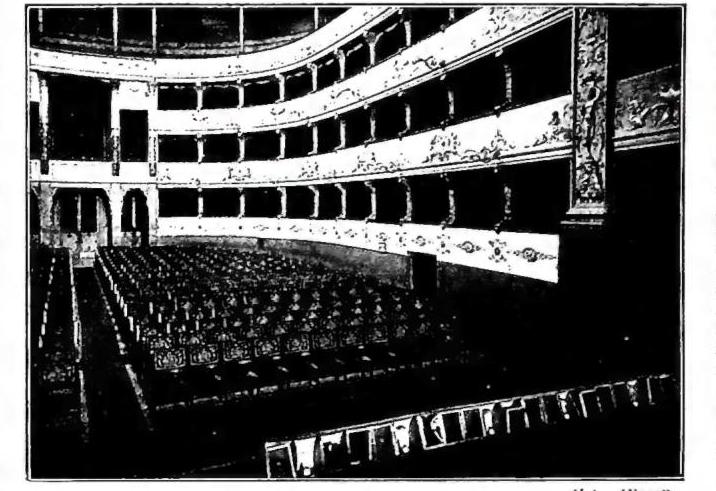
Theater - Interior of the Teatro della Pergola (18th century) - Florence.
leaves ambitions to founder and delivers naked souls to judgment. More explicit, though less profound, is the religious concern in the theater of François de Curel, who, educated in scientific inquiry and having passed through the experience of Antoine’s Théâtre Libre (a program of total spectacle, following the strictest canons of documentary realism) and echoing social preoccupations, comes to pose metaphysical problems dramatically, without however resolving them. The so-called Cavalieri dello Spirito in Italy (a mention not without official irony) gather such concerns and present them in various ways (Fogazzaro, Bracco, Butti). These were, however, uncertain expectations, inclined to dramatize uncertainty itself; until the actuality of a total religious meditation was proposed—and, with magnanimous confidence, left to come to fruition—by Paul Claudel, who from the final years of the nineteenth century dominates the twilight of an already old culture and invades the new. In him, not only does the legacy of sacred theater become current once more, but everything becomes sacred representation, even the comedy of manners (L'Échange, 1893) and historical comedy (L'Otage, 1911), as well as the baroque adventure comedy (Le soulier de satin, 1914-24, performed in 1943), while the explicitly religious theme (L'Annonce faite à Marie, 1912) projects itself over vast zones of historical, moral, and social life.
At this point, it becomes evident—earlier in France than elsewhere, due to the solicitations of poetic language and the vast movement of religious renewal—the necessity of a new conception of theater and of a scenic organization that responds to II. Jacques Copeau (1878-1949) became the interpreter of this need, having also passed through Antoine’s realistic conception, from which he learned the commitment to concreteness, which can become coherence and an appeal to transcendence; but he was also moved by literary-cultural exigencies to oppose the dominance that both the verist dogma and the exclusivity of the professionals exercised over the French stage. The restoration of aesthetic values could also obey the aestheticizing wave that in Italy, for example, coincided with the so-called theater of poetry; but
he aims at a total reinstatement of perennial values; and his program is no less one of truth and morality than of beauty. To promote it, he composes theatrical works, gives life to the Vieux Colombier, which upends all the conventions of theatrical architecture, reduces the spectacular element that favors dissipation and distraction, and promotes a symbolist simplification of staging and direction, training actors through a confraternal discipline. The efficacy of this program and example is decisive in contemporary theater; and his disciples extend his technique and inspiration especially in France (Jouvet) and in Italy (Costa). With Henry Ghéon (1875-1943), the religious current becomes a popular phenomenon, texts of immediate suggestion and simplest meditation multiply, and companies of parishes, colleges, and schools form; theater even arises for boy scouts (Chanceret).
It is not difficult to recognize in this religious revival a decisive factor for the new orientations of theater worldwide: for by now it is impossible to pursue an information confined to isolated national circles, if indeed the case of incommunicability among national expressions ever truly occurred in Europe. Equally important will be to reconnect, by consent and dissent, all the significant facts of dramatic literature, organization, direction, and even historical reflection on theater, naturally tied to the investigation of the primordial movement that promoted renewal or offered its most evident occasions. Spanish theater attended to this, though uncertain between the naturalistic and folkloric animation of García Lorca and the poetic effusion of Martínez Sierra; and rich in a tradition that revives many contemporary experiences, from Benavente and the Quintero brothers, through Unamuno, to the two mentioned and to Alberti. English theater (almost in reaction to the dissolution proposed by the sarcastic and most cerebral, yet inventor of perfect scenic machines, G. B. Shaw) does so with the work of the American T. S. Eliot (Murder in the Cathedral, 1935) and Christopher Fry: while French theater gravitates more explicitly around it, both in the apologetic and reflective continuations of Marcel and Mauriac, and in the lost crepuscular and intimist phase of the armistice (Vildrac, Bourdet; nor is the mythological theater of Giraudoux foreign to this retreat), as well as in the multifaceted experimentation of Jean Cocteau, and in the deliberate and defiant negation of the existentialist Sartre, in the second armistice, which in part also reconnects—through political reaction—to German expressionism. Indeed, in every country of Europe and America, observing these events and forms led to modifying a development that within certain limits presumes to be autonomous (nor do we claim here to offer anything more than a few reference points and some of the most valid perspectives). In Scandinavian theater, for example, rich in the great tradition of Ibsen, dramaturgy seems to unfold more or less independently, connecting to the violently negating work of Strindberg; but the Norwegians Helge Krog and Nordahl Grieg reflect emotions and speak a more broadly shared language. The two countries in Europe where the crisis was most acutely felt are Germany and Italy. In the former, the defeat of the First World War gave urgency and resonance to the innovative and revolutionary current that reacted against the restless presumption of Wilhelmine customs; equally and even more important, however, is to recall that the German cultural primacy of the nineteenth century had already attempted everything possible and accustomed critical literature to draw on every suggestion, from whatever source it came: expressionism, the most imposing theatrical phenomenon of the armistice years, has affinities with the visual arts, from which it takes its name (a reaction to French impressionism, which submerged images in a luminous atmosphere, with the native joy of a new discovery of created nature, and a proposal of new evidence assigned to things and an invasive, obsessive corporeality assigned to creatures), accumulates revolutionary ferment, decomposes the mechanism of the individual or disperses it in the mass. Brecht, Kaiser, Toller are the most frequently recalled names of a large group that
theater goes from Reinhard Sorge to Fritz von Unruh; and it concludes and transfigures itself in the poetry of Franz Werfel, destined to open himself to the religious message. The preeminent director, in contrast to the eclecticism of Max Reinhardt—who experimented with expressive modes of direction and stage organization, almost establishing the rules for those open-air performances, widespread throughout the world, that leverage environmental suggestion and historical memories—was Erwin Piscator, opposed to that humanistic liberation of the actor which was the Italian message. And precisely in Italy, with a clarity perhaps unassuming but eloquent and conscious even in its acceptance of limits, these experiences are easily summarized. The work of Luigi Pirandello should be observed not so much in its dialectical responsibilities, which are scarce and, moreover, introduced as lines of dialogue beyond which the character lives solely through its suffering and pity, but in the indictment he proposes, with desolate insistence, of a theater and a social custom devoid of valid justifications, resting on habit: thus summarizing the final demands of verist theater and surpassing the often vain and ambitious parenthesis, with its pseudo-historical preciosity, of the theater of poetry. He himself proposed a final fideistic and poetic solution in the "myths"; and this was the path, already opened and frequented with far greater awareness, by religious theater. It served, in the meantime, to denounce the provisionality of the invasive and corporeal solutions of Expressionism, the mechanical nature of existentialist proposals, and to abolish many of the traditional superstructures; and to propose to the word and to moral life the necessity of ultimate decisions pronounced without the aid of rhetoric.
To the east and west of this Europe, which thus closes the cycle of Romantic culture and perhaps inaugurates a culture of more immediate and profound moral responsibility—a language that calls for the co-responsibility of all men and the total commitment of man to the word, almost a "theater of the world," as the Spanish playwright said after the merely geographical dominion of the earth had been achieved, where norms and customs exist only to be surpassed, a benign yet arduous occasion for the rediscovery of the soul—Soviet theater and American theater seem to have divided the task of textual organization. Already at the turn of the century, Russia had witnessed the work of Nemirovič-Dančenko and Stanislavskij and the founding (1898) of the Moscow Art Theatre: theater was, perhaps, the only form of participatory life to which the imperial government allowed the freedom to choose proposals and formulate responses with a certain degree of initiative. With the Revolution, not only did organizational support multiply, giving rise to thousands of theaters in every articulation of the new society and in all the languages of the peoples of the Union, but the most diverse directorial experiments were attempted, still following the path of Stanislavskij, who never rigidified in his initial verism but instead promoted chromatic and choreutic experiences, which gained European fame through the Russian ballets, and also embraced the symbolism and constructivism of various tendencies. Meyerhold, Tairov, Akimov, Vakhtangov indicate the most acute and dynamic attentions of contemporary Russian theater, where the act of interpretation as recreation almost always surpasses textual depth. Among the theater authors, we mention, alongside Gorkij, who accompanies it from pre-revolutionary times to the Revolution, Vsevolod Ivanov, Bulgakov, and a typical figure of the "producer," a role that in such a theater necessarily comes to replace the author: Reuben Simonov.
As for America, without excluding the multiplicity of organizational and directorial experiences, which leave no program untried—from industrial theater to the Nationwide Theatre, from university and youth theater to touring companies—for a humanistic and Romantic tradition that repositions the word at the center of human participation, the author maintains his preeminence: Eugene O'Neill, who also arrives at a religious reconciliation after many divergent experiences (costumbristic, psychoanalytic, mythographic), is the best-known and most followed of a very numerous group, in which the names of Howard, Sherwood, Rice, and Anderson stand out: concluding, provisionally, with the work most observed in Italy, and certainly most ready to propose a message that draws on many occasions from European history and American life to reposition man at the margins of an ultramundane expectation: Thornton Wilder. - Vedi tavv. CXXXII-CXXXV.