
TOLSTÓJ, LEV NIKOLÁEVIČ. — Russian writer, born at Jásnaja Poljána on 26 August 1828, died at Astápovo on 7 November 1910. Left orphaned, he was entrusted to the care of a relative, F. A. Ergólskaia, who exerted considerable influence on the formation of his character.
He spent his childhood between Jásnaja and Moscow, where he completed his early studies; in 1844 he enrolled at the University of Kazán but, distracted by a brilliant social life, attended the courses with little interest and abandoned them altogether in 1847, when, having divided the inheritance with his brothers and received Jásnaja as his share, he returned to settle there. While still an adolescent he had turned away from the faith, “learned from his nurse,” in the conviction that “religious doctrine does not participate in life... it professes itself far from life and independently of it” (Confession), and had replaced it with a principle of moral, intellectual, and physical self-perfection, aimed at attaining the socially exemplary condition, according to his own definition, of a comme il faut man. The Diary (begun at the age of nineteen and continued almost without interruption until his death) attests to the extensive programme of work he imposed upon himself as a daily discipline in order to attain this perfection. His preferred reading consisted of the Bible and the works of J. J. Rousseau, and to these, perhaps more than to the democratic currents of the time, must be attributed his attempt to emancipate his peasants from serfdom; it was unsuccessful because of the negative attitude adopted by the latter (cf. A Landowner’s Morning, 1852). An ideal autobiography of the first twenty years of his life is found in the novels Childhood (1852), Boyhood (1854), and Youth (1857), in whose protagonist, Irtenev, T. portrayed himself, and in Irtenev and Nechljúdov the ambitious principles of the comme il faut man. But he realized that beneath them, instead of “the desire to be better in one’s own eyes or in the eyes of God,” there lay the vanity of being better “in the eyes of other men.” And soon the tendency to be better in the eyes of others changed into the desire to be... “more glorious, more influential, richer” (Confession). In 1851, following the advice of his brother Nicola, he enlisted and left for the Caucasus. He then began by writing the novel Childhood, which was published by the journal Sovreménnik (“The Contemporary”), and by composing a series of tales drawn from his wartime experiences: The Wood-Felling, The Raid, etc. Promoted to ensign in January 1854, he was then transferred to Sebastopol, where he fought during the siege and gathered the impressions that inspired the trilogy Sebastopol in December 1854, Sebastopol in May 1855, and Sebastopol in August 1855. He left the army in 1856 with the rank of lieutenant and settled in St Petersburg, where, because of his social position and his fame as a writer, the doors of literary and fashionable circles were opened to him; but after less than a year, weary of everything, he left for abroad with a profound faith in the social and individual evolution of humanity, in “progress”: “Then it seemed to me that this word expressed something” (Confession). But on 6 April 1857, after witnessing a capital execution in Paris, this new conviction of his also collapsed: “I understood, not with my reason but with my whole being, that no theory of the rationality of progress could justify that act” (ibid.). Western Europe found in him anything but an admirer: the impression he took away from it was, on the whole, negative. During his stays abroad (1857 and 1860–61), however, he took the opportunity to study several educational systems, thanks to which (although his own method was to have no method and to follow the principle of “free education”) he organized a popular school at Jásnaja Poljána and became its teacher. Beginning in 1862, T. started publishing an educational journal, Jásnaja Poljána, in which, alongside theoretical articles, he began printing stories and fables for children. A very important article, insofar as it prepares and justifies T.’s future abandonment of the so-called artistic style in favour of a popular style, is Who Should Learn to Write from Whom: The Peasant Children from Us, or We from the Peasant Children?, in which he displays his admiration for the compositions of his pupils. In 1862 T. married Sófija A. Behrs, and for several years conjugal happiness completely absorbed him; War and Peace (1864–69) dates from this period, a novel completed with extraordinary rapidity, considering its length and the extraordinary care with which T. worked (some chapters exist in as many as seven drafts). From 1873 to 1877 he wrote Anna Karénina, a work which, because of its perfect architecture and the sustained tension of its style and psychological investigation, should be considered his masterpiece even in comparison with War and Peace, a novel of brilliant conception but unequal poetic force and defective, over-elaborate construction. The central theme of the two novels is the search for the purpose of human existence, which T. identifies with living “according to God” and with love of one’s neighbour, though in both novels this formula has an unclear content. Having lost faith in “progress,” T. had once again taken up the religious problem: “Through two years of intellectual torment I discovered an old and simple truth... that immortality exists, that love exists, and that one must live for others if one wishes to be eternally happy. These discoveries surprised me by their resemblance to the Christian religion... I began to seek them in the Gospel, but found little. I found neither God, nor the Redeemer, nor the mysteries: nothing” (letter to A. Tolstája, 3 May 1859). Some time later, at Hyères in 1860, he had witnessed the agony of his brother Nicola and had asked himself what purpose life itself possessed: either it had a reason, a meaning that eluded him, or, if its sole end was annihilation, it was an evil, in which case it was not worth “deceiving oneself: death is preferable to life — one must free oneself from the latter” (Confession; cf. Lévin’s suicidal thoughts in Anna Karénina). Tolstoyan pessimism (of Schopenhauerian colouring) is characteristic of the first period, when T. attempts to reach God through reason, with
(from the doctor’s illustration, 1815, no. 28, p. 13)
TOLSTÓJ. LEV NIKOLÁEVIČ — Portrait, painted by P. Troubetzkov (1909).
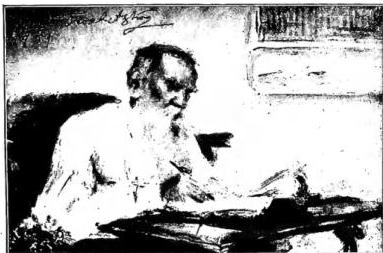
It is difficult to account for the diversity of style found among Tolstójan works using T.’s own words: “I know that every great artist must also create his means of expression. If the content of works of art can be infinitely varied, so too can their means of expression.” Nevertheless, it is evident that, while he wrote his first three novels in a style of exquisite literary ambition that would find no further counterpart in any other of his works, he was simultaneously writing the Sebastopol tales, in which a restrained liberality guided the choice of expressive means, and in which greater terseness was accompanied by less supervision. Thus, again, after a novel such as War and Peace, in which the lack of continuous control over form causes perfect pages to alternate with others that are angular, and even bureaucratic in their writing (as Šklovskij observed), Anna Karčinina transports us into a stylistic climate in which the simplicity, apparent terseness, and almost schematic quality of the expression acquire a flavour of immediacy and unalloyed wonder. Later (for example, in the tale What Men Live By, 1881), T. would move with equal ease among the cadences of popular storytelling, employing without affectation or effort the humble materials of everyday speech and a spare, elementary syntax, succeeding in transforming that manner of expression, just as the people themselves do, into a mode and world of poetry. This protean aspect of his writing is, however, a phenomenon far more superficial than substantial. The unity of Tolstójan style resides in a unity of temperament rather than of taste; in a particular disposition to accept things, rather than to change and recreate them according to his own measure and image. T. did not remake the universe in his own likeness; he limited it to those aspects that most resembled him, and reflected himself in them from every angle of incidence. But what also kept him from crystallizing his sensibility into a verbal style was a preconceived aversion to every “literary” aspect of literature; for he never regarded the latter as something that fulfilled, or was fulfilled in, itself, but as a means of communicating an inner problematic of his own, before the gravity of which every stylistic embellishment appeared to him frivolous. Because of his interest in that problematic, T. may be considered an essentially autobiographical writer concerned with content, provided that this assertion is stripped of anything premeditated and programmatic that it might suggest, to the detriment of art; for he almost never had theses already resolved for exemplification, but problems in a dramatic state. Even the formulas of “living according to God” and “self-sacrifice” out of love for one’s neighbour, which seem to represent points of arrival, solutions to the question posed—as may also be judged from the insistence with which he returned to propose them anew in each of his works—reveal themselves to be the products of a partial conviction, far more rational than deep and absolute. But it was precisely this impossibility of catharsis, and the consequent persistence of his problems in an emotional state, that prevented him from lapsing into programmatic and thesis-driven literature; just as, at the same time, it was precisely his concern with content that conditioned his detachment from the modes of the traditional artistic novel, understood as the biography of a hero. The true plot of each of his works is never, or only very rarely, a human adventure, but an inner current of thought that drives the whole action. A typical example is Anna Karčinina, where the story of Lévin ultimately assumes an even spatially predominant position over the biography of the eponymous heroine.
In Lévin and Anna the same problem is shadowed forth—the problem in which the whole of Tolstójan ideology is concentrated—namely, the search for happiness; but, in relation to T.’s true interest, Anna’s negative experience, re-
turned toward an egoistic solution, has ultimately receded into the background in comparison with that of Lévin, who arrived at the true key to the solution: existence «according to God». The particular nature of Tolstój’s novels, substantially different both from biographical novels and from novels of ideas; the fact that their real plot is never disclosed, but takes shape through as many secret channels as there are destinies of the characters—major and minor—who move through them, have caused an erroneous judgment concerning their construction, which has been deemed defective, or even nonexistent. Yet another factor closed to T. the paths of the biographical novel: his philosophy had no conception of the «hero». He knew that life has its own reason, but that this reason is its law; and, whether or not he succeeded in discovering it, man remained equally subject to II. Discovery redeemed him from his condition as a «brute», illuminating his consciousness, but did not lead him to freedom. That is why in Guerra e pace (and certainly not because of some bizarre attitude toward history) he regarded men who, like Napoleon, considered themselves makers of destiny, «heroes», as simply instruments of a will transcending them. For T. man is not only not the creator of destinies, but within certain limits not even of his own destiny; thus, whenever he attempts to exercise his free will, the «law» (or, as some have said regarding Anna Karčinina, «fate») hastens to strike him down. It is perhaps from this conception of human non-heroism that the modes of Tolstój’s psychology derive, never intended to weave an epos of feelings, organizing them into a solar system around which the world might revolve and from which things might draw their light; their story never unfolds consistently, arranged along a continuous thread, for T. communicates the soul of a character not through the results of its psychological process, already distilled and clarified, but through the process itself in its raw state, in its discontinuous, chaotic becoming. This bold realism, which brings passions down from a sublimated and novelistic aura to an everyday truth, constitutes one of the greatest innovations introduced by T. into the modern novel. T. also proved profoundly realistic in his descriptions of nature, which represent one of the most characteristic aspects of his work. T. never romanticized the landscape, nor did he ever make it anthropomorphic, even though at times he made it a mirror of a pathos, or, conversely, used it as a stimulus for provoking one. In nature he perceives a primordial goodness in which man rediscovers and renews his own innocence, harmony with all created things, and direct communion with God. He perceives it as something mysteriously alive, animated, consonant with himself and spiritually and physically confused with him. All the adjectives he uses in such descriptions, rather than defining the object represented, mediate an almost sensual adherence to II. And it is in these descriptions that T., more than anywhere else, betrays his fundamentally, instinctively pagan nature; it is in them, moreover, that his style unfailingly recovers and preserves a perfectly consistent register and vocabulary.
Bari 1938; A. Bounine, La délivrance de T., Parigi 1939; E. Gasparini, L'esordio di T., Milano 1942; id., Il vigore di T., there 1943; N. Gourfinkel, T. sans tolstolisme, Parigi 1946; E. I. Simmons, L. T., Londra 1946; L. Derrick, T. la vita e le opere, Milano 1947; B. Gabba, Dottrine religiose e sociali del conte L. N. T., there n. d.; L. Šestov, Le rivelazioni della morte, Firenze 1948; M. Gorki, Colloqui con L. Andreieff e L. T., Milano 1949; F. Porché, Portrait psychologique de T., Parigi 1949; P. Boyer, Chez T., there 1950; B. Metzel, T., there 1950; L. Šestov, La filosofia della tragedia, Napoli 1950.
THE RELIGION OF T. - T. did not create a new religious system; his religion is a mixture of the Gospel, especially the Sermon on the Mount, with strong doses of agnosticism, fideism, rationalism, and, most often, pantheism. He was not, however, a pantheist consistent with himself, who carried practical applications through to their ultimate consequences; nor could it have been otherwise, because his rationalism, whenever it came to saying something positive in religious matters, was coupled with a profound aversion to logic.
Here are the principal aphorisms of his religious beliefs: true religion is the relation of the soul to the universal life in which it is immersed, to God, who is infinite and impersonal life and goodness. Man has the duty to awaken divinity within himself. One must become aware of this fact: that earthly life is but a moment in the infinite series of lives. To assert that God is the creator of the world is blasphemy; it amounts to denying that God is the infinite love of which I am a part. One must love everything: «the dog, the grass, your mother». The purpose of life is to drown one's own will in that of God. What matters in religion is morality, conduct, relations with one's neighbour, in conformity with the precepts of the Gospel. Christian doctrine and dogmas must be rejected; the very historical personality of Jesus Christ matters very little, and Christological dogmas are absurdities; the moral teaching set forth in the Gospel suffices for everything. All men are equal; therefore no one has the right to punish his neighbour. It is not fitting to resist evil with violence. The Church, every Church, is harmful; the same must be said of everything it offers: dogmatic definitions, sacraments, rites. No one may intervene between man and God. The veneration of images and relics is immoral. Priests serve only their own interests. Authority in religious matters is absolutely inadmissible.
T.'s fundamental error consists in this: that he confuses the abuses of historical Christianity with the Church, and fails to reflect that what offends him—and rightly so—is not the Church, but rather infidelities toward II. His tragedy is that of all dissenters: by undermining the supernatural basis of Christianity, T. rendered a great service to Soviet atheism, which, while professing gratitude to him, mocks his moral doctrine.