
ROUSSEAU, JEAN-JACQUES. – Philosopher and man of letters, born on 28 June 1712 in Geneva to the Calvinist Isaac R., a watchmaker, and Suzanne Bernard; died at Ermenonville on 3 July 1778. He was educated by his uncle Bernardo and learned Latin: he was unable to adapt to the occupations first of clerk, then of engraver. In 1728 (14 March), having found the gates of Geneva closed in the evening, he began wandering through Savoy until, taken in by the Catholic parish priest of Confignon, the latter introduced him to M.me de Warens in Annecy, and she sent him to Turin for his conversion to Catholicism (21–23 Apr. 1728). As a servant, at the household of the counts of Govone, he met the ab. Jean-Claude Gaime (1692–1701: the « Savoyard Vicar »), who gave him some guidance in his studies. Returning the following year from M.me de Warens, in Chambéry, he obtained permission to study music; in 1732 he took employment with the cadastral office of the King of Sardinia and entered into a love relationship with his protectress (Maman), which lasted until 1741. During his stay at the villa of Les Charmettes in Chambéry (1738–40), he began systematically studying science and history and reflecting on the Port-Royalists and the Oratorians. In 1740–41 he was a tutor in Lyon in the household of Bonnet de Mably, brother of the historiographer Condillac (v.).
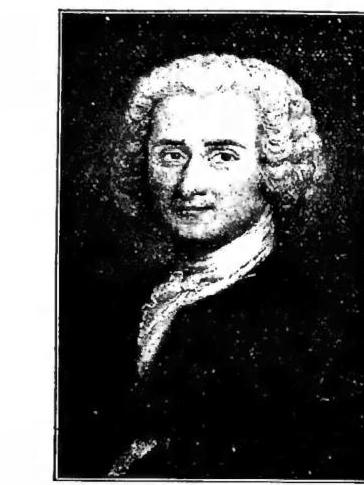
In 1754 R., by then famous, was triumphantly received in Geneva (where he returned to the Calvinist faith) and began to contemplate a vast work on « Political Institutions ». From the spring of 1756 to the end of 1757 he left Paris for Montmorency, where his patron Madame d'Epinay had offered him the country residence of the Ermitage. But because of his affair with M.me d'Houdetot, d'Epinay’s sister-in-law, he had to leave the Ermitage and come into conflict with his friends of the Encyclopédie. He was a guest of the Marshal of Luxembourg at the château of Montmorency and remained there from 1757 to 1762, completing his major literary and philosophical works: Julie ou la nouvelle Héloïse (1761), a novel (in epistolary form) in which he summarized his passion for d'Houdetot; the Lettre à M. D'Alembert sur les spectacles (1758–59), concerning the article Genève in the Encyclopédie; the Contrat social (1762), the only completed part of the « Political Institutions »; Emile ou de l'éducation (1762); and the posthumous Essai sur l'origines des langues. The Contrat and the Emile were condemned by the Holy Office, and on 9 June 1762 the Parliament of Paris, following the opinion of the Sorbonne, condemned the Emile and ordered the author’s arrest. On 19 June the Parliament of Geneva likewise condemned the two works. R. managed to flee Paris on 10 June and first took refuge at Molis-Travers near Neuchâtel, in the dominions of the King of Prussia; then, frightened by a popular demonstration, he went to the small island of St-Pierre in Lake Biel, where he remained until 1765. There he wrote the Lettre à Mgr Beaumont, Archbishop of Paris, in defence of the Emile (1763), and the Lettres écrites de la montagne (1764), in reply to the Lettres écrites de la campagne, written against the Contrat social by Jean Robert Tronchin, Attorney General of the Republic of Geneva (1741–93). In this
At the end of 1741 R., carrying with him a Projet concernant des nouveaux signes pour musique, left for Paris, where he obtained the approval of the Académie des Sciences for his musical system and published it (1742) together with a Dissertation sur la musique moderne. Secretary to the French ambassador in Venice, Montaigu, after a year (1743–44) he returned to Paris and found hospitable protection with Duon de Franceuil, the King’s cabinet secretary, who entrusted him with the instruction of his son in chemistry. In 1745 he succeeded in having his musical comedy *Les
during this period he devoted himself to composing Pygmalion, a lyric scene set to music, and to compiling the Dictionnaire de musique (1767). In 1765 R. was also evicted from Biel; at the beginning of 1766 Hume (v.) in England. The failure of King George III to grant him a pension brought on a crisis of persecutory mania. Returning to France in June 1767, he was first a guest of the Prince of Conti at the château of Trye (1767–68), then travelled through Dauphiné, and finally, in June 1770, settled again in Paris, living poorly as a music copyist. He then composed the Confessions (begun in 1761 and continued until 1765; posthumous); the apologetic dialogues (R. juge de J.-J. [1772–76]; posthumous); and, from 1776 to 1778, at the suggestion of his last friend Bernardin de St-Pierre, the Rêveries d'un promeneur solitaire [posthumous]. He died at Ermenonville, as a guest of the Marquis de Girardin. His remains were transferred to Paris by decree of the Convention in 1794.
As a musician, R. was more a theoretician and reformer than a creator and artist. His system of musical notation, replacing reading on the staff with the reading of numbers assigned to the notes, has merely didactic value. Nevertheless, his very persistence in music and the theatre demonstrates that this was the most naïve aspect of his personality, and the one in which he was most self-assured. He criticized contemporary theatre (Préface au Narcisse, Lettre à M. d'Alembert) instead, as artificial and corrupting of sentiment.
In literature, R. introduced and brought to triumph sentimentalism, until then regarded as characteristic of the English and their imitators, and opposed by hedonistic Enlightenment thought. The Nouvelle Héloïse, recounting in the form of passionate outpourings Julie’s love for the meditative Saint-Preux, although she is the wife of the rationalist Wolmar, represents the first modern attempt to unite the intimate drama of love with the torment of the moral and social problem of fidelity, and with the search for a universal law that might justify sentiment in its unrestrained expansion. The Confessions establish R. among the masters of sentimental autobiography: he attempts to recount himself, blending psychological realism with the loving and intellectual simplicity in which he locates the tone of his own personality. Of himself, too, he maintained that society and intercourse with men had corrupted primitive purity, defined by the spontaneous tendency to follow in one’s actions one’s own way of feeling, loving, and thinking (cf. Conf., I. VI). For him, humanity’s naïve movement was as rich in inspiration as feminine gentleness, and could be recognized both in the individual and in the mass. It was artistically joined to nature’s idyllic and vitalistic aspect, and led poetry and music to interpret consciousness as the sentimental unity of nature and man (op. cit., I. IX). He attained the full expression of this unity only at the end, however, and in madness, with the Rêveries, in which the freest childhood memories intertwine Romanticism (v.). He may be regarded as having anticipated this more consciously than any of his contemporaries, although his uncertain and contradictory relations with Christianity prevented him from achieving it, holding him back in pre-Romanticism.
As a politician, R. thought (v.), and initiated the movement of ideas that led to the French Revolution. The two Discours of 1749 and 1753 adopt a distinctly anti-historical attitude toward the whole Renaissance and the age of scientific progress, and toward the absolutist and commercial system that had become established in the modern era. R.’s fundamental concept is that, even in nature, man is created by God good and equal to his fellows, and that nature offers him the conditions for realizing this goodness and equality (Disc. sur l'inégalité, preface and part 1ᵃ): something still discernible in the civilization and forms of wisdom of the ancients who were closest to nature, Montaigne (v.) Montesquieu (v.) had shown. Progressive and feudal society corrupts primitive purity and equality in favour of vested interests, an artificial morality, an imposed religion, and ruinous and unjustified hierarchies founded on sophistic science. Only the return to nature and to orders and the
forms required by it could save humanity (Disc. sur les moeurs, part 2: Disc. sur l’inégal., part 2). Thus R. came to reconnect with modern natural-law thought, from Grotius (v. GRAMONT) to Vico (v.), and especially with the form of that thought current among Leibniz (v.) and Montesquieu. Yet, while agreeing that Roman law, with its political consequences, was the system that most closely conformed to it, and that natural society ought to be organized according to rationally established contractual and conventional principles, R. in the Contrat social (but already in the Discours of 1753, and in the other, posthumous work on the origin of languages) sought to give the dual historical and Epicurean, natural and conventional foundation of that system a psychological justification that led him to quite different consequences. There exists in every individual (he maintains), by nature, a dual will: one individual and ingenuous, the “will of all,” which each citizen of a state exercises in his own spontaneous interest, and the other directed toward the common good, the “general will,” which generates the compact among citizens to live together according to reason and morality (Contrat, I. II, 1-3; I. IV, 1). The “general will” is indivisible; it establishes the freedom and real equality of the political body and its members, and is represented by sovereign power, as single and indivisible, by elective democratic institutions, and by the laws that subordinate particular and transient wills to II. Faith in this will according to reason, transcending the momentary phase of individual consciousness, and the appeal to human nature itself in its spontaneous feeling as its source, separates R. from the Calvinists and the Enlightenment thinkers, and makes him historically the precursor of the Kantian distinction between the categorical and hypothetical imperatives. But in him this is justified by revolutionary aims, because it remains dogmatically asserted by the author himself that a general will, nourished and arising from feeling, can be identified with reason.
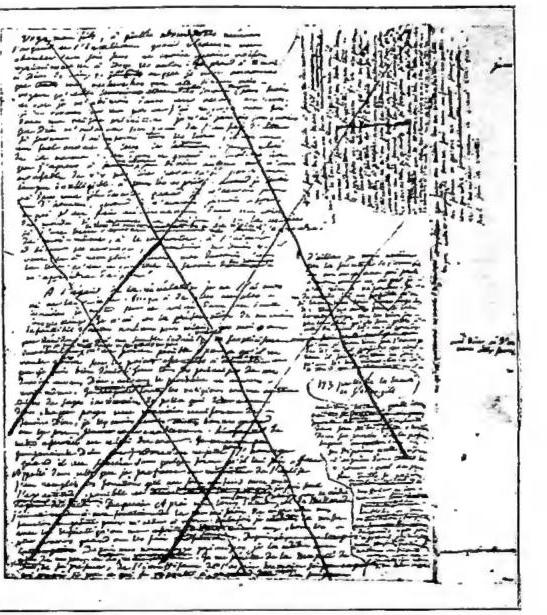
R., however, in his novel assigned the greatest importance to the “gradual method,” proposing and following Emilio’s education from age to age and from phase to phase: infancy (I. I), childhood (II), boyhood (III), adolescence (IV), youth (V). These phases correspond to: the origins
(from P. M. Masson, La Profession de foi..., Fribourg 1915)
ROUSSEAU, JEAN-JACQUES — Autograph of the first draft of the Profession de foi du vicaire auvoyard — Geneva, Civic Library.
of sensibility (I), the formation of expressive, imaginative, and sentimental powers (II), the experience of nature and of scientific and economic phenomena (III), the development of moral, religious, and social consciousness (IV); it is here that R. inserts the “Profession of Faith of the Savoyard Vicar,” in memory of his youthful Turin conversations with Abbé Gaime), and finally the ultimate test of love for Sophie and for the family. This last test does not prove entirely favorable to Émile: he becomes attached to his wife and succeeds in having children with her only after travelling throughout the world and submitting himself to the “social contract.” Although these divisions and successions of phases correspond to R.’s abstract notions (e.g., he regards Émile’s growth as that of a slow-developing child, who can devote himself to reading, study, and artistic exercises according to a program only at the age of twelve), they enabled him to incorporate into the Emile important and decisive contributions from his research on the study of infancy (in which he was an emulator of Locke’s child psychology), on the relations between infant consciousness and the primitive and heroic world (cf. G. B. Vico), on the method of teaching geography and the physical sciences (for which he takes up ideas from Spinoza), and to connect his pedagogy with the philosophy of religion (v.) society (v.). Despite its condemnation, the novel immediately enjoyed, and still enjoys, immense success; criticized by the Catholics (Gerdil, Muzzarelli, Formey, De Staël, Necker de Saussure, Capponi, Gioberti), imitated by the Romantics (Goethe, Richter), it was imposed by the naturalists and positivists pedagogy (v.). In fact, it contributed more intrinsically to the development of modern thought through the subsequent analyses of practical activity in its formation and differentiation (Kant) and through the connections between philosophy and pedagogy (Fichte); whereas its educational merit, though exceptional, is suggestive and abstract in character.
(Int. dimers)
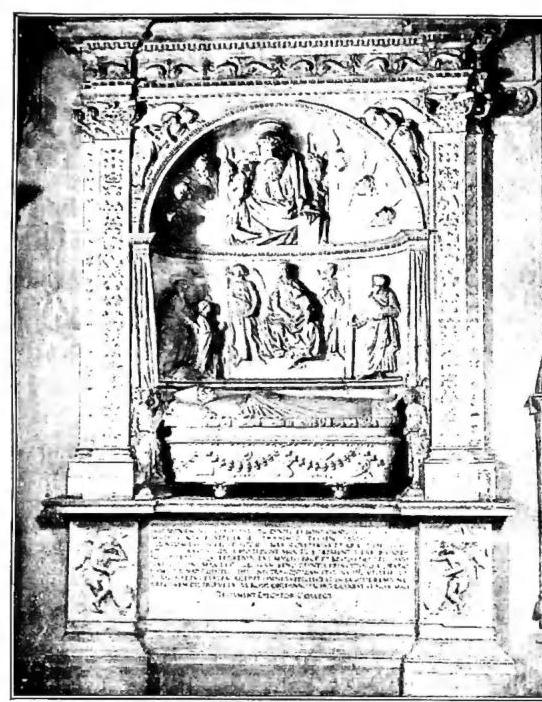
ROVERELLA, BARTOLOMEO — Monument to Cardinal B. R. Sculptures by G. Dalmata and A. Bregno (1476) — Rome, church of S. Clemente.
which he had studied. Other noteworthy elements in R.’s Malebranche (v.) for the theory of a rational social order founded on moral and religious conscience (cf. Malebranche, Traité de morale, I, 7 and II, 9), and from Leibniz for the monadological conception of Émile’s consciousness and of its relations with the idea of perfection. Yet sensism still prevails in the derivation of the genesis of moral conscience, in the manner of the French moralists and pedagogues (from Montaigne to Fénelon), from the internal crisis of natural egoism (amor proprio, amor di sé). In metaphysics, R. instead retreats toward creationist deism, in the manner of the Encyclopedists (Diderot, Voltaire).
Florence 1934; B. Brunello, R., Modena 1936; J. Sciaky, Il problema dello Stato nel pensiero del R., Florence 1938; R. Buck, R. u. die deutsche Romantik, Berlin 1939; E. Cassirer, Il problema G. G. R., Florence 1939; C. A. Sacheli, R., Messina 1940, 2nd ed., 1942; A. Cresson, J.-J. R., Paris 1940; A. Schinz, Etat présent des travaux sur J.-J. R., there 1941; D. Morando, R., Brescia 1945; N. Petruzzella, Il pensiero politico e pedagogico di G. G. R., Rome 1946; S. Caramella, Leibniz e R., in Arch. di filos., 16 (1947), pp. 15–18; A. Saloni, R., Milan 1949. Santino Caramella