Machine translation of the 1948–1954 Italian original. The original text is authoritative.
PORT-ROYAL. — Cistercian monastery founded in 1204 and elevated to an abbey in 1212, famous in the seventeenth century as a center of Jansenism (v. GIANSENIO e GIANSENISMO).
Situated in the Chevreuse valley, a two-hour walk from Versailles (and therefore called P.-R. des champs), in 1626, because of the unhealthy air, it moved to Paris, in the suburb of St-Jacques (P.-R. de Paris). The abbey would have become the French center of Catholic spirituality within the sphere of the «Counter-Reformation» had Saint-Cyran not filled it with religious anxieties and disorders; for this reason, on 29 October 1709, by royal decree, the nuns were removed from it, and on 29 January 1710 it was demolished. Upon its ruins
the dispersed Jansenists hastened on a melancholy pilgrimage; the most famous was that held on the centenary of its Degola (v.), the Genoese Jansenist survivor. P.-R. subsequently became a myth to which Mme de Sévigné, Racine, Voltaire, Sainte-Beuve, Renan, and Gazier devoted their historical and literary veneration, considering it now a Lycaeum spirituale, now a mystical Thebaid, now a school of humanism. Because of the influence exerted there by the Oratorian spirituality of Bérulle and by that of s. Francesco di Sales, it might have achieved these aims had Du Vergier de Hauranne not directed this moral revival toward heresy and sectarianism. The original sin of P.-R. was the Augustinus of Giansenio, whose doctrine emerged refined by the sensitivity of the Port-Royalists, while retaining its pessimistic view of the world and of life. To this were added an «angelic pride» and a «spiritual anger» which, intolerant of the authority of the Church’s magisterium, turned souls toward living in the Church despite the Church, through equivocations and ambiguities that remained characteristic of the history of Jansenism and repeated, almost identically in all its epigones, the mystique of disobedience. P.-R., the Arnauld family (v.), especially of Mère Angélique, its reformer, consisted of Les Vierges, Les Messieurs, and Les Petites Ecoles; these were centers of education and, at the same time, institutions of culture maintained and directed by the nuns and the solitaries. The nuns had boarding schools where they received girls destined for the cloister or for the world, while the solitaries had the proper schools where they instructed boys. From the boarding schools and the schools emerged nuns, women of Parisian high society, and distinguished men such as Pietro Nicole, Biagio Pascal, and Racine. Les Messieurs, laymen or ecclesiastics known as solitaries, were spiritual sons of St-Cyran, to whom the entire idea of renewal was owed; they served as confessors, directors, and teachers in the Petites écoles: an association, therefore, of devout persons, gathered in small numbers, who worked simultaneously, each within his own condition, for «the salvation of the soul». Seeking to imitate the Christians of the primitive Church, they devoted four hours a day to spiritual and manual labor, and to personal and communal prayers that resounded through the valley of P.-R. des champs. Their directors were Singlin, Mangueleine, and Le Maître de Saci, nephew of Angelica Arnauld, an illustrious orator and lawyer and a Councillor of State, who had abandoned his profession in order to found this family of hermits, known as the «fathers of the desert», in the new Thebaid of P.-R. Some of them also performed humble tasks, such as De la Petitère, the finest soldier in France who, as penance after a duel, had taken up the trade of shoemaker, and De la Rivière, a scholar of Hebrew, Greek, and Spanish who became a forest ranger. The solitaries, 10 in 1647 and 25 in 1652, gradually increased in number. Les Vierges, the spiritual daughters of Angelica Arnauld, often came from families of lawyers and magistrates; they were inclined to see miracles everywhere, to find in Sacred Scripture texts that precisely justified the circumstances of their conventual life and of life in the world, and to regard every idea in their minds as divine inspiration, every work of their apostolate as a sacred mission, and every contradiction as persecution. They could not tolerate being accused of Jansenism, nor did they endure the condemnation of Giansenio, St-Cyran, or Arnauld. And when the Pope or an ecclesiastical Superior demanded submission, rather than obey inwardly they would repeat in chorus: «blessed are those who suffer persecution for justice». Among them Jacqueline, Pascal’s sister and «sa directrice», was famous, as were the sisters of Angelica Arnauld. Theology, mysticism, asceticism, and the diplomacy of Jansenism were strangely mingled within the walls of P.-R., and the pages of the Augustinus of Giansenio did everything, as did Les lettres chrétiennes et
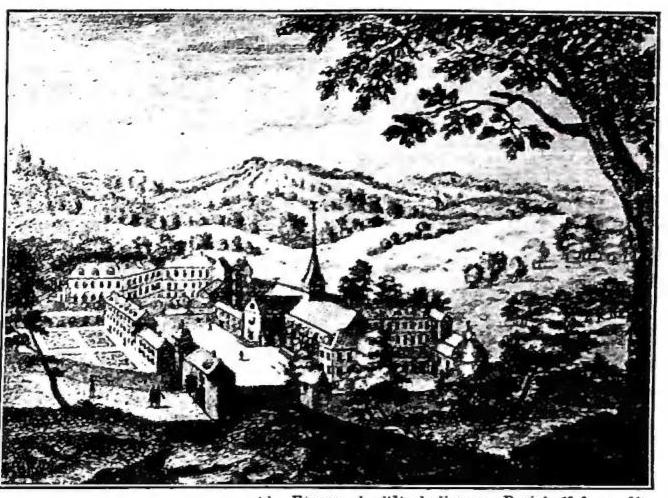
(from Visages de l'Île-de-France, Paris 1848, p. 81)
PORT-ROYAL – View of the abbey of P. R. des-Champs. Engraving by M. Horthemels.
spirituelles by St-Cyran and the treatise De la fréquente Communion by Antonio Arnauld, works that were later replaced, in the abbey’s darkest hour, by Quesnell’s Réflexions, which brought together all the preceding motives of the heresy, constituting its fundamental and undisputed code. To these documents must be added Les lettres of Angelica, Maddalena, and Agnese Arnauld, in order to learn the intimate chronicle of Jansenist rigorism, which had its experimental center at P.-R.; this includes Le chapelet secret du St-Sacrement. In the austere awareness of a distant father-God, of a severe judge and mediator Christ, and of a mother Mary exalted by a “terrible” dignity; in a vocabulary in which the terms “inaccessible,” “incomprehensible,” “incommunicable,” and “ineffable” frequently occur; within a complicated and rigid sacramental life, P.-R. shut itself within its ancient walls in a frigid piety, a stoic pride, and a pursuit of perfection without holiness, following a logic, La logique de P.-R., by Antonio Arnauld, which was constantly attempted but never resolved.
BIBL.: C. A. Sainte-Beuve, P.-R., Paris 1867; F. Cadet, L'éducation à P.-R., there 1887; P. Racine, Abrégé de l'histoire de P.-R., there 1913; H. Brémond, Hist. littér. du sentiment religieux en France, there 1920–26; J. La Porte, La doctrine de P.-R., there 1923; C. Gazier, Histoire du monastère de P.-R., there 1929; J. Laporet, La doctrine de P.-R. La morale, there 1951; see also the bibliography of the entry V. GIANSENIO E GIANSENISMO. Benvenuto Matteucci
Cite this article
“PORT-ROYAL.” Enciclopedia Cattolica, vol. IX (1952), p. 1086. Azione Romana digital edition, https://azioneromana.com/article/port-royal.