Machine translation of the 1948–1954 Italian original. The original text is authoritative.
PASSIONEI, DOMENICO. – Cardinal, born at Fossombrone on 2 December 1682, died at Camaldoli (Frascati) on 5 July 1761. In Rome he attended the Clementine College of the Somaschi, subsequently devoting himself to the study of dogmatics and ecclesiastical history under the direction of the Theatine G. M. Tommasi, and thereby becoming an advocate of the strictest Augustinianism and of moral rigorism. A theological orientation opposed to Molinism and probabilism lent itself to a secret sympathy toward the theology and morality of the Jansenists. For P., this was fostered by his friendship with Cardinals Noris and Ferrari and with Msgr. Fontanini, who brought him into contact with French intellectual circles, including the Maurists. Eclectic by nature, he did not miss an opportunity to associate with the learned men and writers of his time, including Montesquieu and Voltaire, absorbing sympathies and antipathies whose intimate motives of resentment—now secular and Enlightenment-inspired, now Gallican and Jansenist—his not very profound theological formation was unable to evade, directed against the Church.
His two-year stay in Paris and four-year stay in Holland, from 1706 to 1713, on assignments for the Holy See, enabled him to become acquainted with the religious milieu of Paris, Amsterdam, and Deventer, and his ambition offered an easy point of entry to the rebels, many of whom were exiles in Holland. These and his other Utrecht (v.) influenced his formation. For the various services rendered to the Holy See, as an agent
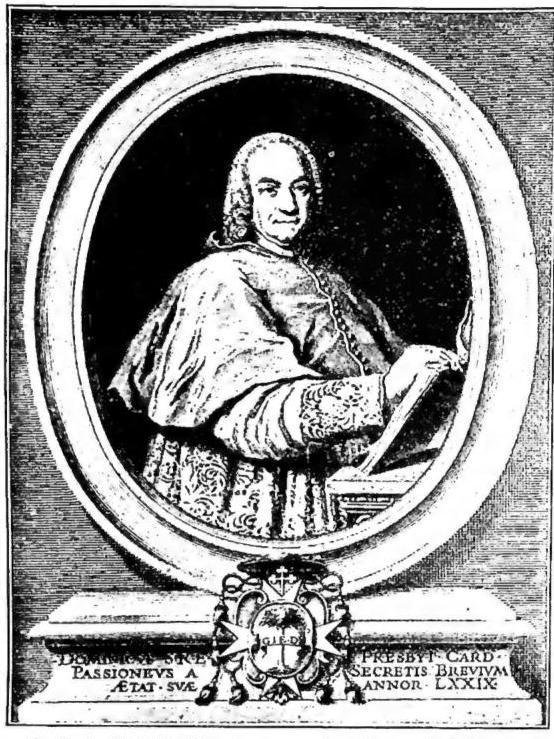
(from P. L. Galletti, Memorie per servire alla storia della vita del card. D. Passionei, Rome 1785, plate opposite p. 1) PASSIONEI, DOMENICO – PORTRAIT. Engraving.for the preliminaries of the Peace of Utrecht (1712), and as the Pope’s representative in the negotiations between the Emperor and France first, and then in the alliance between Switzerland and France, after a brief period as secretary of Propaganda, he was sent in 1721 by Innocenzo XIII as nuncio to Switzerland; from there, in 1730, he was transferred by Clemente XII to Vienna, and finally created cardinal on 23 June 1738 and appointed secretary of Briefs, an office he held until his death. In the Palazzo della Consulta at the Quirinal, where he resided, he assembled his celebrated Library. He had another unofficial residence on the property of the Camaldolese Hermits near Frascati, famous for its luxurious and artistic furnishings, visited by popes and princes, which he himself called the “hermitage” and where he would regularly gather friends for rest and discussion. They came there under such names as fra' Paolo, fra' Giovanni, fra' Antonio, and the like: Bottari, Foggini, Niccolini, Martini, Orsi, etc., under the direction of the prior, that is, P. himself, who sat beneath the portrait of Arnauld, always keeping Pascal’s Lettres provinciales close at hand. This constant and often violent anti-Jesuit attitude was accompanied by an irresponsible criticism of the Church and the popes, as well as by inactivity in his pastoral office. Averse to the Congregations and to every curial responsibility, he caused continual difficulties for the Holy See, not only through his imprudent conduct, but above all through his association with libertine writers and the protection he afforded to the spirit spread by the Encyclopédie. His conduct thus equally encouraged the suppression of the Society of Jesus and the development of Jansenism in Rome, far more than the hoped-for return to the primitive practice of the Church and to its sacramental and disciplinary rigorism. His extensive correspondence and the manuscripts, of which only a few remain, testify that P. was a superficial, ambitious, scheming, and ambiguous encyclopedist. His temperament was responsible for his death. The Catechism of Mesenguy, whose translation he was responsible for, having been condemned despite his opposition, he himself
was supposed to sign the decree. In order to avoid doing so, he withdrew to Camaldoli. Clemente XIII sent him the brief ordering him either to sign it or to resign. P. signed, but his irritation was such that, struck by an apoplectic paralysis, he died twenty days later.
BIBL.: P. Galletti, Memorie per servire alla storia della vita del card. D. P., Roma 1762; A. Vernarecci, Fossombrone dai tempi autichissimi ai nostri, II. Fossombrone 1914; E. Dammig, Il movimento giansenista a Roma nella seconda metà del sec. XVIII, Città del Vaticano 1945, pp. 61-63, 77-79, 278-81; Pastor, XV-XVI (v. indici). Benvenuto Matteucci
Cite this article
“PASSIONEI, DOMENICO.” Enciclopedia Cattolica, vol. IX (1952), p. 579. Azione Romana digital edition, https://azioneromana.com/article/passionei-domenico.