
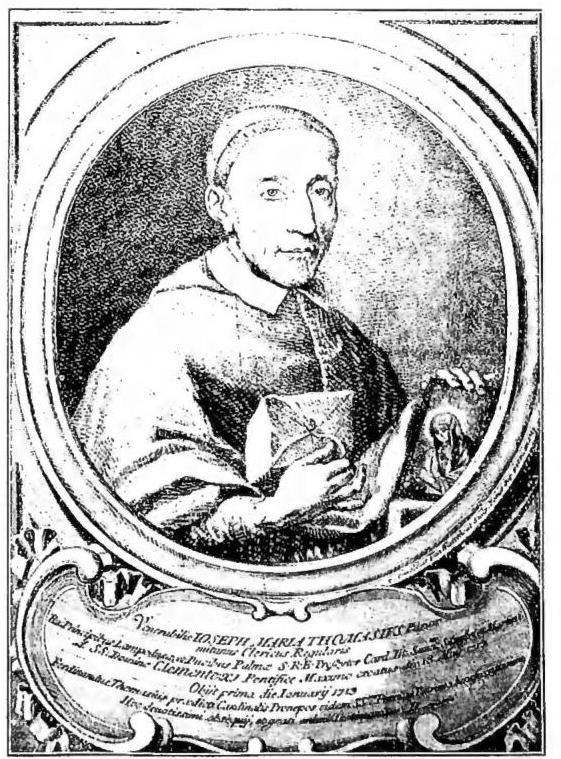
TOMMASI, GIUSEPPE MARIA, blessed. — Cardinal, liturgist, historian, and Theatine theologian, born at Licata (Sicily) on 12 September 1649, died at Rome on 1 January 1713.
The firstborn of the dukes of Palma and princes of Lampedusa, he renounced his birthright in favor of his brother and entered the Theatines at Palermo, where he made his profession on 25 March 1666. Ordained a priest at Christmas 1673, he lived in Rome for 40 years, almost always at S. Silvestro al Quirinale, devoting himself to the study of the Roman liturgy, the Bible, ecclesiastical history, and the Fathers. Alongside his knowledge of the classical languages, he studied the Oriental languages—Arabic, Ethiopic, Syriac-Chaldean, and Hebrew—under the learned rabbi Mosè da Cave, whom he converted to the Christian faith. For his studies, for the important research he conducted in archives and libraries, and for the publication of his works (codices Tommasini), he was celebrated, even by Protestants, as one of the most learned men of his century, and he remains today, especially in the field of the Roman liturgy, an authority of the first rank. His efforts toward liturgical reform aimed not so much at innovation as at restoring and preserving the ancient tradition. He held various offices in the Roman Congregations; in 1712 he was created cardinal. He was beatified in 1803; feast day, 1 January.
Among his principal publications, most of them issued under the pseudonym Giuseppe Maria Caro, the following should be recalled in chronological order: Codices Sacramentorum nongentis annis antiquiores (1680: these are four extremely ancient sacramentaries of the seventh and eighth centuries, namely Missale Gelasianum, Missale Gothicum, Missale Francorum, and Missale Gallicanum vetus; this edition, the earliest in date and the most important, still retains all its value today); Psalterium iuxta duplicem editionem... Romanam et Gallicanam una cum Canticis et Hymnarium atque Orationale (1683: with this edition T. restored the use of obeli and asterisks, already almost completely lost for a thousand years or nearly so); Responsorialia et antiphonaria Romanae ecclesiae (1686, according to the manuscripts of the ninth to twelfth centuries in the Vatican Library and the monastery of S. Gallo); Antiqui libri Missarum Romanae ecclesiae (1691; that is, the Antiphonarium of St. Gregory the Great, called Comes, already emended by Alcuin, together with the Lectionary and the Gospel chapters; thus T. completed the Missale plenarium of the Roman liturgy). Also important are the Institutiones theologicae antiquorum Patrum (1709–12), which comprise a series of dogmatic and moral works by the holy Fathers arranged according to an Indiculus (1701), or plan of study, by which T. wished to provide the clergy with a complete course in patristic theology. He also left other original works and numerous pamphlets on historical and biblical criticism, including works that remain relevant on the reform of the liturgical books of the Roman Church.
Works: Opera omnia, ed. A. Vezzosi (11 vols., Rome 1747–69). Other pamphlets published by Vezzosi, in Scrittori dei Chierici Regolari (II, Rome 1780, pp. 409, 416–27), and by G. Mercati, Opuscoli inediti del beato card. G. T. (Rome 1905).
(photo Alinari)