
THOMAS, APOSTLE, saint. —
I. LIFE
One of the “twelve,” characterized by the epithet Didymus, meaning “twin,” a version (In Io. 11, 16; 20, 24; 21, 2) of the Hellenized Aramaic name T. (Θωμᾶς ὁ λεγόμενος Δίδωμος). Some wrongly interpret it as a synonym for “double-minded.”Ancient writers indulged in speculation in an attempt to discover whose twin T. was. Some (Chronicon Paschale, 9: PG 92, 1076) call him the twin of a certain Lydia or Lysia; others, of a certain Eliezer (Hom. Clem., 2, 1: PG 2, 77). The apocryphal Acts of T. (v. appresso), the History of Abgar (cf. Eusebius, Hist. eccl., I, 6: PG 20, 126), and the Doctrine of the Apostles call him Judas-T.
In the catalogues of the Apostles in the Synoptics (Mt. 10, 3; Mc. 3, 18; Lc. 6, 15) and in Act. 1, 13, only the name T. occurs. The Fourth Gospel relates several episodes involving him. One shows his courage: “Let us also go and die with him,” said T. when it was a question of going to Bethany, where Jesus was being sought in order to be put to death (Io. 11, 16). Another shows his argumentative character: “Lord, we do not know where you are going; how can we know the way?” he asked Jesus at the Last Supper (ibid. 15, 14). His skepticism in the face of the claims of the other apostles, who had seen the risen Jesus (ibid. 20, 24-25), is well known; this was remedied by his declaration of faith in the human and divine reality of the risen Christ, pronounced eight days later: “My Lord and my God!” Jesus replied to him: “Because you have seen me, you have believed; blessed are those who have not seen and yet have believed” (ibid. 20, 26-29). Io. 21, 2 lists T. among the five who took part in the second miraculous catch of fish. It therefore follows that T. too was a fisherman.
Uncertain information is provided by tradition concerning his field of apostolate. A relatively consistent line of tradition assigns him the eastern regions between Syria, Persia, and India. The Roman Breviary commemorates him on 21 Dec. as a martyr at Calamina in India. The Greek and Syriac Churches celebrate his feast on 6 Oct.; the Melkite Church, on 3 July, the anniversary of the translation of his relics to Edessa. Christians of the Malabar rite pride themselves on having been evangelized by the apostle T., a claim that is still disputed by many.
II. CHRISTIAN ARCHAEOLOGY
One of the earliest representations of the incredulity of St. T. is found on the sarcophagus of St. Celsus in Milan, on which the Apostle places his finger on the Lord’s side (R. Garrucci, Storia dell'arte crist., II, Prato 1876–81, pl. 315, 5). Also in Milan, the Cathedral preserves an ivory diptych depicting the Apostle T. in the same attitude (Venturi, I, p. 426, fig. 390). In London, on an ivory piece in the British Museum, the haloed Lord, standing upon a platform, is surrounded by four disciples: the first on his left is T., who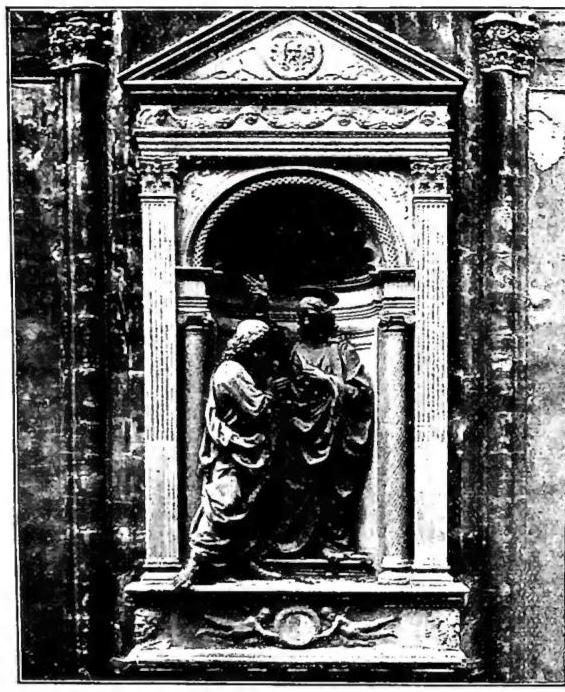
III. ART
In the Middle Ages, the apostle S. T. was represented with a square (regula), which initially is to be regarded as his usual iconographic attribute. He appears in this form in paintings of the thirteenth and fourteenth centuries and in various sculptures, including several from beyond the Alps, among which the most noteworthy seems to be that of the Cathedral of Bamberg (thirteenth century).The art of the Italian Renaissance customarily represented S. T. first of all in the scene of his unbelief, showing him in the act of placing his finger in the wound in Our Lord’s side. The magnificent bronze by Andrea del Verrocchio, executed between 1464 and 1483 to adorn the tabernacle of the Mercanzia in Orsanmichele in Florence, is one of the earliest representations of this kind. The altarpiece by Cima da Conegliano, preserved in the Accademia in Venice, depicts the scene of S. T.’s unbelief, witnessed by S. Magno.
According to the testimony of the historiographer G. P. Bellori, an Incredulità di s. T. was painted around 1595 by Michelangelo da Caravaggio; the original has been lost; it is nevertheless known through seventeenth-century copies, one of which is preserved in the Berlin Museum and another in the Uffizi in Florence. The subject itself was often repeated by Caravaggesque painters, both Italian—e.g., by the Veronese Marcantonio Bassetti (Verona, Museo di Castelvecchio)—and Dutch and Flemish—e.g., P. W. Crabeth (Amsterdam Museum). A fine canvas by Guercino, in the Vatican Pinacoteca, likewise depicts this sacred subject.
For the art of the early eighteenth century, noteworthy is the statue of the apostle S. T. carved in marble by Pietro Legros for the central nave of the basilica of S. Giovanni in Laterano in Rome; the Saint is seen showing his finger, a detail alluding to the scene of his unbelief.
IV. APOCRYPHAL BOOKS
1. Apocalypse of T
An apocryphal work, decree of Gelasius (v.) under the title of Revelatio quae appellatur Thomae Apostoli.In 1907 F. Wilhelm believed that he had rediscovered its text in an'Epistola domini nostri Jesu Christi ad Thomam discipulum suum, in which the physical and moral disasters of the last seven days preceding the cosmic catastrophe are described. The text, very late in date, can be assigned, according to E. Amann (in DBs, I, col. 529), to the Merovingian period. In 1911 P. Bihlmeyer rediscovered a better-preserved and more ancient recension, which seems already to have been in use among the Priscillianists, published in Revue bénédictive, 28 (1911), pp. 270–82. A critical reconstruction translated into English was published by M. R. James, The apocryphal New Testament, Oxford 1924, pp. 555–62.
2. Acts of T
An apocryphal book, regarded as Encratite by St. Epiphanius (PG 41, 852), Manichaean by St. Augustine (PL 42, 452.758), and Priscillianist by Turribius (PL 44, 694). The Acts of T. have come down to us in many manuscripts with Catholic reworkings, in two principal recensions: one in Greek, the other in Syriac; the latter seems to be the original language. The Ethiopic reworkings are of lesser importance.In the Greek recension the text is divided into 13 parts (plus one concerning the martyrdom of T.). Its subject is as follows: the Apostles divide the field of missionary work among themselves in Jerusalem. Judas-T., also called Didymus, is assigned India. He does not wish to go there. Jesus, appearing to him, repeats the command and sells him as a slave to a merchant sent by a king of India named Gundafor, who was seeking a skilled architect to build him a splendid palace. At a certain point during the journey, T. attends the wedding of the King’s daughter and recites a hymn on the mystical union of the soul with eternal wisdom. Meanwhile, Jesus, in the guise of T., persuades the newlyweds to maintain perfect continence within marriage. Later, presented to the King as an architect, T., entrusted with the construction of a palace, distributes among widows and the poor the funds received for this purpose. The enraged King is then pacified by a dream showing him the palace built by the souls converted by T., and he himself is baptized. T. performs various miracles. Among other things, he frees the daughter of King Misdai from the demon and recommends perfect continence in marriage to all women. Imprisoned for this reason, T. miraculously escapes, but then, again miraculously, returns to prison, and finally is killed by blows from a lance. His body continues to work miracles.
Traces of Gnosticism are found especially in the poetic sections; it is difficult, however, to determine to which Gnostic system they belong. If the poetic sections, which according to some may be interpolations, are excluded, the legendary narrative proves to be substantially orthodox and might contain some trace of reliable tradition. Some think that the book arose in Syria through the work of Bardesanes. Among the Latin reworkings, without the poetic sections and therefore substantially orthodox, one notes that attributed to St. Gregory of Tours: De miraculis b. Thomae Apostoli. There is also a Passio s. Thomae Apostoli from the sixth century. The Ethiopic reworking, derived from a Coptic reworking, takes many liberties.
3. Gospel of T
The earliest mention of a Gospel attributed to the Apostle T. is found in Origen (Hom. in Lucam, I, 1: CB, IX, p. 5; cf. Eusebius, Hist. eccl., III, 25, 6: CB, II, 1, p. 252), and in Hippolytus (Philosophumena, V, 7, 20: CB, III, p. 83), who quotes a brief verse from it and states that the work was widespread among the Naassenian heretics.St. Irenaeus (Adv. haer., I, 20, 1: PG 7, 653) seems to presuppose its use by the Marcosians; while St. Cyril of Jerusalem (Catech. IV, 36: PG 33, 500), together with the pseudo-Gelasian decree, declares that the work was of Manichaean origin. From such statements it is legitimate to conclude that a Gospel of T. of Gnostic origin existed in the second century. Of it, the only passage known with certainty is the saying quoted by Hippolytus: « He who seeks me will find me among children seven years old and above; for, hidden in the fourteenth aeon, I shall become manifest ». What remains of the Gospel of T. is in all probability a Catholic reworking which nevertheless preserves evident traces of Gnosticism, in the apocryphal work entitled in Greek Tales about the Childhood of the Lord by T., an Israelite philosopher, and in Latin Tractatus de pueritia Iesu secundum Thamam. Its circulation is documented by the numerous versions (Syriac, Latin, Arabic, Slavic). In Greek there are two recensions: the long one, first published from a codex in Bologna by G. L. Mingarelli in 1764, consists of 19 chapters and narrates the life of Jesus from the ages of 5 to 12; the short one (13 chapters), taken from a Sinaitic codex, is limited to the years 5–9. The unknown author was neither a philosopher nor an Israelite; his knowledge of Jewish customs is very limited, while he displays a mean conception of religion. The narrative is a succession of useless miracles performed by a vengeful and capricious Child Jesus. The hypothesis has also been advanced that the substratum is of pagan, specifically Indian, origin (cf. A. Mayer, Kindheitserzählung des Thomas, in Ed. Hennecke, Neutestamentliche Apokryphen, 2nd ed., Tubinga 1924, p. 94 ff.).
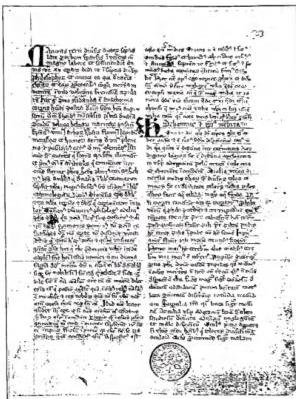
(Illustration from Enciclopedia Cattolica) THOMAS OF CANTIMPRÉ - Incipit of the De rerum naturis - Vatican Library, cod. Vat. lat. 822, f. 23f (14th century).