VERONA, DIOCESI di. – City of the Veneto, provincial capital, at the foot of the hilly spurs of the Lessini, watered by the Adige, along whose banks the enchanting « Lungadigi » run and are laid out. The two banks are connected by 10 bridges, which were demolished by the Germans (Apr. 1945); the most characteristic and historically important are the Scaligero bridge, medieval (second half of the 14th century), rebuilt as it was and where it was (1950), and the « Pietra » bridge, Roman in its two left-hand arches, sixteenth-century in the others.
By virtue of its position, V. acquired pre-eminent importance as a Roman, medieval, and modern center. A first-rate railway junction connects it with the Brenner and with Milan, Venice, and Bologna. Economic life is based on agriculture and viticulture (the wines are prized and very well known); the mining, construction, chemical, food, and hydroelectric industries are gradually developing and intensifying. A considerable network of canals provides irrigation for the water-poor areas in the same province.
(Ist. Alinari)
The diocese, formerly a suffragan of Aquileia and now of Venice, borders the dioceses of Trento, Brescia, Mantua, Rovigo, Vicenza, and Padua; it has an area of 3,098 sq. km. and a population of 645,402 inhabitants; 319 parishes, 26 curacies, 11 rectories, 7 non-residential establishments, 3 sanctuaries, 260 public oratories, 331 semi-public, and 68 private; 664 priests, 186 religious priests, and 3,280 women religious.
I. HISTORY
The origin of V. is uncertain: Celts, Etruscans, and Euganeans probably contributed to its first nucleus, peoples who established on the banks of the Adige the site of a ferry for transit and trade; it was at first an important Venetian centre; in the Roman period (3rd century B.C.) it was a crossroads of roads, which later took the names of Postumia (from the Lombard plain to Aquileia) and Clodia (from the Po valley to the Alps, along the Adige). In the subsequent political organization of Venetia, it was first a municipium and then, under Augustus, a colony (Colonia Augusta V.), enrolled in the Pobilia tribe. The Roman quadrangular city arose within the bend of the Adige, divided into four districts by the decumanus maximus, the road corresponding to the Corsi Crispi and the Roman gate known as the Borsari, and by the cardo maximus, the perpendicular street corresponding to the streets of Cappello and S. Egidio; at their intersection the Forum was formed, the present Piazza Erbe. The Roman city wall began at the Adige and ran along Via A. Diaz, then continued near the present church of S. Niccolò, turning towards Via Leoncino to return to the river; in 265 the emperor Gallienus rebuilt the walls, enlarging their circuit, which also included the Arena. In 312 the emperor Constantine won the victory over Maxentius that opened the way to Rome for him. V., among the cities of the “X Augustan Region,” whose capital was Aquileia, was perhaps the first, after Aquileia, to receive Christianity and to have an ecclesiastical hierarchy (mid-3rd century).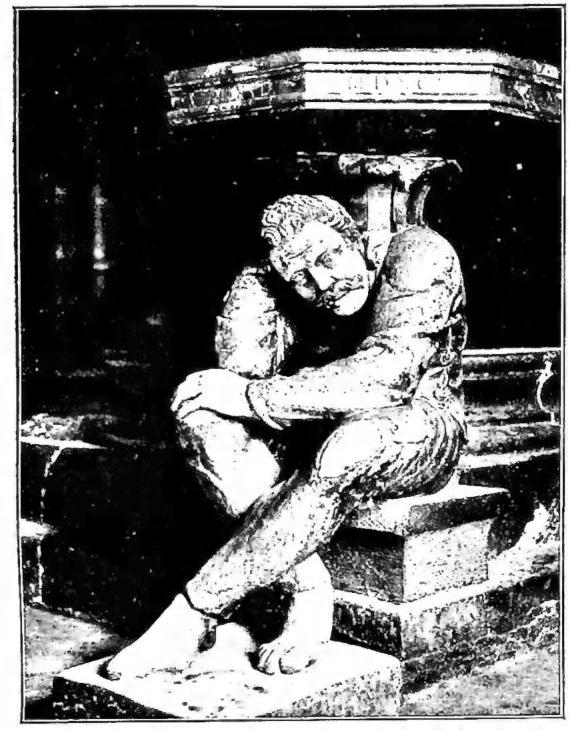
(courtesy of Don Zanatto)
VERONA, DIOCESI di - Holy-water stoup in the church of S. Anastasia (1591).
during the repair and restoration of the medieval cloister and the Capitular Library, severely damaged by aerial bombardments; the Basilica, in its structural and mosaic elements, has stylistic affinities with the post-Theodorian one at Aquileia and with the basilica of SS. Felice e Fortunato at Vicenza.
From the fall of the Western Empire to the end of the Carolingian Empire, V. was the scene of complex historical events: Alaric, king of the Visigoths, was defeated by Stilicho (403); in 489 Odoacer was defeated by Theodoric, who made V. S. Pietro; Alboin (A.D. 569) united it to the Kingdom of the Lombards, of which V. became the seat of a duchy; at the fall of the Lombards (774), Charlemagne, king of the Franks, defeated Adelchi, son of Desiderio; Pippin, son of Charlemagne, resided for a long time in V., enlarged the church of S. Zeno, following the design of the archdeacon Pacifico, who embodied and guided the cultural and artistic revival of the Carolingian city and county of V.; Berengario, king of Italy, won a victory over the emperor Lodovico III and the Hungarians, and there lost his life. Otto I (984) detached the March of V. Bavaria; in the 11th century the bishops of V. VIZI; in 1061 Cadalo of Verona, founder of the monastery of S. Giorgio in Braida and bishop of Parma, was elected antipope under the name of Honorius II. While feudal struggles raged, V. succeeded in constituting itself as a Commune (1136) with consuls and, shortly afterwards (1164), in forming the “Veronese League,” which foreshadowed the Lombard League and fought at Legnano (1176). In 1184 V. received the fugitive Pope Lucius III, who died there the following year and was buried in the Cathedral (where his successor, Urban III, was also elected).
After fierce struggles among feudal lords, Ezzelino III da Romano, in 1226, proclaimed himself podestà of V.; defeated at Cassano d’Adda, upon his death (1259) power passed to the Guilds (1262) and to Mastino della Scala, captain of the people and of the city; he was succeeded by Alberto (1277), Bartolomeo (1301), who offered Dante “his first refuge and first hostel”; with the accession of Cangrande (1308), the Scaliger lordship was consolidated, subjugating Vicenza, Padova, and Treviso; Cangrande II built Castelvecchio (1351), as a fortress and refuge. In 1386 the Visconti of Milan succeeded to Scaliger power; and after an ephemeral Scaliger restoration, V. passed under Venice (1405); in the 15th century the bishops were generally Venetians. Subsequently V. became involved in Venetian wars against Milan: it was occupied by the emperor Maximilian (1509) and finally returned to Venice (1516); in the first half of the 16th century the architect Sammicheli erected walls and gates. In 1796 V. underwent the French invasion and the following year rose against the French (Veronese Easter); by the Treaty of Campoformio it passed to Austria, subsequently forming part (1804–14) of the Italian Kingdom, and from 1814 of the Lombardo-Venetian Kingdom under Austria until 1866; in 1822 the Congress was held there which adopted the political programme of the Holy Alliance.
For a long period it became an entrenched camp, the pivot of the quadrilateral, with renewed walls and a double outer circuit of fortifications. Decisive battles of the Risorgimento took place near V.: S. Lucia (1848), S. Martino and Solferino (1859), and Custoza (1866).
Among the many floods, memorable was that of 1882, which caused serious damage and led to the construction of the embankment walls along the Adige.
II. RELIGIOUS LIFE AND INSTITUTIONS
Among the saints born in the diocese are remembered: St. Pietro martire (v.), St. Angela Merici (v.), Blessed Maddalena Gabriella di Canossa, Bertoni (v.).Many bishops, besides S. Zeno, left a great memory: Adelardo I (876-915) lived and worked effectively during a period of political unrest between the Carolingians and the German princes; Notkerio (915-28), endowed with outstanding virtues, and «pater Veronensium clericorum»; Raterio (932-68), a Benedictine, eminent scholar and man of learning, whose writings reveal the conditions of V. in the 10th century and the topography of the city, viewed from the point where the citadel now stands (Raterian iconography); Ognibene (1157-85), who carried out a lofty work of pacification in the struggle between the Italian cities and Federico Barbarossa; after the Peace of Constance (1183, liberty of the Church and of the Communes), it could be said of V.: «est iusti latrix urbs haec et laudis amatrix»; Adelardo II (1188-1214), the first cardinal of V., who took part in the Second Crusade; Ermolao Barbaro (1453-71), distinguished for his services to ecclesiastical studies; Gian Matteo Giberti (1524-43), whose work was of primary importance in pre-Tridentine reform, opening practical criteria of reform for the Council of Trent, of which he is to be regarded as «quasi dux et magister» (cf. St. Ehses, Conc. Trid., Actorum, Friburgo in Br. 1901, p. 321); Agostino Valier (1565-1608), cardinal, who in 1576 founded the Seminary, which in 1695 took up its permanent seat in the houses of the Somaschi and was adapted and embellished through the work of the bishops G. F. Barbarigo (1697-1714) and Morosini (1772-89); Cardinal Luigi di Canossa (1861-1900) and Cardinal Bartolomeo Bacilieri (1900-23), eminent figures of pastors whose work still has living effects. The 18th century was the golden age of Veronese ecclesiastical culture, with G. Bianchini, the Ballerini, Scipione Maffei, Girolamo da Prato, Vallarsi, Patuzzi, Dionisi, Perazzini, etc.
Charitable and hospital institutions, hospices and xenodochia developed extensively in V. and its suburbs, following an ancient tradition dating from the first spread of Christianity; they continued to grow in intensity through the merits of the Benedictine Order in its branches, and subsequently of the Friars Minor and Preachers and of various other male and female Orders, down to the recent foundations of Veronese origin: the Congregation of priests of the Oratory (18th century), to which Antonio Cesari belonged; Blessed Maddalena di Canossa (Canossiane); Venerable Gaspare Bertoni (1816, Stimmatini); don Mazza; Monsignor Daniele Comboni, to whom is due the foundation (1867) of the flourishing Istituto dei Figli del S. Cuore per le Missioni in Africa (with its mother house and generalate at V.); don A. Provolo (Sordomuti), don Calabria (the flourishing and deserving Opera dei Poveri servi della Provvidenza). The women’s institutes: Suore della Misericordia, Pie Madri della Nigrizia, Figlie di s. Maria Imm., Figlie di Gesù, S. Famiglia (Terese), Piccole Figlie di S. Giuseppe,
Sordomute, Sorelle Minime di M. Addolorata, Terziarie Francescane, Clarisse.
III. ABBEYS AND MONASTERIES
The most important is certainly the abbey of S. Zeno. It was erected on the right bank of the Adige, opposite V., probably on the site of a nucleus of early Christian buildings, to be associated with the memory of the eighth bishop of Verona, s. Zeno (second half of the 4th century), with Bishop Petronius (5th century), and with the miracle recounted by s. Gregory the Great, whereby the waters of the swollen river did not burst into II. Tradition and certain elements of Late Christian sculpture, reused in the adjoining oratory of S. Benedetto (11th century), would confirm the hypothesis of a church and a monastery for virgins, also in connection with expressions of s. Ambrose, who speaks of a virgin named Indicia, approved by the judgment of s. Zeno.Documentary information concerning the Abbey dates back to the beginnings of the 9th century, when King Pipin and Bishop Ratold, following a plan by the archdeacon Pacifico, erected here the church over the body of s. Zeno; its custody was entrusted to Benedictine monks, and the abbey they established grew and prospered rapidly, until it became independent of the bishop, earning protection, privileges, and possessions from Pipin, Ludovicus the Pious, Berengarius, Urban III, and Frederick II. It soon also acquired political importance and feudal jurisdiction over Bardolino (the church of S. Zeno near Lake Garda), Caffi, Ostiglia, Vigasio, Trevenzuolo, Cellose di Illasi, Pastrongo, Castelnuovo dell’Abate (Affi and its environs), Chievo and Romagnano, and over certain lands of Bonferraro, Roncoletto, Pigozzo, Fatoledo, etc. These possessions were distributed to colonists on advantageous terms, often becoming their property under the monks’ superior lordship; others remained the property of the abbey until its suppression. Bishop Raterius, with the aid of Otto I, restored the abbey, which had been damaged by the Hungarian invasions; the abbot Albericus (mid-11th century) laid the foundations of the bell tower, which the abbot Gerard (1163–67) raised, graceful and elegant, in its Romanesque form.
During the rule of the Scaligeri, the abbey became almost their own domain; in 1425 it passed to commendatory abbots, who entrusted it to German monks until 1630. Suppressed by the Venetian Republic (1753), its goods were ceded to the hospital of V. (1779), the buildings were sold (1810), and then demolished for building material. Only a very modest portion remains, with some cells and a few medieval structures; the Romanesque cloister (12th–13th centuries) survives, with paired columns of red marble and semicircular arches, together with later alterations and additions (14th century) of pointed arches, the oratory of S. Benedetto, and the massive tower with Ghibelline crenellation (13th century). On one side of the cloister is attached a small colonnaded enclosure (lavabo). The 9th-century church, after the damage caused by the Hungarian invasion (10th century) and by the earthquake (1117), underwent transformations and alterations: it was lengthened to the west and its sides were renewed (12th century); between the 12th and 13th centuries the central section and façade were raised, while the tribune above the crypt was adapted (13th century) and the apse assumed a Gothic form and structure (1389–96). The ship’s-keel roof also dates from this period.
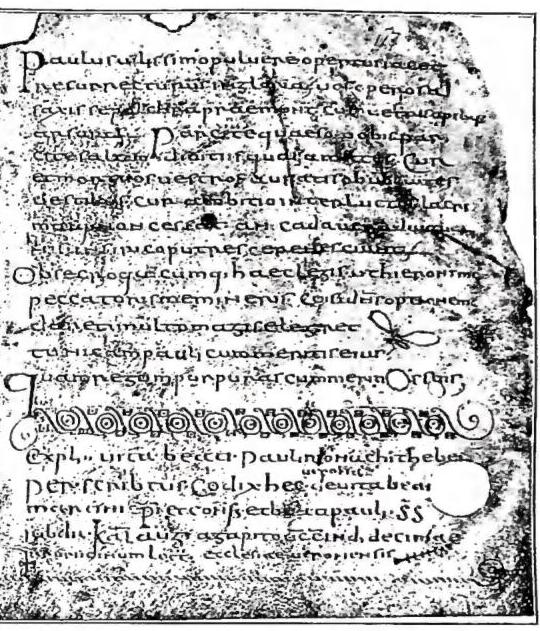
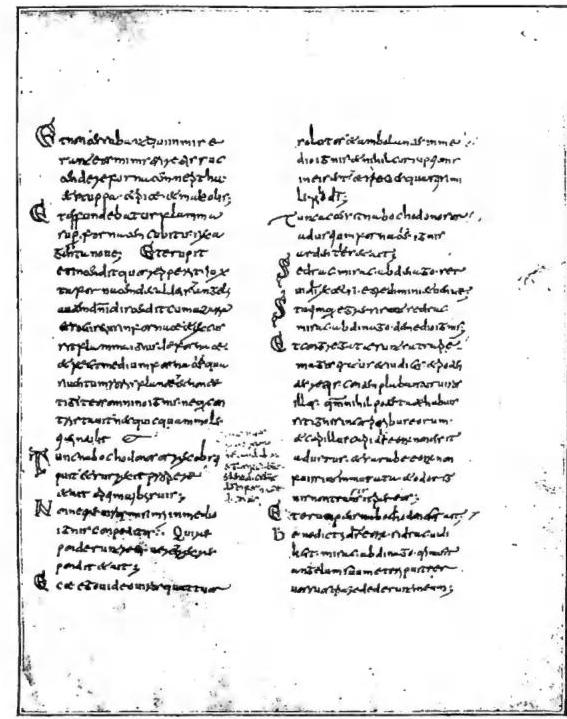
(from E. Carusi, W. M. Lindsay, Monumenti paleografici veronesi, I, Roma 1918, tav. 2)
VERONA, BIOCESI di — Expliciti del cap. 17 dei Dialoghi di Sulpicio Severo, con la sottoscrizione di Ursicino, Codice del 517, scritto a V. BIBLICA. capit., cod. XXXVIII (36), f. 117 f.
carved in marble the bas-reliefs of Genesis, attributed to Niccolò, and scenes from the life of Christ, attributed to Guglielmo (1138): a group of Romanesque sculptures among the most notable of the 12th century. The exterior walls of the Basilica consist of alternating courses of brick and dressed stone, characteristically Venetian; the interior, with three aisles divided by alternating columns and piers, its solemn and luminous central nave breathing deeply in space, echoes the basilical rhythm of Roman and Ravenna. Noteworthy are the Romanesque capitals of the columns, decorated with floral and animal motifs; the frescoes on the walls and piers; and, on the presbyterial tribune, the statues of Christ and the Apostles (13th century) and, in the left apsidiole, that of s. Zeno laughing (13th century). The sacristy (15th century) is also of considerable artistic interest, with its coffered ceiling, frieze, flowers, and roundels with Benedictine saints. The Basilica is magnificently framed by the Piazza and the churchyard, where a charitable festival is still celebrated, attended by the entire city and called «venerdì gnocolar», after the gnoccolo distributed on the Friday before Lent.
Within the city limits of V. there were two female monasteries: S. Maria in Solaro, founded in 774 by the two sisters Auteonda and Natalia, subject to S. Maria in Organo and to the patriarch of Aquileia; and S. Pietro «ad puellas» (780), later inhabited by Benedictine monks. A Benedictine monastery was attached to the church of SS. Fermo e Rustico (end of the 10th century); one of Vallombrosian monks to the church of S. Trinità
(from E. Cerusi, W. M. Lindsey, Monumenti paleografici veronesi, II, Città del Vaticano 1921, 35)
VERONA, DIOCESI di - Lectio Danielis prophatae. Codice del sec. VII scritto a V. capitolare, cod. XXXVII (35), f. 2317.
and other monasteries were attached to the churches of S. Giorgio in Braida (11th century), S. Nazaro (9th century), whose Benedictine abbot bore the title of abbot of Badia Calavena, and S. Eufemia (1275), belonging to the Augustinians.
In the territory of the diocese of V. S. Maria al Gazzo Veronese, dependent on S. Maria in Organo and, like it, subject to the patriarch of Aquileia. Founded in the 8th century and endowed by the Lombard kings Liutprand and Idebrand, it received privileges and donations from Ludovicus II, Berengar, and Otto II. The present Romanesque structure of the church, with good frescoes, restored and altered, stands on the primitive nucleus, of which various sculptures and fragments of the mosaic pavement survive (second half of the 8th century); it has been a parish since 1526.
To these should be added: the Benedictine monastery «ad Flexium» (early 9th century), that of S. Salvatore of Sirmione (8th century), united in the following century with S. Salvatore of Brescia; the hermitage of Benigno and Caro (late 8th century) at Malcesine, on Lake Garda; on the Rocca di Garda, the Camaldolese hermitage is still flourishing. The Veronese abbey of S. Maria della Vangadizza, founded in the first half of the 10th century by Ugo, marquis of Tuscany, and inhabited by Black Monks, received privileges and possessions from Berengario II and Adalberto, and later passed to the Camaldolese; since 1454 it has been a parish; another abbey of the same monks flourished at Vangadizza di Badia Polesine (Rovigo).
IV. SHRINES
In the diocese of V., the shrine of Madonna della Corona, on the slopes of Montebaldo, is much frequented. Its origins date back to the end of the twelfth century, as evidenced by the remains of a small church and frescoes; it passed (fifteenth century) under the jurisdiction of the Order of the Knights of Malta, and at that time the simulacrum of the Pietà, donated by Lodovico di Castelbarco in 1432, was venerated there; the present church, recently renovated and embellished, dates from the seventeenth century. The shrine of Madonna di Campagna, in the parish of S. Maria della Pace, was built by Sanmicheli in 1559, and in 1597 was occupied by the Camaldolese.In the immediate vicinity of Peschiera, near the small lake, the shrine of Madonna del Frassino (sixteenth century), with an adjoining hospice, stands in a very beautiful location. The minor basilica dedicated to S. Teresa del Bambino Gesù (Tombetta), in the parish of Tomba, a few kilometres from V., is likewise a frequent destination for pilgrimages.
IV. ART
In V. art. The most important monuments of the Roman period are: the amphitheatre of the Arena (1st cent. A.D.), which in the Middle and Modern Ages witnessed judicial duels, tournaments, and chivalric festivities; now restored, it is the venue of great mass spectacles. On the Via Postumia, half a kilometre from the Roman gate known in the Middle Ages as Borsari, stood the Arch of the Gavi (1st cent. A.D.), now reconstructed (1932) beside Castelvecchio; on the left bank of the Adige, on the slopes of the hill of S. Pietro, stands the theatre, one of the most remarkable and significant works of Roman civilization in northern Italy (1st cent. A.D.). In the ancient cloisters that house the Archaeological Museum on the hill of S. Pietro are preserved the remains of the prehistoric and Roman periods. The Maffeiano Museum, the oldest lapidary museum in Europe, established at the beginning of the 1700s on the initiative of Scipione Maffei, contains many sculptural monuments, architectural fragments, and Latin and Greek epigraphic documents from the Veneto and from other places, including locations outside Italy.The early Christian period is represented by the mosaics in the area of the Cathedral, the noteworthy remains of two basilicas of the 4th cent., one of which, larger and at a higher level, is to be assigned to S. Zeno; by a splendid example of a sarcophagus with a background depicting city walls (mid-4th cent.), and the strigilated sarcophagus (3rd cent.), reused by the Christians, remarkable artefacts housed in the crypt of S. Giovanni in Valle; in the Museum of Castelvecchio, by several gold-glass vessels (4th cent.), a small reliquary in the form of a tiny sarcophagus in the Ravenna style (6th cent.), and remains of the suspension elements of a Veronese «gabata» (lamp) (4th cent.); to these must be added mosaic fragments, ornamental sculptures, goldsmiths’ work, and iconographic rarities in the Chapter Library and in churches and museums (from the 6th to the 11th cent.); the church of S. Teuteria and Tosca, connected with the early Christian church now known as the Romanesque church of the SS. Apostoli, in its original cruciform symmetrical structure, recalls the mausoleum of Galla Placidia at Ravenna and may be dated to the second half of the 5th cent.; various alterations have partly changed its original appearance.
The Lombard, Carolingian, and Ottonian periods have left noteworthy traces in ornamental sculptures (capitals, plutei, the ciborium of S. Giorgio di Valpolicella, the bronze doors of S. Zeno) and in sacred buildings in V. and the province (S. Stefano, S. Giorgio di Valpolicella, S. Zeno di Bardolino, S. Benedetto di S. Zeno Maggiore, S. Giovanni in Ponte, S. Nazaro), as well as in the crypts and original structures of other churches, such as S. Giovanni in Foro, S. Maria in Organo, S. Procolo, and S. Giovanni in Valle.
Romanesque art, through a group of churches, lends V. a note of high spiritual and artistic value and of severe nobility. Typical are their gabled façades, built in courses of brick and tuff, which the centuries have gilded, divided by pilasters indicating the internal naves, some with stair towers (the church of S. Lorenzo) or a narthex (S. ma Trinità), all with hanging protyri (S. Giovanni in Valle, S. Maria Antica), decorated with little arches and bands fancifully carved with monsters and floral volutes. The interiors possess the fascination of mystical shadows and of the perspectival recession of the piers and columns which support, on cubic or figured capitals, the daring cross vaults and the tiburium (S. Stefano), or the roofs with trusses; they possess the mystery of deep crypts, the light of elevated presbyteries with ambulatories (S. Stefano), and the matronea (S. Lorenzo). Various houses and towers still reveal their Romanesque structure. Other Romanesque churches in the surrounding district rival those of the city in importance and architectural value and raise interesting questions of derivation and varied influences (such as S. Severo di Bardolino, S. Pietro in Valle, etc.).
The monuments in the Gothic style assert and fuse constructive elements of Romanesque workmanship and tradition, ever alive and operative in V., and are often enriched with Renaissance decorations; in the Cathedral, Gothic development makes use of the Romanesque structures (1139–87) of the lower part, of the protyri (by Niccolò), and of the imposing apse, with ambulatory, a masterpiece by the Sanmicheli, with Renaissance frescoes by Falconetto and paintings by Liberale, Giolfino, Morone, Caroto, and Titian (the Assumption). S. Fermo Maggiore, renovated in the 8th cent., rebuilt by the Benedictines (11th–12th cents.), and transformed by the Friars Minor (second half of the 13th cent.), displays a harmonious fusion of Romanesque and Gothic elements; S. Anastasia, to which the Dominican convent was attached (13th–14th cents.) and which now houses the classical Lyceum, recalls the church of SS. Giovanni e Paolo in Venice and the forms of Italian Gothic, especially in the interior; the Scaliger Tombs (14th cent.), unique of their kind, are the work of stonecutters from Campione. Other palaces and houses combine elements of Venetian Gothic with Renaissance elements. The great Veronese architect Michele Sanmicheli (1484–1559), through the monumental and elegant constructions of the Palazzi Pompei, Bevilacqua, and Canossa (which contains splendid frescoes by G. B. Tiepolo), the Pellegrini chapel in S. Bernardino, the church and bell tower of S. Giorgio and of the Cathedral, and the fortifications, walls, and gates with their solid classical structure, gave V. a distinctive Renaissance character, just as Vicenza received one from Palladio and Venice from Sansovino at the same period. Sanmicheli’s teaching continued in later architecture, apart from a few Baroque exceptions, and thus the classical tradition continued until the erection of the monumental cemetery in the Doric order (1830). Fra’ Giocondo created the utterly pure Loggia del Consiglio (late 15th cent.) in the Piazza dei Signori, where, above the cornice, Alberno da Milano sculpted the statues of the great Veronese figures of the Roman age: Catullus, Pliny, Emilio Macro, Vitruvius, and Cornelio Nepote. The characteristic and evocative Piazza Erbe, site of the ancient Forum, is adorned with Roman monuments (the statue of Madonna V.), Romanesque monuments (Torre Lamberti), Gothic monuments (the house of the Mercati, Torre del Gardello), Renaissance monuments (Casa Mazzanti and its frescoes), and Baroque monuments (Palazzo Maffei).
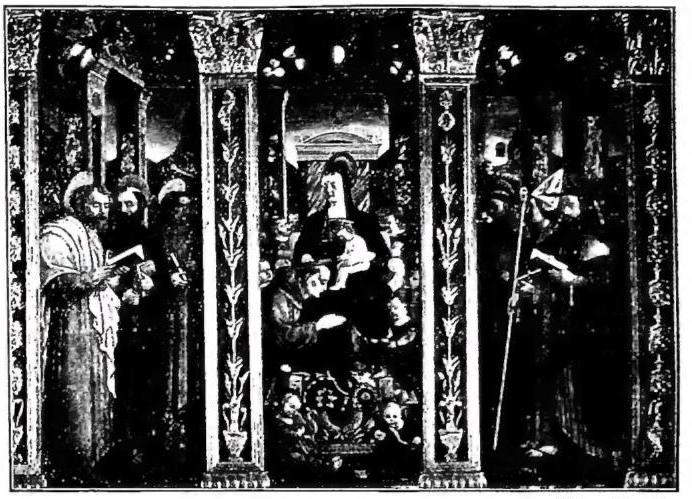
Veronese painting has examples dating from as early as the 10th cent. in the frescoes of the grotto of S. Nazaro, now in the church of S. Libera on the Colle S. Pietro; in the 13th cent. at S. Zeno Maggiore, where one may also admire the most remarkable cycles of sculpture from the 11th and 12th cents.; in the same Basilica, Mantegna’s triptych, with Madonna and saints.
Castelvecchio houses the Museum’s Picture Gallery, where the Veronese school of painting is amply represented from the 13th to the 18th cent. – See pls. CXXXII–CXXXIII.
scultura veronese dal sec. VIII al sec. XIII, Milano 1943; P. Gazzola, Il musaico nel sottosuolo della Bibliot. capit. di V., in Studi stor. veron., 1948; P. L. Zovatto, Antichità cristiane di V., Verona 1950. Per l'abbazia di S. Zeno; C. Cipolla, Annales Veron. antiqui, in Boll. Ist. Stor. Ital., 29 (1908), p. 7 8gg.; L. Simeoni, La basil. di S. Zeno in V., Verona 1909; A. Boelder, Die Bronzetür von V., Marburgo 1931; G. De Francovich, La corrente comasca nella scultura romanica europea, in Rivista R. Ist. d'arch. e st. dell'arte, 5 (1937); G. Trecca, La facciata della basil. di S. Zeno, Verona 1938; A. Da Lisca, La basil. di S. Zenone in V., ivi 1941. Per le abbazie: Cottineau, II, coll. 3342-46.
Paolo Lino Zovatto
V. BIBLIOTECA CAPITOLARE
Founded in the 5th century through the work of the «Schola sacerdotum sanctae Veronensis Ecclesiae», it drew the holdings of its codices chiefly from the production of its own scriptorium, for liturgical service in the Cathedral and for the individual study of the members of the Chapter, the teachers, and the pupils of the schools attached to the Cathedral itself. The oldest scribe of the scriptorium to have recorded his name and the date is Ursicino, «reader of the Veronese Church», in the year 517. The greatest impetus was given to the Library in the 9th century by the archdeacon Pacifico (776–844), and by many clerics under his direction.The capitular Library of V., known as «the queen of ecclesiastical collections», is particularly renowned for the richness and exceptional importance of its manuscripts. The Veronese codices, beginning with the 5th century, represent, in groups of varying size but always of note, each of the subsequent centuries, especially the early Middle Ages. The following deserve particular mention: 1) the «Gato» (5th century, palimpsest), a famous unique codex and an eminent source for the study of Roman law; 2) the «s. Agostino» (De Civitate Dei: 5th century), probably written while the holy Doctor was still alive; 3) and 4) «s. Ilario» (In Psalmos and De Trinitate: both 5th century); 5) Evangelario purpureo (5th century), one of the most important biblical manuscripts of the Vetus latina, known among scholars by the designation Cod. b. Veron., written in silver and gold on exceptionally fine purple parchment; 6) La Didacalia Apostolorum (5th century, palimpsest); 7) Il Sulpicio Severo (517), written by the aforementioned Ursicino; 8) Il Psalterium bilingue, Greek-Latin (6th century); 9) Il Sacramentarium Leonianum (6th century), a liturgical codex of exceptional importance. The manuscripts of the 9th century are particularly numerous, including several autograph works by the archdeacon Pacifico. Other especially precious autographs include two manuscripts of S. Lorenzo Giustiniani (15th century), two of Girolamo Fracastoro (16th century), and all those of Scipione Maffei and Francesco Bianchini (18th century). Miniatures and bindings of special distinction include two codices of Mattia Corvino, king of Hungary (15th century); the illuminated Choir Books by Turone, a Veronese painter of the 14th century; a lectionary of Holy Scripture (15th century) by a Flemish artist; and a «Candido Decembrio» (15th century) by a Lombard illuminator. Almost all the manuscripts dating from before the 10th century, together with several documents from the Archive, were restored at the Vatican Library through the generosity and munificence of Leone XIII, Pio X, Benedetto XV, and Pio XI. The printed bibliographical holdings are likewise outstanding in quality and quantity, including a good number of precious incunabula, among them a few «unicum» and quite a number of very rare works. Also noteworthy are the sumptuousness and artistic beauty of the premises, rebuilt—following the bombing of 4 January 1945, which completely destroyed them—in accordance with the most careful measures for the securest custody, best preservation, and most worthy presentation of the bibliographical, documentary, archaeological, and artistic materials. The new chapel is also worthy of note, entirely frescoed by Elena Gazzola Schiavi with episodes from the life of the archdeacon Pacifico.
VI. CATHEDRAL ARCHIVE
The same Library also houses the Archive of the canons, comprising approximately 11,000 parchment documents and countless paper ones. The former begin with seven parchments from the eighth century, the oldest dating from 710; the latter with notarial registers from the beginning of the fourteenth century. The parchment documents are preserved in folders arranged in chronological order.
VERONICA – S. V., dressed in mourning, supports the Holy Face. Illumination from the Book of Hours made for Luigi di Laval (ca. 1480) – Paris, National Library, ms. lat. 920, f. 296v.