
VERONICA. — An appellation given, by metonymy, to the icon bearing the “Holy Face” of Christ, preserved among the greater relics of the basilica of S. Pietro in Vaticano. V. (from Βερνίκη, Βερονίκη, Beronica, and not from vera eicon) is the name given by the Apocrypha of Pilate to the woman with the issue of blood healed by Jesus (Mt. 9:20–22; Mk. 5:25–34; Lk. 8:43–48), owner of the “Holy Face,” and the byname of Marta, identified with the aforesaid woman with the issue of blood following the example of pseudo-Ambrose (PL 17, 721) and others, as one reads in the Otia imperialia of Gervasio di Tilbury: « propter diutinam passionem fluxus carnalis in poplitis vena incurvata, unde Veronica dicta est » (III, 25: Dobschütz, op. cit. in bibl., p. 292*).
I. V. « VOLTO SANTO ». — The first references to the presence of the V. S. Pietro are found between the end of the 10th century and the beginning of the 11th. From that time the V. altar, placed before the oratory of the Virgin built by Giovanni VII (705–707) at the beginning of the last small nave on the right of the Vatican Basilica. This oratory, destroyed in 1606 together with the ciborium for the V. erected by Celestino III in 1197, is called by the monk Benedetto di S. Andrea (v.) « a Veronice » (Chronicon, ed. G. Zucchetti, Roma 1920, p. 41), and the abbot Giovanni, in a document of 18 February 1018, adds to his signature the designation of mansionarius « S. Marie in Beronica » (cf. L. Schiaparelli, Le carte antiche dell’Arch. cap. di S. Pietro in Vat., in Archiv. della R. Soc. Rom. di St. Patria, 24 [1901], pp. 450–53).
Stylistically, insofar as one may judge from the medieval and modern copies still extant, which differ considerably from one another (the original has not yet been studied directly), the V. is related to the icons reproducing the face of Christ whose prototype must be sought in the celebrated
μανδύλιον of Edessa, transported to Constantinople in 944 (v. ACHEROPITA). The V., however, in comparison, for example, with the S.Laon (v.) and the S. Volto of Genova, transported in the 14th century from Constantinople and still preserved in S. Bartolomeo degli Armeni, has a more realistic and pathetic appearance (see also the Holy Faces reproduced in vols. II, pl. 32; IV, 971, Christ with V. in the penultimate panel on the left [beginning of the 14th century]; VI, 1539; X, pl. 92; XI, pl. 42, XII, pl. 53).
Popular tradition naturally attributes another origin to the V. Roma. The veil of V. bearing the face of Christ is mentioned in antiquity by the group of the Apocrypha of Pilate (v. 2nd, 4th–8th centuries). First of all, the Acta Pilati call Bernice or Beronice (Greek text), or V. (Latin, Coptic, and Syriac text), the woman with the issue of blood healed by Jesus (chap. VII: ed. C. V. Tischendorf, Evangelia apocrypha, 2nd ed., Lipsia 1876, pp. 239, 356; P. Vannutelli, Actorum Pilati textus synoptici, Roma 1938, pp. 74–75; Hypomnemata Domini nostri seu Acta Pilati, Syriac version, ed. J. E. R. hmâni, Šarfah [Mount Lebanon] 1908, p. 18). Now the Vindicta Salvatoris places the pious V. Christ, which Velosiano has forcibly confiscated in order to take it to Tiberius; the latter is cured of leprosy as soon as he sees it and adores II. V. abandons everything in Palestine and follows her relic to Roma (Tischendorf, op. cit., pp. 478–85; cf. also the Cura sanitatis Tiberii, in St. Baluzius, Miscellanea edited by J. D. Mansi, IV, Lucca 1764, p. 56). The Mora Pilati specifies how V. came into possession of the portrait of Christ: the pious woman wished to have Christ’s features portrayed; when he learned of this, he asked her for the veil on which the artist was to work and left his features imprinted upon II. Volusiano, less cruel than the Velosiano of the Vindicta, has her brought to Roma and there presents her to Tiberius, who is cured as soon as he sees the Holy Face (Tischendorf, op. cit., pp. 456–57).
Other versions concerning the manner in which Christ is said to have impressed his face upon V.’s veil are found in the late Middle Ages. Around the middle of the 12th century, MANILIO (v.)
(from a photostatic edition edited by Ch. Hülsen, Berlin 1955)
VERONICA - Ostensione della V. S. Pietro. Incisione inserita nei Mirabilia Romae, Roma, per i tipi di Stefano Pianck, 20 nov. 1489.
attesta, sulla fede dei maggiori, che il Salvatore avrebbe impresso il suo volto sul sudario conservato in S. Pietro «quando sudor eius factus est sicut guttae sanguinis decurrentis in terram», cioè durante l'agonis al Giardino degli Ulivi (Descriptio Bas. Vaticanae, ed. R. Valentini-G. Zucchetti, Cod. top. della città di Roma, III, Roma 1946, p. 420; cf. anche Pietro Diacono di Montecassino, cit. in Dobschütz, p. 283). Dal sec. xiv in poi, per influsso di Ruggero d'Argenteuil (ca. 1300, Bible en françois o Storia sacra: Dobschütz, p. 304), e soprattutto delle grandi Posizioni francesi del sec. xv (Mercadè, Grèban, Jean Michel) e del pio esercizio francescano della Via Crucis ([v.] VI Stazione; cf. D. Baldi, Enchiridion locorum sanctorum, Gerusalemme 1935, pp. 762, 764-65, 769, 779, 780-81), cominciò a divulgarsi l'opinione che l'impressione del Sacro Volto della V. Calvario, quando una donna con gesto coraggioso e pietoso avrebbe asciugato il volto del Salvatore madido di sangue e di sudore, gesto che in arte non viene difatti raffigurato prima del sec. xiv (cf. E. Mâle, L'art religieux de la fin du m. â. en France, 4ª ed., Parigi 1931, p. 64). Infine, la 3ª lezione del II Notturno della festa di s. V. nel Breviario Ambrosiano del 1513 spiega come la Chiesa Romana sia venuta in possesso del prezioso cimello: la V. l'avrebbe lasciato per testamento al papa s. Clemente I. Inoltre il Grimaldi (cit. in bibl., p. 6) precisa che la V. sarebbe stata portata a Roma l'anno 34 (p. 2).
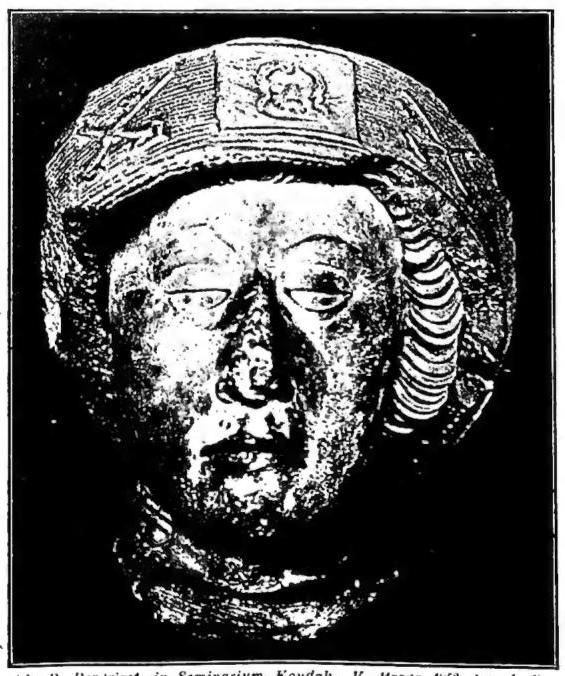
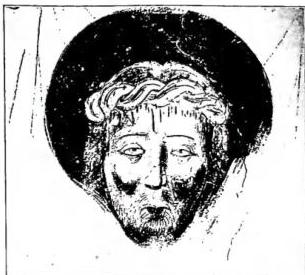
VERONICA – Badge bearing the V. Holy Face, affixed to a pilgrim’s cap. Stone head from the beginning of the fifteenth century, preserved in the Museum of Evreux.
(from Guide des monuments visités par les membres du XIIIe Congrès International d'histoire de l'Art, Stockholm 1932, fig. 20)
VERONICA - La V. o Volto Santo riprodotto in una volta della chiesa di Hårnevi (Svezia), pittura a tempera, attribuita ad «Albertus Pictor» (1480 ca).
1208, stabilisce che l'«effigies Christi» venga trasportata con solennità, la 1ª dom. dopo l'Ottava dell'Epifania, nell'Ospedale di S. Spirito (Potthast, 3260), uso durato sino al pontificato di Clemente V (1305-14); Niccolò IV, il 25 febbr. 1289, rinnovando le indulgenze per quelli che visitavano S. Pietro, ricorda espressamente la «pretiosissimi Vultus Domini imaginem, quam Veronicam fidelium vox communis appellat» (Potthast, 22890). Dello straordinario entusiasmo che si ebbe per la V. nel tardo medioevo basti ricordare alcune testimonianze del sec. xiv: G. Villani per il Giubileo del 1300 (Hist. Fiorentine, VIII, 36, in RIS, XIII [1728], col. 367), Dante (Paradiso, XXXI, 103-109 [la V. nostra]); Vita Nova, 40, 1), Petrarca (lettera a Filippo di Vitry del 1350: Familiarium rerum lib., IX, 13: ed. V. Rossi, II, Firenze 1934, p. 254, e il sonetto Movesi il vecchierel: Le rime, ed. G. Salvo Cozzo, Firenze 1904, pp. 11-12) e M. Villani (Istorie, I, 56, in RIS, XIV [1729], col. 57) per il Giubileo del 1350. I pellegrini a ricordo della visita a Roma portavano sul loro capricapo un distintivo quadrato con la V. (v. es. in G. Kaftal, Iconography of the Saints in Tuscan Painting, Firenze 1952, coll. 515, 895). Giova ricordare che Cincio Romano (L. Bertalot, Cincius Romanus u. seine Briefe, in Quellen u. Forschungen aus italienischen Archiven u. Bibliotheken, 31 [1929-30], p. 224) si lamentava nel 1416 della caccia data ai codici nelle biblioteche dell'Urbe da coloro che allestivano tali distintivi, chiamati da altri «pictores veronicarum». Tra le prose medievali in onore del S. Volto (cf. U. Chevalier, Repertorium hymnologicum, VI, Bruxelles 1920, p. 33, indice, s. V. CRISTO), le più note erano l'Ave facies praeclara del tempo di Innocenzo IV (1243-1254) e soprattutto la Salve sancta facies, attribuita a Giovanni XXII (1316-34), il quale avrebbe concesso 10 mila giorni d'indulgenza a chi la recitava guardando la V. (Grimaldi, p. 121). I Mirabilia Romae (manoscritti o stampati, si cita l'ed. di Roma per i tipi di Stefano Planck, 11 genn. 1499, esemplare della Bibl. Vaticana) ricordano addirittura che i presenti all'ostensione della V. potevano lucrare 3 mila anni d'indulgenza se Romani, 6 mila se dei dintorni, 12 mila se provenienti da più lontano «et tot quadragenas et remissionem tertie partis omnium peccatorum».
Fu la V. Roma, come lasciano supporre due lettere alla duchessa d'Urbino di un certo messer Urbano, scritte da Orvieto e da Nepi, il 14 e 21 maggio 1527 (M. Sanuto, I Diarii, XLV, Venezia 1896, coll. 133, 192) e la lettera del card. Salviati dell'8 giugno 1527 (Pastor, IV, II, p. 725)? Non sembra, poiché la relazione di un soldato del Fronsberg dice che
la V. non fu trovata dalla soldataglia (cf. E. Rodocanachi, Rome au temps de Jules II et de Léon X, Parigi 1912, p. 432). D'altronde l'antico rito di mostrarla al Papa quando celebrava pontificalmente in S. Pietro il giorno di Pasqua, fu osservato dopo il sacco di Roma, nel 1533, 1535 e 1536, come risulta dai Diari di Blasio de Martinelli (cod. Vat. lat. 12277, foll. 182, 239, 248). Inoltre l'Alfarano nel 1582 (De bas. Vat. antiquis. et nova structura, ed. M. Cerrati, Roma 1914, pp. 107, 194, altare n. 115), e il Grimaldi nel 1618 (p. 174) parlano della V. Basilica.
La V. fu trasportata nell'odierna tribuna della cupola il 21 maggio 1606 (Grimaldi, pp. 210-14) ed è racchiusa in tre teche d'argento protetta da un cristallo e da un velo o «crivellotto». Le fattezze del S. Volto si distinguono, a quanto pare, pochissimo. Dal pontificato di Paolo V e soprattutto di Urbano VIII è proibito levarne copia, anzi Urbano VIII ordinò, nel 1629, che tutte le copie della V. venissero bruciate. Tra le copie non distrutte è da ricordare quella tuttora conservata nella chiesa del Gesù, ritratta sull'originale con permesso di Gregorio XV (1621-23).
La V. viene mostrata ai fedeli dall'alto della tribuna la 2ª domenica dopo l'Epifania, i 4 ultimi giorni della Settimana Santa, a Pasqua quando il papa celebra in S. Pietro, il lunedì di Pasqua, il lunedì di Pentecoste, il 22 febbr., 3 maggio, 18 nov. e in altre straordinarie circostanze (cf. X. Barbier de Montault, cit. in bibl., II, pp. 377, 393-94).
II. CULTO TRIBUTATO ALLA V. «PERSONA». - La V., supposta persona, ebbe qua e la culto al 4 febbr. (s. Carlo Borromeo soppresse questa festa, che figurava nel Breviario [1513] e nel Messale [1560] ambrosiani), 26 febbr., 25 marzo. A S. Pietro si credeva possederne il corpo (cf. Alfarano, op. cit., pp. 108, 194). In Francia, è stata considerata cervellotticamente, assieme al marito Zaccheo il pubblicano (identificato con s. Amatore, Amadour), l'apostola del Médoc e si additava la sua tomba a Soulae in diocesi di Bordeaux. A Parigi, s. V. (Ste Venisse) era la patrona della confraternita delle lavandaie e stiratrici, con sede in S. Eustachio. Era invocata contro i mali viscerali e di testa ed è la patrona dei fotografi. - Vedi tav. CXXXIV.
A. Pietro Frutaz