ACHEIROPOIETA (from Ἀχειροποίητος, literally «Not Made by Hand [Human]», and in proper sense «True Image of Christ»). - Even antiquity believed that the simulacra of Pallas at Athens and Troy and that of Artemis at Ephesus had fallen from heaven, sent by Jupiter (Ἀναστέλ).
Among the Christian a. of the early Middle Ages the most famous are two images of Christ: that of Edessa and that of Kamulia in Cappadocia. Today they no longer exist, but the effigy of the suffering Christ, which they reproduced with beard and long hair, can be reconstructed from the many copies that the early Middle Ages has transmitted to us and that are now preserved: the oldest at Laon, Rome, Genoa and the most recent in Russia.
The history of the a. of Edessa is obscure. The oldest document that speaks of it is the letter reproduced many times, with which Christ would have accompanied his own portrait sent to King Abgar Ukkämä. Eusebius of Caesarea (Historia ecl., I, 13) asserts that the letter derives from an ancient Syriac text from the archive of Edessa, containing Christ's promise to visit the king to heal him.
In a later text there is talk for the first time of the icon as the work of the painter Ananias; it is then from around 600 the report according to which in the year 544, by the help of the icon itself, the attack of the Persians against Edessa would have been repelled. A legend rich in details, falsely attributed to Constantine Porphyrogenitus, appears in 944: in it the a. of Edessa is defined, following what Evagrius had already said, as the imprint left by Christ's face on a cloth; it would then have remained walled up, from the time of Abgar until 544, above the gate of the city. The legend alludes to two other miraculous imprints, impressed on bricks, one of which was kept at Hierapolis and the other at Edessa; in the dispute between Nestorians and Monophysites there is talk of two other copies that were to be found in the churches of Edessa.
Apparently, in the year 944 the icon of Edessa was brought to Constantinople, probably with the aforementioned letter of Christ to King Abgar and with the copy on brick called Keramidon, which was placed in the chapel of the imperial palace. In 1247 these relics passed to the West and it may be that the a. that disappeared from the Sainte-Chapelle of Paris during the revolution of 1792 had a direct connection with them.
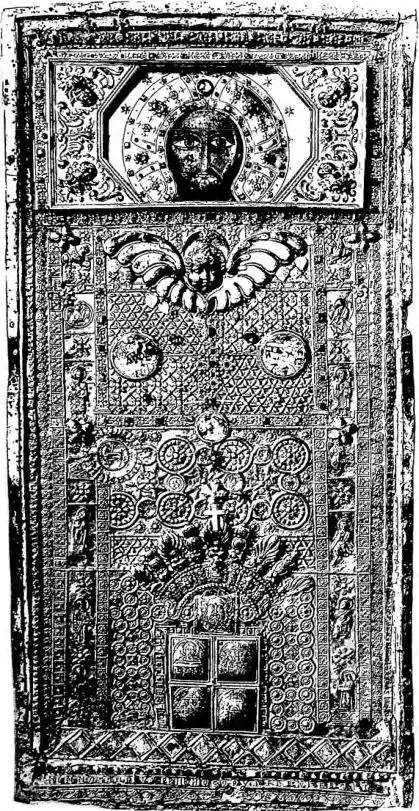
Other icons too were identified with the mandylion of Constantinople; among these the panel preserved in Rome in S. Silvestro in Capite and brought by Pius X to the Vatican, and that of S. Bartolomeo degli Armeni in Genoa. But both are Oriental works, which, as their inscription in the Slavic language testifies, prove to be later than the panel of Laon, painted not before the 12th century and perhaps sent from Rome to Montreuil-les-Dames in 1249. They all repeat the type of the a. of Edessa.
Between 560 and 574 occurs the first mention of the a. of Somulia. It is painted on linen and represents Christ as "Pantokrator." It is told that, found by a pagan woman in a fountain, by its own power it reproduced itself on her garment, which was then sent to Caesarea. A second copy is found at Diobulion.
The a. kamuliana was translated in 574 to Constantinople, where it would have reproduced itself miraculously on a cloth, later donated to a convent of Melitene. The original of Constantinople, considered as the palladium of the city, disappeared around 800. Antonio da Piacenza says he saw the a. at Memphis, in Egypt, on a "pallium lineum."
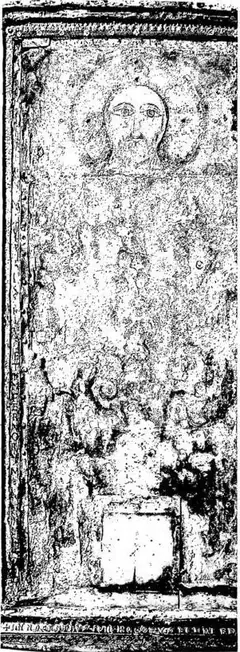
Also the Pantokrator of the Sancta Sanctorum in Rome was believed in the Middle Ages to be an a. The panel, which is very damaged and depicts Christ enthroned, seems to have been painted in Rome between the 5th and 6th century. The head already in the early Middle Ages was replaced by another painted on canvas, an imitation of the Veronica of St. Peter's.
This icon was much venerated already in the 8th century. In 752 it was carried in procession by Stephen II; and from then began the custom that in the solemn procession of 15 Aug. the Pope would carry it in visit to S. Maria Maggiore. As the practice of this procession spread throughout Latium, almost all the cities of the region, such as Velletri, Tivoli, Tarquinia, Sutri, procured a copy of this a.
Of the Veronica of St. Peter's in Rome there is certain notice already in the 9th century; kept at first in the chapel of John VII, today it is in the pier of the Vatican Basilica, called for that very reason that of the Veronica. Faithful to the oldest reproductions, this a. too shows the face of the bearded Christ, with long hair and a suffering appearance. The original came without doubt from the East and perhaps stylistically recalled the icon of Edessa.
The tradition of St. Veronica, whose name some scholars believe is a derivation from versi icone, is influenced by that of King Abgar. Around 1300 Roger of Argenteuil recounts that St. Veronica took the effigy of Christ, wiping his face during the journey to Calvary; accordingly the sudarium was called simply Veronica. During the Middle Ages it was reproduced so frequently as to give rise to a kind of craft among painters (the "pictores Veronicarum"); it was carried throughout the world by pilgrims who gained indulgences from it.
The history of the Holy Shroud (v.) recalls that of the sudarium of Rome, but refers to the imprint left by the entire body of Jesus. Already in the 7th century we find traces of the cult paid to the Holy Shroud and in the early Middle Ages there is talk of several examples of the relic existing at Constantinople, at Compiègne, at Caen. Today by Holy Shroud is meant that which is preserved in the cathedral of Turin. It shows the body of the Lord from the facial side and from the dorsal side. The imprint is 1.78 m long; the sheet has an overall size of 4.36 × 1.10 m.
The relic was kept from 1353 to 1478 at Sirey in Champagne and then, until 1578, at Chambéry, whence it came to Turin, with the Dukes of Savoy. Current studies on the Holy Shroud tend to identify it with the one that disappeared from Constantinople.
Some a. of the Madonna were venerated from the 7th century onward. In the 8th century an icon is remembered at Diospolis in Palestine; about its origin there circulates a double version: one affirms that the image would have been produced by the Virgin's contact with a column, the other presents it as miraculously determined solely by the will of the Madonna herself. Other a. of the Madonna are preserved at Constantinople, in Rome (S. Maria in Trastevere) and in various churches of southern Italy.
Among the a. of saints one of the most venerated is that of St. George which is preserved in his church near Diospolis-Lydda in Palestine; it is told that it was produced on the column at the contact of the saint when he was bound there for the flagellation. - See Pl. XVI.