
ANANIA (gr. Ἁνανίας, from the Heb. Ḥananjāh 'Jahweh has shown mercy'). - Various personages of the Old and New Testaments.
I. OLD TESTAMENT
1) Fictitious father of the angel Raphael (v.), who calls him "the great one", presenting himself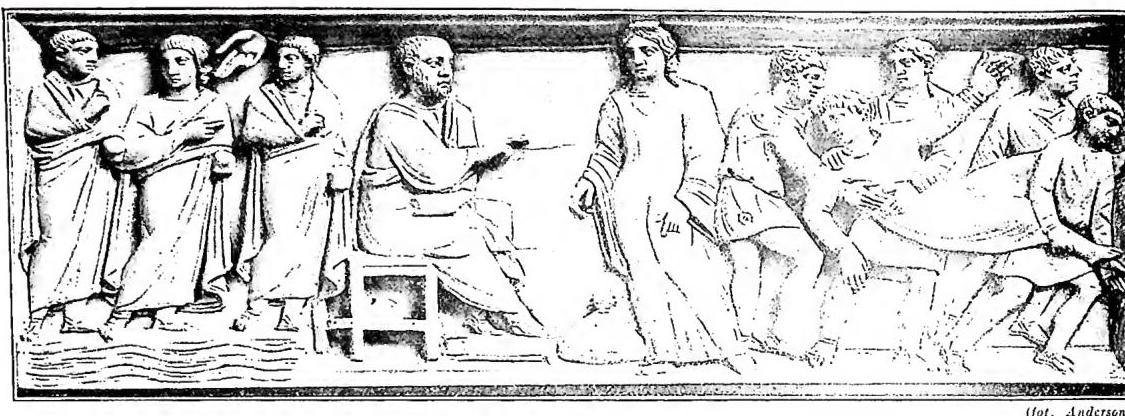
2) False prophet (Vulgate: Hananias) of Gibeon, opponent of Jeremiah who exposed his illusory prediction of the Babylonian collapse; d. two months later, in the 7th month of the 4th year (594 B.C.) of Zedekiah (Jer. 28).
3) One of the three youths of the tribe of Judah and of royal lineage, deported with Daniel to Babylon. At Nebuchadnezzar's court his name was changed to Shadrach (Heb. Sadhrakh). Azariah (v.) and Mishael to worship the statue of the king erected at Dura, he was thrown with them into a fiery furnace. After prayers and admirable hymns to the Creator, the three emerged unharmed. Nebuchadnezzar, marveling at the miracle, confirmed them in the governance of the province of Babylon (Dan. 1, 6-20; 3, 1-97). Mattathias, on his deathbed, would recall their heroic observance of the divine law (I Macc. 2, 59).
4) Levite, firstborn of the Korahite Shallum; he was a maker of sacred perfumes (I Chron. 9, 31). A descendant of his of the same name, returned from the Babylonian exile, oversaw the restoration of a section of the walls of Jerusalem (Neh. 3, 8, 23).
5) Head of the birâh (citadel) of Jerusalem (Neh. 7, 2; Vulgate: Hananias), of singular virtues, who together with Hanani brother of Nehemiah was appointed by the latter to guard the city. A few decades later, a Hânanjâh, perhaps a high official of the Persian court, communicated to the priest Jedonjâh that Darius II had prescribed the Feast of Unleavened Bread at Elephantine (Elephantine Papyrus 21, ed. Cowley), and arrived there in the same year, 419 B.C.
II. NEW TESTAMENT
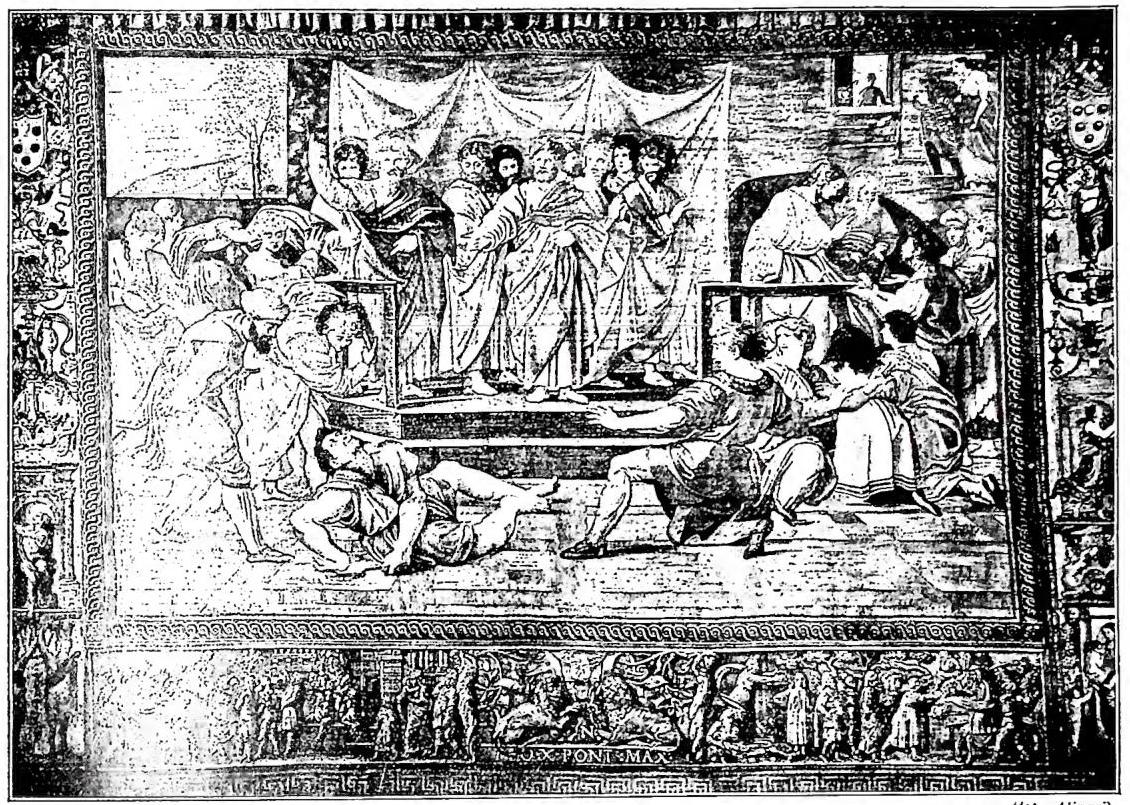
1) A Christian of the early community of Jerusalem, husband of Sapphira, with whom he was condemned and struck dead by St. Peter, as a terrible example, for having deceived the Apostle by defrauding the "brethren". Along with his wife, A. defrauded the Church by keeping back part of the proceeds from the sale of a field, while asserting instead ("seduced by Satan and lying to the Holy Spirit") that he was handing it all over (Act. 5, 1-11). On the representations of A. and Sapphira in Christian art, see below.2) A Christian of Damascus, a Jew by birth, highly esteemed by all; following a vision he went to find Saul in the house of Judah on the "Straight Street", restored his sight by laying his hands on him, and baptized him, proclaiming to him the apostolic mission to which he was chosen by God (Act. 9, 10-18; 22, 12-16).
According to E. P. Le Camus (L'œuvre des Apôtres, I, Paris 1891, p. 342), he is supposedly identical to the Jewish propagandist (Christian, according to Orosius, VII, 6) who converted Izates, son of Monobazus king of Adiabene (Flavius Josephus, Antiq. Iud., XX, 2, 4). According to the Constit. Apostolorum, VIII, 46, 17 (ed. F. X. Funk, I, Tübingen 1905, p. 563) he was a layman; Oecumenius (In Act. 9, 10; PG 118, 170) calls him a deacon; St. Augustine considers him a priest. A Byzantine tradition counts him among the 72 disciples and considers him the first bishop of Damascus and martyr (Simeon Metaphrastes: PG 114, 1101-10).
An underground chapel (at the Roman level of Damascus) near the East Gate (Bâb el-Sâql), held by the Franciscans since 1820 (destroyed in the massacre of 1860, rebuilt in 1867), has been venerated for centuries by Christians and Muslims as the dwelling of St. A.; it was part of a vanished Byzantine basilica, whose foundations emerge. E. de Lorey explored (1920 ff.) the "house of A." The Greeks celebrate his feast on Oct. 1, the Latins on Jan. 25 (Acta SS. Ianuarii, III, Paris 1863, p. 227 sq.).
3) Jewish high priest, son of Nebedaeus, successor of Joseph son of Camithus; appointed by Herod of Chalcis in 47, he remained in office until 59. He belonged to the family of Annas (v.) or Hanan, and was known for his wealth and gluttony. In 52 he was sent to Rome by the legate of Syria Quadratus to account to Claudius for his conduct during the struggles between the Samaritans—supported by the procurator of Judea Cumanus and his tribune Celer—and the Jews. Through the good offices of Agrippa II and Agrippina, he returned acquitted to the triumph of the Jews. He presided over the Sanhedrin assembled after the arrest of St. Paul, to accuse him, and had him struck on the mouth as soon as the Apostle began his defense; Paul cursed him and called him a "whitewashed wall"; but, upon the rebuke of those present, he added that he did not know he was the high priest. Shortly thereafter he went with the priests and other Jews to accuse Paul before the procurator Felix (Act. 23, 2-6; 24, 1-9).
Even after being deposed, owing to his wealth and the favor of the Roman procurators Albinus and Gessius Florus (62-66), he exerted great influence in Jerusalem, although of ill repute for his greed. He was assassinated in 66, as a friend of the Romans, by the sicarii led by his son Eleazar, at the beginning of the Jewish revolt (Flavius Josephus, Antiq. Iud., XX, 5, 2; 6, 2; 9, 2; Bell. Iud., II, 12, 6; 17, 6, 9).
4) Another high priest A., son of Masbalus,
5) A. son of Sadoc, was among the early instigators of the Jewish revolt of 66. He was sent by the leader of the insurgents, Eleazar, to the commander of the Roman garrison, Metilius, whom he promised safe conduct if he evacuated Jerusalem with his troops; however, the soldiers were slaughtered and Metilius was circumcised. Eleazar also sent him as his envoy to the Idumeans to ask for help against Ananus II (v. II), whom he accused of wanting to surrender the city to the Romans (Flavio Giuseppe, Bell. Iud., II, 17, 10; IV, 4, 1).
Antonino Romeo
III. A. AND SAPPHIRA IN CHRISTIAN ARCHAEOLOGY. - The passage in Act. 5, 1-10 is documented in Christian sculpture only in the final decades of the 4th century. It has been possible to identify it on a fragment of a sarcophagus in Avignon and probably on another in the cemetery of S. Callisto, by means of the well-preserved scene on the back panel of the Brescia lipsanotheca. There, the two phases of the event are united in a single panel: on the left, s. Pietro sits questioning Sapphira; between them, on the ground, is the bag of money; on the right, some young men carry away the corpse of A. It is likely that the motif has a doxological character.
ANANIENSIS (ANAUNIENSIS), Giovenale Ruffini di Nonsberg: V. GIOVENALE di VAL DI NON.