
TOBIA. – A pious Jew who gives his name to the deuterocanonical book of the Old Testament that recounts his story. In the Vulgate the title is Liber Tobiae; in the ancient Greek manuscripts Τοβίτ (or Τωβίτ), and in the more recent ones Βίβλος λόγων Τωβίτ, together with the genealogy, homeland, and deportation of T. In the Vulgate the father and son are both called Tobias; in Greek, on the other hand, Τωβίας is only the son, whereas the father is called Tobit, a form derived from a Hebrew name whose abbreviated form must have been Τόβιτ and whose complete form Τόβιβήλ (Ecd. 3, 60) or Τόβιβήλ (II Par. 17, 8) = “Jahweh is good.” Tob. recounts the trial of the just man, whom God providentially raises up and consoles. It unfolds in three parts coordinated into a harmonious whole.
1. Virtue and afflictions (1,1–3,17 [S]; 1,1–3,23 [Vulg.]). Tobit is an Israelite of the tribe of Nephthali, deported under Salmanasar to Ninive, where he remains constant in the observance of the Law, as he had been in his homeland. He marries Anna and has a son called T.; he conducts business, protected by the Assyrian king (1, 9–15). Faithful to God and to his countrymen even during the persecution that the new king Sennacherib unleashes against the Israelites, Tobit buries their corpses (1, 16–19); he is therefore sought for execution and stripped of everything. After the tyrant is killed by his own sons, Tobit returns to his house and recovers his possessions (1, 20–23). Having returned exhausted from burying the abandoned corpses, while he is sleeping at the foot of the wall of his house, bird droppings fall into his eyes from a nest; improperly treated by physicians, Tobit becomes blind. Afflicted by the taunts of his friends and wife, as though his works of piety had been useless (2, 1–14), he addresses a sorrowful prayer to God (3,1–6). At the same time, Sara, daughter of Raguel, in Ecbatana of Media, having been married seven times and seven times widowed through the death of her husbands on the very day of the wedding, and distressed by the insults of one of her maidservants, also turns to God (3, 7–15). God hears their prayers (3, 15 ff.).
2. God’s providential intervention, by which he sends the angel Raphael (v. RAFFAELE) to their aid (4,1–12, 22 [S]; 3,24–12,22 [Vulg.]). Tobit sends his son T. to Media to collect a sum of money from Gabael (v. GABELO), his kinsman (4,1–5,3). The angel Raphael offers himself to T. as a traveling companion and guide, appearing in human form and concealing his true identity, and departs with him (5, 4–22). On the evening of the first day they reach the Tigris; T. approaches the waters to wash his feet and is threatened by a large fish; at the Angel’s command he seizes it, guts it, and preserves its heart, liver, and gall for use as possible remedies (6, 1–9). At Ecbatana, the Angel persuades T. to lodge with Raguel, his kinsman, and to ask him for Sara in marriage; he teaches Asmodeus (v.), who had killed Sara’s first seven husbands: he must burn the heart and liver of the fish, and before consummating the marriage the bride and groom must keep vigil and pray (6,10–7,8). To everyone’s satisfaction, the marriage is concluded (7,9–8,19): T. remains for two weeks with his father-in-law, while Raphael goes to collect the money from Gabael (8,20–9,6). Tobit and his wife anxiously await their son’s return (10, 1–7); T., having taken leave of his father-in-law, returns to Ninive with his bride; he goes ahead of the others and runs to embrace his father, applies the fish’s gall to his eyes, and restores his sight, to everyone’s great joy (10,8–11,17). Raphael reveals his true identity and disappears (chap. 12). Tobit bursts into a hymn of thanksgiving (chap. 13).
3. Epilogue. As death approaches, Tobit gives his final instructions to his son T. and dies. After his mother also dies, T. emigrates to Media to live with his father-in-law and dies at an advanced age, after hearing the announcement of the fall of Ninive (chap. 14).
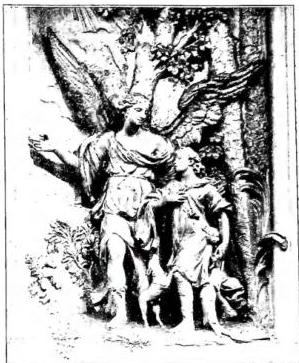
TOBIA - The Archangel and Tobiolo. Marble panel by G. Baratta (1670–1747) - Florence, Church of S. Spirito.
(1:1–2:6) is in the first person; in the Vulgate the parenetic element is more abundant, while in the Greek the biographical element predominates. Although the Vulgate has particular value in Tob., it transmits the original source less purely than the Greek (Vaccari; A. Clamer [V. BIBLICA.], p. 397 f.). The third recension, represented by a few minuscule manuscripts (44, 106, 107), is secondary and incomplete; in it, the beginning (1:1–6:6) belongs to the second form, as in the Syriac version (Pēlīṭā), which only from 7:13 onward gives a text almost identical with that of the third. The Hebrew texts now known are translations from a late period (from the fifth to the twelfth century).
The loss of the original and the frequent textual divergences often do not permit firm positions in exegesis and in the definition of the literary genre.
Tob. is an edifying story, written to inculcate religious and moral lessons arising from the events narrated. Tobit reveals himself as a living example of complete fidelity to the prescriptions of the Law; his vicissitudes demonstrate the divine providence and justice, which do not leave piety, and above all mercy toward one’s Israelite neighbor, without recompense. The value of almsgiving and piety toward the dead, gratitude for divine benefits, the duties of parents toward their children and reciprocally, and the upright intention with which one must enter into marriage are taught insistently. The strictly religious doctrines inculcated by Tob. are: the existence and ministry of angels among men, the baleful influence of evil spirits, the Sinai covenant narrowed after the schism to the sole Kingdom of Judah (the schism was an apostasy: 1:5 BA) and to those Israelites who persevere in Yahwism, spiritually united to Jerusalem, the city chosen by God (1:4 BA), and to the house of David (1:4 S). Tobit went to Jerusalem for worship, according to the divine prescription (1:6). Yahweh is called «our God», «our father forever» (13:4), «king of Israel» (14:9, according to the Old Latin); he punished Israel for its iniquities; but the punishment, temporary and medicinal, was intended to convert and purify his people (13:3, 5 ff.). The community that rises again in Judah, in the land of Abraham (14:5, 7 S), centered on the Temple (14:5 b), will never again perish, according to the prophecies of the prophets; it will be holy (14:7 S) and will realize the relationship begun at Sinai:
«His people will bless the Lord, and the Lord will exalt his people» (14:7 BA). The risen Israel is the final step toward the kingdom of the Messiah; then all the nations will hasten to the new Jerusalem of sapphires and emeralds, with walls of precious stones, resounding with praise of the Most High (13:13–23; cf. 14:6).
The didactic character of Tob. is undeniable. In defining its literary genre, modern exegetes increasingly agree in recognizing in it a narrative with a historical background or nucleus, freely elaborated with accessory embellishments whose principal and direct purpose is the instruction of the truths mentioned above. This balanced position takes account of the arguments of the proponents of the two extreme tendencies: complete historicity and a merely novelistic character; and especially of the numerous relationships between Tob. and the story of Ahlqār (v.), to which clear allusion is made (14:10 f.; Ahlqār, a relative of Tobit: 1:21; cf. 2:10; 11:19). Both books intermingle the narrative and didactic elements, with the former predominating in Tob. and the latter in Ahlqār. This would lead to placing the two books in the same literary genre: the moral tale with a historical background. But an absolute and definitive judgment is impossible for lack of the unshakable foundation of the original text of Tob. (Vaccari).
In this literary genre, it is not so much the narrative details that matter as the teaching inculcated. Thus, the angel who assists in human form and his medicines represent divine intervention: the flight of the demon Asmodeus (a feature of local popular coloring) is connected with moral motives (6:16 f.); the deaths of Sarah’s seven previous husbands were caused by the lack of thought they gave to God and to the holy purposes of marriage.
The unknown Jewish author of Tob. wrote after the Exile (fourth–third century B.C.). The destruction of Nineveh (612 B.C.) lies far in the past (14:6, 16); chapters 13–14 presuppose the destruction of Judah, the Exile, and the return with the restoration.
The book of T. is not included in the Jewish canon; Protestants relegate it among the «apocrypha». But the Catholic Church, both Latin and Eastern, from the beginning always venerated it as inspired (Polycarp, Ad Phil., 10:2 cites Tob. 4:10; 12:9; Hermas, Pastor, mand. V, 11:3, and sit. I, 1:6 cites Tob. 4:19; 5:17; Clement of Alexandria, Stromata, I, 21, cites Tob. 4:19, etc.; likewise Origen and Cyprian) and placed it in the earliest lists or canons of the sacred books (Councils of Hippo [393] and Carthage [397 and 419], Innocent I [405], Council of Florence [1441], down to the definition of the Council of Trent [1546], repeated by the First Vatican Council [1870]). The doubts of certain Fathers (localized in time, in the fourth and fifth centuries, and geographically, in Churches in contact with the Jews) were caused by the lack of an authentic, officially defined list, and by the influence of the Jews, who excluded Tob. from their biblical canon.
«With Tob. the Church offers us, for our instruction, a delightful model of narrative prose, full of religious and moral teachings (St. Bede)… Similar to the book of Ruth in the sweetness of its domestic scenes, Tob. surpasses it in the variety and interweaving of its events and in the abundance of its moral teachings. It also transports us to a much broader theater, unfolding the scene among several families of Israelites deported by the Assyrian conqueror to the eastern provinces of his vast empire (cf. II Reg. 17:6)» (A. Vaccari).
Wilpert (Pitture, p. 50) deserves credit for having identified the scene. When, in cubiculum III of the Domitilla Catacomb, the painter first depicted T. naked in a lunette of the ceiling, with the fish in his right hand and the pedum in the other (the figure was removed, but copies exist; cf. Wilpert, op. cit., p. 355), the artist must have realized that he had created a figure easily confused with the other, far more famous one of the Good Shepherd. And indeed, in the fourth century, while on the vault of an arcosolium in the catacomb of Trasone (Wilpert, op. cit., pl. 164, 2) the artist, depicting T., found a way to distinguish him by representing a fish hanging from a branch, in another representation—the last known—in the catacomb beneath the Massimo vineyard (Wilpert, op. cit., pl. 212), T. is encountered wearing only the loincloth, with a branch on his shoulder, the fish in his right hand, and the angel in tunic and pallium, distinguished by a swastika (an image of Christ).
There is an even greater paucity of examples—and always late ones—in the field of sculptural representations; but, as often happens, these are more complete and more faithful to the episode they illustrate. In the only sarcophagus known to Wilpert (Sarcofagi, pl. 65, 5), that of Mas-d’Aire, the details of the scene (T. extracting from the fish the heart, liver, and gall, which will free Sara and cure her father’s blindness) express precisely the determining elements of the narrative in a felicitous synthesis. A second sarcophagus with this scene came to light in 1939 in a “forma” discovered in the left aisle of S. Sebastiano (L. De Bruyne, Sarcofago cristiano con nuovi temi iconografici scoperto a S. Sebastiano sulla Via Appia, in Riv. di archeol. crist., 16 [1939], pp. 262-63, fig. 7): the angel in tunic and pallium significantly points to the eyes of the youth holding the fish he has just caught. The scene on the sarcophagus of Verona published by Maffei (Verona illustrata, parte 3ª, Verona 1732, coll. 53-54; cf. Wilpert, Sarcofagi, pl. 150, 2), which is still disputed as to whether or not it is intended to represent T., is to be assigned to the cycle of the prophets. Two lamps are also known, one published by De Rossi (in Bull. d’archeol. crist., 4ª serie, 3 [1884], p. 127), the other reported by E. De Blant (Les sarcophages chrétiens de la Gaule, Parigi 1886, p. 99, n. 7) but left unpublished; various bases of glass bowls (R. Garrucci, Vetri ornati con figure in oro, 3ª ed., Roma 1874, pl. 3, nos. 4-5-6; pl. 6, no. 10); and a bronze patera shown by Fr. Marchi to Martigny, but not published. For later representations of T.