
MASSIMO, CEMETERY OF. — On the Via Salaria Nuova (present entrance on Via Simeto). It is mentioned for the first time in the Depositio Martyrum on the VI idus Iulias (10 July), in connection with the burial of the martyr Silanus, whose remains were stolen by the Novatians. Under the same date it appears again in the Leonine Sacramentary and subsequently in the Hieronymian Martyrology, where it is also mentioned on 24 November as the burial place of the martyr Felicita.
The Lib. Pont. (I, pp. 227–28) records that Pope Boniface I (418–22) lived near this cemetery, to which he gives the name of the martyr Felicita, whom legend makes the mother of the seven martyrs of 10 July, among whom was Silanus. Pope Boniface erected an oratory to s. Felicita, adorned her tomb and that of Silanus by offering liturgical vessels, and wished to be buried near her.
Symmachus (498–514) restored the basilica, which was falling into ruin (Lib. Pont., I, p. 263). S. Gregory delivered Homily III «in Matthaeum in basilica s. Felicitatis martyris in die natalis eius» (PL 76, 1086–89). Hadrian I (772–95) carried out the final restoration of the tomb of s. Felicita, of s. Silanus, and of Pope Boniface (Lib. Pont., I, p. 509); his successor Leo III (795–816) transferred the relics of s. Felicita and of s. Silanus to the title church of S. Susanna.
The itinerary Notitia ecclesiarum indicates the venerated tombs of s. Felicita «in ecclesia sursum», of Pope Boniface I «in altero loco», and of s. Silanus «sub terra deorsum» (G. Zucchetti, Itinerari della città di Roma, II, Rome 1942, pp. 75–76).
In the 17th century the site was owned by the Antonian religious of Vienne (France), who sent relics and Christian inscriptions extracted from the underground cemetery to their mother house; at that time it was called S. Antonio, after the religious. Around 1720 M. A. Boldetti entered the cemetery and read there the votive inscription «Petrus et Pancara botu(m) posue(ru)nt Marture Felicitati». In 1785 the remains of a small building with a staircase descending into the underground cemetery came to light; among them was one dating from 492 (G. B. De Rossi, Inscr. chr., I, Rome 1857–61, no. 178).
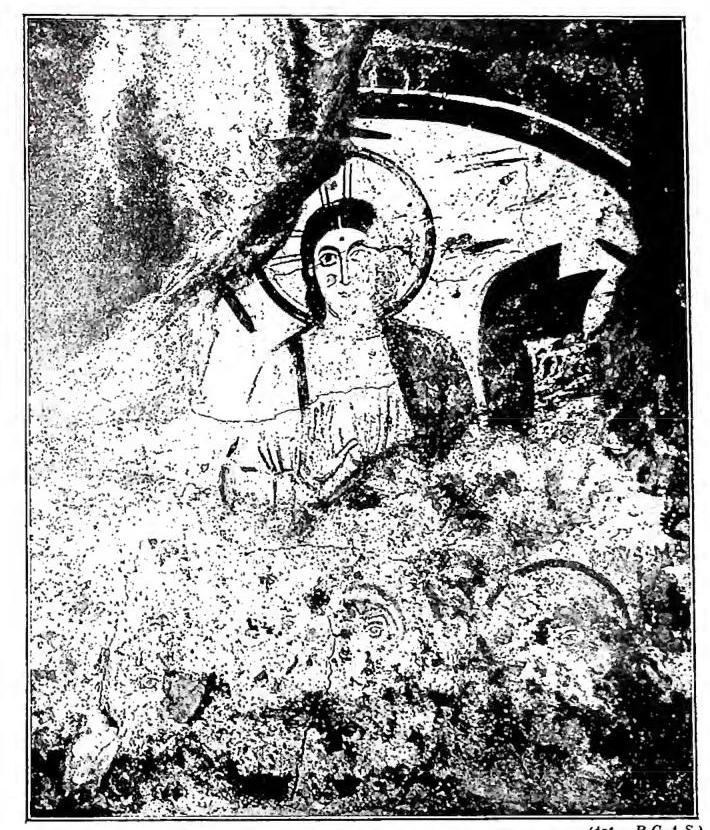
In November 1884 G. B. De Rossi discovered a descent from the sopratra leading into a hall divided by columns, of which the bases remained; toward the rear wall there were remains of an altar and fragments of screens. At the top of the wall the Saviour was depicted with a cruciform nimbus and below him, according to the legend, the martyr Felicita with her seven haloed sons and wearing the crown; originally each was identified by his own name. The names «(Phili)ppus, Martia(lis) S(ilanus) (Ia)nua(rius)» can still be distinguished. The fresco is dated to the 6th or 7th century.
Among the inscriptions, noteworthy is that recording the purchase of
Agostino Amore
(Int. P.C.A.S.) MASSIMO, cemetery of — The Redeemer with s. Felicita and the seven haloed Martyrs, identified by their names. Fresco of the 6th–7th century — Rome, cemetery of M.