
NOVAZIANO and NOVAZIANISM. — N. was a Roman presbyter of the 3rd century, founder of the schismatic Church of the Novatians.
The exact form of the name is undoubtedly Novatianus, and not Novatus (Ναυατός), as Eusebius (Hist. eccl., VI, 43) and later Greek literature call him (alongside the forms Ναυατός or Ναβατός). The Novatians designated themselves as “the pure” (καθαροί = mundi), in opposition to the members of the Catholic Church, stained by communion with sinners.
I. SOURCES
What is available is not free from a certain bias; particularly, the letters of Cornelius see in him nothing but “a monster of cunning and wickedness” (Eusebius, Hist. eccl., VI, 43, 6). The contemporary sources are: 1) the collection of Cyprian’s letters (Ep., 44–55; 59–61; 68; 69; 73), including letters by Cyprian, Cornelius, and the Roman confessors. 2) Eusebius’s account, drawn from a collection of Roman letters, with substantial excerpts from a letter by Cornelius to Fabius of Antioch (Hist. eccl., VI, 43, 4–22). 3) The letters of Dionysius of Alexandria, including one addressed to N. himself (Eusebius, ibid., 45). 4) The pseudo-Cyprianic treatise Ad Novatianum (ed. G. Hartel, CSEL, III, 3, pp. 52–69), composed by an African bishop (v. B. Capelle, in Bull. d'ancien littér. chrét. lat., 1924, n. 236). Later accounts are more important for knowledge of Novatianism than for that of N. (St Ambrose, De paenitentia [PL 16, 465–524]; Pacian of Barcelona in the three letters to the Novatian deacon Sempronianus [PL 13, 1051–82]). In the East, Eusebius of Emesa, St Basil, St Gregory of Nazianzus, and Chrysostom wrote against Novatianism. The history of the Novatian communities is described with a certain sympathy in the Historia ecclesiastica of Socrates (PG 67).II. LIFE OF N
N. was originally from Rome or, at least, from Italy. Philostorgius (Hist. eccl., VIII, 15) says that he was a native of Phrygia, owing to the tendency to establish a connection between N.’s doctrine and the rigorism of Phrygian prophecy (v. MONTANO E MONTANISMO). His conversion took place at a mature age. He was a man of great intelligence, highly versed in sacred and profane literature, and endowed above all with a perfect mastery of oratory, as is shown by the descriptions of him (Cyprian [Ep., 55, 24; 60, 3]: « facundiae venenatae lacula contorquens »; Jerome [Ep., 36, 1]: « eloquentissimus vir »). The ironic expressions with which Cornelius presents N. to Fabius of Antioch (ὁ θνημόσιος, ὁ λημερότατος, ὁ θνηματοστής [Eusebius, loc. cit.]) likewise attest to the esteem enjoyed by N. in the Roman community. N. was also conscious of his own cultural superiority (Cyprian, Ep., 55, 24), ambitious, austere in character, and not very sociable. He had received Baptism during a serious illness, by aspersion, without Confirmation (σφρενός) by the bishop. In the ancient Church there was some distrust of the Baptism of the « clinici »; nevertheless, because of his exceptional qualities, N. was ordained « presbyter » by a Roman bishop (probably s. Fabianus), overcoming the opposition of the clergy and of some laymen. N. first appears in history at the time of the persecution of Decius. During the long vacancy of the Apostolic See, from the death of Fabianus (January 250) to the election of Cornelius (March 251), he occupied a leading position among the Roman clergy. It was N. who wrote two of the letters sent by the Roman presbyters to Carthage concerning the delicate question of the « lapsi » (Ep., 30, 36 in the Cyprianic collection). N. then expressed his full agreement with the ideas of the primate of Africa (v. ASI). But when, in March 251, a large majority elected Cornelius to the see of Rome, N., also encouraged by the African agitator Novatus, placed himself at the head of a rigorist party of several presbyters and confessors and had himself consecrated bishop by three naïve country bishops who, according to Cornelius, half drunk, ordained him at the tenth hour (Eusebius, op. cit., VI, 43, 8-9). The schism immediately became extremely violent. N. launched an intense propaganda campaign; rejected by s. Cyprian, he sought especially to win over the Churches of the East. He had no success with Dionysius of Alexandria, who insistently urged him to return to unity: « Bisogna sopportare tutto piuttosto che lacerare la Chiesa di Dio » (v. Ch. L. Feltoe, The letters and other remains of Dionysius of Alexandria, Cambridge 1904, p. 62); but Fabius of Antioch must at one point have inclined toward the schism (Eusebius, op. cit., VI, 44, 1). Dionysius, in the form of a consultation, attempted to lead him toward a milder practice regarding the lapsi and, after the death of Fabius, personally took part in a council convened at Antioch, at which peace was restored among the Churches of Asia, gravely disturbed by Novatian rigorism (Eusebius, op. cit., VII, 5, 1). Cornelius (v.) convened, in the autumn of 251, some sixty bishops and many priests and deacons in a Roman council, at which N. was solemnly excommunicated, while reconciliation was guaranteed to all the libellatics and, at least when in danger of death, also to those who had sacrificed.There is no precise information concerning the events of N.’s final years or his death. According to the testimony of Socrates (Hist. eccl., IV, 28: PG 67, 540), N. died a martyr under Valerian (257–58). This is consistent with the statement of the Novatian deacon Sempronianus, according to which Cyprian, in one of his letters, alluding to N., wrote: « praecessit me adversarius meus » (Pacianus, Ep. II ad Symproniaeum: PL 13, 1062). The first chapter of the De cibis Iudaicis indicates that N. lived for some time away from his community, probably in exile; such a death may have been regarded as martyrdom.
III. DOGMATIC IMPORTANCE OF THE SCHISM OF N
An attempt has been made to see in the reconciliation of the lapsi by St. Cyprian and St. Cornelius a break with the ancient conception of the Church (the “Church of saints,” which definitively excludes grave sinners), and N. would represent the protest of the primitive “Church of salvation” against the Church of the Sacraments and of priests (H. Koch). Certainly, as in the time of Tertullian, even in the middle of the 3rd century there were rigorist bishops who completely closed the Church to the lapsi. But that these rigorist tendencies did not represent the ancient tradition is clear from the indisputable fact that St. Cyprian and the Roman confessors, who were otherwise inclined to severity, and N. himself, at the beginning, admitted the possibility of reconciling apostates. The question that so greatly concerned St. Cyprian was not whether the ecclesiastical “venia” should be granted to the lapsi, but when it should be given. In Carthage as in Rome, that is, the principle of “paenitentia plena et iusta” prevailed; peace would be granted, but the fruit of reconciliation could not be received “crudo tempore” (Cyprian, Ep., 16, 2; note also N.’s identical assertion in Ep., 36, 1). Cyprian and Cornelius, then, were not the authors of a revolutionary change in penitential practice, nor was N. the advocate of the ancient tradition: it was N. who changed. At the time of the persecution he rejected only the premature reconciliation of the lapsi and regarded their desire for ecclesiastical peace as the fulfillment of an evident duty (Ep., 30, 7); he consented to the reconciliation even of the dying who had not yet performed full penance; indeed, on this point, together with the Roman clergy, he showed St. Cyprian the way. His schism, therefore, did not have its root in the penitential question. This was to justify his rebellion against St. Cornelius, which was due to ambition and personal rivalry. Just as N. did not hesitate to ally himself, against Cornelius, with the scheming African Novatus, leader of the laxists in Carthage, so he repudiated his initially moderate position, later denying the Church the right to pardon apostasy, even at the moment of death (Ep., 55, 28). St. Cyprian does not fail to note N.’s inconsistency: while he cruelly rejects the lapsi, he tolerates in his communion the “fraudatores et moechi” (Ep., 55, 26). The later Novatians, more logically, in fact excluded from reconciliation the other perpetrators of grave sins as well.(from E. Jasi, in Riv. d'arc. crist., II [Bli]) NOVAZIANO, CIMITERO detto di — Plan of the cemetery’s second floor. The plan has been updated.
IV. THE WORKS AND DOCTRINE
Of N.’s literary legacy, which according to St. Jerome (De viris illustribus, 70) was quite considerable, the following are certainly authentic: two treatises that, in the manuscript tradition, go under the name of Tertullian: De Trinitate (probably composed before the year 250) and De cibis iudaicis (written after the schism); two treatises, De spectaculis and De bono pudicitiae, which had found a place among the works of St. Cyprian; and finally the two letters to St. Cyprian (Ep., 30, 36).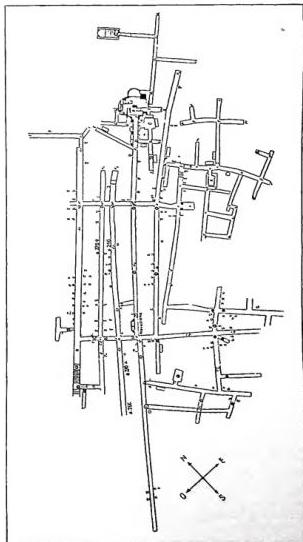
V. LA CHIESA NOVAZIANA
Novatianism spread as Montanism had done 80 years earlier: the principles of N. likewise appeared to many as a movement of spiritual renewal within the same Church, and the penitential question might have seemed purely disciplinary. N.’s propagandistic activity was added to this. “He sends out to very many cities new apostles chosen by himself,” says s. Cipriano as early as 252 (Ep., 55, 24). Soon there were Novatian churches throughout almost the entire Empire, giving the schism an ecumenical character. In its subsequent development, rigorism was further intensified, and reconciliation was denied to all grave sinners. Thus, for centuries, a schismatic Church lived alongside the Catholic Church, sharing with the Catholics the struggle and persecutions of the Arian and Macedonian controversy. The Novatians’ sincere adherence to homousia won them the favor of the Catholic emperors. Constantine I in 326 allowed them to possess churches and cemeteries. Whether the Emperor truly revoked this edict of toleration ten years later is uncertain (cf. I. Daniele, I documenti costantiniani della « Vita Constantini » di Eusebio di Cesarea, Roma 1938). The Council of Nicaea (can. 8) showed great conciliation toward the Novatians; upon returning to the Church, their Ordinations would have been considered valid, and their bishops authorized to receive the honors of their title.Theodosius I reconfirmed to the Novatians the use of their churches because of their Trinitarian orthodoxy, demonstrated in the religious dispute (383) in which the Novatian bishop Agelius and his lector Sisinnius had played an important part (Socrate, Hist. eccl., V, 10; PG 67, 584-93). But the emperors Honorius (a. 412; Cod. Theod. de haerct., 52) and Theodosius II (ibid., 59) included the Novatians in the antiheretical legislation. At Rome Innocent I (401-17) and Celestine I (422-32) took their churches from them (Socrate, Hist. eccl., VII, 9 and 11); at Alexandria they were closed by Cyril (Socrate, ibid., VII, 7). But the sect seems to have remained strong in the Eastern Church for a considerable time, because at the end of the 6th century the patriarch Eulogius of Alexandria composed against the Novatians a work in 6 books, of which Photius preserved excerpts.