
LAPSI, CONTROVERSIA dei. — In the 3rd century, those Christians who apostatized from the faith during the persecution of Decius (250) were called l. The controversy of the lapsed is the name given to the controversy that began in the Church when, as the persecution diminished in intensity, the lapsed requested their reinstatement among the faithful.
I. THE PERSECUTION AND THE L
It is known that Decius’s edict of persecution obliged not only all Christians, but also every person suspected of Christianity, to make a declaration of adherence to pagan worship. By doing so, anyone who had fallen under suspicion demonstrated that, however well founded it might have been, that suspicion was nevertheless unfounded; the Christian, moreover, who abjured his faith, by virtue of Trajan’s legislation, was thereby immediately acquitted of the offense, which ceased with his apostasy. As in the past, the aim was less to punish this offense than to bring it to an end. The watchword was to make not martyrs, but apostates (cf. Cyprian, Ep. 56, 2).Indeed, although many were the intrepid confessors of the faith who paid for their fidelity to Christ with their lives, in some Churches there were also innumerable apostasies, according to the testimony of Cyprian (De lapsis, 7–8). Weakened by a long period of peace, numerous Christians were unable to withstand the prospect of tortures. Some of them thought it easy to escape the rigors of the persecution by consenting to some act or gesture which, while it had the significance of an apostasy for the representative of the authorities, did not, in the eyes of the wavering believer, constitute a formal abjuration. Thus there were apostates of various kinds: the “sacrificati,” that is, those who consented actually to offer sacrifices before the statues of the gods; the “thurificati,” namely those who burned only incense before such statues and especially before those of the emperor; and the “libellatici,” or acta facientes, that is, those who had themselves entered in the public registers as though they had complied with the legal requirements, or merely had certificates (libelli) issued to them, as though they had obeyed the imperial orders.
II. THE CONTROVERSY
Toward the end of 250 the persecution diminished in intensity. The l. then, repentant, asked to be reinstated among the ranks of the faithful. It must be acknowledged that the simultaneous presence of so large a number of l. in the Church constituted a new and unprecedented situation. The question of how to deal with their request therefore presented itself in a new form: whether to readmit them all at once into the Church, or instead to examine individual cases, requiring from each different proofs of conversion and a different form of penance. Opposing opinions were expressed on the matter, and thus began the c. of the l.In Africa, in fact, numerous confessors, relying on the authority that their heroism had won for them in the Church, did not hesitate to give the l. letters of pardon (libelli pacis) that dispensed them from penance. There were also certain priests who admitted these l. to Eucharistic Communion without first requiring adequate penance and without waiting for the imposition of hands by the bishop and clergy to be carried out first (cf. Cyprian, Ep., 15, 2). These were especially the priests who had opposed the election of Cyprian as bishop and of whom Novatus was the principal instigator.
At Rome, on the other hand, the l.’s request for reconciliation provoked a rigorist movement, which gained a wide following in various Churches and took its origin and name from Novatian (v.). This rigorist tendency already appears in the rather severe tone and in certain expressions found in the two letters that Novatian, in the name of the Roman presbyters, wrote to Cyprian (Epp. 30, 36) during the vacancy of the Roman see. After Cornelius had been elected as Fabianus’s successor, this rigorism became the banner under which Novatian, disappointed at not having been elected, gathered his adherents. He opposed them as the Church of the Cathars, or pure, to the laxist Church of Cornelius; indeed, in order not to contaminate the Church, they absolutely denied the l. any reconciliation.
Opposed to the laxism of Novatus and the rigorism of Novatian, however, was the practice of s. Cyprian, fully shared by the Church of Rome and the Churches of the East.
From the refuge where he was concealed, as soon as Cyprian received news of the abuses being committed by the confessors and certain members of the clergy, he announced that every question concerning the l. would be settled at an imminent council, which was to adapt the ancient principles of the Church uniformly to the various needs of the new times. Meanwhile, he established in several points the line of conduct to be followed for the time being. First of all, the bishop’s power to readmit apostates into the Church was reaffirmed; the idea of mass reconciliation was rejected as absurd, since each person required a suitable prior penance; he praised the confessors, while also urging prudence in issuing the libelli pacis; he gave the clergy sound advice, followed by severe admonitions directed toward the apostates; then, while affirming his compassion for them and urging them not to despair, he maintained a prudently reserved attitude regarding their reconciliation. They could obtain it only in danger of death, and then, in the absence of the bishop, it could be granted by any priest or even by a simple deacon (cf. Epp. 15, 16, 17, 18). Cyprian communicated this rule of action to the other bishops of Africa and to the Roman clergy, who at that time were without a bishop.
In the spring of 251 Cyprian was able to return to Carthage. He then convened the previously announced Council, and the awaited decisions concerning the reconciliation of the l. were taken. Shortly afterward they were expounded and commented upon by Cyprian himself, both in the De lapsis and in the letter to the bishop Antonianus, who was inclined toward Novatian (Ep. 55), and they are as follows: those who had merely obtained a certificate attesting to sacrifice (libellatici) were admitted to penance and consequently obtained reconciliation; those, however, who had actually sacrificed (sacrificati) were required to do penance, but were not to be reconciled until the point of death.
In 252, however, because the edict of Trebonianus Gallus, who had succeeded Decius, announced the renewal of the persecution, the bishops of Africa again assembled in council. With the aim of arming all the faithful of good will for the struggle, they mitigated the discipline applied to the l.; they therefore decided to grant them immediate pardon if, after their fall, they had shown signs of repentance and had performed penance.
In its discipline toward the l., the Church of Rome agreed with the Churches of Africa. For the period during which the episcopal see was vacant, after the death of Pope Fabianus, this agreement is especially evident from the two letters sent by the Roman clergy to Cyprian, written by the skilled hand of Novatian (Epp. 30 and 36). Although, as D’Alès observes (L'édit de Calliste, Paris 1914, p. 310), the diplomatic formulas and the countless precautions through which «une affectation de sévérité et comme une sorte de regret de pardonner» becomes apparent can readily be detected in these letters, ultimately the Roman clergy agreed on the two principal points of the line of conduct set out by Cyprian: a reserved attitude toward the l. while awaiting the settlement of the question by a council in a uniform manner; and the granting of pardon and reconciliation in danger of death.
In March 251 Pope Fabianus was finally given a successor in the person of Cornelius. He too, as Cyprian had done at Carthage, immediately convened a council at Rome to address the question of the l. At it, as Eusebius writes (Hist. eccl., 6, 43), it was decided «that the l. must be healed by the salutary remedies of penance». Cyprian, moreover, in his letter to Antonianus (Ep. 55, 6), stating that «Cornelius with his cœpsicopi agreed with us in the same opinion, with equal gravity and salutary moderation», makes it perfectly clear that Rome’s decisions concerning the reconciliation of the l. fully agreed with those already taken at Carthage.
The same conduct toward the l. followed at Rome and Carthage can be observed in the Churches of the East. For the Church of Caesarea in Cappadocia, it is indicated by an incidental and therefore incomplete phrase occurring in the letter of Bishop Firmilianus to Cyprian, in which, among other things, he expresses the concern of the bishops of Asia, assembled in council, that «lapsis quoque fratribus et post lavarum salutare a diabolo vulneratis, per paententiam medella quaeratur» (Ep. 75, 4).
The practice of the Church of Alexandria is illuminated by the various fragments of letters of Bishop Dionysius, quoted by Eusebius or recently discovered, and especially by the fragment from the letter addressed to Fabius of Antioch, who, according to Eusebius himself (Hist. eccl., 6, 44), was inclined toward the schism of Novatian. Dionysius, in fact, asserts against Novatian the principle that the l. may be reconciled if, having repented, they have done penance for their offense; he accords due value to the work of the martyrs or confessors, certainly more discreet than that of the confessors of Carthage; and, to make his argument more compelling, he recounts the story of the old man Serapion, in which God himself intervened to reconcile the dying apostate.
Regarding the reconciliation of the l., therefore, and the conditions that make it possible, the thought of the Church, as expressed through its representatives in Rome, Carthage, Caesarea, and Alexandria, appears certain and harmonious. Rejecting equally the laxism of Novatus and the rigorism of Novatian, it affirms the principle that reconciliation may be granted to the l., provided that they have given proof of conversion and perform the prescribed penance.
III. DOCTRINAL EVALUATION
With regard, however, to this discipline of reconciliation of the l., the question arises—and not only today—as to whether or not it represents an innovation with respect to the penitential discipline of the preceding period. Harnack answers in the affirmative, and with him many other liberal Protestants, who maintain that the reconciliation of the l. after the persecution of Decius represents a stage in the process by which the Church usurped the power to absolve sins. The ancient Church, in fact, considered itself the Church of the saints and attributed the power to remit sins to God alone. Callistus was the first to claim for the Church the faculty of granting forgiveness for the sins «moechiae et fornicationis» (Tertullian, De pudicitia, 1, 6), while still denying such forgiveness for other grave sins. After the persecution of Decius, this power of remission was claimed by Cyprian and Cornelius also for the sin of apostasy. The discipline of reconciliation of the l., therefore, in the third century, represents an innovation, not merely disciplinary but doctrinal as well.Many Catholics too (Funk, Vacandard, Batiffol, Rauschen, Amann) support the thesis of innovation: evidently not doctrinal, since they take it as certain that the power to remit all sins was granted to the Church by its divine founder (and that she was always conscious of possessing it), but only disciplinary. According to these authors, in fact, during the first centuries the Church permanently denied her forgiveness to the faithful who had stained themselves with one of the gravest sins (adultery, apostasy, murder), limiting herself to urging them to do penance and to obtain mercy and remission directly from God. It is with regard to this practical norm that, just as the edict of Callistus represents a disciplinary innovation, so the reconciliation of the l. granted at the time of the persecution of Decius represents an identical innovation.
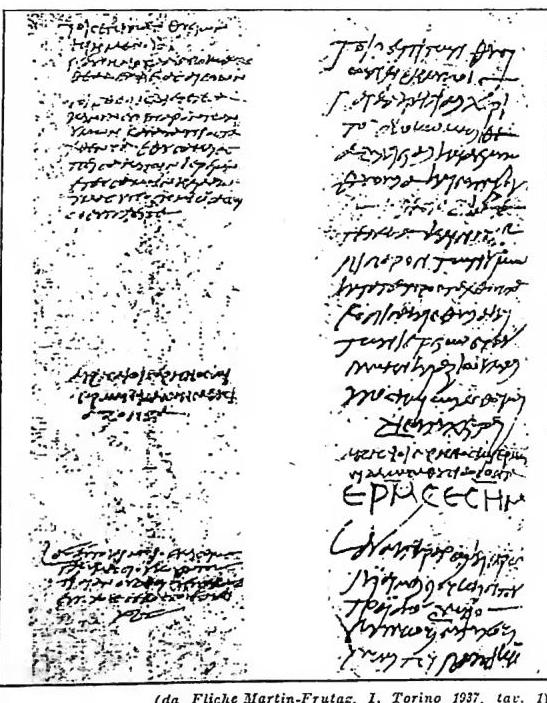
(from Filché Martin-Fratze, I, Torino 1917, pl. 1)
LAPSI, CONTROVERSIA dei «Libelli or certificates of worship rendered issued under the emperor Decius (249–51).