
L'AQUILA, ARCHDIOCESE of. — Principal city of Abruzzo and provincial capital, with an area of 2,172 sq. km. and 115,000 inhabitants, all Catholics, of whom 60,000 are in the municipality of A. It has 145 parishes, with 149 diocesan priests and 75 religious priests; one seminary (1949). The city is situated 720 m. above sea level, on the left bank of the Aterno River, in an area rich in water, at the edge of a basin enclosed by mountains, among which rises the Gran Sasso.
The city’s earliest Christian memories are connected with the uncertain and obscure accounts of a group of martyrs, s. Massimo, s. Giusta, and companions, venerated in the region. But the first known bishop of Furconium (Forconium, Furcona, today Civita di Bagno) dates from the 7th century. When the city of A. was founded in the 13th century, Alessandro IV made it an episcopal see, transferring to it the see of Furconium, which thereafter ceased to exist and took the name of the new city (20 February 1257). The diocese absorbed the territories of ancient Amiternum, today S. Vittorino, and, in the last century (1818), the diocese of Città Ducale. Since 1881 it has been an archdiocese immediately subject to the Holy See.
ABBEYS. – In the territory of L’Aquila the following flourished: the renowned abbey of S. Giovanni di Collimento, founded after the 11th century and suppressed by Pius II in 1461; S. Benedetto, now S. Maria della Riviera, dating from before 1303 and a Cistercian priory; S. Lorenzo, a Benedictine abbey later united to Collemaggio; S. Maria di Collemaggio, founded de Colle Madio in 1287 by s. Pietro Celestino, who was crowned there in 1294 and is buried there (G. Pansa, Regestum S. Mariae de Collemadio, in Rassegna abruzzese di storia ed arte, 3 [1899], p. 248); S. Maria di Soccorso of the Olivetans (1472); Alexander VI united to it the abbey of S. Maria di Picciano; S. Spirito, granted in commendam in 1547 and united to the hospital of S. Spirito in Sassia in Rome; Bominaco S. Maria and S. Pellegrino, an abbey of the Benedictines of Farfa, erected in 1001 by Oderisio, count of Valva, and suppressed in 1762.
The archives of the Cathedral and of the episcopate have been stripped of their ancient documents.
Serafino Prete
ART. -
I. Architecture
The earliest documents of L'Aquila’s architecture date from the second half of the 13th century, and they already reveal that distinctive character which simultaneously participates in the Romanesque and Gothic traditions and is enriched by cultural elements arriving from the most diverse centers, from centers of Benedictine artistic culture or of northern Romanesque origin as well as from the forms of Campanian or Apulian architecture.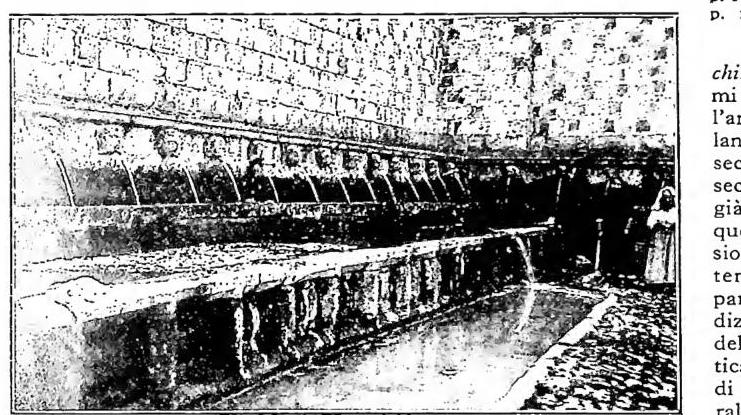
The oldest of the churches that have been partly preserved is perhaps S. Pietro di Sassa (ca. 1256), today much transformed, followed by S. Giusta (1257), whose façade, however, dates from 1349, and S. Maria di Collemaggio, the finest monument in the entire region. It was begun in 1283 and consecrated in 1288, but construction continued for many years, and the splendid main portal and rose windows date from the second half of the 14th century. The horizontal façade, set in an evocative landscape against the backdrop of the Gran Sasso and the Maiella, has an elegant decoration of geometric designs in white and pink stone blocks. In this church, s. Pietro Celestino, having descended from his hermitage on the Morrone, was crowned pope in 1294, and his tomb is also there, executed in 1517 by Girolamo da Vicenza.
Other churches were built in the following years. S. Antonio, near Porta Romana, bears the date 1308 on the surviving portal architrave, and the façade with the remarkable portal of the church of S. Maria Paganica is traditionally assigned to the same year. Churches displaying more distinctly Angevin features, especially in their sculptural decoration, are S. Domenico (commissioned by Carlo II in 1309, but still unfinished in 1362), S. Maria di Rojo, predating 1322, S. Marciano, S. Marco, and S. Pietro in Coppito. The church of S. Silvestro was begun before 1351: its façade, despite its simpler decorative arrangement, recalls S. Maria di Collemaggio. Inside, on the altar to the left of the high altar, under the patronage of the Branconio family, was the Visitation attributed to Raffaello, now in the Museo del Prado in Madrid.
Renaissance influences reached A. late: an initial attempt to fuse Gothic forms with the new currents was made in the little church of S. Maria del Soccorso, begun in 1469, whose façade, in its structure, recalls examples by Sangallo, while its white-and-pink bichromy in the decorative bands repeats reminiscences of the local prototype. Of all the monuments of this period, the church of S. Bernardino stands foremost, associated with the memory of the Saint’s final years spent in the city. The façade, a composite work by Cola dell'Amatrice, dates from 1540; the majestic interior was remodeled several times and preserves an 18th-century gilded ceiling by Ferdinando Mosca da Pescocostanzo, with canvases by Cennatiempo. Also worthy of mention are Palazzo Benedetti and Palazzo Dragonetti, for their elegant courtyard loggias, and the later Palazzo Franchi.
In 1534 work began on the imposing bulk of the castle, an unfinished work by the architect Pietro Scriba of Valenza, commissioned by the Spanish government to defend the viceroyalty. Remodeled several times, it was recently restored and is the seat of the Museo nazionale d'Abruzzo.
Good examples from the Baroque period survive in Palazzo Pica-Alfieri, Palazzo Antonelli, Palazzo Centi, Palazzo Cipolloni,
Palazzo Rivera, mostly modeled on Roman examples; in the oratory of S. Antonio de' Nardis, traditionally attributed to Ercole Ferrata (1647); and in the churches of S. Agostino, partly attributed to Fuga, and S. Maria del Suffragio, which has an elegant dome designed by Valadier.
2. Sculpture
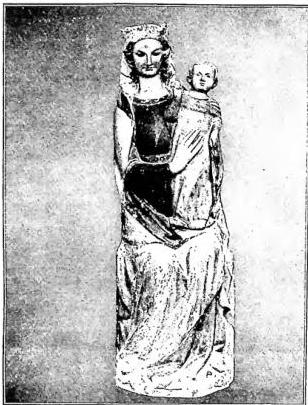
Evidence of medieval sculpture at A. is scarce and insufficient to indicate any genuine flourishing of the art. Pisan influences, mediated through Naples by the workshops of the followers of Tino di Camaino, can be detected in the statuettes decorating the main portal of S. Maria di Collemaggio and in the group of the Madonna and Child in the lunette of the façade of S. Maria Paganica. Several wooden sculptures in the Museo derive from the same cultural milieu, including the Madonna regina and S. Balbina. International Gothic influences are instead evident in the monument to Ludovico Camponeschi in S. Giuseppe, executed by Gualtiero d'Alemagna in 1432, and in the fragmentary baptismal font, formerly in the cathedral, by the Milanese Giovanni de' Rettori.A first substantial document of Renaissance sculpture in L'Aquila is the tabernacle in S. Maria del Soccorso, by Andrea dell'A., a pupil of Donatello, active in Naples at the Arco di Alfonso d'Aragona between 1455 and 1458. Of Silvestro dell'A., the foremost artist of the Renaissance in L'Aquila, documented between 1471 and 1504, the city preserves a group of works that attest to his Tuscan derivation, from Rossellino and Desiderio, combined with Roman elements, particularly those of Bregno. They are: the tomb of Cardinal Agnifili in the cathedral, damaged by the earthquake of 1703, dating from 1476; the wooden S. Sebastiano in the Museo, from 1478; the monument to Maria and Beatrice Pereyra Camponeschi, from 1496; and the terracotta Madonna and Child, from 1499–50, in S. Bernardino. Only the design and the partial execution of the first tier of the Arca del Santo, from 1500–1505 and later completed by his pupils in the same church, are attributable to him.
A Robbian altarpiece in S. Bernardino should also be mentioned. In the Tesoro del Capitolo, together with good examples of sacred goldsmithery from L'Aquila—which had a vigorous school between the 15th and 18th centuries—is the silver processional cross by Nicola « la Guardiagrele » from 1434; in the Museo, by contrast, is the processional cross by G. Rosecci.
3. Painting
The city’s most important cycle of paintings is that of the frescoes mentioned in the church of S. Silvestro. The same artist is to be credited with a triptych (ca. 1416–20) and a panel depicting the Tree of the Cross in the Museum. For an understanding of painting culture before this period and thereafter up to the sixteenth century, the Museum, recently arranged in the rooms of the castle, provides precise and concise information. In addition to the works mentioned, several notable fourteenth-century icons should be recalled, as well as a polyptych by Iacobello del Fiore, a Nativity, and a small diptych with the Crucifixion and a Madonna with Child by Andrea Delitio (ca. 1450), two fragments by Giovanni da Sulmona, a series of polyptychs recently removed from Cola dell’Amatrice’s catalogue in favor of a “master of the Crivellesque polyptychs” (ca. 1480), and finally several works by Saturnino de’ Gatti, painter and sculptor, active at the end of the fifteenth century within the orbit of Umbrian-Antoniasian influences.Paintings of the Neapolitan seventeenth and eighteenth centuries are found in the Cappelli, Dragonetti, and Rivera collections: works by Preti, Cavallino, Solimena, and de Mura, whose Christ and Saints in the church of S. Basilio is noteworthy.
Works by Teofilo Patini of Castel di Sangro (1840–1906) are found in the Cathedral, the Government Palace, and the Provincial Library, which also preserves important fifteenth-century miniatures. — Vedi tav. LV.
BIBLI: V. BELLINI, Monumenti storici ed artistici dell'Abruzzo, Napoli 1889, V. indice; L. Serra, A. monumentale, L'Aquila 1912; M. Chini, Pittori aquilani del '400, in Rassegna d'arte dell'Abruzzo e Molise, 1 (1912), pp. 7-15, 49-60, 75-82, 116-23; 2 (1913), pp. 9-13, 34-47, 63-71; 4 (1915), pp. 75-97; I. C. Gavini, Storia dell'architettura in Abruzzo, Milano 1926, V. indice; e infine, per una completa e aggiornata bibl., V. Chierici, s. V. Abruzzo, Roma 1947, pp. 174-79; e inoltre: F. Bologna, La ricostruzione di un polittico e il « Maestro dei polittici crivelleschi », in Bollettino d'arte, 33 (1948), pp. 367-70; U. Chierici, Gli affreschi della chiesa di
S. Silvestro ad A., ibid., 34 (1949), pp. 111-28; A. Chiappini, Intorno alla fondazione della città dell'Aquila, Aquila 1949; F. Bologna, Andrea Delitto, in Paragone, 1 (1950, III), pp. 44-50.