Machine translation of the 1948–1954 Italian original. The original text is authoritative.
PRETI, MATTIA, known as the CAVALIER CALABRESE. - Painter, born at Taverna (Catanzaro) on 24 February 1613, died at Malta on 3 January 1699. When little more than seventeen years old he went to Naples, and immediately afterwards to Rome, to the workshop of his painter brother Gregorio.
His early activity, between 1630 and 1650, has been elucidated in terms of two different cultural interests: luminism and Neo-Venetian taste. To the former belong such works as the Musicians and Poets in the Albertina at Turin, the Flagellation of St. John Calybite and the fresco of the Charity of St. Charles Borromeo at S. Carlo ai Catinari in Rome, the Miracle of St. Pantaleon formerly in the Cecconi collection at Florence, the Tribute in the Corsini Gallery and Hagar and Ishmael in Palazzo Doria at Rome, the Raising of Lazarus in Palazzo Bianco and Clorinda in Palazzo Rosso at Genoa, the Gamblers in the Sili Collection at Rome, the Concert belonging to Longhi, and the St. John Chrysostom in the Gualino collection at Turin. The other tendency is instead attested, in a more complex and still not completely clarified manner, by the Bacchanal in the Raggi collection at Rome, the Triumph of Silenus in the Museum of Fine Arts at Tours, Moses on Sinai in the Musée Fabre at Montpellier, the Little Concert in the Museum of Carcassonne, and Homer in the Venetian Galleries. During those twenty years P. travelled extensively: before 1644 he was in Spain; then at Cento, Parma, and Paris; at Modena he left frescoes in the church of S. Biagio, while at Bologna he painted for Cardinal Pallotta a canvas of Olindo and Sofronia, now in the Jerace collection at Naples.
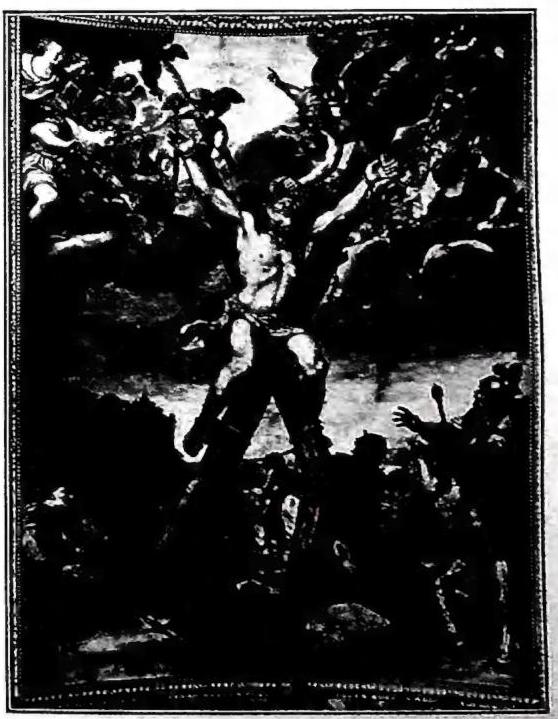
His many experiences of travel proved beneficial to him, eventually determining, from 1650 onwards (the frescoes in S. Andrea della Valle at Rome date from about this year), a distinctive style, vigorous and emphatic at the same time, and one of the most complex and remarkable personalities in seventeenth-century painting. From 1656 to 1660 he was at Naples, where his activi-
(Int. Andrena)
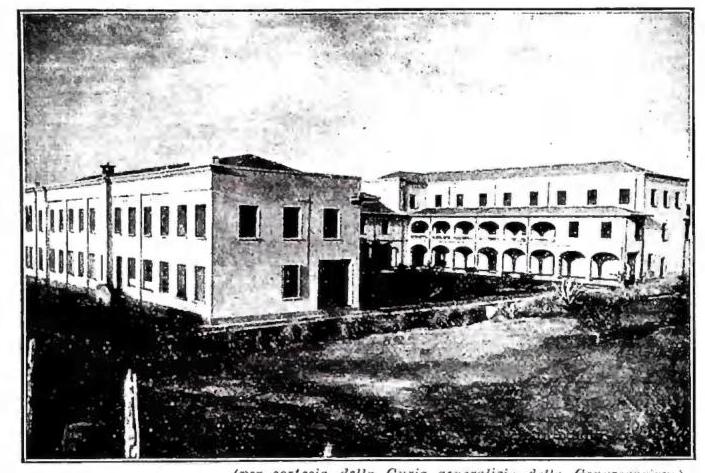
PRETI, MATTIA, known as the CAVALIER CALABRESE - Martyrdom of St. Andrew, fresco in the church of S. Andrea della Valle - Rome PRETI DELLE STIMMATE DI N. S. GESÙ CRISTO – Missionary Institute – G. Bertone – of Ribeirao Prato (S. Paolo), Brazil.His activity began with the frescoes depicting scenes of the plague on the city gates, now worn away by time and the elements. The Pinacoteca still preserves the two sketches for the Capuana and Nolana Gates, together with other drawings for the frescoes of the dome of S. Domenico Soriano, which have likewise almost entirely disappeared. Among his other Neapolitan works are the Figliuol prodigo in the Royal Palace, the Ecce Homo formerly in the Proto-Albaneta collection, and the Conviti owned by the Gerace family and the Pinacoteca. But his masterpiece consists of the ten canvases painted for the ceiling of S. Pietro a Maiella, depicting scenes from the lives of s. Pier Celestino and s. Caterina d'Alessandria. In 1660, P. left the city to decorate a salon of the Pamphily villa at Valmontone, and in 1661 moved to Malta, where he left works in the church of S. Giovanni at Valletta and in others on the Island. In 1668 he returned to his native Taverna, where he painted numerous canvases for the principal churches; he also sent others from Malta, where he had to return, summoned there urgently, around 1674. The Cristo fulminante, the S. Barbara, the S. Sebastiano, and the Battesimo di Gesù, with the Autoritratto below in the attire of a knight, are among the finest works preserved at Taverna. During his second Maltese period, P. also sent works to Naples, Siena (a Predicazione di s. Bernardino, 1675) for the Duomo, and Rome.
BIBL.: A. Venturi, M. P. il cavalier calabrese, in Grandi artisti italiani, Bologna 1925; A. Frangipane, M. P. il Cavalier calabrese, Milano 1929; V. Mariani, M. P. a Malta, Roma 1925; F. Baumgart, s. V. in Thieme-Becker, XXVII, pp. 384–86 (with bibliography); V. Mariani, s. V. in Enc. Ital., XXVIII, pp. 219–21 (with bibliography); E. Carli, Una scheda per M. P., in Le arti, 3 (1940), pp. 42–44; R. Longhi, Ultimi studi sul Caravaggio e la sua cerchia, in Proporzioni, 1 (1943), pp. 59–63; G. Briganti, M. P., i Seicentofili e gli Snobs, in Paragone, 2 (1951), pp. 45–49.
Cite this article
“PRETI, MATTIA, DETTO IL CAVALIER CALABRESE.” Enciclopedia Cattolica, vol. IX (1952), p. 1183. Azione Romana digital edition, https://azioneromana.com/article/preti-mattia-detto-il-cavalier-calabrese.