
RILIEVO. – In the figurative arts, it is distinguished from a statuary group by being attached to a background plane from which figures, architectural elements, and landscapes emerge. It may be subdivided into high relief, or full r. or complete r., half r., low r., and flattened or stiacciato r.
High relief does not involve any reduction of perspectival planes: it represents a single order of planes, while those behind are superimposed or treated conventionally, as in low relief, with perspectival reduction. Half relief, on the other hand, already implies a need for perspective, and the areas of the second plane are partly occupied, according to the viewpoint, by those of the first plane. Low relief, and stiacciato to an even greater degree, no longer present half-rounded figures or volumes. There is precise drawing and a relief very low in relation to the surface of the background plane. This distinction among genres, made by Vasari and subsequently repeated by Baldinucci, corresponds to the practice of every sculptor from antiquity to the present day.
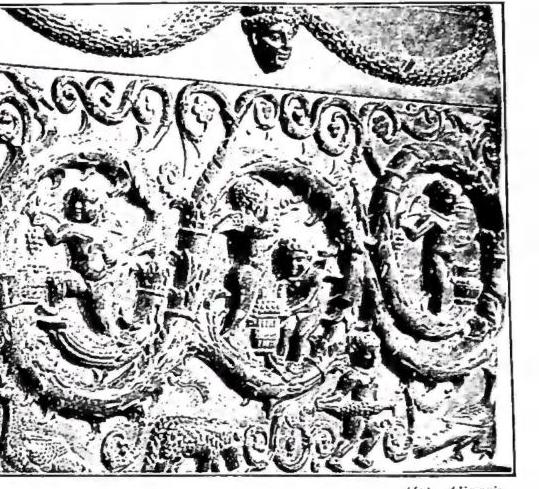
High relief is very frequent in Roman Christian sarcophagi beginning in the 11th century, and continued throughout the early Middle Ages in the considerable abundance of sculptural decoration in churches, both in architectural members and in ciboria, ambons, iconostases, and balustrades. Low relief nevertheless prevailed for the most part. In the Byzantine period, the calligraphic decorative taste of Eastern art corresponded admirably to this type of sculpture, both in marble or stone and in other materials used in the industrial arts, such as ivory, alabaster, and precious metals.
In the Romanesque period, low relief triumphed absolutely everywhere, interpreting one of the most characteristic and distinctive elements of the architecture of that period. One may recall the sculptures of Wilgelmo and Antelami, of the Roman marble workers, of Bonanno Pisano at Pisa and Morreale, and those of so many anonymous carvers.
High relief, on the other hand, prevailed in fourteenth-century Pisan sculpture, especially with Nicola, who achieved effects of astonishing vivacity, dynamism, and tension in his pulpits at Pisa and Siena. Giovanni Pisano too was able to maintain equal vigor in high relief, as was Arnolfo di Cambio.
The Renaissance, with its canons of the most rigorous perspectival demands and its preference for pictorial solutions, restricted the use of high relief; but Ghiberti, in the figures set within the curvilinear frames of the southern door of the Florentine Baptistery, as Andrea da Pontedera had already done on the first door, still perceived the vigor of high relief. So too did Donatello in the choir loft of S. Lorenzo and the della Robbia in their many terracotta friezes
In the sixteenth century, with the imposing development of grand architecture, high relief was generally preferred, and very often sculptures in the round assumed the appearance of genuine high reliefs, conceived as they were in a distinctly architectural function. Bas-relief was confined to the decoration of pilasters, candelabra, architraves, and portals, and achieved exquisite expression in works by Cellini and Giambologna.
In the Baroque period, the requirements of both genres were likewise understood as ornamentation for scenographic and complex architecture. In Bernini, for example, sculpture in the round likewise involved solutions connected with the effects of relief, as is particularly evident in the sculptural group of the Ecstasy of St. Teresa at S. Maria della Vittoria in Rome.
Neoclassical taste favored certain linear solutions in bas-relief, almost stiacciato, as in Canova’s funerary stelae (see, for example, the monument to Giovanni Volpato in SS. Apostoli in Rome), and the background was polished and reduced to a simple supporting plane from which the figures emerged. High relief was widely used in commemorative sculptures (the triumphal arch in Paris). In contemporary art, relief is often treated by sculptors: generally, preference is given to bas-relief. - Vedi tav. XLVIII.