
DELLA QUERCIA, JACOPO. — Sculptor, born at Quercia, a castle near Siena, probably in 1367, died there on 20 October 1438. Nothing precise is known about his training, except that, like many other sculptors, he began as a goldsmith. His distant derivation from Giovanni Pisano may nevertheless be admitted. In 1401 he took part in the competition for the second door of the baptistery of Florence together with Brunelleschi and Ghiberti, who emerged victorious. Unfortunately, the work submitted by Jacopo has not survived, and it therefore cannot usefully be compared with those of the other two competitors, which have been preserved. Perhaps in 1406 he sculpted in the cathedral of Lucca the tomb of Ilaria del Carretto, wife of Paolo Guinigi, who died in 1405.
The Madonna of Ferrara dates from 1408, and in the same year he was commissioned to make the fountain in the Piazza at Siena, known as the Fonte Gaia. This work was completed only in 1419 and was so celebrated that its author earned the nickname Jacopo della Fonte. In the last century a reproduction of it was made, which took the place of the original, while the parts of the old work were placed in the Palazzo Pubblico for better preservation. Between 1413 and 1422 Jacopo executed in S. Frediano at Lucca the altarpiece of the Trenta chapel, still rich in Gothic features. In 1425 he was commissioned to make the portal of S. Petronio in Bologna, which he left unfinished at his death. His last work was the altar bas-relief for the Casini chapel in the cathedral of Siena (Florence, Ojetti Collection).
The tomb of Ilaria del Carretto, in its arrangement, may recall classical motifs evident in the putti supporting the heavy garland. But the recumbent figure, in which line dominates without depriving the planes of their energy, can better be understood by relating it to the taste proper to Gothic art.
In the Fonte Gaia, in various bas-reliefs, he represented the Creation of Adam and Eve, Wisdom, Hope, Fortitude, Prudence, an Angel, the Madonna and Child, another Angel, Justice, Charity, Temperance, Faith, and the Expulsion of Adam and Eve; he also sculpted the groups of Res. Silvia and Acca Larenzia with Romulus and Remus, allusions to Siena’s Roman derivation. In these sculptures a violent energy predominates, linking them to the formal tradition of Gothic art, whose per-
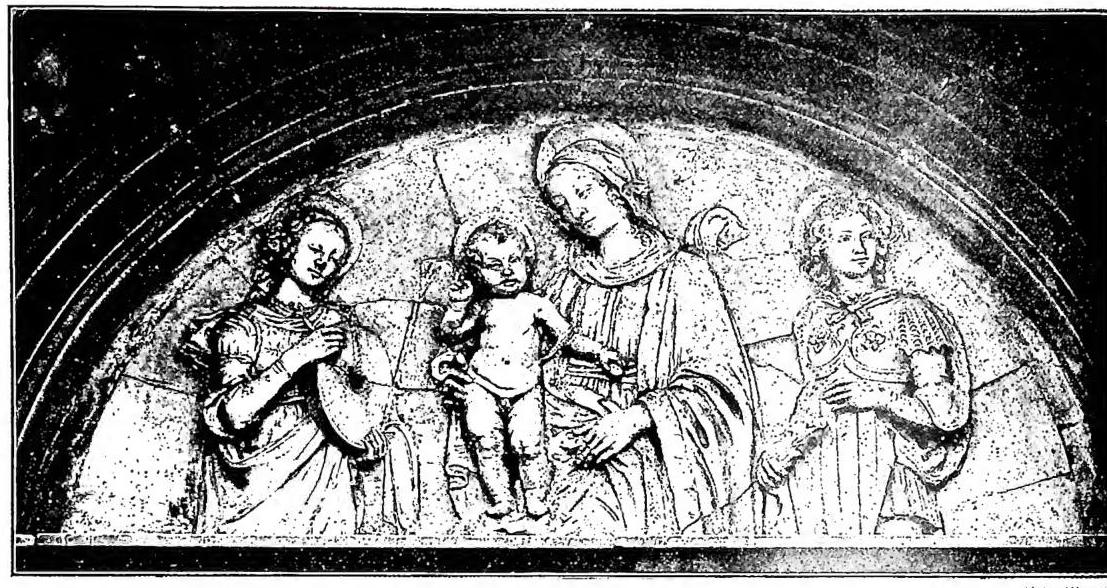
Jacopo’s greatest work is the decoration of the central portal of S. Petronio in Bologna, in which he adorned the two pillars with reliefs representing scenes from the Old and New Testaments and the prophets. In the lunette is the fully rounded group of the Madonna with her Son and s. Petronio. In these sculptures Jacopo appears truly remarkable in the broad, synthetic forms of the figures, in the energy of the relief, and in the absolute predominance of the nude human figure. Michelangelo must not have looked to this work in vain during his stay in Bologna. Jacopo is also responsible for the design of the baptismal font of S. Giovanni in Siena, which is likewise adorned with one of his bronze bas-reliefs, representing Zacharias driven from the Temple, a work executed in a grave and solemn manner.
The wooden statues of S. Gabriele and the Annunciation in the cathedral of Montepulciano are also attributed to Jacopo; they are certainly in his manner and were painted by Martino di Bartolomeo.
J. D. Q. is an isolated figure in fifteenth-century Tuscan sculpture. To explain his highly singular art, it is necessary to reconnect him with the Gothic tradition, which nevertheless does not prevent him from understanding the intimate values of the new Renaissance currents, which in him seem, indeed, to be strengthened by II. An underground sap, the atavistic tradition of the Tuscan land reaching back to Etruria, circulates through his figures and animates them with a rugged energy, at times tempered by an austere sweetness, while the Gothic intensity of feeling imbues them with a vivid sense of dramatic spirituality.