
GIUSTIZIA. – The Greek term δέμις has the same origin and meaning as the Latin term fas and indicates the ius divinum. Νόμος is the human law (from νόμο, I divide), and is the rule according to which the division of a given thing is customarily and necessarily made. Δίχη, then, means j., from the root dik, dic, that is, to indicate, to show. Δίχημος, therefore, is the name given to one who follows another’s directive and example, who acts according to customs and usages, that is, according to the rule. Τὸ δίχημον is twofold: φωτικόν and νομικόν; the former is determined by nature, the latter by human law.
SUMMARY:
I. Survey of the principal concepts of j
II. J. in the strict sense. – III. J. and charity. –IV. Injustice
V. Reparation for injustice
VI. Various forms of j
VII. The implementation of j
VIII. The existence of j. in the world. – IX. Evolution of j.I. SURVEY OF THE PRINCIPAL CONCEPTS OF G
In its broadest meaning, g. signifies conformity in general, correspondence, suitability for a given end, congruence. In this sense one speaks of a correct clock, machine, measuring instrument, forecast, road sign, calculation, solution to a problem, etc.Turning now to the religious-moral sphere, especially the Christian one, three principal meanings of the term g. are found. In the first of these, it indicates virtue in general, good in general; hence, in this sense, the just person is one who fulfills all his duty, who in no way violates the norm of conduct. In this sense the term g. is already found in Plato (cf. especially Rep. IV, 10, 433: “g. consists in performing one’s own function”), for whom g. is the universal virtue harmonizing all duties, and in Sacred Scripture, especially in the New Testament. Thus, in this sense, s. Giuseppe is called “just” (Mt. 1, 19), and s. Pietro reproaches the Jews for having put to death the one who had fulfilled g. as no one else had done (Act. 3, 14 ff.); in this sense Jesus is called “just” by Pilate (Mt. 27, 34) and by the centurion (Lc. 23, 27); in this sense it is said that Jesus came to call not the “just” but sinners (ibid. 5, 32), that one must seek the Kingdom of God and his “g.” (Mt. 6, 32), that one must not practice our “g.” out of regard for men (ibid. 6, 1), that at the Last Judgment the angels will separate the wicked from the “just” (ibid. 13, 49), etc.
In a second sense, g. signifies a particular virtue, that by which each person is given what is due to him, that which inclines us to give each person his own. In this sense g. is already encountered in the Pythagorean school. “For this school, g. is above all equality, that is, correspondence between opposed terms; and it may properly be likened to the square number, that is, to the equal multiplied by the equal, because it renders like for like. Consistently with this conception, but with an even more precise determination, the same school declares that g. consists essentially in reciproc-
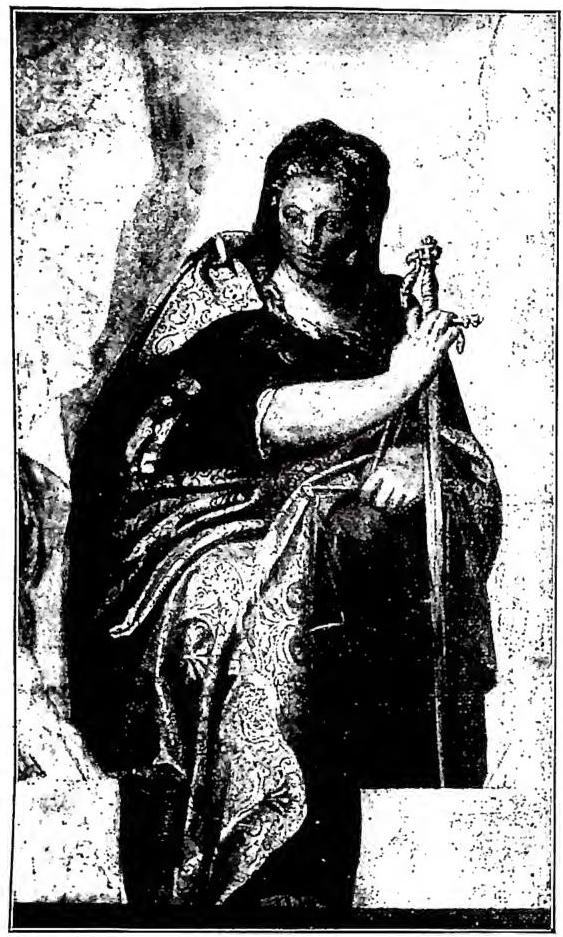
A third concept of justice appears with Christian Revelation. According to it, moral goodness is usually accompanied in us by the presence of sanctifying Grace (and, conversely, moral evil causes its deprivation), so that the state of justice in the first sense indicated above coincides with the state of Grace, the acquisition of justice with the acquisition of Grace, the loss of justice with the loss of Grace, and so forth. In this sense theologians speak of original justice, of the justification of the ungodly, etc., and the Council of Trent devoted its sixth session to “justification.”
Of the three senses indicated by the term justice, the first is essentially identified with morality. The sources from which a complete indication of the rule of conduct may ultimately be derived, as it results from reason and
Revelation, are divine and human law (ecclesiastical and civil). While the end and divine law are essentially immutable, human law can and must change, since its sole task is to apply the eternal and inalienable demands of nature and Grace to different times and different places. Moreover, human law necessarily has a statistical character, being modeled on an average. Human law can therefore become unjust for two reasons: either because it is transferred to times and places for which it is unsuitable; or because its application is persisted in even in exceptional cases that depart from the average line the legislator had in mind. Thus arise all the problems of reforming juridical structures so as to adapt them to new times and new places, in order to apply as effectively as possible the demands of natural and revealed law; as well as the institution of dispensation from the law and of epicheia: in general, all the problems concerning law yet to be constituted, as opposed to constituted law, with a view to an ever more profound realization of the supreme demands of the good.
Here we are concerned with justice as the virtue by which each person is given his due.
II. JUSTICE IN THE STRICT SENSE
Its study requires a deeper examination of that “one’s own,” that is, of the right which it seeks to give to each person. Every human being, possessing a spiritual soul and therefore being a person, has a proper end to attain: the complete development of self in the immediate and supernatural possession of God. To attain that end, human beings need very many things: goods to nourish their vegetative life, to protect their existence from the elements and from illnesses that endanger it, to cultivate their sensibility and intelligence, to manifest to God their complete submission, their gratitude, their indigence, etc. Such things, at least insofar as strictly necessary, belong to the person; they pertain to the person. They are not the person, nor do they physically enter into its constitution, but nevertheless they belong to it; they constitute that “one’s own” which justice, in the sense now under examination, requires be given to each person. “Mine,” “yours,” “one’s own,” etc., and, in general, every right indicates something that is neither the person nor part of its physical constitution; hence it can be taken away without destroying the person; at the same time, however, it belongs to the person and is necessary for its complete fulfillment; consequently, it cannot be taken away without diminishing the person itself, without offending its fundamental needs. Here lies the difference between personal pronouns and possessive pronouns: the former stand for the person, whereas the latter stand for something that is not the person but nevertheless belongs to II. Here too lies the special characteristic of right: it is at once something external and internal to the person. Since right is external, it can be violated without destroying the person; since it is internal, it cannot be violated without deeply affecting the person.From what precedes it immediately follows that justice presupposes the otherness of persons. Through justice we go out of ourselves, breaking with concern for our limited individuality in order to concern ourselves with our fellow human beings. For each of us, justice is the defense of persons distinct from ourselves.
Moreover, justice has in view what is owed to others, not what one is free to give or not to give; and, furthermore, what is owed to others because it is “theirs,” because it belongs to them. Since justice is the virtue that inclines one to give others what is “theirs,” it is not within its power to give or not to give; and it must give for the precise reason that the matter concerns something belonging to others.
And this leads to establishing other characteristics of justice: it has a minimalist character, but it can also be enacted by force and is independent of the disposition with which one gives or does not give. Minimalist character: the object of justice is right, that is, what is indispensable for the person to be able, if willing, to attain its own end. These words must evidently be understood in a human sense, taking into account the actual possibilities of nature as it historically presents itself, and the weaknesses that are in fact found in it; but also in a rigorous sense: what is not indispensable for attaining the ends of the person is not an object of justice. It can also be enacted by force: one is in fact faced with something that is owed because it belongs to the person, because it is “theirs”; by taking it here even against the will of the person who in fact, but wrongly, holds something in possession, justice takes nothing that does not belong to that person; it does no more than take actual possession of what is already “theirs.” It is independent of the spiritual disposition with which one gives or refuses: justice is not concerned with whether something is given willingly or against one’s will, whether it is given gladly or with imprecations; it is concerned only that what must be given is given; its sole concern is the object of justice, not the disposition of the person who must put it into practice.
III. JUSTICE AND CHARITY
These characteristics of justice become clearer when compared with what occurs in charity. Charity, too, presupposes an otherness of persons, but not insofar as they are different and opposed; rather, insofar as they are united in some way (through a common origin, destiny, etc.), insofar as, although distinct, they in some way form a single thing. Moreover, charity tends to give even what belongs to oneself, first establishing an equality among the different persons who love one another, and then a situation of favor toward the loved person (one may think of the mother who does not sleep so that the child may sleep more peacefully, or of the wife who renounces something of her own to please her husband): it therefore has a maximalist character, at least in tendency.Consequently, what predominates in love is the spiritual attitude with which one gives: one may give something extremely precious and show no love whatsoever, indeed offend the loved person; while, on the other hand, one may give something extremely modest and show very great love, making the loved person happy. Because of this character of spontaneity and generosity, love cannot be demanded by force: one may ask for it, one may implore it; one cannot demand it in any way.
IV. INJUSTICE
We now have all the elements needed to specify what injustice is. In the religious-moral sphere, it too has three meanings: a general one, according to which it signifies vice in general and every violation of the moral order; a narrower one, according to which it signifies violation of the moral order insofar as it commands that each person be given what is his; and finally a third, still more particular one, according to which it signifies the absence of sanctifying Grace.Here too, we shall limit ourselves to the second of the meanings indicated, which is also the most frequent. For injustice in this sense to exist, there must be a violation of a right in the strict sense; that is, there must be an otherness of persons, the matter in question must be something owed to another precisely because it belongs to him, and this thing owed must not be given. Strictly speaking, therefore, a bad action, a harmful action, and an unjust action are not the same. An act may be bad without being unjust in the sense indicated (a blasphemy, for example, does not take anything away from God). An act may be harmful without being unjust: the State, expropriating for reasons of public utility, may cause harm, but not unjust harm. Conversely, every unjust act is also harmful and bad.
Among the many questions upon which casuistry has long dwelt, it seems necessary to say something here also about the following: 1) whether consentienti fiat iniuria; 2) whether injustice can be committed by a purely internal act; 3) whether injustice can be committed by depriving someone of attaining a good that he does not yet possess.
On the question whether consentienti fiat iniuria, there are two currents among authors. One, upheld in recent times especially by the Jesuit A. Vermersch (cf. Quaestiones de iustitia, 2nd ed., Bruges 1904, nos. 142–144, pp. 152–57), reasons as follows: a right is something which, although ordered to the person, belongs to him neither metaphysically nor physically; it is therefore possible, even if not always lawful, to divest oneself of it; whoever does so can no longer suffer injustice; by consent, precisely, one divests oneself of one’s right; therefore consentienti non fit iniuria. Thus, according to these authors, the principle has universal validity.
The other current, which is said to have been advocated by a group of theologians mentioned, without being named, by Lessius (De iustitia et iure, Louvain 1605, chap. 7, d. 3), and by some modern authors (e.g., E. Ione, Comp. di teol. mor., Turin 1949, no. 323, p. 290), reasons as follows: the connection between the right and the person is neither physical nor dependent upon the will alone; it therefore cannot be removed by the physical separation of the thing or by the consent of the will; consent, therefore, does not remove the injustice, unless the rights in question are ones that a person may renounce.
The first opinion seems unquestionably preferable. It will be necessary, however, that the consent be genuine, not fictitious, and that it be consent by which one renounces one’s own right (for example, it is not enough to consent by accepting what the other unjustly does without opposition, as happens, for example, in the case of martyrs). It must also be borne in mind that such consent removes from the action the specific malice of injustice; it does not remove every other malice. The action performed by the other may therefore be bad, even if it does not possess that particular deformity which is characteristic of injustice. The second current seems to have arisen, on the one hand, from confusion between valid renunciation and lawful renunciation and, on the other, between a bad action and an unjust action. No one can lawfully renounce his own right; often, however, he can validly renounce it: when a valid renunciation has taken place, the violation of the right always ceases to be an injustice, even though it may sometimes remain a morally unlawful action. In any case, the Italian Penal Code is aligned with the first current, stating in art. 30: « he who violates or endangers a right with the consent of the person who may validly dispose of it is not punishable ».
With regard to the question whether injustice can be committed by an internal act alone, it is first necessary to clarify the meaning of the question. It is one thing to ask whether an injustice can be committed by a purely internal act, and another to ask whether the mere will to commit an injustice is already an unjust action. The first question must unquestionably be answered in the affirmative. One need only think of rash judgment. The second question, however, must be answered in the negative. Certainly, if the term “injustice” is taken in the first sense indicated at the outset, the will to commit an injustice is already an unjust action. If, on the other hand, the term “injustice” is given the precise meaning determined above, the mere will to divest someone of what is his, or in any event not to give someone what is his, does not yet in itself constitute the actual denial of that “what is his,” and therefore does not in itself constitute an unjust act.
These observations lead toward the solution of the third question mentioned above, namely, whether injustice is committed merely by preventing someone from attaining a good. Clearly, one may deny someone what is his either by taking away what he already in fact possesses or by preventing him from attaining what he has the right to be able to possess (for this V. DANNO; LUCRO CESSANTE).
V. LE RIPARAZIONI DELL'INGIUSTIZIA
It entails, in addition to repentance, the restitution of what has been taken or compensation for the harm unjustly caused. This obligation is explicitly affirmed, among other places, in Ex. 22, 1-3, Lev. 6, 2-5 and isclearly established by reason (v. RESTITUZIONE). There must, however, truly be harm caused unjustly and culpably; in the absence of harm or of unjust harm, one cannot speak of injustice; in the absence of a causal relationship, the obligation to make reparation cannot be affirmed.
VI. DIFFERENT FORMS OF J
From the general treatment of justice we now pass to the question of the different forms in which it appears or may appear. This is a much-debated issue and, in many respects, one that remains quite obscure. The traditional, now classical, conception divides justice into three kinds: commutative, distributive, and legal justice. In the first, the individual renders to other individuals what belongs to them; in the second, society renders to the individual what belongs to him; in the third, the individual renders to society what belongs to II.Not everyone agrees on the details: some, in fact (e.g., A. Vermeersch, op. cit., n. 21 p., 17), divide justice into particular and general justice, subsequently subdividing the latter into distributive and legal justice; others (e.g., s. Alfonso, Theol. mor., l. III, tr. V, n. 486 [ed. L. Gaudé, II, Roma 1907, pp. 3-4]), pass directly from justice to commutative, distributive, and legal justice. All, however, agree in admitting three kinds of justice: only violation of commutative justice would entail the obligation of restitution.
A second school of thought, represented especially by the Dominican M. Hering, maintains that there are only two forms of justice: commutative and distributive justice; what is usually called legal justice would, according to him, be merely a special virtue directing the acts of the other virtues toward the common good, or simply the ensemble of the other virtues without any relation to the common good. This would, among other things, make intelligible the absence of an obligation of restitution in cases of violation of legal justice.
Finally, a third, very small school tends to admit three forms of genuine justice, with an obligation of restitution for each of them. Thus, for example, J. Carrière writes: « Iustitia commutativa duplici sensu valde diverso apud auctores multos sumitur : aliquando idem sonat ac iustitia stricta; aliquando significat eam quae exercetur a privato erga privatum. Hae duae notiones si non attendantur, magna erit confusio : saepe enim dicitur V. g. violationem solius iustitiae commutativae inducere obligationem restituendi : porro illud verum erit, si sumatur in priori sensu; aecus, si in posteriori; nam aliae iustitiae aliquando pro obiecto habent ius strictum ». (De iustitia et iure, I, n. 7, 2°, p. 9 sg.; cf. anche III, n. 1107, p. 151).
Without entering here into lengthy and subtle discussions, it seems that Hering’s opinion is difficult to sustain: wherever there is a person, there is a right, and therefore there is room for injustice. Now society is also, morally, a person; it therefore too has a “its own” which must be given to it, just as it too owes others “what is theirs.” It therefore seems difficult to deny a threefold relationship or a threefold form of justice: that by which the individual person gives to other individual persons what is due to them; that by which society gives individuals what is due to them; and that by which individuals give society what is due to II.
It is unnecessary to recall that the last two forms of justice have been particularly emphasized in recent papal documents, especially in the great social encyclicals of Leone XIII and Pio XI and in the radio messages of Pio XII. It would be well for theologians and jurists to focus their attention on them if they wish to resolve the problems that our age poses in this field. In such inquiries, clarification of the purpose of human life seems decisive, and in particular clarification of the purpose of life in society. The latter consists above all in creating the common good, that is, in creating conditions whereby each person may, if he wishes, live according to the moral norm and thus attain his own end. On the other hand, society does not possess the means of creating the common good by itself, nor does it receive them directly from God; rather, it needs to receive them from the members of society themselves. Hence we arrive at these formulas: society owes each person everything necessary for attaining his own end; each person owes society everything necessary for the common good, that is, so that each person, in turn, may have everything indispensable for attaining his own end—or, as some like to say (in an expression requiring some qualification): to each according to his needs; from each according to his abilities.
Distributive justice imposes on society the duty to give each person what is indispensable for attaining his own end. Legal justice imposes on each person the obligation to give society what is indispensable for the existence of the common good. Beyond that limit, the individual owes society nothing in justice, nor does society owe anything to the individual.
Within this framework must be situated the problems of state intervention, civic liberty in its various applications, criminal law, the death penalty, and so forth, concerning which it seems that something still remains to be said.
VII. IMPLEMENTATION OF JUSTICE
Who is responsible for implementing justice, that is, for assigning to each person what is his due? Undoubtedly, in many cases, the parties concerned will suffice. Experience demonstrates every day that many just things are carried out by individuals without any intervention by third parties. This, however, especially in disputed cases, is not always possible. It is enough to bear in mind, on the one hand, that law is minimalistic and enforceable even by force, and, on the other, that man, as he appears historically, is profoundly selfish and therefore inclined to exaggerate his own rights and undervalue those of others. Thus, if the holders of rights were left to obtain justice for themselves, they would run the grave danger of violating justice. For this reason it is said that no one may take justice into his own hands.Through a millennia-long effort, humanity has sought increasingly to remove the implementation of justice from those concerned and entrust it to third parties. The prohibition of vengeance and self-defence, the progressive organization into ever broader social groups (from the tribe to the infranational society, to the national society, and to the supranational society), the division of powers (legislative, executive, judicial), together with the independence of the judiciary, and the search for forms of control (courts of appeal and, within certain limits, courts of cassation), etc., all form part of this effort.
Unfortunately, this effort is far from complete. One need only think of the lack of a seriously structured supranational society with legislative, executive, and judicial power; one may also consider, within the national society itself, the lack of bodies suited to resolving all labour disputes (for example, those aimed at obtaining new labour contracts).
Indeed, humanity seems by its very nature incapable of establishing legal institutions capable of offering everyone, always, an absolute and complete protection of rights and an absolute and complete defence of justice. Let us suppose, for the sake of simplification, that the supranational society has been perfectly implemented: who will defend the individual or the individual State against an abuse of power by that society? How can one prevent the usurpations that have so often occurred historically within the national society from being repeated there? The same may be said of the division of powers and the establishment of courts of appeal: who will be able to offer an effective guarantee against possible abuses of judicial power, at least in its highest structures?
Thus, in order to implement justice completely, nothing remains but to appeal to good will (by which the inadequacies of institutions may be remedied) or to defer the matter to another life (in which satisfaction may be given to what cannot always receive satisfaction in this one).
In the absence of good will, even before the complete implementation of justice that will take place in the other
life, it is difficult to see how, at least in extreme cases, when fundamental rights are at stake, one can deny the individual or inferior groups the right to take justice into their own hands.
The right to take what is necessary when one is in a state of extreme necessity, clandestine compensation, the strike, the lockout, legitimate defence, war, revolt, etc., all belong to this order of considerations. Referring to the individual entries for a complete treatment of the matters concerned, it will be sufficient here to note that in all these institutions the issue is merely the defence of fundamental rights in cases where society does not offer sufficient protection. For all these institutions, therefore, it is necessary: a) that the right in question be evident and, moreover, fundamental; b) that the impossibility of obtaining justice through appropriate institutions be evident (either because they are wholly lacking or because at a given moment they are not functioning); c) that only what is indispensable for defending one’s own right be done. The issue, therefore, is not to offend another’s right, but only to defend one’s own, and to resign oneself to doing so unaided, with all the dangers that may be involved, solely because the institutions that ought to do it do not exist or are not functioning. These considerations must be borne particularly in mind with regard to war and the strike, if one wishes to avoid both the danger of a mystique of the strike and of war and the danger of a mystique of peace and opposition to strikes. In every case, preferences will have to be guided by the higher demands of greater justice in the world.
VIII. EXISTENCE OF JUSTICE IN THE WORLD
Passing now from considerations of a normative character—that is, from the “ought to be”—to considerations of a historical character—that is, to the “being”—it is not difficult to see that justice is not always realized in this world. The imperfection of institutions and the progressive perfection of instruments of force, placed at the service of profound selfishness, mean that each person is not always given “his own.” The spheres and forms in which justice is violated vary, sometimes profoundly (individual rights [e.g., slavery], civic rights [e.g., totalitarian forms of government], economic rights, etc.); but violations appear always to have existed.The ardent appeal of humanity to God and to the beyond, with a view to the complete realization of justice, is thus understandable. To what extent this requirement and this appeal constitute a rationally sufficient reason for admitting the existence of God and of a future life is left to philosophers to judge. Sociologists likewise are left to judge to what extent that appeal historically underlies the religious fact.
Here it is intended only to say that, according to Catholic doctrine, that justice which does not always exist in this life will certainly be realized in the beyond. In the other life, each person will in fact have what he will have “earned” in this life through his free actions. Grace constitutes a true right to glory, and guilt a true title to damnation; moreover, both reward and punishment will correspond to criteria of justice. The infinite divine wisdom and power, and his perfect knowledge of the human heart and of the use of freedom, far from being an obstacle, will precisely be the presupposition for giving each person “his own” and thus for truly and completely realizing justice.
IX. EVOLUTION OF JUSTICE
A first evolution of justice is found in the search for increasingly perfect institutions for implementing historically acquired rights. In this sense, the introduction of the separation of powers was certainly an achievement; likewise, the structuring of a supranational society will be so in the future.A further form of evolution lies in the more profound determination of the sphere of rights. The assertion, that is, that justice gives each person his own is still purely formal, since it does not in itself say what, concretely, falls within that “own” which one wishes to give each person: does the family wage, for example, fall within the scope of that “own”?
This second line of development requires an ever deeper understanding of the inalienable needs of the human person and of his absolute value, at least within the created world.
From this point of view, Christianity has historically represented an incalculable contribution to the evolution of justice.
BIBLI: An exceptionally extensive bibliography is indicated in G. Del Vecchio, La g., Rome 1946, passim, in the notes; anyone wishing to undertake even a modest study of the subject cannot disregard II. Cf. also A. Van Hove, Prolegomena, 3rd ed., Malines-Rome 1945, pp. 3–4. For the treatment of the various concepts of justice, and in particular of justice in the strict sense, together with the related questions of violation of justice and restitution, one may consult the classical scholastic treatises De iustitia et iure; almost every scholastic philosopher and theologian has his own (e.g., De Lugo, Lessius). The manuals of moral theology may also be consulted. E.g.: J. Carrière, De iustitia et iure, 3 vols., Paris 1839; s. Alfonso, Theologia moralis, tr. V, ed. L. Gaudé, II, Rome 1907; A. Vermeersch, Theologiae moralis principia, responsa, consilia, II, ibid. 1937, pp. 291–478. For justification, see the scholastic treatises De gratia. For certain questions concerning justice, see A. Vermeersch, Questiones de iustitia, 2nd ed., Bruges 1904. For the various forms of justice, see M. Häring, De iustitia legali, Freiburg 1944. On social justice V. G. SOCIALE. — For the implementation of justice in the hereafter, see the dogmatic treatises on merit.
Giovanni B. Guzzetti