Machine translation of the 1948–1954 Italian original. The original text is authoritative.
DEL COSSA, FRANCESCO. — Painter, born in Ferrara in 1436, died there in 1478.
Having settled in Bologna in 1470, in 1472 he restored the Madonna del Baraccano there and completed it with a landscape background and figures; in 1474 he painted the picture of the Foro dei mercanti; and, at an unknown date, the stained-glass windows of the church of S. Giovanni in Monte. Death prevented him from completing the decoration of the Garganelli chapel, in which he had painted only the vault, and which was continued by Ercole
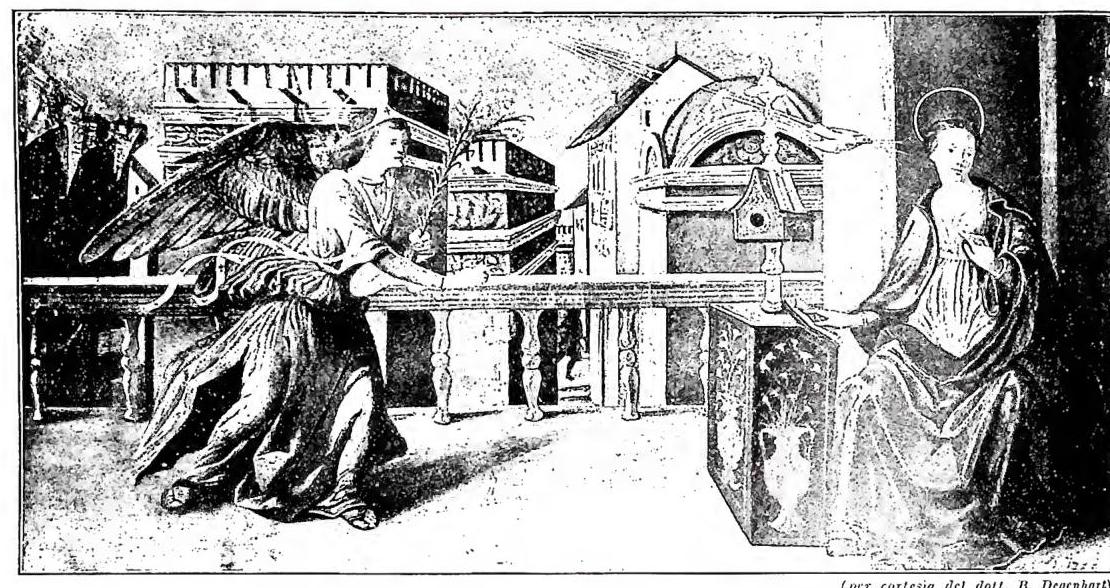
DEL COSSA, FRANCESCO — Annunciation — Amsterdam, Lanz Collection. (courtesy of Dr. B. Depenkert)de' Roberti. Del C. was a pupil of Cosmé Tura, whose forms he always remained faithful to, but he was also influenced by Domenico Veneziano, Andrea del Castagno, and Baldovinetti. The St. Jerome in the picture gallery of Ferrara, if it is his work and not that of Ercole de Roberti, as Berenson maintains, also reveals reflections of Mantegna’s art in the statuary forms of the figure. Likewise, if it came from his hand, the Allegory of Autumn in the Kaiser Friedrich Museum in Berlin clearly displays derivations from Piero della Francesca in the power of its construction and in the monumental forms of the figure, firmly planted on the ground. Del C. distinguished himself from his master Tura through his ability to render movement, which we see animating the predella with the Miracles of St. Vincent Ferrer, in the Vatican Picture Gallery. This predella formed part of the triptych painted for the Grifoni Chapel in S. Petronio in Bologna. Its central section was the St. Vincent Ferrer now in the National Gallery in London, while the two lateral sections consisted of the panels with SS. Peter and John the Baptist, now in the Brera Gallery in Milan. Del C.’s last work is the Madonna Enthroned with St. Petronius, St. John the Evangelist, and a patron, signed and dated 1474, executed for the Merchants’ Forum in Bologna at the expense of Domenico Degli Amorini and Alberto de' Cattanei, who is depicted venerating the Virgin; it is now preserved in the picture gallery of that city. In this painting, which is one of the masterpieces of Emilian painting of the fifteenth century, the artist once again reveals the teachings of Piero della Francesca in the powerful relief of the two saints’ monumental figures.
F. Del C. is one of the most powerful individualities of the Ferrarese school; he succeeded in harmonizing the intricate line of late Gothic with the statuary solemnity of Mantegna and the hieratic monumentality of Piero della Francesca.
BIBL.: Venturi, VII, pp. 586-630; Catalogo dell'esposizione della pittura ferrarese del Rinascimento, 2ª ed., Venezia 1933, pp. 69-79; R. Longhi, Officina ferrarese, Roma 1934 (indice degli artisti e indice delle opere per autore e per luoghi); B. Berenson, Pitture italiane del Rinascimento, trad. di F. Cecchi, Milano 1936, pp. 133-34; R. Longhi, Ampliamenti nell'officina ferrarese, Firenze 1940, passim; S. Ortolani, Cosmé Tura, F. Del C., Ercole De Roberti, Milano 1941, pp. 83-138.
Vincenzo Golzio
Cite this article
“DEL COSSA, FRANCESCO.” Enciclopedia Cattolica, vol. IV (1950), p. 785. Azione Romana digital edition, https://azioneromana.com/article/del-cossa-francesco.