Machine translation of the 1948–1954 Italian original. The original text is authoritative.
CUSPIDE. - Con il termine c. (o guglia, pinnacolo, freccia) si designa comunemente la parte più elevata di una costruzione che termina in una punta. C. di tale specie si trovano nei monumenti medievali, e particolarmente nei campanili. Da principio
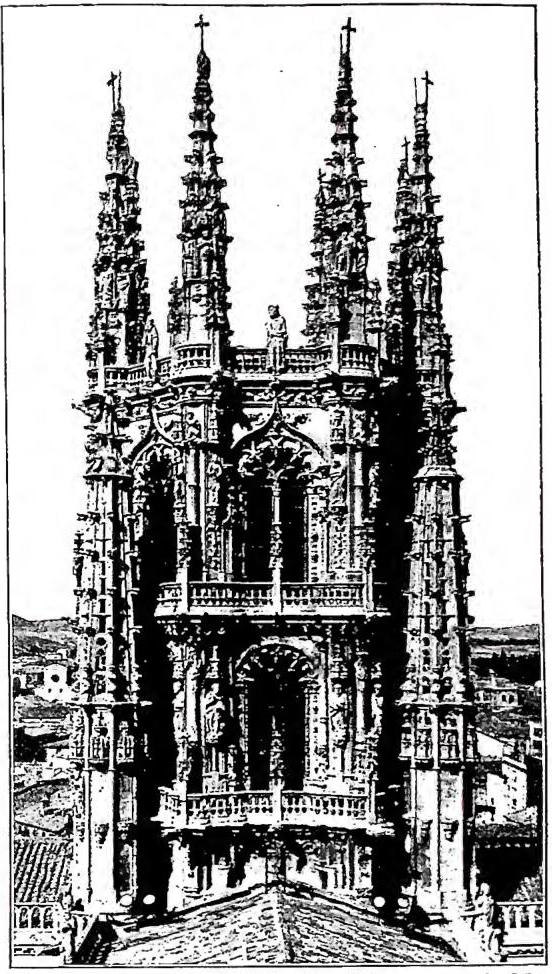
(per cortesia dell'Ambasciata di Spagna presso la S.S.) CUSPIDE - Lantern of the cathedral of Burgos, ending in a spire (1539-67).they had little elevation and the shape of a cone or square pyramid; later, of a polygonal-based pyramid. They were constructed of stone or of timber covered with lead. Scarcely slender during the Romanesque period, spires became extremely acute in the Gothic, sometimes reaching a height equal to that of the parts of the building which they terminate. In Gothic architecture as well, spires assumed dimensions so large as to have wide and ornate windows to the point of giving them the appearance of stone embroidery. The decoration of the spires was often completed by cruciform flowers, crockets, or ramping leaves placed along the edges. Among many, the openwork spires of the cathedrals of Strasbourg and Burgos are worthy of mention.
In Italian Gothic, the spires of the Milan Cathedral stand out principally; erected in various epochs (the highest one supporting the famous Madonnina dates from the 18th century), they present an interesting example of stylistic mimicry. Among modern constructions, the terminal pinnacle of the Mole Antonelliana in Turin and that of the dome of S. Gaudenzio in Novara, both by A. Antonelli, and the conical spires of the bell towers of the church of the Sagrada Família in Barcelona should be recalled.
By spire is understood even more generally an architectural motif whose fundamental line is an acute angle. Thus there are single-spire, double-spire, triple-spire, and multi-spire buildings, depending on whether they terminate in one, two, three, or more spires.
BIBL.: E. Viollet-le-Duc, Dictionnaire raisonné de l'architecture française, I, Paris 1875, p. 11; III, pp. 1-58; V, pp. 426-472; VII, p. 220. Vincenzo Golzio
Cite this article
“CUSPIDE.” Enciclopedia Cattolica, vol. IV (1950), p. 649. Azione Romana digital edition, https://azioneromana.com/article/cuspide.