Machine translation of the 1948–1954 Italian original. The original text is authoritative.
BURGOS, DIOCESE of. — In Old Castile (Spain). Once the Greek or Roman origin of the city of B. has been rejected as unfounded, its foundation—and consequently that of its church—must be placed immediately after the expulsion of the Saracens from that region, that is, two years after the victory of Pancorvo (882), won by Count Diego Rodriguez under the banner of King Alfonso III of Asturias. Ecclesiastically, during the first ninety years, the city and territory were subject to the diocese, today
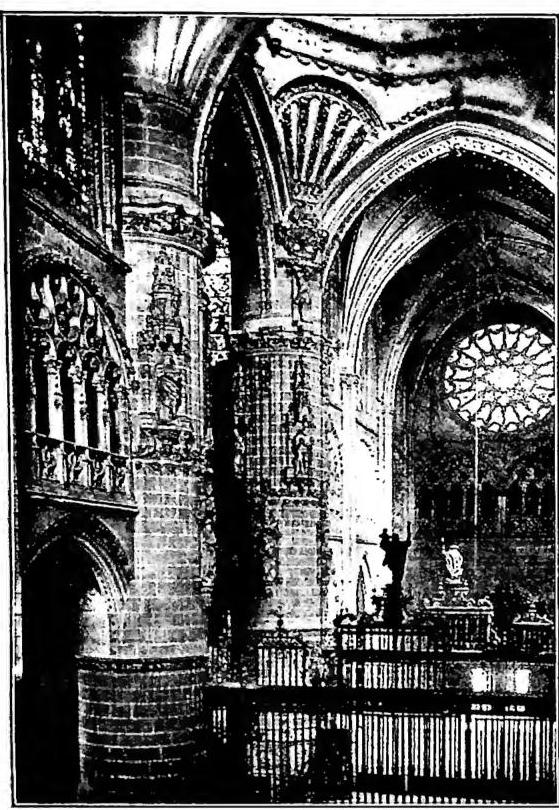
(courtesy of Fr. Ortiz de Urbina) BURGOS — Interior of the Cathedral (13th century and following).which had disappeared, of Valpuesta, united for several centuries with the older see of Auca or Oca, destroyed together with the city during Arab rule. When the see of Valpuesta ceased to exist in 1052, having been incorporated into that of Nájera (the residence of the prelate of Calahorra during Moorish rule over that city), the documents relating to the territory of Burgos speak only of the restored diocese of Oca and occasionally of that of B., whose bishop, however, did not reside in the capital until 1074, although the diocese had already been established almost a century earlier. After the death of the last bishop of Oca, named Nunio (ca. 1079), the diocese was governed by the prelate of B., who soon attained great importance. The latter’s claims were opposed by the metropolitan of Toledo, who wished the new diocese to declare itself his suffragan, in defiance of Tarragona, to which the former bishop of Oca had been subject. But Pope Urban II, in 1097, ended the controversy by granting that the see of B. should be immediately subject to the jurisdiction of the Holy See; and thus it remained a simple diocese until Gregory XIII, at the request of King Filippo II, raised it in 1574 to the dignity of an archbishopric, which it retains today, with the suffragan sees of Palencia, León, Santander, Calahorra, Burgo de Osma, and Vitoria. Several important provincial councils were held at B., at which affairs concerning the entire kingdom were discussed. The first was held in 1085 under the presidency of Cardinal Riccardo, sent there by Pope St. Gregorio VII at the request of King Alfonso VI to introduce the Roman liturgy into the kingdom, the Visigothic or Mozarabic liturgy still being in use. Another council was held at B. in 1136, presided over by Cardinal Guido on the occasion of the dispute between the first archbishop of S. Giacomo di Compostella and King Alfonso VII, called the emperor; it was almost a national council, since bishops from León, Castile, and Galicia took part in II. A third council, also important, was held there in 1379 with the aim of resolving the fundamental question of the Western Schism; it seems, however, that, despite the inclination of King Giovanni I of Castile to recognize the Avignon pope, a position of neutrality was decided upon. Among the bishops of B. are to be remembered Maurizio, who in 1221 founded, together with King s. Ferdinando, the remarkable cathedral church; Lodovico Acuña Ossorio (d. 1495), to whom the cloister of the same cathedral is owed; Giovanni Alvarez di Toledo, who built the great transept of the same church; the writers Paulo di S. Maria, Alfonso di S. Maria, or da Cartagena, and Giuseppe Rodriguez de Fonseca; and Cardinals I. López de Mendoza, J. Alvarez de Toledo, F. de Mendoza y Bobadilla, F. Pacheco de Toledo, A. Zapata, F. de la Fuente, G. Aguirre, and J. Benlloch (d. 1926), founder of the Seminary for Foreign Missions.
Within the diocese, the two ancient Benedictine abbeys of Oña and Silos held great historical importance (S. Ruiz, s. V. in DHG, X, cols. 1308–51; Cottineau, II, cols. 2130–31 and 3036–37).
The Cathedral archive contains an 11th-century manuscript of the Gospels; a Chronicon from the 15th century; a copy of the Biblia poliglota complutense; and the collection known as the «libros Redondos» of 1352.
The archdiocese covers an area of 14,210 sq km, with 1,089 parishes, 518 secular priests, and 160 regular priests. Its population is 535,964.
BIBL.: P. Orcajo, Historia de la catedral de B., Burgos 1856; R. Amador de los Ríos, B., Barcellona 1888; M. Martínez Añibarro, Intento de un diccionario biográfico y bibliográfico de autores de la provincia de B., Madrid 1889; Enc. Eur. Am., IX, pp. 1453–1472; A. Salva, Historia de la Ciudad de B., 2 vols., Burgos 1914–15; L. Ruiz, Escritores burgaleses, Alcalá de Henares 1930; L. Serrano, El Obispado de B. y Castilla primitiva desde el siglo V al XIII, 3 vols., Madrid 1935. Giuseppe M. Pou y Marti
ART. - Although few remains survive of the first cathedral built in 1075 by order of Alfonso VI, the most remarkable building is the present Cathedral, in the form of a Latin cross, which is among the most outstanding examples of Gothic art and was the first of its kind built in Spain. Begun in 1221, it was completed in the 15th century; the imposing three-tiered façade, the work of Giovanni di Colonia (1442–58), is adorned with two richly pierced towers and the dome begun in 1539 to a design by Felipe de Vigarni et Bergoñón but completed (1567) by Juan de Vallejo. The Coroneria and Sacramental doors at the ends of the transept, with 13th-century sculptures, and the Pellejeria door in the Plateresque style are noteworthy; inside, the following are especially deserving of notice: the choir with magnificent carvings by Vigarnis, and the tomb of Bishop Maurizio in copper and Limousin enamels; the chapel containing the tombs of the constable Pedro Fernández de Velasco and his wife; the chapel of S. Anna by Simone di Colonia, with the tomb of Bishop Acuña, the work of de Silos; the chapel of the Presentation, with a Madonna by Sebastiano del Piombo; the chapel of the «Corpus Christi», where the Cid’s casket is preserved; the adjoining cloister dates from the 14th century.
The Gothic churches of SS. Cosma and Damiano (13th century), of S. Esteban (1280–1350; noteworthy are the choir, the pulpit, and the tomb of Juan García de Castro), and of S. Gil, which dates from the same period, are also remarkable, as are those of S. Lesmes (1380), S. Nicola da Bari (15th century), with a marble altar by Francesco di Colonia and another from the Navarrese school (15th century), S. Gadea, and S. Egidio, which contains two paintings by Mengs.
Civil architecture is characterized by the town hall and the episcopal palace, by the arches of S. Stefano and S. Martino, dating from the period of Arab domination, and by the triumphal arch in honour of Fernando Gonzales, first count of Castile, to whom belonged the castle that also served as a residence for the kings of Castile; typical are the old Gothic-Renaissance houses of Cordón (1482), Miranda (1543; with the most elegant «patio» in Burgos), and Inigo Angulo (second half of the 18th century).
Two kilometres from the city are Las Huelgas, transformed by Alfonso VIII in 1187 into a monastery, whose church (1249) contains the sarcophagi of kings and knights, and the Carthusian monastery of Miraflores (second half of the 15th century), a Gothic-Renaissance work by Giovanni and Simone di Colonia, also noteworthy for the richest mausoleum in Spain, the work of de Siloe, for Giovanni II and Isabella of Portugal. - Vedi Tav. XVIII.
BIBL.: F. Iniguez, Un sepulcro de la catedral de B., in Archivo español de arte y arqueología, 32 (1935), pp. 201–203; F. B. Deknatel, The thirteenth century gothic sculpture of the cathedrals of B. and Leon, in The art bulletin, 17 (1935), pp. 243–389; H. E. Wethey, Gil de Siloe and his school. A study of late gothic sculpture in B., Cambridge 1936; F. Iniguez, Las yeserias descubiertas recientemente en Las Huelgas de B., in Archivo español de arte y arqueología, 45 (1941), pp. 306–308; M. Gómez Moderno, La surna de st. Domingo de Silos, ibid., 48 (1941), pp. 493–562; F. Chueca Goitia, El antiguo hospital de la Concepción en B., ibid., 66 (1944), nn. 360–69; Enc. Eur. Am., IX, p. 1455. Fabia Borroni
Cite this article
“BURGOS, DIOCESI DI.” Enciclopedia Cattolica, vol. III (1949), p. 157. Azione Romana digital edition, https://azioneromana.com/article/burgos-diocesi-di.